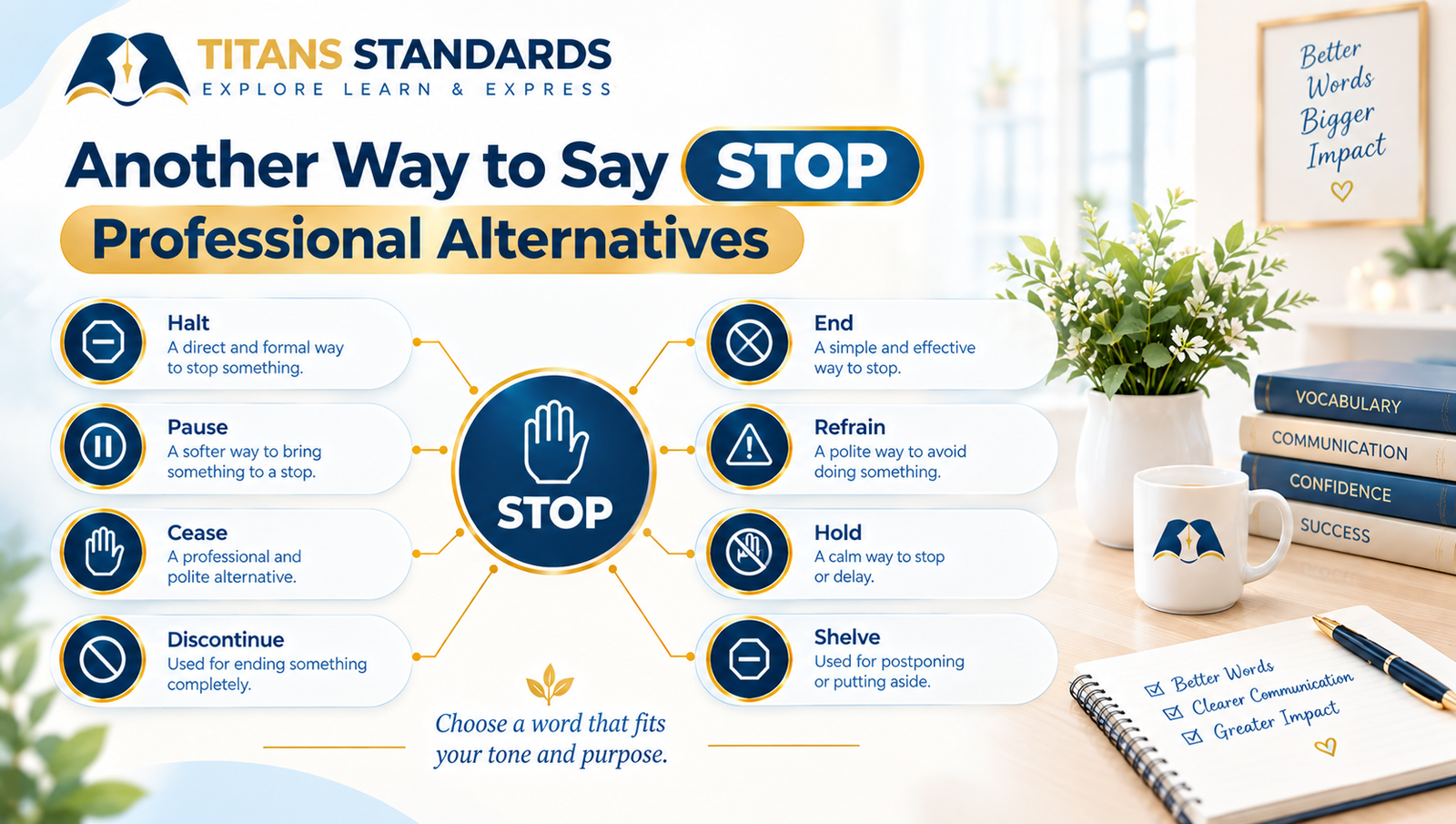
Another way to say stop depends on the context. Strong alternatives include halt, cease, quit, discontinue, pause, end, desist, suspend, terminate, and break off. Use halt for movement or activity, cease for formal writing, quit for leaving or ending an activity, and pause when the interruption is temporary.
Quick Answer
Here are some of the best alternatives to stop:
- Halt — stop movement or activity, often suddenly or firmly.
- Cease — come to an end; formal and often more final.
- Quit — stop an activity or leave something, often permanently.
- Discontinue — stop an ongoing activity, service, product, or practice.
- Pause — stop temporarily and usually continue later.
- End — bring something to a conclusion.
- Desist — stop doing something, especially after being asked or warned.
- Suspend — stop temporarily, often as an official decision.
- Terminate — bring something formally or permanently to an end.
- Break off — stop an activity, discussion, relationship, or process before completion.
The best choice depends on whether you mean stop moving, stop doing something, stop temporarily, prevent something, or bring something to a final end. Dictionaries distinguish these uses rather than treating every alternative as interchangeable.
Key Takeaways
- Halt is a strong replacement when something stops moving or operating.
- Cease sounds more formal and often suggests finality.
- Quit is natural for stopping an activity, habit, or job.
- Pause means stopping temporarily rather than ending something.
- Discontinue works especially well for products, services, practices, and ongoing activities.
- Terminate is formal and often appropriate for contracts, employment, services, or processes.
What Is Another Way to Say Stop?
The word stop can mean several different things: to end an activity, stop movement, pause temporarily, prevent something, or discontinue something. Because of these different meanings, there is no single replacement that works in every sentence.
For example:
- “Please stop talking.” → “Please cease talking.”
- “The car stopped.” → “The car halted.”
- “I need to stop smoking.” → “I need to quit smoking.”
- “Let’s stop the meeting for ten minutes.” → “Let’s pause the meeting for ten minutes.”
- “The company stopped offering the service.” → “The company discontinued the service.”
Choosing the right alternative is therefore more useful than simply replacing stop with the first synonym you find.
Best Alternatives to “Stop”
1. Halt
Meaning
Halt means to bring movement, progress, or activity to a stop. It can suggest a sudden, complete, or deliberate stopping.
How It Differs
Halt is more forceful and formal than the everyday word stop. It works especially well for vehicles, operations, construction, production, or progress.
Best For
Professional Communication, Formal Writing, Business, Instructions
Tone
Formal, Professional, Strong
Example
“The company halted production after discovering a safety problem.”
Resume Example
“Implemented procedures that halted recurring production delays.”
Quick Tip
Use halt when you want to emphasize that something has been brought to a standstill.
2. Cease
Meaning
Cease means to come to an end or cause an activity to end. It is a formal alternative to stop and can suggest that an activity or condition is no longer continuing.
How It Differs
Cease is less conversational than stop. It is common in formal notices, policies, legal language, reports, and professional writing.
Best For
Formal Writing, Business, Legal Communication, Professional Communication
Tone
Formal, Professional
Example
“The company asked employees to cease using the outdated system.”
Resume Example
“Identified redundant processes and helped cease unnecessary administrative work.”
Quick Tip
Choose cease when stop feels too casual for the setting.
3. Quit
Meaning
Quit means to stop doing something or leave something, such as a job or activity. It often emphasizes finality or an individual’s decision to stop.
How It Differs
Unlike halt, which can describe stopping almost anything, quit commonly refers to a person ending an activity, habit, job, or effort.
Best For
Casual Conversation, Personal Statements, Everyday English
Tone
Neutral, Informal
Example
“She decided to quit smoking last year.”
Resume Example
“Not normally used as a resume replacement for stop.”
Quick Tip
Quit is very natural in everyday American English, but it can sound too informal for some professional documents.
4. Discontinue
Meaning
Discontinue means to stop an established or ongoing activity, practice, service, product, or process. Merriam-Webster notes that it particularly applies to stopping an accustomed activity or practice.
How It Differs
Discontinue is more specific than stop when something has been regularly provided, produced, offered, or practiced.
Best For
Business, Product Communication, Professional Writing, Formal Notices
Tone
Professional, Formal, Neutral
Example
“The company will discontinue the product at the end of the year.”
Resume Example
“Discontinued inefficient reporting procedures and introduced a streamlined workflow.”
Quick Tip
Use discontinue for services, products, policies, procedures, and recurring practices.
5. Pause
Meaning
Pause means to stop temporarily before continuing. It suggests that the activity is expected to resume.
How It Differs
The biggest distinction is duration. Pause usually means stop for a while, whereas end, cease, or terminate can imply that something is finished.
Best For
Meetings, Conversations, Videos, Work, Everyday Communication
Tone
Neutral, Friendly, Professional
Example
“Let’s pause the discussion and review the numbers.”
Resume Example
“Paused project activity while requirements were reassessed.”
Quick Tip
If the activity will probably continue later, pause is usually better than end.
6. End
Meaning
End means to bring something to a conclusion or cause it to no longer continue.
How It Differs
End is one of the broadest and most natural alternatives to stop. It emphasizes completion rather than the act of physically stopping.
Best For
Everyday English, Professional Writing, Formal Writing
Tone
Neutral, Professional
Example
“The manager ended the meeting at 4 p.m.”
Resume Example
“Led negotiations that ended a recurring vendor dispute.”
Quick Tip
Use end when you mean something has reached its conclusion rather than simply being interrupted.
7. Desist
Meaning
Desist means to stop doing something, especially when restraint or a request to stop is involved.
How It Differs
Desist is much more formal than stop. It is often associated with warnings, instructions, legal language, or deliberate restraint.
Best For
Formal Writing, Legal Communication, Official Notices
Tone
Very Formal, Professional
Example
“The organization was instructed to desist from using the copyrighted material.”
Resume Example
“Not generally appropriate as a direct resume synonym for stop.”
Quick Tip
Use desist sparingly. It is accurate in formal contexts but can sound unnatural in everyday American English.
8. Suspend
Meaning
Suspend means to stop something temporarily, often through an official or deliberate decision.
How It Differs
Unlike terminate, suspend normally leaves open the possibility that the activity will resume.
Best For
Business, Policies, Services, Employment, Projects, Formal Communication
Tone
Formal, Professional
Example
“The company suspended the program while it reviewed the new regulations.”
Resume Example
“Coordinated the temporary suspension of operations during facility renovations.”
Quick Tip
Choose suspend when something is intentionally stopped but not necessarily permanently ended.
9. Terminate
Meaning
Terminate means to bring something to an end. It is commonly used for formal processes, agreements, contracts, services, employment, or relationships.
How It Differs
Terminate is considerably more formal than stop. In workplace settings, it can also carry a specific meaning when referring to ending someone’s employment.
Best For
Legal Writing, Business, Contracts, Formal Communication
Tone
Formal, Corporate, Professional
Example
“The client decided to terminate the agreement.”
Resume Example
“Reviewed contracts and identified agreements eligible for termination.”
Quick Tip
Do not use terminate simply because it sounds more professional. In everyday workplace writing, end or discontinue may sound more natural.
10. Break Off
Meaning
Break off means to stop something before it is completed. It is commonly used for conversations, negotiations, relationships, discussions, and attempts.
How It Differs
Unlike end, which can describe a natural conclusion, break off often suggests that something was interrupted or deliberately ended before completion.
Best For
Conversations, Negotiations, Relationships, Informal and Professional Communication
Tone
Neutral, Conversational, Professional
Example
“The two companies broke off negotiations after failing to agree on the terms.”
Resume Example
“Supported negotiations that were later broken off due to changing business requirements.”
Quick Tip
Use break off when something stops prematurely rather than simply reaching its normal conclusion.
Alternatives to “Stop” for Different Contexts
The right replacement depends heavily on what stop means in the sentence.
If You Mean “Stop Doing Something”
Use:
- cease
- quit
- desist
- discontinue
- end
Example:
“Please stop discussing the issue.”
→ “Please cease discussing the issue.”
For everyday American English, however, simply stop is often the most natural choice.
If You Mean “Stop Moving”
Use:
- halt
- come to a stop
- pull over — specifically for a vehicle
- come to a standstill
Example:
“The vehicle stopped at the intersection.”
→ “The vehicle halted at the intersection.”
If You Mean “Stop Temporarily”
Use:
- pause
- suspend
- take a break
- hold
Example:
“We stopped the project temporarily.”
→ “We suspended the project temporarily.”
If You Mean “Stop Permanently”
Use:
- end
- cease
- terminate
- discontinue
- conclude
The exact choice depends on what is ending.
If You Mean “Prevent Something”
Use:
- prevent
- block
- prohibit
- restrain
- hinder
- thwart
These are not always direct synonyms for stop. They describe preventing something from happening, which is a different sense of the word. Cambridge lists prevent, avoid, avert, prohibit, and check among terms related to this meaning.
Example:
“New rules stopped the problem from spreading.”
→ “New rules prevented the problem from spreading.”
Stop vs. Similar Words
| Word | Main Focus | How It Differs |
| Stop | Ending or interrupting | Broadest and most natural everyday choice |
| Halt | Movement or activity | Often stronger or more sudden |
| Cease | Ending activity or a condition | More formal and potentially more final |
| Quit | Person ending an activity | Common for habits, jobs, or personal actions |
| Discontinue | Ongoing activity or practice | Often used for services, products, and procedures |
| Pause | Temporary interruption | Implies continuation later |
| End | Conclusion | Focuses on completion rather than interruption |
| Desist | Deliberately stopping | Formal and often connected with warnings or requests |
| Suspend | Temporary official stop | Usually suggests possible resumption |
| Terminate | Formal ending | Common with contracts, services, employment, and processes |
| Break off | Premature ending | Often used for negotiations, discussions, or relationships |
These distinctions reflect the way major English dictionaries separate the meanings of stop and its common alternatives.
How to Choose the Right Alternative
A simple four-step test can help.
1. Ask whether the stop is temporary.
If yes, choose pause or suspend.
2. Ask whether something is completely finished.
If yes, consider end, cease, or terminate.
3. Ask whether a person is choosing to stop.
For everyday language, quit may be the most natural option.
4. Ask whether something is physically moving.
Halt is often the strongest alternative.
You should also consider your audience. A text message may naturally use stop, quit, or pause. A policy may use cease or discontinue. A contract may use terminate. The most sophisticated word is not automatically the best word.
Common Mistakes to Avoid
1. Treating every synonym as interchangeable
Pause does not mean the same thing as terminate. One normally suggests temporary interruption; the other can suggest a formal or permanent ending.
2. Using formal words unnecessarily
“Please cease talking” is grammatically correct, but “Please stop talking” is more natural in most everyday situations.
3. Using “quit” for everything
Quit works well for activities, habits, and jobs, but it does not replace stop naturally in every context.
4. Confusing prevention with stopping
Prevent means to keep something from happening. It is related to one meaning of stop, but it is not always a direct replacement.
5. Assuming “terminate” always sounds better
“Terminate” can sound overly formal or harsh when end or stop would communicate the idea more clearly.
6. Ignoring temporary versus permanent meaning
If a meeting will continue after lunch, pause is more accurate than end.
7. Choosing a synonym simply because it sounds sophisticated
Good writing is not about using the longest or most formal word. The strongest alternative is the one that precisely communicates your intended meaning.
Frequently Asked Questions
What is another professional word for stop?
Halt, cease, discontinue, suspend, and terminate can all work in professional settings, but they have different meanings. Discontinue is useful for services or practices, suspend usually indicates a temporary stop, and terminate often refers to a formal ending. For general workplace communication, stop itself is often perfectly professional.
What is a better word than stop in formal writing?
Cease is often the closest formal alternative when you mean that an activity should end. Discontinue works well for ongoing practices, products, or services, while terminate is appropriate for certain formal processes or agreements. The best choice depends on the noun or action being stopped.
What is a softer way to say stop?
Pause is usually softer when you want someone to stop temporarily. Hold off can also work in conversational American English when asking someone to delay an action. For example, “Please pause the presentation” sounds less final than “Please stop the presentation.”
What is another way to say stop doing something?
Depending on the situation, you can say quit, cease, discontinue, desist, give up, or refrain from. Quit is common in everyday English, while cease and desist are more formal. Refrain from focuses on choosing not to perform an action.
Is “halt” the same as “stop”?
Halt and stop overlap strongly, particularly when referring to movement or ongoing activity. However, halt can sound more forceful or formal. “The vehicle stopped” is ordinary everyday English, while “The vehicle halted” gives the sentence a more deliberate or formal tone.
Is “cease” stronger than “stop”?
Often, yes. Cease tends to sound more formal and can suggest that an activity or condition has come to an end. However, the difference depends on context. “The noise stopped” is natural everyday English, while “The noise ceased” sounds more formal or literary.
What is the difference between stop and discontinue?
Stop is a broad everyday word. Discontinue usually refers to ending something that has been regularly offered, produced, practiced, or maintained. For example, a company might discontinue a product, while a person might simply stop using it.
What is the difference between stop and suspend?
Stop can mean either temporary or permanent cessation. Suspend specifically emphasizes a temporary interruption or an official decision to stop something for a period. “The school suspended the program” generally leaves open the possibility that the program will return.
What is the difference between stop and terminate?
Terminate is more formal and often indicates a definite ending. It is common in contexts involving contracts, services, employment, agreements, or formal processes. Stop is much broader and more natural for ordinary actions, movement, and conversation.
What is the best synonym for stop?
There is no single best synonym for every situation. Halt is strong for movement, cease suits formal writing, quit works for personal activities and habits, pause indicates a temporary interruption, discontinue fits ongoing services or practices, and end is a broad, natural alternative.
Conclusion
The best way to say stop depends on exactly what you want to communicate. If something is moving or operating, halt may be more precise. If an activity is ending formally, cease can work well. For habits or personal activities, quit is natural. For products, services, and established practices, discontinue is often the better choice. And if something will resume later, pause or suspend is more accurate than a word suggesting finality.

Editorial Desk
The Titan Standards Editorial Team develops, reviews, and maintains practical English-language resources. The team checks articles for clarity, accuracy, context, readability, and consistency with Titan Standards’ editorial guidelines.