
Another Way to Say “In Summary”: 12 Natural Alternatives
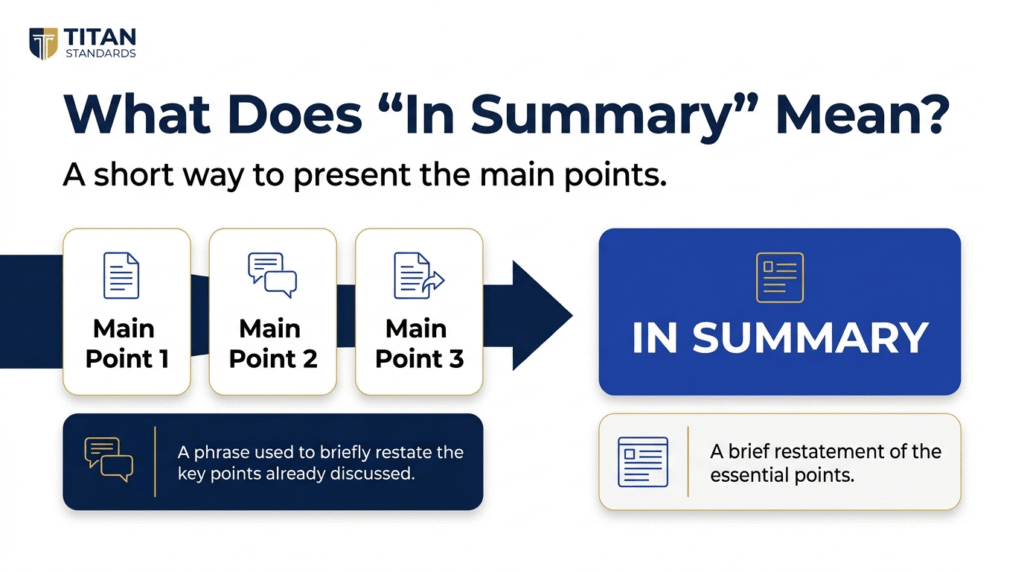
If you need another way to say “in summary,” you can use phrases such as “to summarize,” “in short,” “to sum up,” “overall,” “in conclusion,” and “taken together.” The best choice depends on whether you are briefly restating information, drawing a conclusion, reviewing key points, or speaking casually. Key Takeaways What Does “In Summary” Mean? “In summary” is a transition used to introduce a brief statement of the main ideas, facts, or conclusions that have already been discussed. It is common in essays, reports, presentations, professional writing, and other situations where information needs to be condensed. For example: In summary, the project met its main goals while staying within budget. The phrase does not necessarily mean that the entire piece of writing is ending. It can simply signal that the writer is bringing several points together. That distinction matters when choosing an alternative. “In conclusion” can suggest a final judgment or ending, while “to recap” focuses more directly on reviewing information. Why Use Another Way to Say “In Summary”? There are several good reasons to vary the phrase: The goal is not to replace “in summary” every time. If it is the clearest phrase for your sentence, there is nothing wrong with keeping it. 12 Best Ways to Say “In Summary” 1. To Summarize “To summarize” is probably the closest direct replacement for “in summary.” It clearly tells the reader that you are about to condense the information already presented. To summarize, the proposal addresses the company’s three main concerns. It works especially well in essays, reports, presentations, and professional writing because it is direct without sounding overly formal. 2. Overall Use “overall” when you want to give a broad assessment of something rather than simply repeat its individual points. Overall, the new process has reduced delays and improved communication. This phrase can often replace “in summary,” but the meaning is slightly different. “Overall” emphasizes the big picture or general result. 3. To Sum Up “To sum up” is a natural, flexible alternative that means you are briefly bringing the main points together. To sum up, the plan is practical, affordable, and easy to implement. It works in many types of writing and speech. It is somewhat more conversational than “to summarize,” making it useful for presentations, emails, general articles, and everyday communication. 4. In Short Choose “in short” when you want to reduce a longer explanation to its essential point. In short, we need more time to complete the project properly. It is concise and natural, but it often introduces a simplified version of the message rather than a detailed recap of every major point. 5. In Conclusion “In conclusion” is appropriate when you are moving into the final conclusion of an essay, report, argument, or formal discussion. In conclusion, the evidence supports the need for further research. It is related to “in summary,” but it is not always interchangeable. “In summary” focuses on condensing information; “in conclusion” more strongly signals that the discussion is ending or that a final conclusion is being presented. 6. Taken Together Use “taken together” when several facts, arguments, results, or observations combine to support one overall idea. Taken together, these findings suggest that the policy needs further review. This is particularly useful in analytical and academic writing because it makes the relationship between multiple pieces of information explicit. 7. To Recap “To recap” means to briefly review information that has already been discussed. To recap, we agreed on the budget, timeline, and next steps. It is especially natural in meetings, presentations, emails, and spoken communication. It is usually less formal than “to summarize.” 8. In Brief “In brief” is a concise, somewhat formal way to introduce a shortened version of the main information. In brief, the report identifies three major areas of concern. It can work well in reports, professional writing, and formal explanations. It is less conversational than “to sum up.” 9. In Essence Choose “in essence” when you want to express the basic or central meaning of something. In essence, the proposal asks the company to invest more resources in training. This is not a perfect substitute in every sentence. It focuses on the core idea or fundamental meaning rather than necessarily summarizing every point. 10. In a Nutshell “In a nutshell” is a distinctly informal way to introduce a very concise explanation. In a nutshell, the project needs more funding and a longer timeline. It is natural in blogs, casual explanations, conversations, and friendly communication. It may sound too informal for a formal academic paper or highly professional report. 11. On the Whole Use “on the whole” when summarizing a general assessment while allowing for some exceptions or limitations. On the whole, the training program has been successful. It is useful when your summary reflects the overall situation rather than claiming that every individual detail points in exactly the same direction. 12. All in All “All in all” introduces a general conclusion after considering several aspects of a situation. All in all, the conference was informative and well organized. It is common in everyday and general writing. For a formal academic paper, a more neutral option such as “overall” or “to summarize” may fit better. Quick Comparison of “In Summary” Alternatives Alternative Best Used In Tone To summarize Essays, reports, professional writing Neutral/formal Overall Assessments, reports, general writing Neutral To sum up Essays, presentations, emails Neutral/conversational In short Concise explanations Neutral In conclusion Essays and formal conclusions Formal Taken together Analytical or academic writing Formal/precise To recap Meetings, presentations, emails Conversational In brief Reports and formal explanations Formal In essence Explaining a central idea Neutral/formal In a nutshell Casual explanations Informal On the whole Broad assessments Neutral/formal All in all General conclusions Conversational “In Summary” vs. “In Conclusion” These two phrases are close, but they do different jobs. “In summary” primarily tells the reader that the main information is about to be condensed: In summary, the report identifies three causes of the problem. “In conclusion” more strongly indicates that