
Another Way to Say Happy Birthday: 12 Natural Wishes

If you want another way to say “Happy Birthday,” the best choice depends on who you’re talking to and how you want the message to feel. Try “Wishing you a wonderful birthday” for a warm, versatile option, “Cheers to another year” for something casual, or “Warmest birthday wishes” for a more polished message. For close relationships, you can make the wording more personal and affectionate. Key Takeaways What Does “Happy Birthday” Mean? “Happy Birthday” is a standard greeting used to wish someone happiness on the anniversary of their birth. It can be said in person, written in a card, sent by text, added to an email, or posted on social media. The phrase is already natural and appropriate in most situations. You do not need to replace it just because it is common. However, another wording can help when you want your message to sound warmer, more personal, more professional, or simply less repetitive. For example: Happy Birthday! I hope you have a great day. could become: Wishing you a wonderful birthday and a year filled with good things. The second version puts more attention on the person and the year ahead. Why Use Another Way to Say “Happy Birthday”? Sometimes the basic phrase does not quite match the message you want to send. You may want to: The goal is not to find a “better” synonym. It is to choose wording that fits the relationship and occasion. 12 Best Ways to Say “Happy Birthday” 1. Wishing You a Wonderful Birthday This is one of the most versatile alternatives. It keeps the meaning of “Happy Birthday” while sounding slightly more thoughtful and complete. Use it for friends, relatives, coworkers, acquaintances, or someone you do not know extremely well. Example: Wishing you a wonderful birthday and a year full of exciting opportunities. 2. Have a Fantastic Birthday “Fantastic” adds energy and enthusiasm without making the message overly emotional. It works especially well in casual texts, cards, and friendly conversations. Example: Have a fantastic birthday! I hope you get to spend the day doing exactly what you enjoy. 3. Hope You Have an Amazing Day This sounds natural in everyday American English because it focuses on the person’s actual birthday experience rather than simply naming the occasion. It is a good choice for texts, quick messages, and casual conversations. Example: Hope you have an amazing day and get plenty of time to celebrate. 4. Wishing You All the Best This is useful when you want your birthday message to feel kind and polished without becoming overly personal. It can work especially well for coworkers, acquaintances, teachers, or professional contacts. It also works nicely when followed by a specific birthday wish. Example: Wishing you all the best on your birthday and in the year ahead. 5. Enjoy Your Special Day “Enjoy your special day” is simple, friendly, and easy to use. It does not sound as formal as some traditional birthday greetings, but it is still polite. It fits cards, texts, workplace chats, and everyday conversations. Example: Enjoy your special day, and I hope you get to celebrate with the people you love. 6. Warmest Birthday Wishes This phrase gives a birthday message a more polished and heartfelt tone. “Warmest” adds friendliness without making the greeting too intimate. It works particularly well in cards and written messages where you want to sound thoughtful. Example: Warmest birthday wishes to you. May the coming year bring you plenty of happiness. 7. Cheers to Another Year This is a more casual and celebratory option. Instead of focusing only on the birthday itself, it celebrates another year of the person’s life. It is a natural choice for friends, siblings, social media captions, and informal cards. Example: Cheers to another year! Here’s hoping this one brings you new adventures and great memories. 8. May Your Year Ahead Be Filled With Happiness This alternative shifts the focus from the birthday itself to the year that follows. It sounds sincere and works well when you want a more meaningful message. It is especially suitable for cards or messages to someone important to you. Example: May your year ahead be filled with happiness, good health, and plenty of reasons to smile. 9. Many Happy Returns “Many happy returns” is a traditional birthday expression that wishes someone many more happy birthdays. It is recognizable, but it has a more traditional feel than everyday “Happy Birthday” in American English. Choose it when a classic or slightly formal tone suits the recipient. Example: Many happy returns! I hope you have a wonderful birthday and a great year ahead. 10. Celebrating You Today This phrase puts the focus directly on the person rather than the birthday greeting itself. It can sound especially warm in a social media post, card, or personal message. Example: Celebrating you today and all the kindness and laughter you bring to the people around you. 11. Sending Birthday Love This is an affectionate option for people you are close to. It sounds much more personal than a standard workplace greeting, so it should be reserved for appropriate relationships. Example: Sending birthday love your way. I hope your day is full of laughter, good food, and your favorite people. 12. Hope Today Feels Extra Special This is a gentle, natural alternative when you want to make the message feel personal without using a very emotional expression. It works well for friends, relatives, and other people you care about. Example: Hope today feels extra special because you deserve a wonderful year ahead. Which Alternative Fits Your Situation? The relationship matters as much as the wording. Alternative Best Used In Tone Wishing You a Wonderful Birthday Most situations Warm, neutral Have a Fantastic Birthday Friends and casual messages Cheerful Hope You Have an Amazing Day Texts and everyday conversation Casual, friendly Wishing You All the Best Coworkers and acquaintances Polite, warm Enjoy Your Special Day Cards, texts, workplace chats Friendly, neutral Warmest Birthday Wishes Cards and written greetings Warm, polished Cheers to Another
What’s Another Way to Say Thank You? 12 Natural Alternatives

“Thank you” is one of the most useful expressions in English, but you do not have to use the same phrase every time. The best alternative depends on who you are speaking to, what they did, and how strongly you want to express your appreciation. For a friend, “Thanks!” may be enough. For a coworker, “I really appreciate your help” sounds specific and professional. If someone gave you meaningful emotional support, “That means a lot to me” may express more than a simple thank-you. Featured Snippet Answer Another way to say thank you depends on the situation and how much appreciation you want to express. Natural options include thanks, I really appreciate it, I’m grateful, that means a lot, that’s very kind of you, much appreciated, and I can’t thank you enough. Choose a phrase that matches your relationship, tone, and level of gratitude. Key Takeaways What Does “Thank You” Mean? Thank you is a polite expression used to show gratitude or appreciation for something someone has done, given, or said. It can be used in almost any setting: Because thank you is neutral and widely accepted, it is rarely wrong. The main reason to choose another expression is not that “thank you” is incorrect. It is to make your response more specific, personal, casual, warm, or formal. Why Use Another Way to Say Thank You? Different expressions can help you: The important point is not to replace “thank you” just for variety. Choose another phrase when it communicates your meaning more precisely. 12 Best Ways to Say Thank You 1. Thanks Thanks is the simplest and most common casual alternative to thank you. It works well with friends, family, coworkers you know well, and in quick everyday exchanges. “Thanks for picking me up at the airport.” It is shorter and more relaxed than “thank you,” but it still clearly expresses appreciation. 2. Thanks so much Use thanks so much when you want to sound warmer or more appreciative than a simple “thanks.” “Thanks so much for helping me move this weekend.” It fits texts, conversations, cards, and friendly messages. It can also work in professional communication when the relationship is reasonably friendly. 3. I really appreciate it I really appreciate it is one of the most flexible alternatives. It works when someone has done something helpful, thoughtful, or generous. “You stayed late to help me finish the report. I really appreciate it.” This phrase is especially useful when you want your gratitude to sound sincere without becoming overly formal. 4. I appreciate your help When you want to identify exactly what you are grateful for, I appreciate your help is a strong choice. “I appreciate your help with the presentation.” This is particularly natural in workplace communication because it recognizes the person’s assistance directly. It can also be used with friends or family. 5. I’m grateful I’m grateful expresses more personal or meaningful appreciation than a quick “thanks.” “I’m grateful for everything you did to support me.” It works especially well when someone has offered significant help, support, kindness, or encouragement. For a small everyday favor, however, it may sound more serious than necessary. 6. That means a lot to me Use that means a lot to me when the person’s action has emotional or personal importance. “You remembered my birthday. That means a lot to me.” This is warmer and more personal than a routine “thank you,” making it useful for close friends, family members, partners, or someone who offered meaningful support. 7. That’s very kind of you That’s very kind of you acknowledges not only what someone did but also the kindness behind the action. “You brought dinner for everyone? That’s very kind of you.” It can be used in both personal and polite everyday situations. It is especially natural after a thoughtful gesture. 8. Much appreciated Much appreciated is a concise way to show appreciation, particularly in informal or professional communication. “Thanks for sending the updated file. Much appreciated.” It is efficient and friendly, but it can sound less personal than I really appreciate it. It works well when you want to keep a message brief. 9. I owe you one I owe you one is an informal expression that suggests you will return the favor later. “Thanks for covering my shift. I owe you one!” This is best for friends or familiar coworkers. It is not a direct substitute for every “thank you,” because it adds the idea of future repayment or reciprocity. 10. I can’t thank you enough Use I can’t thank you enough when someone has helped you so much that a normal expression of thanks feels insufficient. “I can’t thank you enough for helping my family through this.” This phrase communicates strong gratitude. It is better suited to meaningful favors or major support than to small everyday actions. 11. Many thanks Many thanks is a polite, concise expression often used in writing. “Many thanks for your quick response.” It can work in emails, notes, and other written communication. It sounds more polished than “thanks,” while remaining less formal than highly ceremonial expressions of gratitude. 12. Thank you so much Although it still contains the original phrase, thank you so much deserves a place among useful alternatives because it changes the strength and warmth of the expression. “Thank you so much for making time to meet with me.” It works across many situations, from personal conversations to professional messages. The added so much makes the appreciation more emphatic without requiring an entirely different expression. Which Thank-You Phrase Should You Choose? Alternative Best Used In Tone Thanks Quick everyday exchanges Casual Thanks so much Friendly conversations and messages Warm, casual I really appreciate it Help, favors, and support Warm, neutral I appreciate your help Workplace or specific assistance Professional, polite I’m grateful Meaningful support or kindness Sincere That means a lot to me Personal or emotional situations Warm, heartfelt That’s very kind of you Thoughtful gestures Warm, polite Much appreciated Short messages and
Another Way to Say During: 12 Natural Alternatives
If you need another way to say “during,” the best replacement depends on what you mean. Use throughout when something continues across an entire period, while when two actions happen at the same time, in for broad time periods, and amid for a situation or surrounding condition. Other options include over, through, throughout the course of, in the course of, for the duration of, at the time of, and as. Key Takeaways What Does “During” Mean? “During” is a preposition used to say when something happens within a particular period or event. It can describe something that happens throughout an event or something that occurs at an unspecified point within it. For example, “We talked during the meeting” means the conversation happened at some point within the meeting. A key grammar point is that during normally comes before a noun or noun phrase: You generally cannot put a complete clause directly after “during.” For example, “during I was studying” is incorrect; “while I was studying” is the natural construction. Why Use Another Way to Say “During”? “During” is already natural and useful, so there is no need to replace it simply for the sake of variety. An alternative helps when you want to make the meaning more precise. You may want a different expression to: The important point is that a synonym should match the intended meaning, not just resemble “during” in a thesaurus. 12 Best Ways to Say “During” 1. Throughout Throughout is one of the closest alternatives when you mean that something happened across the entire period. Unlike “during,” it often emphasizes continuity from one part of the period to another. The second sentence more strongly suggests that her calmness continued across the meeting. Best for: entire periods, events, or spans of time. 2. While Use while when you are connecting two actions or events that happen at the same time. The grammar is different: “while” normally introduces a clause containing a subject and verb. This makes “while” especially useful when you want to describe simultaneous actions. Best for: actions happening at the same time. 3. In “In” can replace “during” with many broad periods, especially months, years, seasons, and historical periods. It can also work with periods such as “the 1990s,” “the afternoon,” and “the winter.” Best for: broad time periods and dates. 4. Over Over works well when something happens across a period of time. It can suggest repeated activity, change, or development rather than a single moment. It is particularly natural in everyday and professional writing when discussing trends. Best for: periods involving change, progress, or repeated events. 5. Through Through can emphasize continuation across a period, although it does not fit every sentence where “during” appears. It often sounds more active and can suggest movement from one part of a period toward another. Best for: continuous activity across a period. 6. Amid Amid means in the middle of or surrounded by a situation, condition, or event. It is useful when the surrounding circumstances matter as much as the timing. “Amid” is not a direct substitute for every time expression. It works best when the noun describes a surrounding situation. Best for: confusion, uncertainty, change, conflict, excitement, or other circumstances. 7. Amidst Amidst has essentially the same core meaning as “amid,” but it tends to sound more literary or formal. In American English, amid is usually the simpler choice. Use it when its style fits the writing rather than treating it as a universal replacement. Best for: formal or literary contexts. 8. In the Course of In the course of refers to something that happens as part of a period, activity, or process. It is especially useful in formal, professional, and academic writing. The longer phrase can sound more deliberate and formal than the simple “during.” Best for: investigations, projects, processes, professional writing, and formal explanations. 9. Over the Course of Over the course of emphasizes development across a period rather than simply placing an event inside it. It is particularly natural when discussing changes that happen gradually. Best for: gradual change, progress, development, and longer periods. 10. For the Duration of For the duration of explicitly emphasizes the full length of an event or period. This phrase is more formal and can sound official, so it is often better suited to policies, instructions, notices, or formal documents. Best for: formal rules, policies, instructions, and complete durations. 11. At the Time of At the time of points to the period or circumstances surrounding a particular event. It can be useful when “during” feels too broad. The meaning is not always identical. “At the time of” often focuses on the circumstances existing when a particular event occurred. Best for: specific events, dates, transitions, and historical references. 12. As As can describe two events happening at the same time, especially when one action develops alongside another. It is often a smoother choice when you want to connect two clauses rather than place a noun after a preposition. Cambridge notes that “as,” “when,” and “while” can all introduce subordinate clauses describing simultaneous events, with differences in emphasis and context. Best for: simultaneous actions or events in connected clauses. During vs. Its Closest Alternatives Alternative Best Used In Tone Throughout The entire period Neutral While Two simultaneous actions Neutral In Broad time periods Neutral Over Change across a period Neutral Through Continued activity Neutral Amid Surrounding situations Neutral/Formal Amidst Situations or surroundings Formal/Literary In the course of Processes and formal contexts Formal Over the course of Gradual development Neutral/Formal For the duration of Full duration, rules, policies Formal At the time of A particular event or point Neutral/Formal As Simultaneous clauses Neutral During vs. Throughout vs. While These three are easy to confuse because they can describe overlapping time relationships. During places something within a period: We received several calls during the afternoon. Throughout emphasizes the whole period: We received calls throughout the afternoon. While connects simultaneous actions: We received calls while we were working. The grammar also
Another Way to Say You’re Welcome in Spanish: 10 Natural Ways

If someone says “gracias” in Spanish, the standard response is de nada, meaning “you’re welcome.” But Spanish offers several other natural replies depending on the situation, country, and tone. You can use con gusto for a warm response, no hay de qué for a polite “don’t mention it,” or a ti / a usted when you want to return the thanks. What Does “You’re Welcome” Mean in Spanish? When English speakers say “you’re welcome” after someone says “thank you,” they are usually acknowledging the thanks and signaling that the favor was willingly given. In Spanish, the most common equivalent is: De nada — “You’re welcome” / “It was nothing.” For example: —Gracias por tu ayuda.—De nada. —Thanks for your help.—You’re welcome. The important point is that “you’re welcome” in this situation is an idiomatic expression. It should not normally be translated word for word as eres bienvenido. Spanish uses different expressions to respond to gracias. 10 Ways to Say “You’re Welcome” in Spanish 1. De nada — You’re welcome De nada is the standard, neutral way to respond to gracias. It works in everyday conversations and is understood throughout the Spanish-speaking world. —Muchas gracias por el consejo.—De nada. “Thank you very much for the advice.”“You’re welcome.” If you are unsure which expression to use, de nada is the safest choice. 2. No hay de qué — Don’t mention it No hay de qué literally suggests that there is nothing to thank someone for. In natural English, it is close to “don’t mention it” or “you’re welcome.” It can sound especially polite when someone gives you a sincere thank-you. —Muchas gracias por tomarte el tiempo de ayudarme.—No hay de qué. “Thanks so much for taking the time to help me.”“Don’t mention it.” This expression is useful when you want something a little more expressive than the simple de nada. 3. Con gusto — With pleasure Con gusto means “with pleasure” or “gladly.” It presents the help as something you were happy to provide. —Gracias por explicarme cómo funciona.—Con gusto. “Thanks for explaining how it works.”“With pleasure.” You may hear con gusto often in friendly, polite, or service-related situations, particularly in Latin America. 4. Por nada — No problem / You’re welcome Por nada is another expression that can be used in response to gracias. It is similar to de nada and can sound casual. —Gracias por guardar mi asiento.—Por nada. “Thanks for saving my seat.”“No problem.” It is useful to recognize, but de nada remains the more universal default for learners. 5. A ti — Thank you / You’re welcome A ti literally means “to you.” It is commonly used when the speaker feels that the other person deserves some of the thanks. For example: —Gracias por venir conmigo.—A ti. “Thanks for coming with me.”“Thank you.” This expression is informal because ti is associated with the familiar tú form. 6. A usted — Thank you / You’re welcome A usted works similarly to a ti, but it uses the formal usted form. —Muchas gracias por su ayuda.—A usted. “Thank you very much for your help.”“Thank you.” The exact English translation depends on the situation. Rather than functioning as a direct equivalent of you’re welcome in every context, a usted can acknowledge that the thanks are mutual or that the other person is also deserving of appreciation. 7. Es un placer — It’s a pleasure Es un placer means “it’s a pleasure.” It emphasizes that you were pleased to help. —Muchas gracias por recibirnos.—Es un placer. “Thank you very much for having us.”“It’s a pleasure.” This works especially well when you want your response to sound warm and courteous rather than brief. 8. No hay problema — No problem No hay problema literally means “there’s no problem.” It can be used as a relaxed response to thanks. —Gracias por llevarme a casa.—No hay problema. “Thanks for driving me home.”“No problem.” It is a good fit for casual conversations, although it shifts the focus slightly from gratitude to reassurance that the favor caused no inconvenience. 9. A la orden — At your service A la orden can convey the idea of “at your service” or “anytime.” It is particularly associated with service and hospitality in parts of Latin America. —Muchas gracias por su ayuda.—A la orden. “Thank you very much for your help.”“At your service.” This is a good expression to recognize if you are traveling or interacting with Spanish speakers in different Latin American regions. It is more regionally marked than de nada. 10. Cuando quieras — Anytime Cuando quieras means “whenever you want” or, more naturally in some contexts, “anytime.” —Gracias por ayudarme con el proyecto.—Cuando quieras. “Thanks for helping me with the project.”“Anytime.” It is especially natural when you want to suggest that you would be happy to help again. Which Spanish Expression Should You Use? The best expression depends on how you want to sound. Alternative Best Used In Tone De nada General situations Neutral No hay de qué Polite conversations Polite Con gusto Friendly or service situations Warm Por nada Casual conversations Casual A ti Informal exchanges Friendly A usted Formal or respectful exchanges Polite Es un placer Courteous situations Warm / formal No hay problema Everyday conversations Relaxed A la orden Service and regional contexts Courteous Cuando quieras Friends and familiar situations Friendly “De Nada” vs. “Con Gusto” vs. “No Hay de Qué” These three are easy to confuse because all can respond to gracias, but they do not create exactly the same impression. De nada is the neutral default. Use it when you simply want to say “you’re welcome.” Con gusto emphasizes willingness: you were happy to help. No hay de qué emphasizes that the favor was not something the other person needs to worry about thanking you for. Compare: —Gracias por tu ayuda.—De nada. Simple and neutral. —Gracias por tu ayuda.—Con gusto. Warm and willing. —Muchas gracias por tu ayuda.—No hay de qué. Polite and reassuring. Common Mistakes to Avoid 1. Using “bienvenido” as
Another Way to Say Motivated: 12 Natural Alternatives

Another way to say motivated includes driven, determined, committed, dedicated, ambitious, focused, enthusiastic, eager, proactive, inspired, goal-oriented, and passionate. The best choice depends on what you mean. Use driven for strong goal focus, enthusiastic for excitement, committed for dedication, and proactive when someone takes initiative. Key Takeaways What Does “Motivated” Mean? “Motivated” describes someone who has a strong reason, desire, or willingness to do something. It can refer to a person’s attitude, effort, ambition, or emotional drive. For example: She is motivated to improve her writing skills. Here, motivated means she has the desire and determination to improve. The word can also describe someone at work: He is a motivated employee who consistently works toward his goals. Depending on the situation, however, “motivated” can be too broad. It does not tell the reader exactly why someone is motivated or how that motivation appears. That is why words such as driven, determined, committed, or proactive can sometimes communicate the idea more precisely. Why Use Another Way to Say Motivated? Replacing “motivated” is useful when you want to make your writing more specific. For example, compare: She is motivated at work. with: She is committed to improving the customer experience. The second sentence gives the reader more information. You may want another word for “motivated” to: The key is not to replace “motivated” automatically. Choose a word that describes the specific quality you want to communicate. 12 Best Ways to Say “Motivated” 1. Driven Driven is one of the closest alternatives when someone has a strong desire to reach a goal. It works particularly well in professional and career contexts. She is driven to build a successful career in marketing. Use driven when the person’s motivation is closely connected to achievement, progress, or results. 2. Determined Determined emphasizes the decision to keep pursuing something despite difficulty. It is stronger than simply saying someone is interested or willing. He was determined to finish the project before the deadline. Choose determined when persistence is the important part of the person’s motivation. 3. Committed Committed focuses on dedication to a goal, responsibility, person, or cause. It often sounds more measured and professional than driven. She is committed to providing reliable service to every customer. This is particularly useful in workplace communication, performance reviews, interviews, and professional profiles. 4. Dedicated Dedicated describes someone who consistently gives time, effort, or attention to something important. The team is dedicated to improving the quality of its work. While motivated can describe a current state of enthusiasm, dedicated often suggests sustained effort and reliability. 5. Ambitious Ambitious works when motivation is connected to achieving significant goals or advancing professionally. Marcus is ambitious and hopes to lead a larger team within the next few years. It is not always interchangeable with motivated. Someone can be highly motivated without wanting a promotion or major achievement, so use ambitious when strong aspirations are part of the meaning. 6. Focused Focused highlights concentration on a particular objective rather than motivation itself. She is focused on completing the training program this month. This word is useful when you want to show that someone’s motivation has turned into clear attention and effort. 7. Enthusiastic Enthusiastic emphasizes excitement, interest, or positive energy. He is enthusiastic about joining the new project. Use it when the emotional side of motivation matters. Someone can be enthusiastic without necessarily being highly determined, so it is not a perfect substitute in every sentence. 8. Eager Eager means strongly interested or ready to do something. It often sounds more immediate than motivated. The new employees were eager to learn the company’s procedures. This is a natural choice when someone is looking forward to an opportunity or is ready to take action. 9. Proactive Proactive describes someone who takes action without waiting for instructions or problems to appear. She is proactive about finding ways to improve the team’s workflow. This is especially useful in professional writing because it describes behavior, not just an internal feeling of motivation. 10. Inspired Inspired suggests that someone has gained motivation, creativity, or enthusiasm from an idea, person, experience, or goal. The speaker left the audience inspired to make a change. Use inspired when you want to identify motivation as something sparked by a particular influence. 11. Goal-Oriented Goal-oriented describes someone who consistently works toward specific objectives. He is a goal-oriented professional who plans each project around measurable outcomes. This phrase is useful in professional settings, although it can sound more formal or resume-like than ordinary conversation. 12. Passionate Passionate emphasizes strong emotional interest or enthusiasm for a subject, activity, or cause. She is passionate about creating accessible educational resources. It works best when motivation comes from genuine interest or strong personal commitment. It is not the best choice when you simply mean someone is disciplined or persistent. Which Alternative Fits Your Meaning? Alternative Best Used In Main Idea Driven Career, goals, work Strong desire to achieve Determined Challenges, goals Persistence and resolve Committed Work, responsibilities Strong dedication Dedicated Work, projects, causes Sustained effort Ambitious Careers, achievement Strong aspirations Focused Work, study, goals Concentration on an objective Enthusiastic Work, conversation Excitement and interest Eager Opportunities, learning Strong willingness or readiness Proactive Workplace Taking initiative Inspired Creative or personal contexts Motivation sparked by something Goal-oriented Resumes, business Focus on specific objectives Passionate Interests, causes, careers Strong emotional interest Motivated vs. Driven vs. Determined These three words are close, but they are not identical. Motivated is the broadest. It simply tells you that someone has a reason or desire to act. Driven suggests stronger internal pressure or ambition toward an objective. Determined emphasizes persistence, especially when something is difficult. Compare: I am motivated to improve my skills. I am driven to achieve better results. I am determined to finish the certification. All three describe motivation, but each emphasizes a different quality. Common Mistakes When Replacing “Motivated” 1. Treating every synonym as interchangeable Passionate, proactive, and determined describe different qualities. Choose according to the meaning you actually want. 2. Using “passionate”
Another Way to Say Better: Formal & Everyday Alternatives
Featured Snippet Answer: Another way to say “better” depends on the meaning. Use superior for higher quality, improved for something that has become better, preferable for a more desirable choice, and more effective for stronger results. In some contexts, finer, enhanced, upgraded, healthier, or more suitable may be more precise. Key Takeaways What Does “Better” Mean? “Better” is the comparative form of good or well, but it has several common uses. It can describe something that has higher quality, produces stronger results, is more suitable, or has improved from an earlier state. It can also refer to improved health, as in “I feel better today.” As a verb, better can mean to improve something or surpass someone or something. For example: That range of meanings is why there is no single replacement that works in every sentence. Why Use Another Way to Say “Better”? “Better” is perfectly natural in everyday English, but a more precise word can make your writing clearer. You might replace it when: For example, “a better process” is broad. “A more efficient process” tells the reader exactly what improved. 12 Best Ways to Say “Better” 1. Superior Superior is one of the closest alternatives when “better” means higher in quality, performance, or standard. The new software offers superior performance. It is especially useful when making a direct comparison. However, it can sound stronger and more formal than everyday “better,” so it is often more suitable for professional, technical, or evaluative writing. 2. Improved Use improved when something has changed positively compared with an earlier version or condition. The updated website provides an improved user experience. Unlike “superior,” which often compares two things, “improved” emphasizes change over time. This makes it particularly useful for products, systems, skills, processes, and results. 3. Preferable Preferable means more desirable, suitable, or acceptable than another option. The second approach is preferable for smaller teams. Choose this word when the main issue is which option should be chosen, rather than which one has objectively higher quality. Compare: 4. More Effective If “better” means that something produces stronger or more useful results, more effective is usually clearer. The revised training method is more effective for new employees. This alternative is especially helpful in professional, academic, medical, technical, and business writing because it identifies the specific basis for improvement. 5. Finer Finer can replace “better” when discussing quality, craftsmanship, taste, or distinction. The restaurant is known for its finer ingredients. It has a somewhat polished or literary feel compared with everyday “better.” It works naturally in expressions involving quality, details, materials, or experiences. 6. More Suitable Use more suitable when “better” means more appropriate for a particular person, purpose, or situation. This format is more suitable for a formal presentation. This is often a better choice than “better” when writing professionally because it explains that the advantage comes from fit or appropriateness, not necessarily overall quality. 7. More Appropriate More appropriate is closely related to “more suitable,” but it often focuses on what fits the circumstances, audience, or expected standard. A formal greeting would be more appropriate in this email. It is especially useful when discussing language, behavior, communication, professional decisions, or social situations. 8. Enhanced Enhanced means improved or strengthened, often by adding features, quality, value, or capability. The update includes enhanced security features. This word is common in professional, technical, marketing, and product-related writing. It can sound more formal than “better,” so it should be used when the context supports that tone. 9. Upgraded Upgraded works when something has been replaced, modified, or improved to a newer or higher-level version. The company installed an upgraded security system. It is particularly natural for technology, equipment, software, services, and facilities. It does not always mean that something is universally “better”; it often means that it has been moved to a newer or more advanced version. 10. Healthier When “better” refers specifically to health or physical condition, healthier is more precise. She has adopted a healthier diet. You could also say: I feel better today. But if the intended meaning is improved health or a more beneficial lifestyle, “healthier” communicates that meaning more directly. 11. More Advantageous Use more advantageous when one choice provides greater benefits or practical advantages. The flexible schedule is more advantageous for remote employees. This expression is more formal than “better” and works well in business, academic, analytical, and professional writing. 12. More Valuable More valuable is appropriate when “better” means having greater worth, usefulness, importance, or benefit. The feedback from experienced users was more valuable than the general survey responses. It is useful when the comparison involves usefulness or worth rather than general quality. Which Alternative Should You Choose? Alternative Best Used In Tone Superior Higher quality or performance Formal/Neutral Improved Positive change Neutral Preferable Choosing between options Formal More effective Results or performance Professional Finer High quality or craftsmanship Polished More suitable Fit for a purpose Neutral/Formal More appropriate Fit for a situation or audience Professional Enhanced Added quality or capability Professional Upgraded Newer or improved version Professional/Technical Healthier Improved health or well-being Neutral More advantageous Greater practical benefit Formal More valuable Greater worth or usefulness Neutral/Formal “Better” vs. “Superior” vs. “Preferable” These three words are related but should not always be swapped. Better is the broadest and most natural choice. It can describe quality, results, suitability, health, or general improvement. Superior usually suggests that something ranks higher in quality, performance, or standard. Preferable focuses on choice. Something can be preferable because it fits a particular situation, even if it is not objectively higher in quality. For example: This computer is better for gaming.This computer has superior graphics performance.This computer is preferable for users who value portability. The three sentences communicate different reasons for the comparison. Common Mistakes When Replacing “Better” 1. Using “superior” for every comparison “Superior” can sound too strong when you simply mean that something has improved. Better: “The updated version is improved.” 2. Using “preferable” when discussing measurable performance If one product works faster,
Another Way to Say Some: 12 Better Alternatives for Clear English

The word “some” is one of the most flexible quantity words in English. It can refer to an unspecified number, an unspecified amount, or an unspecified part of a group. Because it is so broad, replacing it with another word can make your sentence more precise. For example, “Some employees attended the meeting” does not tell us how many. “A few employees attended the meeting” suggests a small number, while “several employees attended the meeting” suggests more than a few but still fewer than many. Cambridge defines several as an imprecise amount that is fewer than many, while Collins similarly describes it as a number greater than two but not large. The right alternative therefore depends on what you actually want to communicate. What Does “Some” Mean? Some usually refers to an unspecified number or amount. It is commonly used before plural countable nouns and uncountable nouns. The important feature of some is its lack of precision. It does not normally tell the reader exactly how many or how much. That makes it useful when the exact quantity is unknown, unimportant, or intentionally left unstated. However, if you know that the amount is small, the group contains different types, or only part of something is involved, a more specific expression may communicate your meaning better. 12 Best Ways to Say “Some” 1. A Few A few is a natural alternative when you mean a small number of countable people or things. The second sentence suggests that the number was small. It is therefore more specific than some. A few is commonly associated with a small number, although the exact number depends on context. Best for: small numbers of people or things. 2. Several Use several when you mean an unspecified number that is more than a few but still not many in the context. The exact number is still unstated, but several gives the reader a stronger sense of quantity. Cambridge and Collins both describe several as an imprecise number below “many.” Best for: an unspecified but moderately small number. 3. A Number of A number of works naturally with plural countable nouns when you want to refer to multiple people or things without giving an exact figure. This phrase is common in professional and formal writing. It can sound slightly more formal than some, but it does not necessarily tell the reader exactly how large the group is. Best for: professional, neutral, or formal writing. 4. Certain Certain can replace some when you mean particular people or things that are not being specifically identified. There is an important difference here. Certain often focuses on specific but unnamed items, rather than simply quantity. Best for: formal writing when referring to particular but unnamed people, conditions, cases, or factors. 5. Various Use various when the important idea is that there are different kinds or types within the group. Various is not simply a stronger version of some. It emphasizes variety or difference. Cambridge lists various among words related to several, but the meanings are not identical. Best for: different methods, options, reasons, examples, products, or types. 6. A Portion of A portion of is useful when you mean part of a larger whole. This replacement changes the focus from an unspecified amount to a part of a whole. It is particularly useful for money, food, resources, data, land, or other quantities that can be viewed as parts of something larger. Best for: describing part of a larger amount or whole. 7. A Selection of Use a selection of when you mean a chosen group from a larger set. The phrase can imply that the items represent a particular choice or subset rather than simply an unspecified quantity. Best for: products, items, examples, resources, or options chosen from a larger group. 8. A Range of A range of works when you want to emphasize different options, types, or possibilities. Unlike some, a range of suggests variety. It is especially common in business, marketing, education, and informational writing. Best for: services, products, choices, topics, solutions, or possibilities. 9. A Quantity of A quantity of is appropriate when discussing an amount of something, especially an uncountable noun. It is more formal and less conversational than some. In everyday English, some water will usually sound more natural. Best for: formal or technical contexts involving measurable or uncountable substances. 10. A Certain Amount of A certain amount of is useful when the amount is not specified but is known to exist. This phrase is particularly useful with uncountable nouns such as money, time, effort, patience, information, and energy. Best for: unspecified amounts in neutral or formal writing. 11. Not All Sometimes the clearest alternative to some is not all, particularly when the sentence contrasts part of a group with the whole. These sentences can overlap in meaning, but not all makes the contrast explicit. It tells the reader that the entire group did not share the same response. Best for: emphasizing that only part of a group has a particular quality, opinion, or action. 12. A Handful of A handful of is a more conversational way to describe a small number of people or things. It should not normally be treated as an exact numerical measurement. The expression is useful when the speaker wants to emphasize that the group was small. Best for: casual or conversational writing. How to Choose the Right Alternative The easiest way to replace some is to first ask what information you want the sentence to emphasize. Alternative Best Used In Main Meaning A few Everyday English A small number Several Neutral English More than a few, but not many A number of Professional/formal An unspecified group Certain Formal/precise Particular but unnamed Various General/professional Different types A portion of Formal/neutral Part of a whole A selection of Business/general Chosen items from a group A range of Professional/business Different options or types A quantity of Formal/technical An unspecified amount A certain amount of Formal/neutral An unspecified amount Not all Contrastive statements Part
Another Way to Say Overall: 12 Natural Alternatives With Examples

Featured Snippet Answer Another way to say “overall” depends on the sentence. Useful alternatives include in general, generally, on the whole, all in all, all things considered, by and large, as a whole, broadly, total, complete, comprehensive, and entire. Some work as adverbs, while others replace “overall” as an adjective, so context matters. Key Takeaways What Does “Overall” Mean? “Overall” has two common uses. As an adjective, it refers to something considered as a whole or including all relevant parts. For example, “the overall cost” means the total cost when the relevant expenses are considered together. As an adverb, “overall” means generally or when everything is considered together: Overall, the presentation was successful. This distinction matters because not every synonym works in both positions. Major English dictionaries likewise distinguish the adjective meaning from the adverbial meaning. For example, you can say: But you cannot automatically replace “overall” with “total” in the second sentence. Total is normally an adjective, while generally is normally an adverb. Why Use Another Way to Say “Overall”? “Overall” is useful and natural, so there is no need to replace it simply for the sake of variety. However, another expression may be better when you want to: The best replacement depends on what you actually mean. 12 Best Ways to Say “Overall” 1. In General In general is one of the most useful alternatives when “overall” means “generally” or “as a broad statement.” It works especially well when you are discussing a group, topic, or situation without focusing on individual details. Example: “Overall, customers were satisfied with the service.” → “In general, customers were satisfied with the service.” Use in general when you are making a broad statement rather than adding up specific factors. 2. Generally Generally is a concise alternative to “overall” when you mean “in most cases” or “as a general observation.” It is common in everyday, professional, and academic writing. Example: “Overall, the results were positive.” → “Generally, the results were positive.” There is a small difference to keep in mind: generally can suggest that something is true in most cases, while overall often refers to the total impression or result. 3. On the Whole On the whole means considering something as a complete unit rather than focusing on individual details. Example: “Overall, the project was successful despite a few delays.” → “On the whole, the project was successful despite a few delays.” This expression is particularly useful when there are both positive and negative details, but your general assessment remains clear. Collins lists “on the whole” among the adverbial alternatives related to “overall.” 4. All in All All in all is a natural, conversational way to summarize a situation after considering its different parts. Example: “Overall, it was a good experience.” → “All in all, it was a good experience.” It works well in personal writing and everyday conversation. For highly formal writing, overall, on the whole, or all things considered may sound more appropriate depending on the sentence. 5. All Things Considered Use all things considered when your conclusion comes after weighing several factors. Example: “Overall, buying the house was the right decision.” → “All things considered, buying the house was the right decision.” This phrase is more specific than a simple synonym. It tells the reader that different factors have been taken into account before reaching the conclusion. 6. By and Large By and large means generally or for the most part. It can replace “overall” when you are making a broad assessment. Example: “Overall, the changes have been positive.” → “By and large, the changes have been positive.” It is natural English, but it has a more conversational feel than some alternatives. Collins includes by and large among expressions related to “overall” in the sense of a general conclusion. 7. As a Whole As a whole emphasizes looking at something as one complete unit. Example: “The overall team performed well.” Depending on the sentence, you could write: “The team performed well as a whole.” This is especially useful when discussing groups, organizations, systems, books, projects, or other things made up of separate parts. 8. Broadly Broadly works when “overall” means taking a broad view rather than examining every detail. Example: “Overall, the report supports the proposed changes.” → “Broadly, the report supports the proposed changes.” It can also appear in phrases such as broadly speaking, which signals that a statement is intentionally general rather than absolute. 9. Total When “overall” is an adjective meaning the complete amount, total can often be a direct replacement. Example: “The overall cost was $5,000.” → “The total cost was $5,000.” Here, total is more precise because the sentence concerns the complete amount. Do not use total as a general replacement for the adverb “overall.” You would not normally write, “Total, the project was successful.” 10. Complete Complete can replace “overall” when the intended meaning is that something includes all necessary parts. Example: “We need an overall picture of the situation.” Depending on context: “We need a complete picture of the situation.” The two expressions are close, but complete puts more emphasis on nothing important being missing. 11. Comprehensive Comprehensive is useful when “overall” refers to broad coverage of a subject. Example: “The report provides an overall analysis of the issue.” → “The report provides a comprehensive analysis of the issue.” This word is particularly useful in professional, academic, and business contexts. It suggests that the analysis covers the important parts of the subject rather than merely offering a general impression. 12. Entire Entire means the whole of something, with no part excluded. Example: “The overall process took three weeks.” Depending on the intended meaning, you might instead say: “The entire process took three weeks.” Be careful with this substitution. Entire emphasizes the whole duration or object, while overall can simply provide a general assessment. Overall vs. Its Closest Alternatives Alternative Best Used In Tone In general Broad statements Neutral Generally General observations Neutral On the whole Summarizing a situation Neutral All in all
Another Way to Say Stop: 12 Natural Synonyms and Phrases to Use Instead

Featured Snippet Answer Another way to say stop depends on the situation. Use halt for a firm command, pause for a temporary break, quit for leaving an activity or habit, end for bringing something to a close, and cease for formal writing. Other useful choices include discontinue, refrain, desist, suspend, shut off, cut it out, and knock it off. Key Takeaways What Does “Stop” Mean? Stop is a broad and flexible verb that can mean to end an action, prevent movement, discontinue an activity, or no longer continue something. For example: Because stop covers so many situations, there is no single replacement that works everywhere. The best alternative depends on what is stopping, how long the interruption lasts, and how formal or direct you want to sound. That distinction matters when choosing vocabulary. Pause does not usually mean permanent ending. Quit often suggests voluntarily leaving something. Halt can sound like a firm command, while cease is more common in formal writing. Why Use Another Way to Say “Stop”? Sometimes you need more precision than the word stop provides. You may want to: For example, “Pause the meeting” suggests that the meeting may continue later. “End the meeting” suggests that it is finished. The basic idea is similar, but the meaning is not identical. 12 Best Ways to Say “Stop 1. Halt Halt means to stop something, especially movement or an activity. It is stronger and more formal than ordinary stop. It works especially well for commands, official instructions, or situations involving movement. Example:“The officer ordered the driver to halt.” You can also use it in writing: “Construction was halted because of the safety inspection.” 2. Pause Use pause when you want something to stop temporarily rather than end completely. It is one of the most useful alternatives when an activity will continue later. Example:“Let’s pause the discussion and come back to it after lunch.” You can pause a video, meeting, conversation, presentation, or process. Unlike quit or terminate, it normally leaves the possibility of continuing. 3. Quit Quit often means to stop doing something, leave an activity, or give up a habit. It can also mean leaving a job. Example:“He decided to quit smoking.” You can also say, “She quit her job last month.” Be careful with tone. Quit it is an informal way to tell someone to stop doing something, but it can sound impatient or annoyed. 4. End End is useful when something reaches its conclusion. It is natural for meetings, conversations, events, relationships, activities, and periods of time. Example:“We should end the meeting before everyone gets too tired.” Unlike pause, end usually indicates that the activity is finished rather than temporarily interrupted. 5. Cease Cease means to stop or no longer continue. It is more formal than stop and is particularly useful in professional, official, legal, or written contexts. Example:“The company was asked to cease operations until the issue was resolved.” Although grammatically correct in everyday speech, cease can sound stiff in casual conversation. In most ordinary situations, stop is more natural. 6. Discontinue Discontinue means to stop providing, producing, using, or doing something, often as a deliberate decision. It is especially common in business, product, service, and organizational contexts. Example:“The manufacturer will discontinue the older model next year.” You might also see it in notices such as “This service has been discontinued.” It is not usually the best replacement when telling a person to stop an immediate action. 7. Refrain Refrain from means to deliberately avoid doing something. This choice is especially useful when making a polite or formal request. Example:“Please refrain from using your phone during the presentation.” It does not simply mean “stop” in every situation. It focuses on choosing not to perform an action, which gives it a different nuance. 8. Desist Desist means to stop doing something, especially after being told or warned to stop. It is highly formal and is most natural in serious, official, or legal-style language. Example:“The notice instructed the company to desist from using the copyrighted material.” In a casual conversation, “Please desist” can sound unusually formal. For everyday communication, stop, quit it, or cut it out may be more natural. 9. Suspend Suspend means to stop something temporarily, often until a condition changes or a decision is made. It is common in professional, institutional, and administrative contexts. Example:“The school suspended the program while the policy was reviewed.” The temporary aspect is important. If something has been suspended, it may resume later. 10. Shut Off Shut off is commonly used for machines, devices, utilities, and systems. Example:“Please shut off the lights before you leave.” You can also say shut off the computer, shut off the water, or shut off the engine. It is not a universal substitute for stop. For example, “shut off the conversation” sounds unnatural in most contexts. 11. Cut It Out Cut it out is a casual expression used to tell someone to stop an annoying, inappropriate, or unwanted behavior. Example:“Cut it out! I’m trying to concentrate.” It is natural among friends, family members, or in other informal situations. Because it can sound irritated or commanding, it is usually not appropriate for formal workplace communication. 12. Knock It Off Knock it off is another informal way to tell someone to stop doing something, especially something irritating. Example:“Knock it off and give your sister some space.” It is more forceful than a neutral request such as “Please stop.” Use it carefully because the phrase can sound annoyed, confrontational, or parental depending on the situation. Stop vs. Pause vs. Halt vs. Quit vs. Cease Alternative Best Used In Tone Pause Temporary interruptions or breaks Neutral, soft Halt Commands, movement, urgent action Firm, formal Quit Activities, habits, jobs Direct End Bringing something to a close Neutral Cease Formal or official writing Formal, serious Discontinue Services, products, processes Professional Refrain Polite or formal requests Polite, formal Desist Serious warnings or official language Very formal Suspend Temporary institutional or procedural stops Formal, neutral Shut off Machines, devices, utilities Everyday,
Another Way to Say “In Summary”: 12 Natural Alternatives
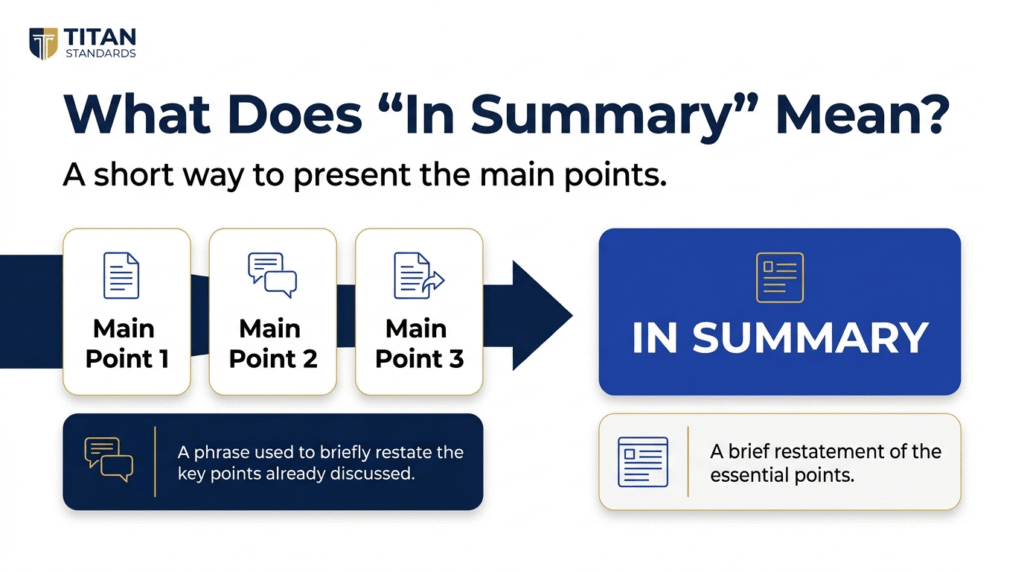
If you need another way to say “in summary,” you can use phrases such as “to summarize,” “in short,” “to sum up,” “overall,” “in conclusion,” and “taken together.” The best choice depends on whether you are briefly restating information, drawing a conclusion, reviewing key points, or speaking casually. Key Takeaways What Does “In Summary” Mean? “In summary” is a transition used to introduce a brief statement of the main ideas, facts, or conclusions that have already been discussed. It is common in essays, reports, presentations, professional writing, and other situations where information needs to be condensed. For example: In summary, the project met its main goals while staying within budget. The phrase does not necessarily mean that the entire piece of writing is ending. It can simply signal that the writer is bringing several points together. That distinction matters when choosing an alternative. “In conclusion” can suggest a final judgment or ending, while “to recap” focuses more directly on reviewing information. Why Use Another Way to Say “In Summary”? There are several good reasons to vary the phrase: The goal is not to replace “in summary” every time. If it is the clearest phrase for your sentence, there is nothing wrong with keeping it. 12 Best Ways to Say “In Summary” 1. To Summarize “To summarize” is probably the closest direct replacement for “in summary.” It clearly tells the reader that you are about to condense the information already presented. To summarize, the proposal addresses the company’s three main concerns. It works especially well in essays, reports, presentations, and professional writing because it is direct without sounding overly formal. 2. Overall Use “overall” when you want to give a broad assessment of something rather than simply repeat its individual points. Overall, the new process has reduced delays and improved communication. This phrase can often replace “in summary,” but the meaning is slightly different. “Overall” emphasizes the big picture or general result. 3. To Sum Up “To sum up” is a natural, flexible alternative that means you are briefly bringing the main points together. To sum up, the plan is practical, affordable, and easy to implement. It works in many types of writing and speech. It is somewhat more conversational than “to summarize,” making it useful for presentations, emails, general articles, and everyday communication. 4. In Short Choose “in short” when you want to reduce a longer explanation to its essential point. In short, we need more time to complete the project properly. It is concise and natural, but it often introduces a simplified version of the message rather than a detailed recap of every major point. 5. In Conclusion “In conclusion” is appropriate when you are moving into the final conclusion of an essay, report, argument, or formal discussion. In conclusion, the evidence supports the need for further research. It is related to “in summary,” but it is not always interchangeable. “In summary” focuses on condensing information; “in conclusion” more strongly signals that the discussion is ending or that a final conclusion is being presented. 6. Taken Together Use “taken together” when several facts, arguments, results, or observations combine to support one overall idea. Taken together, these findings suggest that the policy needs further review. This is particularly useful in analytical and academic writing because it makes the relationship between multiple pieces of information explicit. 7. To Recap “To recap” means to briefly review information that has already been discussed. To recap, we agreed on the budget, timeline, and next steps. It is especially natural in meetings, presentations, emails, and spoken communication. It is usually less formal than “to summarize.” 8. In Brief “In brief” is a concise, somewhat formal way to introduce a shortened version of the main information. In brief, the report identifies three major areas of concern. It can work well in reports, professional writing, and formal explanations. It is less conversational than “to sum up.” 9. In Essence Choose “in essence” when you want to express the basic or central meaning of something. In essence, the proposal asks the company to invest more resources in training. This is not a perfect substitute in every sentence. It focuses on the core idea or fundamental meaning rather than necessarily summarizing every point. 10. In a Nutshell “In a nutshell” is a distinctly informal way to introduce a very concise explanation. In a nutshell, the project needs more funding and a longer timeline. It is natural in blogs, casual explanations, conversations, and friendly communication. It may sound too informal for a formal academic paper or highly professional report. 11. On the Whole Use “on the whole” when summarizing a general assessment while allowing for some exceptions or limitations. On the whole, the training program has been successful. It is useful when your summary reflects the overall situation rather than claiming that every individual detail points in exactly the same direction. 12. All in All “All in all” introduces a general conclusion after considering several aspects of a situation. All in all, the conference was informative and well organized. It is common in everyday and general writing. For a formal academic paper, a more neutral option such as “overall” or “to summarize” may fit better. Quick Comparison of “In Summary” Alternatives Alternative Best Used In Tone To summarize Essays, reports, professional writing Neutral/formal Overall Assessments, reports, general writing Neutral To sum up Essays, presentations, emails Neutral/conversational In short Concise explanations Neutral In conclusion Essays and formal conclusions Formal Taken together Analytical or academic writing Formal/precise To recap Meetings, presentations, emails Conversational In brief Reports and formal explanations Formal In essence Explaining a central idea Neutral/formal In a nutshell Casual explanations Informal On the whole Broad assessments Neutral/formal All in all General conclusions Conversational “In Summary” vs. “In Conclusion” These two phrases are close, but they do different jobs. “In summary” primarily tells the reader that the main information is about to be condensed: In summary, the report identifies three causes of the problem. “In conclusion” more strongly indicates that