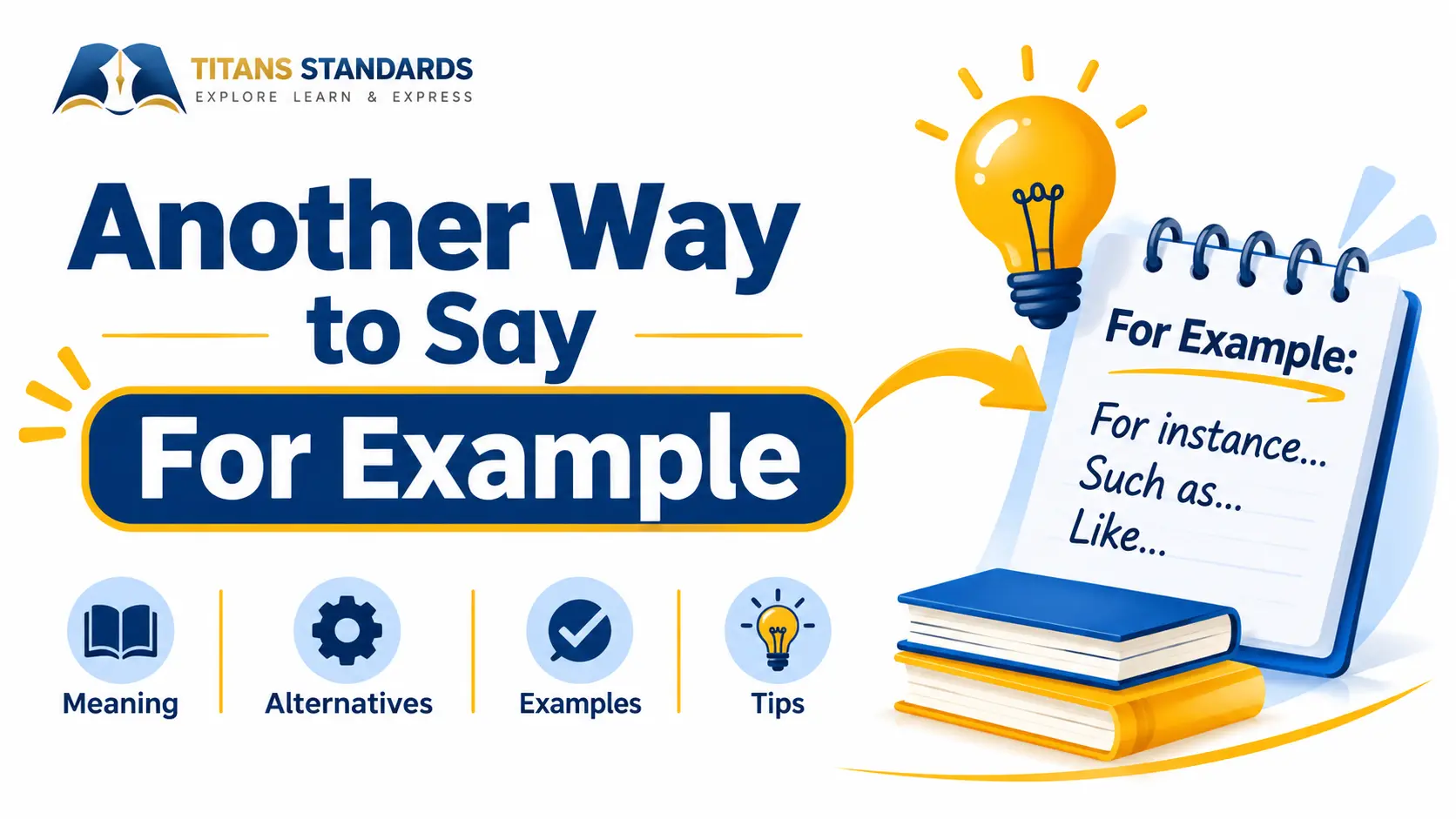
Another way to say “for example” is “for instance.” Other useful alternatives include “such as,” “to illustrate,” “as an example,” “namely,” and “specifically.
” Choose the phrase that best fits your sentence, tone, and purpose. These alternatives help you introduce examples clearly, avoid repetition, and make everyday, academic, and professional writing more natural.
Key Takeaways
- “For instance” is a natural substitute for “for example” in most situations.
- “Such as” works well when listing specific items or examples.
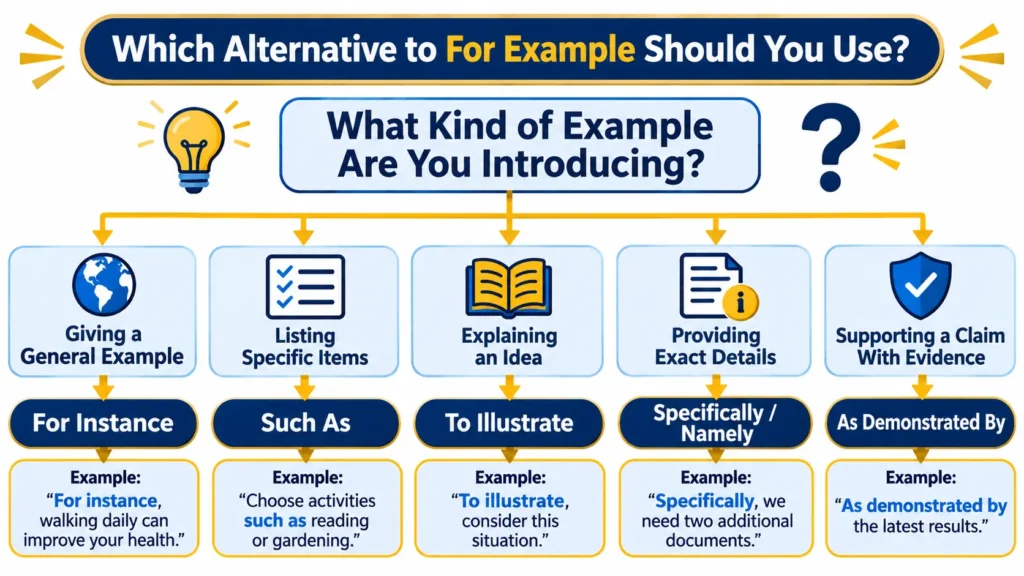
- “To illustrate” is useful when explaining an idea or supporting an argument.
- “Namely” introduces specific details that clarify a general statement.
- Choose alternatives based on sentence structure, tone, and context.
Have you ever used “for example” several times in the same paragraph? Although the phrase is clear and correct, repeating it can make your writing sound predictable.
Fortunately, English offers many alternatives that introduce examples naturally. The best choice depends on whether you’re writing an essay, sending a professional email, explaining an idea, or having a casual conversation.
What Does “What’s Another Way to Say for Example” Mean?
The phrase “what’s another way to say for example” asks for alternative expressions that introduce a specific case, detail, or illustration of a broader idea.
Writers use these expressions to make information easier to understand. They help connect general statements to real examples, clarify complicated points, and support arguments with relevant details.
You will commonly see these phrases in school assignments, business reports, presentations, articles, emails, and everyday conversations.
Why Use Other Ways to Say “For Example”?
Using different expressions can improve your writing without changing your meaning. The right alternative also helps you match your audience and communicate more precisely.
Consider these benefits:
- Avoid repetition: Keep paragraphs interesting by varying your wording.
- Improve clarity: Choose expressions that make the relationship between an idea and its example clear.
- Match the tone: Use conversational language with friends and more formal expressions in academic or business writing.
- Strengthen explanations: Support opinions and arguments with specific details.
- Sound more natural: Make your sentences flow smoothly instead of relying on the same transition.
10 Best Other Ways to Say “For Example”
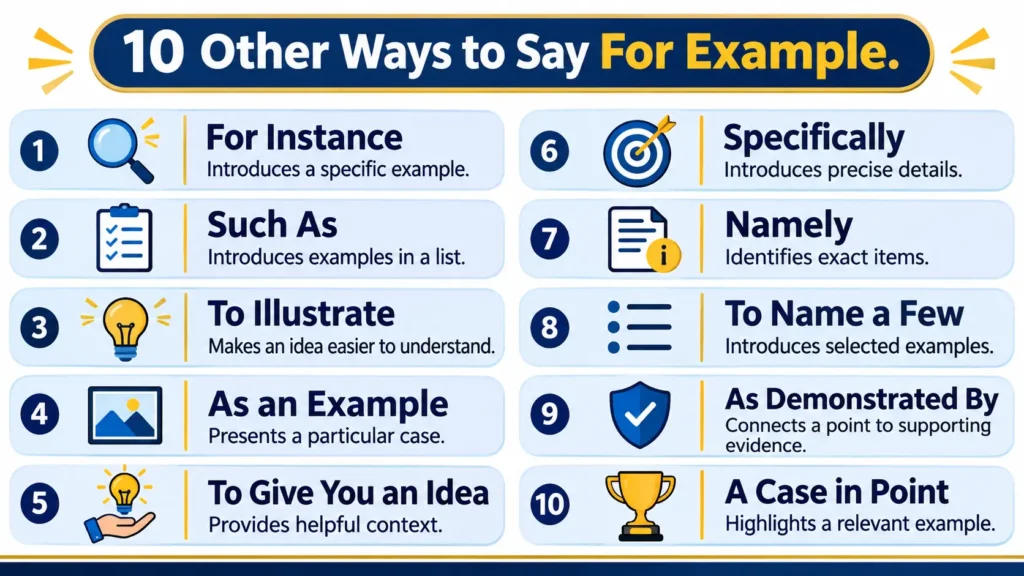
1. For Instance
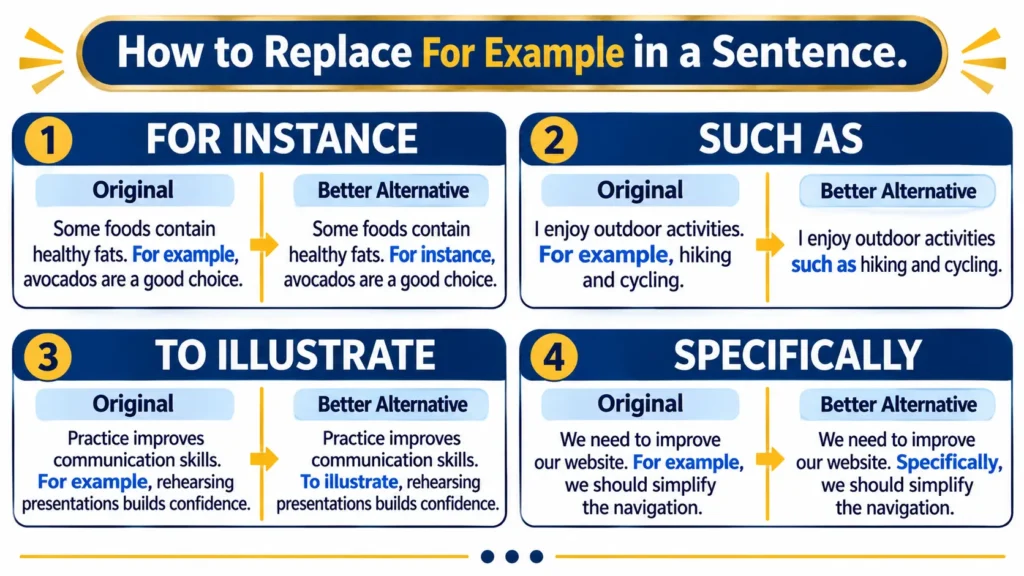
Meaning: “For instance” introduces a specific example that supports a general statement. It has almost the same meaning as “for example,” so you can use it in many of the same situations.
Best For: Professional, Formal, Casual, Friendly
Example 1: Some simple habits can improve your sleep. For instance, avoid drinking coffee late in the evening.
Example 2: We offer several outdoor activities, such as hiking and kayaking. For instance, beginners can join our guided hiking group.
Quick Tip: Use “for instance” when you want an easy, natural replacement that fits both spoken and written English.
2. Such As
Meaning: “Such as” introduces specific items that belong to a larger category. It usually appears before a list or one or more examples within a sentence.
Best For: Professional, Formal, Casual
Example 1: The library provides useful resources, such as grammar guides, dictionaries, and writing manuals.
Example 2: I enjoy relaxing activities such as gardening and reading historical novels.
Quick Tip: Place “such as” directly before the examples. Unlike “for example,” it usually does not need to begin a separate sentence.
3. To Illustrate
Meaning: “To illustrate” introduces an example that makes an idea, process, or argument easier to understand. It works especially well when the example explains an abstract concept.
Best For: Professional, Formal, Polite
Example 1: Small design changes can improve website usability. To illustrate, clearer navigation can help visitors find information faster.
Example 2: Regular practice builds confidence. To illustrate, students who rehearse presentations often feel more prepared.
Quick Tip: Use this phrase when your example explains how something works or demonstrates why a point matters.
4. As an Example
Meaning: “As an example” signals that you are presenting a particular case to support your point. It works in both conversation and writing, although it can sound slightly more deliberate than “for instance.”
Best For: Professional, Casual, Friendly
Example 1: Several changes could reduce our expenses. As an example, switching to digital invoices may lower printing costs.
Example 2: You can prepare healthy lunches in advance. A vegetable wrap, as an example, takes only a few minutes to assemble.
Quick Tip: Use the phrase when you want to draw attention to one specific case rather than introduce a long list.
5. To Give You an Idea
Meaning: “To give you an idea” introduces a detail that helps someone understand the scale, nature, or possibilities of something. It is conversational and often makes explanations feel more personal.
Best For: Casual, Friendly, Warm
Example 1: The new community center offers many classes. To give you an idea, you can sign up for cooking, painting, or yoga.
Example 2: Planning the event took several weeks. To give you an idea, we contacted more than 30 vendors.
Quick Tip: Choose this phrase when speaking with someone or explaining something informally. Avoid relying on it in highly formal academic writing.
6. Specifically
Meaning: “Specifically” introduces precise information that clarifies a broader statement. It can identify particular examples, details, requirements, or areas of focus.
Best For: Professional, Formal, Polite
Example 1: We need to improve customer service. Specifically, our team should respond to support requests within one business day.
Example 2: Several subjects interest Maya, specifically environmental science and marine biology.
Quick Tip: Use “specifically” when you want to narrow a general point to exact details. It does not always mean “for example,” so make sure the sentence expresses clarification or precision.
7. Namely
Meaning: “Namely” introduces the exact people, things, or details being referred to. It is more precise than a general example phrase and often signals that the following information identifies something already mentioned.
Best For: Formal, Professional
Example 1: Two departments will lead the project, namely marketing and product development.
Example 2: The application requires one essential document, namely proof of residency.
Quick Tip: Use “namely” when you are identifying specific items rather than simply giving a few possible examples. It can sound formal in casual conversation.
8. To Name a Few
Meaning: “To name a few” indicates that you are listing some examples without including every possible option. It is useful when a category contains many items.
Best For: Casual, Friendly, Professional
Example 1: The farmers market sells fresh produce, homemade bread, local honey, and flowers, to name a few.
Example 2: Our training covers communication, teamwork, and problem-solving, to name a few important skills.
Quick Tip: Place this phrase after a list when you want to show that the examples are only a selection, not a complete inventory.
9. As Demonstrated By
Meaning: “As demonstrated by” connects a claim to evidence that supports or shows it. It is particularly useful in reports, research, and persuasive writing.
Best For: Formal, Professional
Example 1: The revised schedule improved attendance, as demonstrated by the higher number of participants at each session.
Example 2: The new policy reduced processing delays, as demonstrated by the team’s monthly performance data.
Quick Tip: Use this phrase when you have evidence to support a statement. Do not use it for a random example that does not actually demonstrate your point.
10. A Case in Point
Meaning: “A case in point” introduces a particularly relevant example that supports a general statement. It often emphasizes a real situation that clearly demonstrates the point being discussed.
Best For: Professional, Formal
Example 1: Consistent customer support can build brand loyalty. A case in point is the store that retained customers by resolving complaints quickly.
Example 2: Local initiatives can make a difference. The neighborhood’s successful recycling program is a case in point.
Quick Tip: Choose this expression when an example provides strong support for your argument, rather than when you are simply listing ordinary possibilities.
Comparison Table: Alternatives to “For Example”
| Alternative | Best Used In | Tone |
|---|---|---|
| For instance | Everyday writing, emails | Neutral |
| Such as | Lists and descriptions | Natural |
| To illustrate | Essays and explanations | Formal |
| As an example | General explanations | Neutral |
| To give you an idea | Conversations | Friendly |
| Specifically | Reports and instructions | Precise |
| Namely | Formal documents | Formal |
| To name a few | Short, partial lists | Conversational |
| As demonstrated by | Evidence-based writing | Professional |
| A case in point | Arguments and reports | Formal |
Common Mistakes When Replacing “For Example”
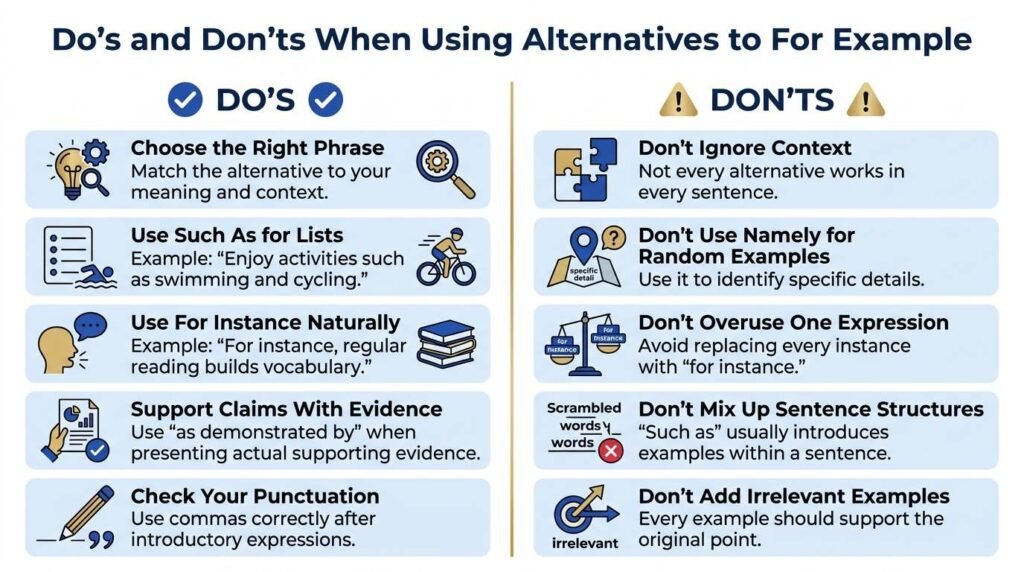
Choosing an alternative requires more than finding a similar phrase. You also need to consider grammar, meaning, and context.
1. Using casual phrases in formal writing. Expressions such as “to give you an idea” may sound too conversational in a research paper. Choose “to illustrate” or another suitable formal expression instead.
2. Treating every alternative as interchangeable. “Namely” identifies specific details, while “such as” introduces examples. They do not always communicate the same relationship.
3. Repeating the same replacement. Replacing every instance of “for example” with “for instance” does not solve the repetition problem. Vary your transitions when appropriate.
4. Ignoring sentence structure. “Such as” usually introduces examples within a sentence, while “for instance” can introduce a complete sentence. Check that your punctuation and grammar fit the phrase.
5. Using examples that do not support the point. An example should clarify or strengthen the statement before it. Choose relevant details rather than adding information just to fill space.
Frequently Asked Questions
1. What is the most common alternative to “for example”?
“For instance” is one of the most common alternatives because it communicates the same basic idea and works in many contexts. You can use it in conversations, essays, emails, and presentations. “Such as” is another useful choice when you want to introduce specific items within a sentence.
2. What is a formal way to say “for example”?
“To illustrate,” “namely,” and “as demonstrated by” can work in formal writing, depending on your meaning. Use “to illustrate” to explain an idea, “namely” to identify exact details, and “as demonstrated by” when presenting supporting evidence. The best phrase depends on how the example relates to your main point.
3. What can I use instead of “for example” in an essay?
In an essay, you can use “for instance,” “to illustrate,” “specifically,” or “as demonstrated by.” Choose the phrase that matches your argument and evidence. For instance, use “to illustrate” to clarify a concept and “as demonstrated by” when the evidence genuinely supports your claim.
4. Is “such as” the same as “for example”?
They have similar meanings, but their grammatical uses differ. “Such as” usually introduces examples within a sentence, as in “I enjoy outdoor activities such as hiking.” “For example” can introduce a separate sentence: “I enjoy outdoor activities. For example, I go hiking on weekends.”
5. Can I start a sentence with “for instance”?
Yes. You can begin a sentence with “for instance” when the sentence provides an example of a point you have already made. For example: “Several habits support better health. For instance, walking regularly can improve cardiovascular fitness.” When used this way, place a comma after the introductory phrase.
6. What is a casual way to say “for example”?
“To give you an idea” is a friendly, conversational option. You can also use “for instance” in casual conversations because it sounds natural and is easy to understand. For example, you might say, “We have plenty of weekend plans. To give you an idea, we’re visiting the museum on Saturday.”
7. How can I avoid repeating “for example” in a paragraph?
Choose alternatives based on what each sentence needs. Use “for instance” for a general example, “such as” for a list, and “specifically” for precise details. You can also restructure sentences to include examples naturally. Avoid changing phrases just for variety if the replacement makes your meaning less clear.
8. Is “e.g.” a good substitute for “for example”?
Yes. “E.g.” is an abbreviation of the Latin phrase exempli gratia, meaning “for example.” It is common in academic, technical, and professional writing, especially in parentheses. For general audiences, however, spelling out “for example” may be clearer. Follow your organization’s or publication’s style guidelines for punctuation.
You may also find these guides useful: another way to say “in summary”, another way to say “instead” and another way to say “next in an essay”.
Conclusion
There are many ways to say “for example,” and choosing the right one can make your writing clearer, more varied, and more natural. “For instance” is an excellent all-purpose alternative, while “such as” works well for lists. For academic and professional writing, consider “to illustrate,” “specifically,” or “as demonstrated by,” depending on your purpose.
Think about what your example is doing before choosing a replacement. Are you explaining an idea, identifying exact details, listing possibilities, or presenting evidence? Each purpose calls for slightly different wording.
Most importantly, prioritize clarity over variety. You do not need to replace every instance of “for example.” Use another expression when it improves the sentence, fits the tone, and helps your reader understand your point.

Editorial Desk
The Titan Standards Editorial Team develops, reviews, and maintains practical English-language resources. The team checks articles for clarity, accuracy, context, readability, and consistency with Titan Standards’ editorial guidelines.