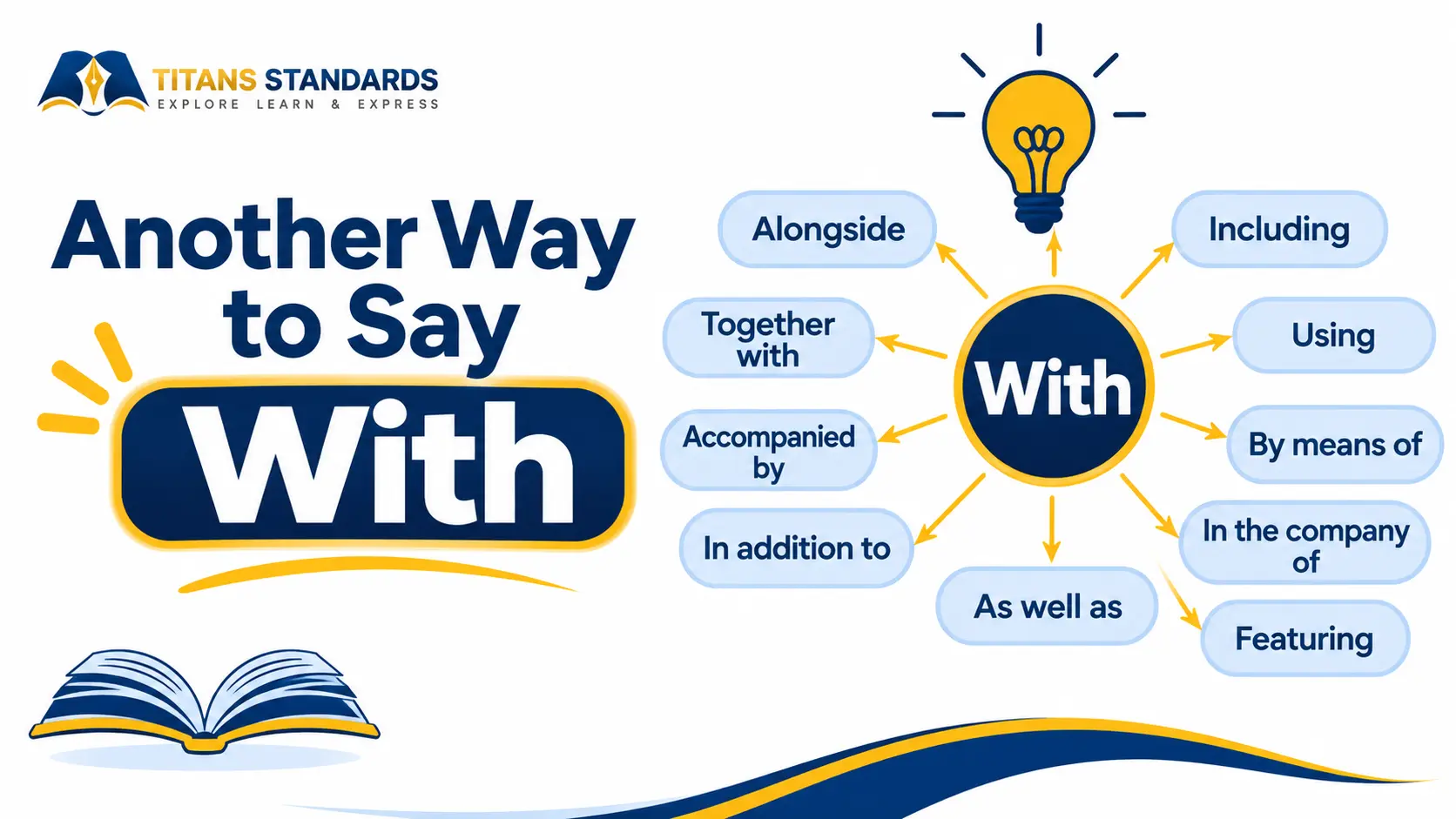
Another way to say “with” depends on the sentence and its meaning. Common alternatives include alongside, together with, accompanied by, in addition to, as well as, including, using, and by means of.
These expressions help you avoid repetition, improve sentence flow, and communicate more clearly in everyday and professional writing.
Key Takeaways
- “With” has several meanings, so the best alternative depends on context.
- “Alongside” and “together with” describe people or things working together.
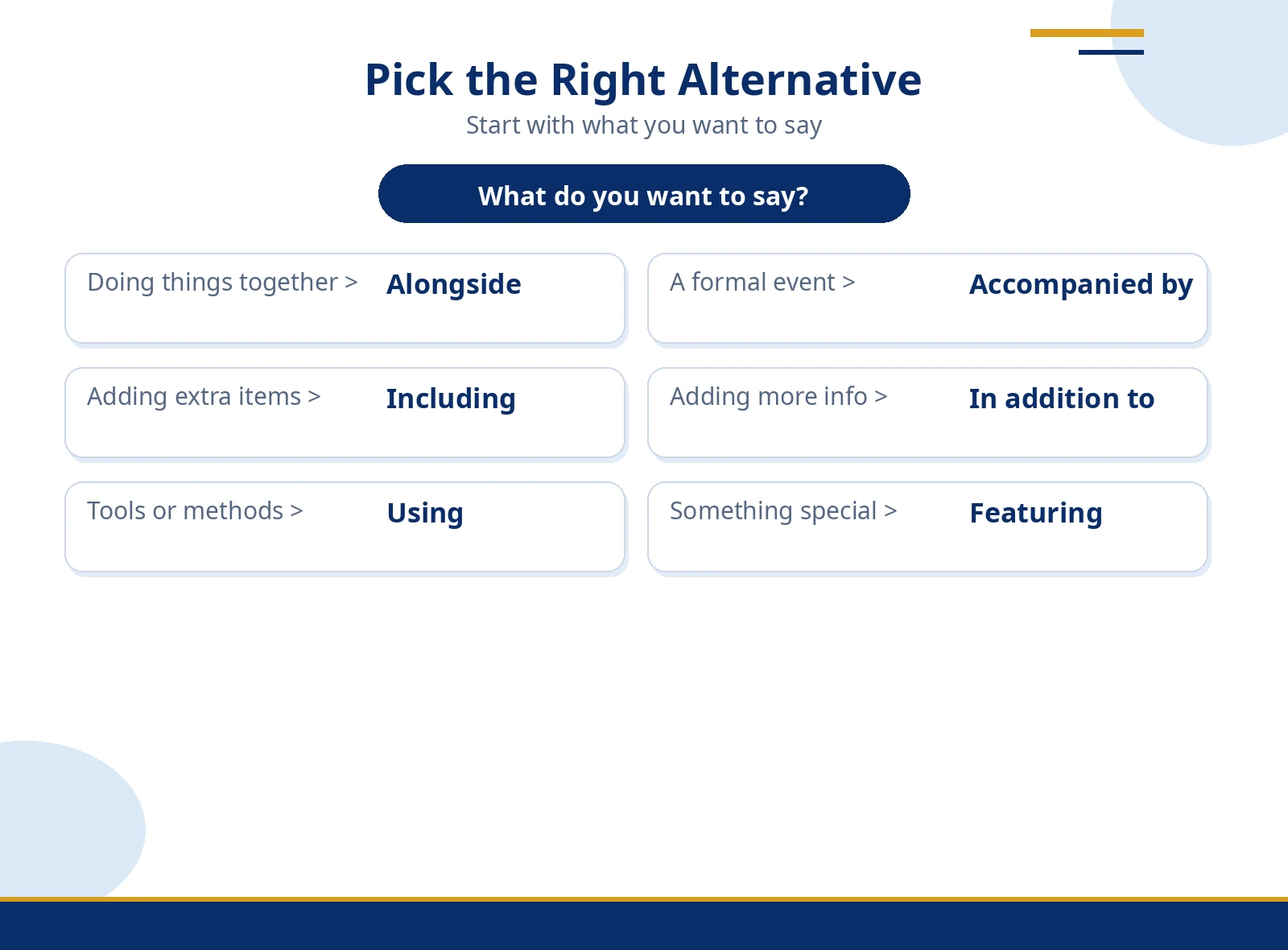
- “Accompanied by” works well when someone or something comes together with another.
- “Using” and “by means of” describe tools, methods, or ways of doing something.
- Choosing the right expression makes your writing clearer and more natural.
The word “with” is one of the most common prepositions in English. We use it to describe relationships, partnerships, tools, feelings, ingredients, and the people or things that accompany something.
However, repeating “with” too often can make your writing sound basic or repetitive. Learning other ways to say “with” helps you express the same idea more naturally while matching the tone of your conversation or writing.
Whether you’re writing an email, completing a school assignment, or having an everyday conversation, the right alternative can make your sentences more interesting and precise.
What Does “With” Mean?
“With” is a preposition that connects people, objects, actions, or ideas. It commonly means being together, having something, using a particular tool, or including someone or something.
For example:
- Together: I went to the movies with my friends.
- Having: The woman with the blue jacket is my teacher.
- Using: She opened the package with scissors.
- Including: I ordered a sandwich with extra cheese.
- Manner: He answered the question with confidence.
People use “with” in everyday conversations, business communication, academic writing, instructions, and storytelling. Since it has several meanings, you should choose an alternative that preserves the original sentence’s meaning.
For the full definition, see Cambridge Dictionary.
Why Use Other Ways to Say “With”?
Although “with” works in many situations, using the same word repeatedly can make your writing less engaging. Alternative expressions help you communicate more effectively.
Here are some reasons to explore different options:
- Avoid repetition: Make your sentences sound less repetitive.
- Improve clarity: Choose words that explain your exact meaning.
- Sound more professional: Use suitable expressions in business emails and reports.
- Improve sentence flow: Connect ideas more naturally.
- Match different situations: Choose language that fits formal, casual, or academic communication.
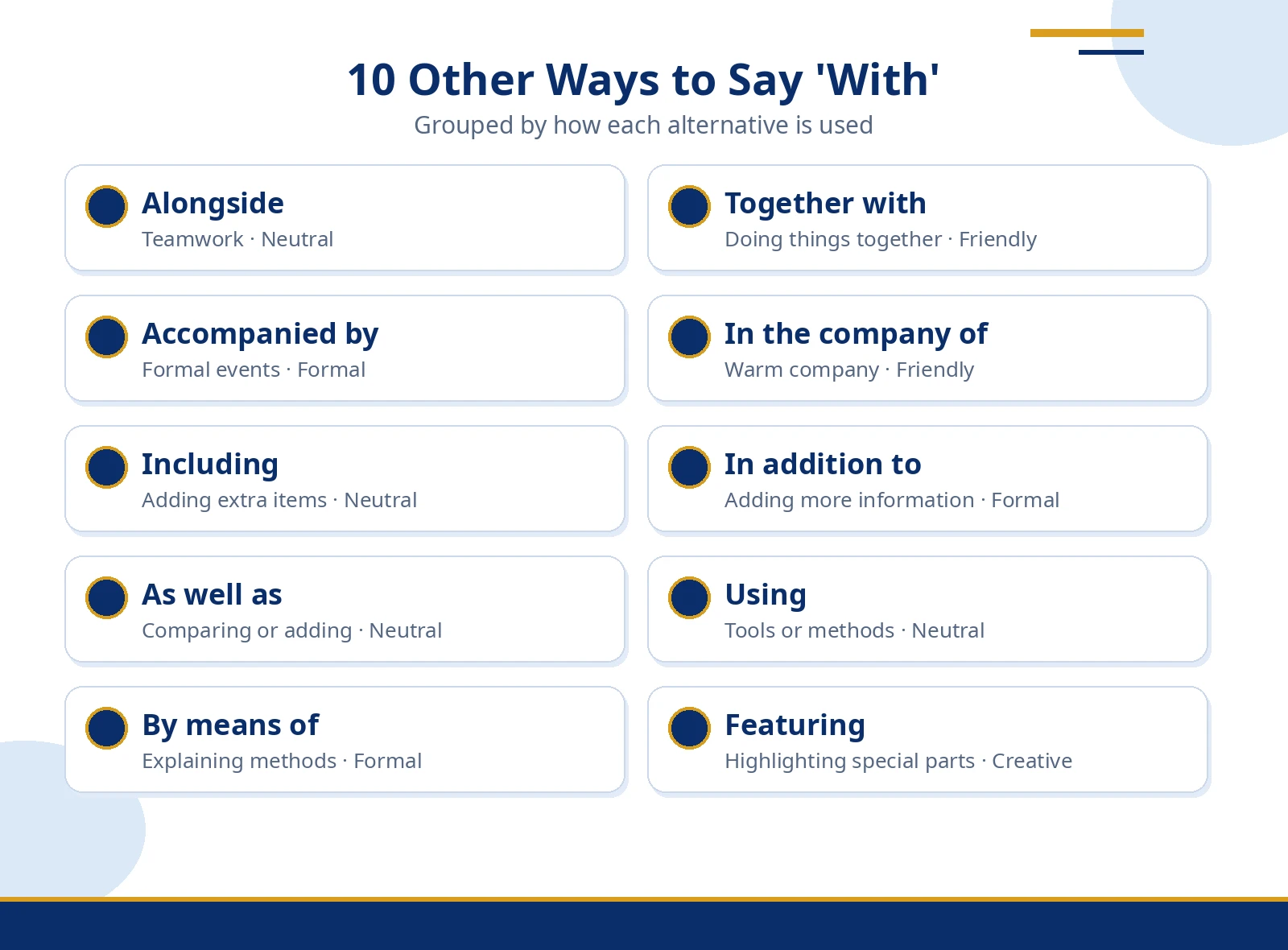
10 Best Other Ways to Say “With”
Here are 10 useful alternatives to “with,” along with their meanings, appropriate situations, and natural American English examples.
1. Alongside
Meaning:
“Alongside” means next to someone or something, or working together with another person. It is useful when describing teamwork, partnerships, or things that exist side by side.
Best For: Professional, Formal, Casual
Example 1: Our marketing team worked alongside the design department to launch the new website.
Example 2: She walked alongside her younger brother through the park.
Quick Tip: Use “alongside” when you want to emphasize cooperation, partnership, or physical closeness.
2. Together With
Meaning:
“Together with” describes two or more people or things being involved in the same activity or situation. It emphasizes unity, cooperation, or shared participation.
Best For: Friendly, Professional, Formal
Example 1: I prepared the presentation together with my coworkers.
Example 2: The invitation arrived together with a handwritten note.
Quick Tip: Use “together with” when you want to highlight that people or things are participating as a group.
3. Accompanied By
Meaning:
“Accompanied by” means that someone or something is present alongside another person or thing. It often appears in formal writing, descriptions, travel-related content, and professional communication.
Best For: Formal, Professional, Polite
Example 1: The CEO arrived at the conference accompanied by two assistants.
Example 2: The main course was accompanied by a fresh garden salad.
Quick Tip: Use “accompanied by” when describing someone or something that comes along with another.
4. In Addition To
Meaning:
“In addition to” means something extra or another thing included alongside what has already been mentioned. It works especially well when adding information, responsibilities, services, or items.
Best For: Formal, Professional, Polite
Example 1: In addition to managing social media, she handles customer inquiries.
Example 2: In addition to the monthly report, please submit the updated budget.
Quick Tip: Use this expression when you want to introduce an extra detail rather than simply describe two things being together.
5. As Well As
Meaning:
“As well as” means in addition to or together with something else. It allows you to connect related ideas without repeating the same sentence structure.
Best For: Professional, Formal, Friendly
Example 1: The job requires strong writing skills as well as basic computer knowledge.
Example 2: She enjoys reading novels as well as watching documentaries.
Quick Tip: Use “as well as” to add another related person, activity, quality, or responsibility.
6. Including
Meaning:
“Including” means that someone or something is part of a larger group, list, or collection. It helps introduce specific examples without listing every possible item.
Best For: Professional, Formal, Casual
Example 1: The package includes several useful features, including free website hosting.
Example 2: Everyone attended the meeting, including the department manager.
Quick Tip: Use “including” when you want to provide examples or highlight specific items within a larger group.
7. Using
Meaning:
“Using” describes the tool, resource, or method someone chooses to complete an action. It is a natural alternative when “with” refers to the way something is done.
Best For: Casual, Professional, Formal
Example 1: She edited the photographs using professional design software.
Example 2: The technician repaired the computer using specialized equipment.
Quick Tip: Replace “with” with “using” when it introduces a tool, device, or resource involved in an action.
8. By Means Of
Meaning:
“By means of” describes the method, instrument, or process used to achieve something. It has a more formal tone and often appears in academic, technical, and professional writing.
Best For: Formal, Professional
Example 1: The researchers collected the data by means of online surveys.
Example 2: The company reduced costs by means of improved automation.
Quick Tip: Choose “by means of” for formal explanations of methods or processes. Avoid using it in casual conversations where “using” sounds more natural.
9. In the Company Of
Meaning:
“In the company of” means being together with another person or group. It often describes social situations, shared experiences, or spending time with people.
Best For: Friendly, Warm, Formal
Example 1: He felt comfortable in the company of his closest friends.
Example 2: We enjoyed a wonderful evening in the company of our relatives.
Quick Tip: Use this expression when describing someone’s presence or social experience rather than a tool or method.
10. Featuring
Meaning:
“Featuring” means presenting or including someone or something as a noticeable part of a product, event, presentation, or collection. It works particularly well in promotional and descriptive writing.
Best For: Professional, Casual, Friendly
Example 1: The restaurant introduced a new menu featuring fresh seasonal ingredients.
Example 2: We watched a documentary featuring interviews with experienced photographers.
Quick Tip: Use “featuring” when you want to highlight an important person, item, or characteristic rather than simply indicate that something is present.
Comparison Table: 10 Alternatives to “With”
The following table helps you quickly choose the right expression based on its purpose and tone.
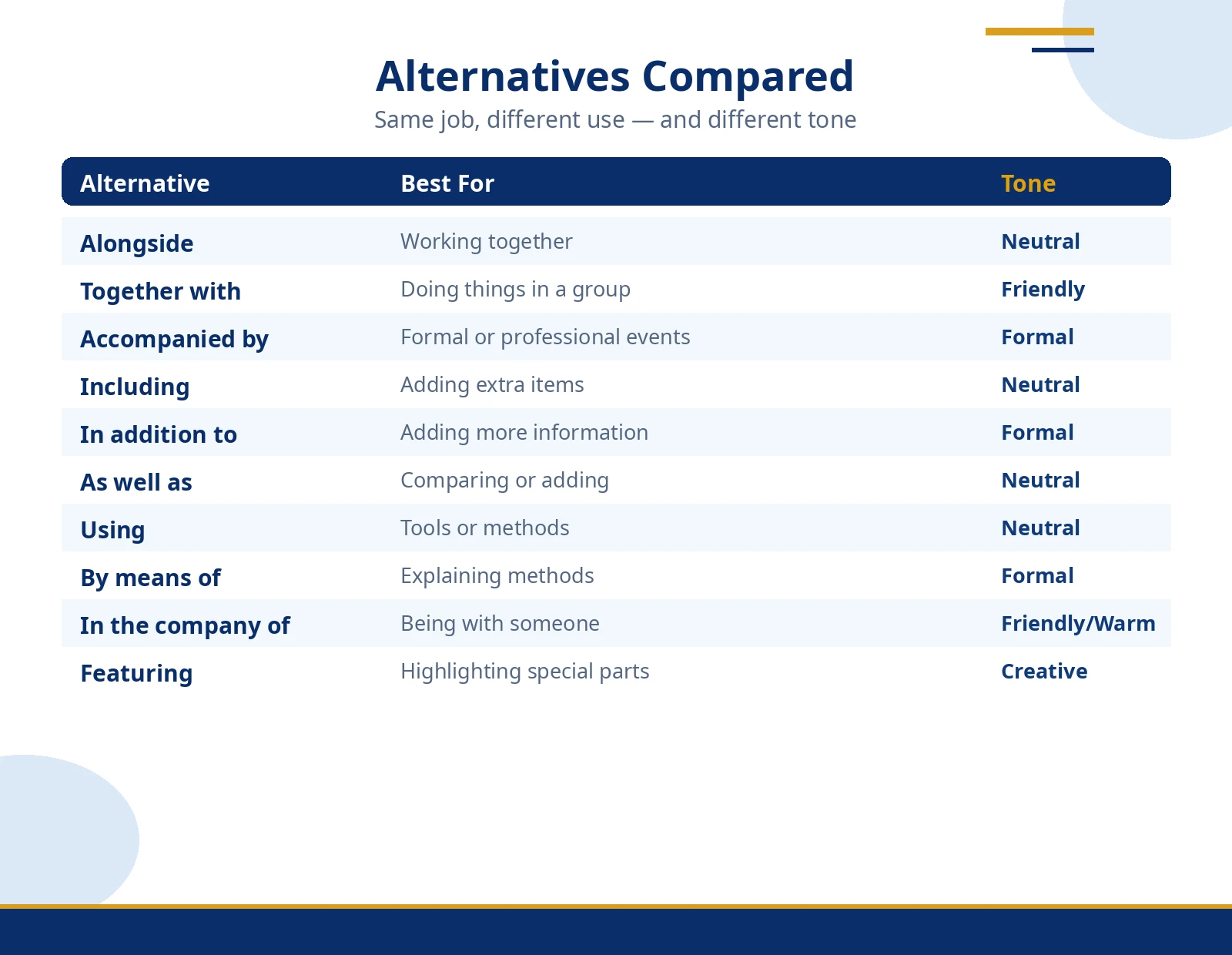
| Alternative | Best Used In | Tone |
|---|---|---|
| Alongside | Teamwork and partnerships | Professional |
| Together with | Shared activities | Friendly |
| Accompanied by | Descriptions and reports | Formal |
| In addition to | Extra information | Professional |
| As well as | Connecting related ideas | Neutral |
| Including | Lists and examples | Neutral |
| Using | Tools and resources | Direct |
| By means of | Methods and processes | Formal |
| In the company of | Social situations | Warm |
| Featuring | Promotions and descriptions | Descriptive |
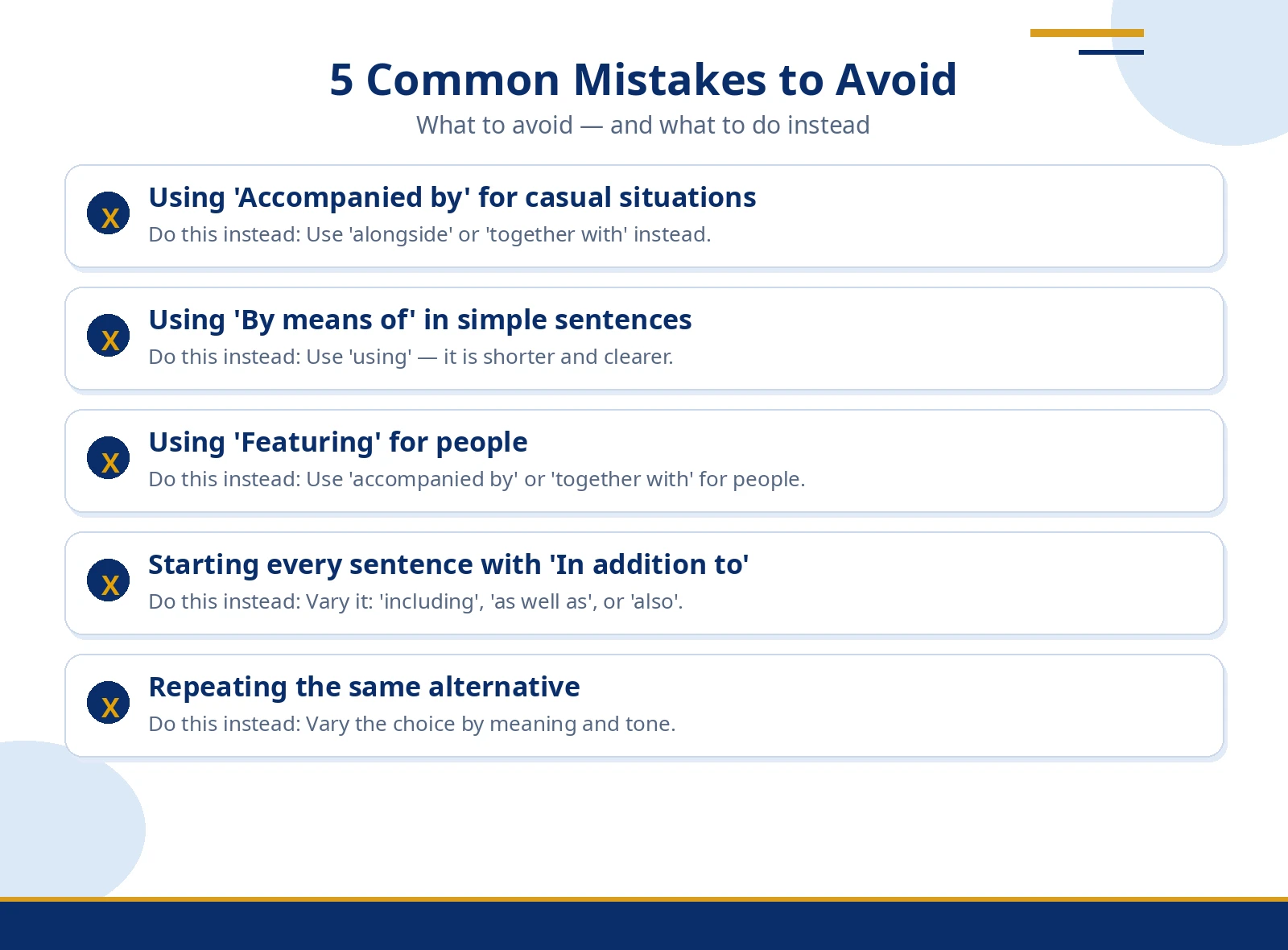
Common Mistakes When Replacing “With”
Choosing a different expression does not always improve a sentence. Some alternatives have specific meanings, so using them incorrectly can confuse readers.
Here are five common mistakes to avoid.
1. Using Alternatives Without Checking Context
Not every alternative works in every sentence. For example, “using” describes a method or tool, while “alongside” usually describes closeness or cooperation.
2. Choosing Overly Formal Expressions
Phrases like “by means of” may sound unnatural in casual conversations. Use simpler words such as “using” when writing friendly messages or everyday instructions.
3. Ignoring the Original Meaning
Replacing “with” with “including” can change the meaning of a sentence. Make sure the new expression communicates the same idea as the original.
4. Repeating the Same Alternative
Using “alongside” or “together with” in every paragraph can create another form of repetition. Mix suitable expressions based on the context.
5. Forgetting Sentence Grammar
Some alternatives require different sentence structures. For example, “accompanied by” usually introduces a noun, while “using” often introduces a tool or resource.
Frequently Asked Questions
1. What is another way to say “with”?
Some common alternatives include alongside, together with, accompanied by, as well as, and in addition to. The best choice depends on your sentence. For example, use “alongside” for teamwork and “using” when describing a tool or method.
2. What is a more professional word for “with”?
“In addition to,” “alongside,” and “as well as” are useful professional alternatives. They work well in business emails, reports, and presentations. For example, you could write, “She worked alongside the sales team” instead of “She worked with the sales team.”
3. How can I avoid repeating the word “with”?
Try replacing repeated uses with expressions such as “together with,” “alongside,” “including,” or “as well as.” However, choose each expression according to the sentence’s meaning. Sometimes keeping the original word is better than forcing an alternative.
4. What is another way to say “with someone”?
You can say “alongside someone,” “together with someone,” or “in the company of someone.” These expressions describe spending time with another person or participating in an activity together. Choose the one that best matches your intended meaning and tone.
5. What is another way to say “with the help of”?
You can use “using assistance from,” “supported by,” or “with assistance from.” For example, “She completed the project with the help of her team” can become “She completed the project with support from her team.”
6. Can I use “alongside” instead of “with”?
Yes, “alongside” can replace “with” when describing people or things working together or being next to each other. For example, “He worked alongside experienced designers” is a natural alternative to “He worked with experienced designers.”
7. What is another way to say “made with”?
Depending on the sentence, you can use “made from,” “created using,” or “prepared with.” For example, “A cake made with fresh strawberries” could become “A cake prepared using fresh strawberries.” Remember that “made from” can suggest a transformation of the original materials.
8. Is “together with” the same as “with”?
They often communicate a similar idea, especially when describing people or things participating in the same activity. However, “together with” places more emphasis on shared involvement. “With” is more flexible and can also describe tools, ingredients, and other relationships.
Readers who checked this guide also looked at another way to say “this shows”, another way to say “shows” and another way to say “like”.
Conclusion
Finding another way to say “with” can make your English writing clearer, more natural, and less repetitive. Expressions such as “alongside,” “together with,” and “as well as” work well when connecting people or ideas. Meanwhile, “using” and “by means of” are better choices when describing tools or methods.
The most important thing is to understand the context before choosing a replacement. A phrase that sounds professional in a business email might feel too formal in an everyday conversation.
You don’t need to replace “with” every time you use it. Instead, focus on choosing expressions that communicate your ideas clearly and naturally. The best alternative is always the one that fits your sentence and preserves its original meaning.
Looking for more ways to refresh everyday phrases? Explore our guides to fresher ways to say said and done, or find a better way to say he says.

Editorial Desk
The Titan Standards Editorial Team develops, reviews, and maintains practical English-language resources. The team checks articles for clarity, accuracy, context, readability, and consistency with Titan Standards’ editorial guidelines.