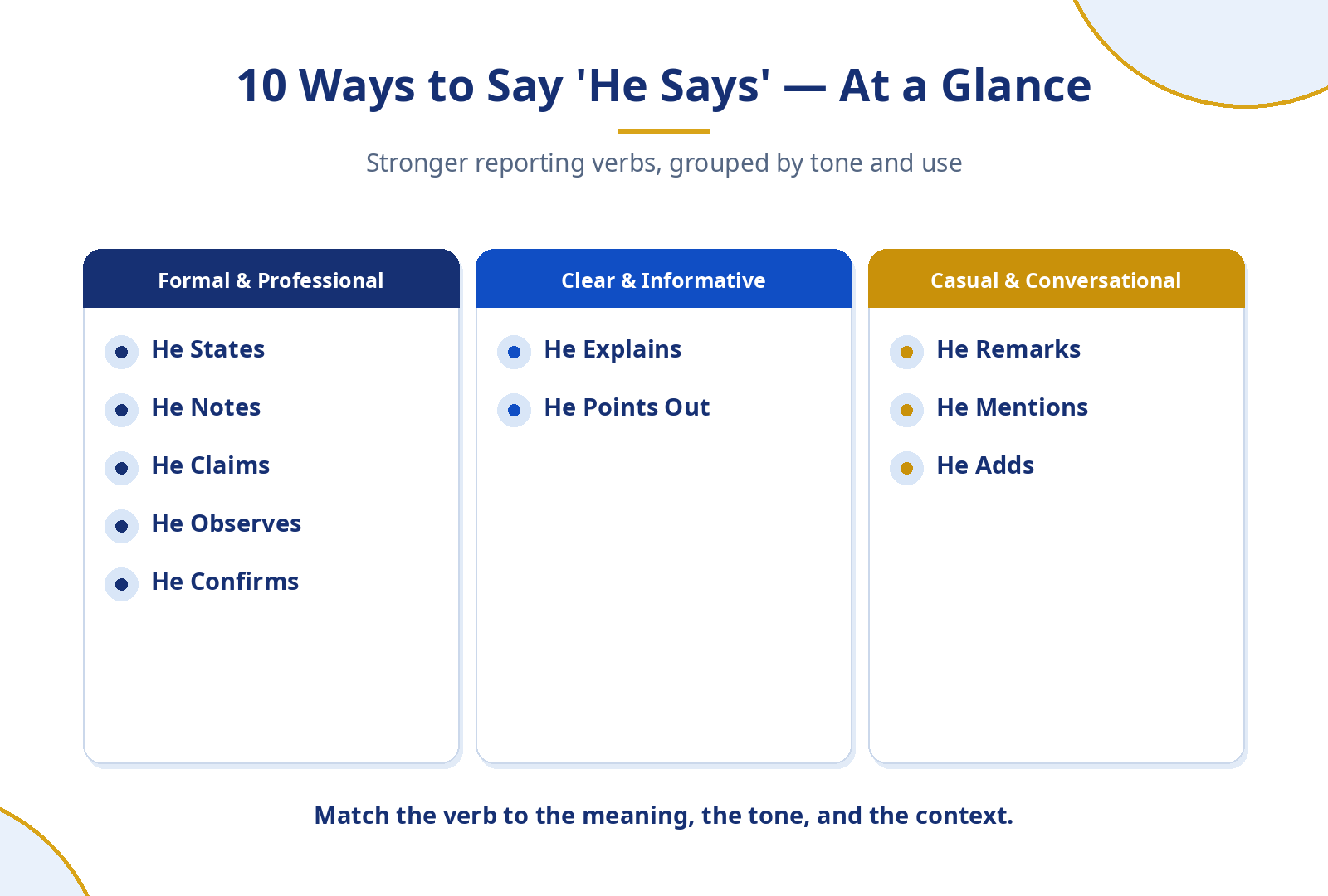
Another way to say “he says” includes “he states,” “he explains,” “he notes,” “he remarks,” and “he points out.” These alternatives help writers avoid repetition and show how a male speaker communicates an idea. Choose the right verb based on whether he shares information, expresses an opinion, adds a detail, or emphasizes a point.
Key Takeaways
- Use “he states” for direct, clear statements.
- Choose “he explains” when someone makes an idea easier to understand.
- Use “he notes” or “he mentions” to introduce additional information.
- Choose “he claims” when reporting an assertion that may need verification.
- Match the reporting verb to the speaker’s meaning and tone.
What Does “Another Way to Say He Says” Mean?
The phrase “another way to say he says” refers to alternative expressions for reporting what a male speaker communicates. Writers often look for these alternatives to make their sentences clearer, more engaging, and less repetitive.
For example, instead of writing, “He says the project is ready,” you could write, “He confirms the project is ready.” The second sentence suggests that he verifies the information rather than simply sharing it.
These alternatives are useful in essays, stories, news reports, professional emails, and everyday conversations. The best choice depends on what the speaker means and how the information should sound.
You can also check the Cambridge Dictionary for the standard meaning and usage of the verb ‘say’.
Why Use Other Ways to Say “He Says”?
Using different reporting verbs can improve your writing without changing the main message. However, each verb has its own meaning, so choose one that accurately reflects the speaker’s words.
Here are the main benefits:
- Avoid repetition: Keep paragraphs from sounding monotonous.
- Improve clarity: Show whether someone explains, reports, or emphasizes information.
- Match the tone: Choose language that suits academic, professional, or casual writing.
- Add meaning: Communicate the speaker’s attitude when the context supports it.
- Strengthen storytelling: Make dialogue and narration more natural.
10 Best Other Ways to Say “He Says”
1. He States
Meaning
“He states” means he expresses information or an opinion clearly and directly. It sounds more formal than “he says” and works well when reporting facts, positions, or official statements.
Best For: Professional, Formal
Example 1: He states that the company will release its annual report on Friday.
Example 2: During the interview, he states his position on the proposed policy.
Quick Tip: Use “he states” in reports, essays, and business writing when you want a direct, neutral tone.
2. He Explains
Meaning
“He explains” indicates that he provides details or reasons to help someone understand something. It is especially useful when the speaker clarifies a process, answers a question, or makes a complicated idea easier to follow.
Best For: Professional, Friendly, Polite
Example 1: He explains how the new scheduling system works.
Example 2: After the meeting, he explains why the deadline needs to change.
Quick Tip: Choose “he explains” when the speaker offers information or reasoning rather than simply making a statement.
3. He Notes
Meaning
“He notes” means he draws attention to a detail or piece of information. It usually sounds neutral and professional, making it useful when introducing an observation that supports a larger discussion.
Best For: Professional, Formal
Example 1: He notes that customer feedback improved during the last quarter.
Example 2: In his report, he notes a small increase in operating costs.
Quick Tip: Use “he notes” to highlight a relevant detail without making it sound more important than it is.
4. He Remarks
Meaning
“He remarks” means he makes a comment about a subject or situation. Depending on the context, it can sound conversational, thoughtful, or slightly formal.
Best For: Formal, Casual, Friendly
Example 1: He remarks that the neighborhood looks different after the renovation.
Example 2: At dinner, he remarks on how quickly the evening has passed.
Quick Tip: Use “he remarks” for comments or observations, especially in storytelling and descriptive writing.
5. He Points Out
Meaning
“He points out” means he directs attention to something important, noticeable, or easy to overlook. It often introduces a fact, correction, or detail that helps others understand a situation.
Best For: Professional, Casual, Polite
Example 1: He points out that the invoice includes an extra charge.
Example 2: During the discussion, he points out a mistake in the original calculation.
Quick Tip: Choose this phrase when the speaker highlights a specific detail or corrects a misunderstanding.
6. He Mentions
Meaning
“He mentions” means he refers to something briefly without necessarily explaining it in detail. It works well when a speaker introduces a topic or shares a small piece of information during a conversation.
Best For: Casual, Friendly, Professional
Example 1: He mentions that his family is visiting next weekend.
Example 2: In his email, he mentions a possible change to the meeting schedule.
Quick Tip: Use “he mentions” when the information is brief or secondary to the main topic.
7. He Claims
Meaning
“He claims” means he asserts that something is true. Unlike “he says,” this verb can suggest that the statement is disputed, unproven, or not independently verified, although context determines the exact tone.
Best For: Formal, Professional
Example 1: He claims that the package was delivered before noon.
Example 2: The witness claims that he saw the car leave the parking lot.
Quick Tip: Use “he claims” carefully because it may make readers question the accuracy of the statement.
8. He Observes
Meaning
“He observes” means he notices something and comments on it. It is often used for thoughtful observations, patterns, or conclusions based on what someone sees or considers.
Best For: Formal, Professional
Example 1: He observes that remote workers often need clearer communication.
Example 2: In the article, he observes a connection between regular practice and improved performance.
Quick Tip: Choose “he observes” when the speaker comments on a pattern, situation, or noticeable detail.
9. He Adds
Meaning
“He adds” introduces extra information after a previous statement. It helps readers follow a conversation or report when someone contributes another detail, reason, or thought.
Best For: Professional, Casual, Friendly
Example 1: He adds that the team will provide an update by Monday.
Example 2: “We have enough supplies,” he adds, “to finish the job today.”
Quick Tip: Use “he adds” when the speaker contributes something additional to what has already been said.
10. He Confirms
Meaning
“He confirms” means he verifies information or makes clear that something is correct, agreed upon, or definite. It is useful when reporting decisions, arrangements, dates, and details that have been checked.
Best For: Professional, Formal, Polite
Example 1: He confirms that the interview will take place at 10 a.m.
Example 2: The manager confirms that the revised budget has been approved.
Quick Tip: Use “he confirms” only when the context supports verification or certainty, not when someone is merely sharing an opinion.
Comparison Table
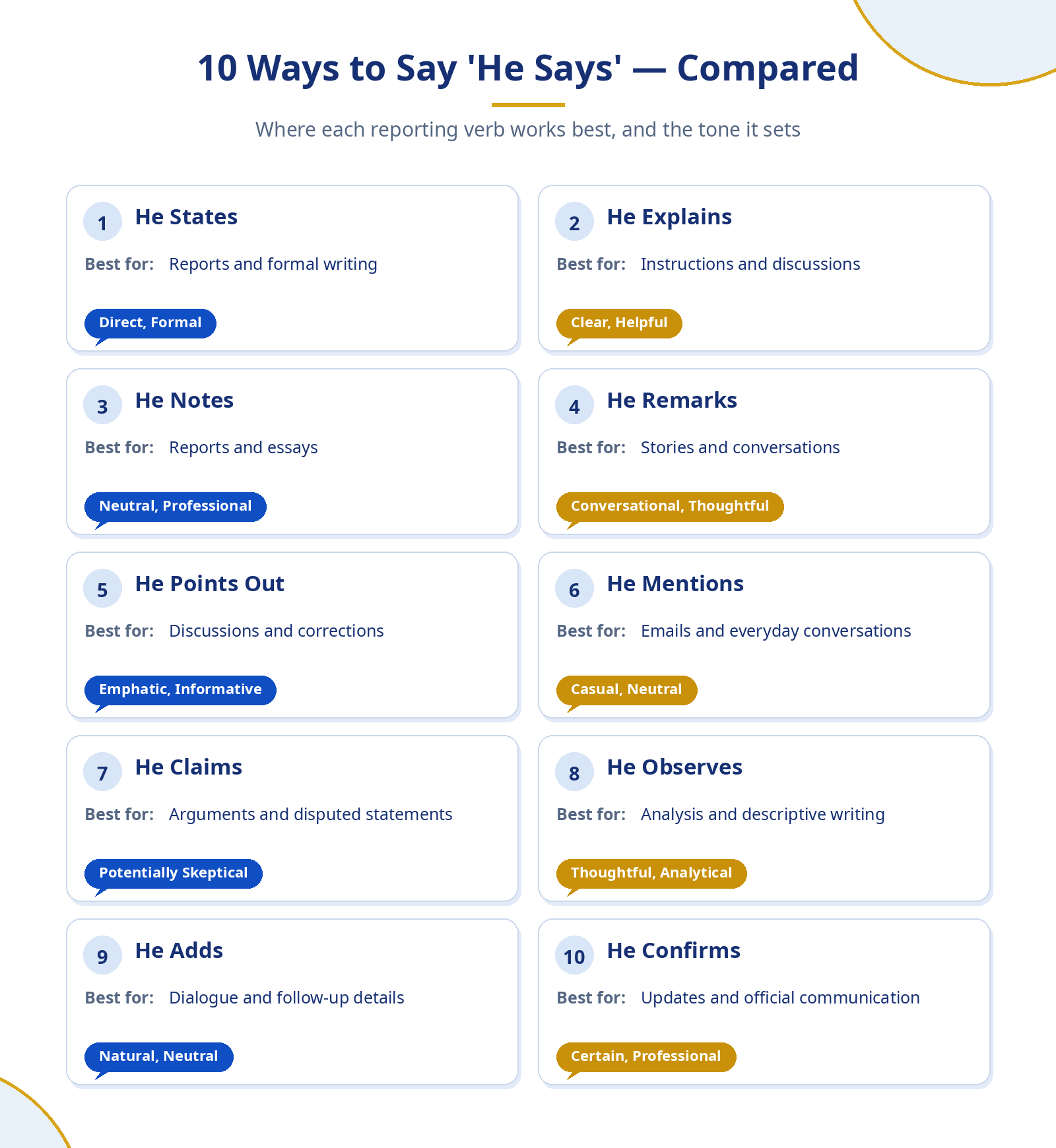
| Alternative | Best Used In | Tone |
| He states | Reports and formal writing | Direct, formal |
| He explains | Instructions and discussions | Clear, helpful |
| He notes | Reports and essays | Neutral, professional |
| He remarks | Stories and conversations | Conversational, thoughtful |
| He points out | Discussions and corrections | Emphatic, informative |
| He mentions | Emails and everyday conversations | Casual, neutral |
| He claims | Arguments and disputed statements | Potentially skeptical |
| He observes | Analysis and descriptive writing | Thoughtful, analytical |
| He adds | Dialogue and follow-up details | Natural, neutral |
| He confirms | Updates and official communication | Certain, professional |
Common Mistakes When Replacing “He Says”
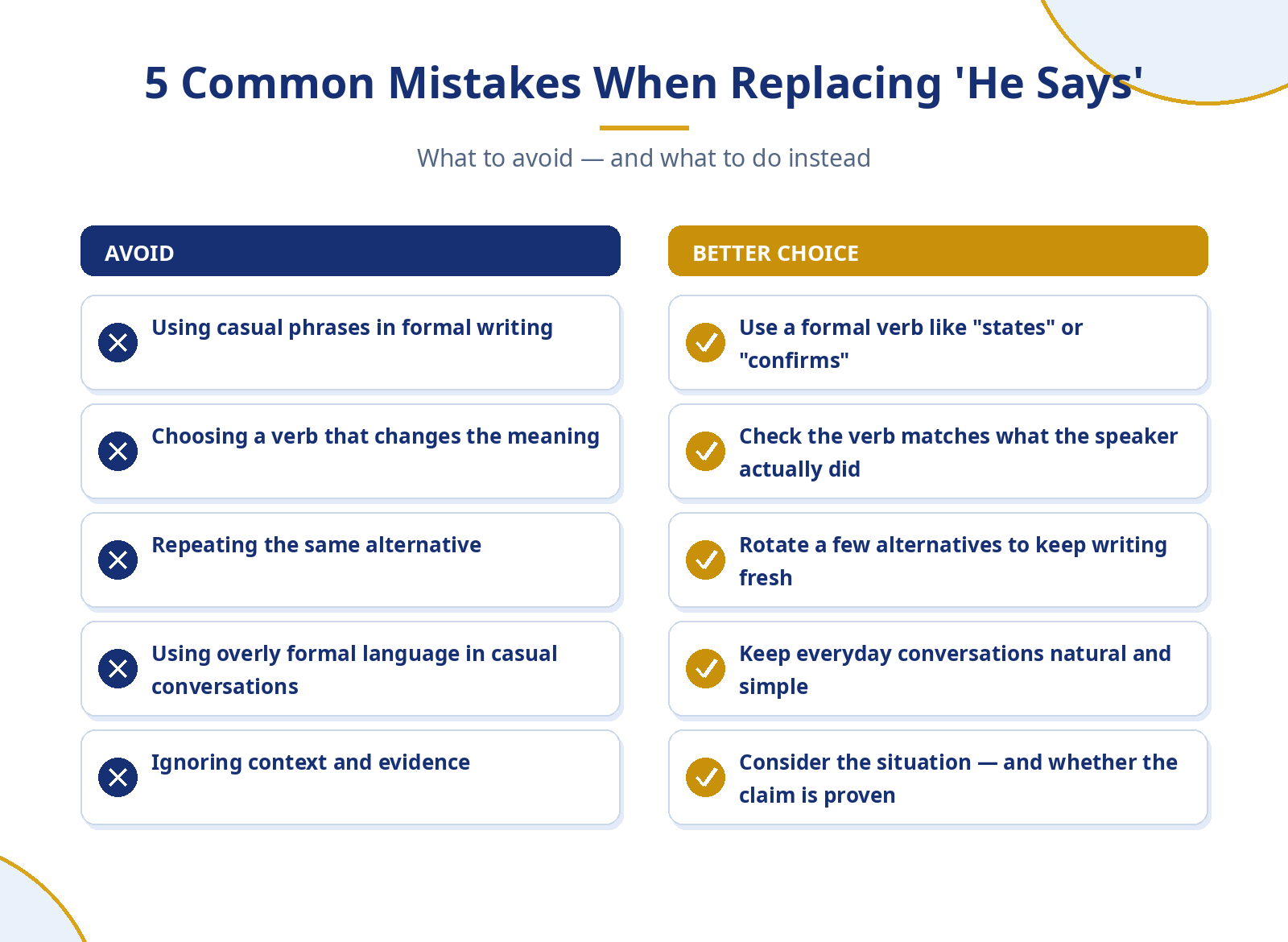
1. Using Casual Phrases in Formal Writing
Some expressions may sound too informal for academic papers or business reports. Choose “he states,” “he explains,” or “he confirms” when the context calls for a professional tone.
2. Choosing a Verb That Changes the Meaning
Not every reporting verb means the same thing. For example, “he claims” can suggest doubt, while “he confirms” suggests verification. Select a verb that accurately represents the speaker’s message.
3. Repeating the Same Alternative
Replacing every instance of “he says” with “he states” does not solve repetition. Vary your reporting verbs according to the purpose of each sentence.
4. Using Overly Formal Language in Casual Conversations
Words such as “states” and “observes” may sound unnatural in an everyday conversation. Simple phrases such as “he mentions” or “he adds” often fit better.
5. Ignoring Context and Evidence
A reporting verb should reflect what actually happened. Do not write “he confirms” unless the information was verified, or “he explains” if the speaker offered no explanation.
Frequently Asked Questions
1. What is the best alternative to “he says”?
“He states” is a strong alternative for formal writing because it communicates information directly. However, “he explains” works better when the speaker clarifies an idea, while “he notes” suits a brief observation. The best choice depends on the meaning, tone, and context of your sentence.
2. How can I avoid repeating “he says” in an essay?
Use reporting verbs that match the purpose of each statement. For example, use “he argues” to present a position, “he explains” to clarify an idea, and “he notes” to highlight a detail. You can also restructure sentences to improve variety without replacing every occurrence.
3. What is a formal way to say “he says”?
“He states” is a common formal alternative. “He asserts” may work when someone expresses a firm position, and “he confirms” is appropriate when someone verifies information. In academic writing, select the verb carefully so that it does not suggest certainty, disagreement, or emphasis that the original statement does not support.
4. What is the difference between “he says” and “he states”?
“He says” is a general expression used in almost any situation. “He states” sounds more formal and often presents information in a direct, organized way. Both can introduce a statement, but “he states” is particularly suitable for reports, official comments, and formal writing.
5. Can I use “he claims” instead of “he says”?
Yes, but only when “he claims” accurately represents the context. The word “claims” can suggest that a statement is disputed or has not been verified. If you simply want to report neutral information, “he says,” “he states,” or “he explains” may be more appropriate.
6. What are casual alternatives to “he says”?
“He mentions,” “he adds,” and “he remarks” can work in casual conversations, depending on the situation. For example, “He mentions that he is running late” sounds natural when sharing a small detail. Choose an expression that fits the relationship between the speakers and the style of the conversation.
7. What reporting verbs can I use in a story?
“He remarks,” “he adds,” “he explains,” and “he points out” can make narrative writing more varied. For emotional dialogue, verbs such as “he whispers,” “he shouts,” or “he mutters” may be appropriate when the scene supports them. These describe how something is said, so they should reflect the character’s actual delivery.
8. Should I always replace “he says” with another phrase?
No. “He says” is clear, natural, and useful in both everyday and professional writing. Replacing it every time can make your sentences sound forced. Use alternatives when they add meaning, improve flow, or clarify the speaker’s intention. Accuracy and readability matter more than using as many synonyms as possible.
Conclusion
Choosing another way to say “he says” can make your writing more natural, precise, and engaging. The key is to select a phrase that reflects what the speaker actually communicates rather than replacing the original words simply for variety.
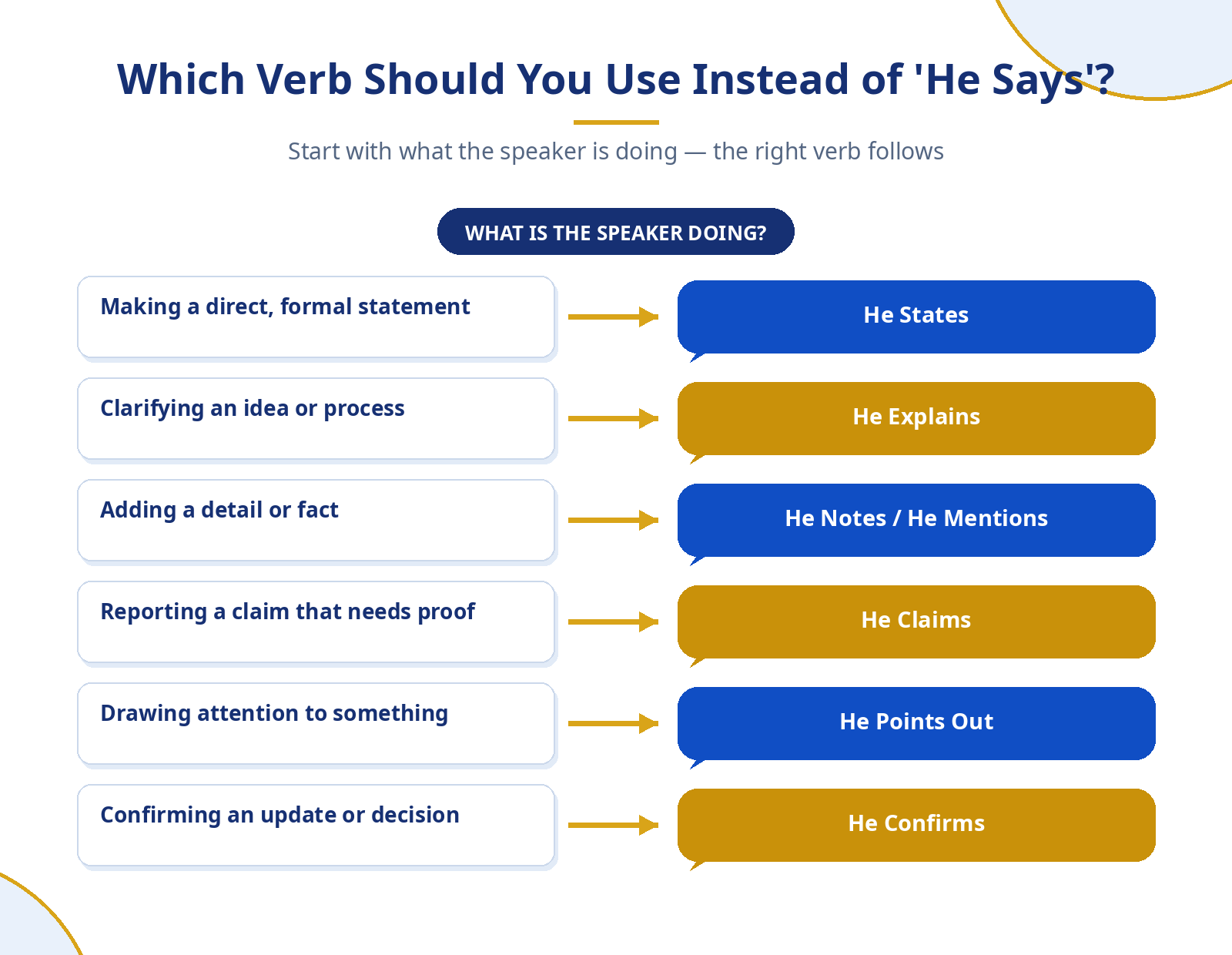
For formal writing, “he states” is a reliable option, while “he explains” works well when the speaker clarifies an idea. Use “he notes” for observations, “he mentions” for brief details, and “he adds” to introduce additional information. When a statement needs verification, “he confirms” may be appropriate. Use “he claims” carefully because it can suggest doubt.
Remember that “he says” is not a weak phrase. It remains useful in almost any context. The best writing balances variety with clarity, ensuring that each reporting verb adds meaning and helps readers understand the message.
Looking for more ways to refresh everyday phrases? Explore our guides to fresher ways to say said and done, or find a better morning greeting.

Editorial Desk
The Titan Standards Editorial Team develops, reviews, and maintains practical English-language resources. The team checks articles for clarity, accuracy, context, readability, and consistency with Titan Standards’ editorial guidelines.