Another way to say “this shows” includes “this indicates,” “this demonstrates,” “this suggests,” “this reveals,” and “this illustrates.”
These phrases help explain evidence, support an argument, or highlight a result. The best alternative depends on your meaning, the strength of your evidence, and whether you are writing an essay, report, email, or everyday message.
Key Takeaways
- Use “this indicates” to explain what evidence points toward.
- Choose “this demonstrates” when evidence clearly establishes a point.
- Use “this suggests” when the evidence supports a possibility rather than a certainty.
- Try “this reveals” to highlight information that was not obvious before.
- Match your phrase to the context, tone, and strength of your evidence.
What Does “This Shows” Mean?
The phrase “this shows” explains what a fact, example, action, or piece of evidence tells us. Writers commonly use it to connect supporting information with a main idea or conclusion.
For example:
- “The survey results show that customers prefer faster service.”
- “Her consistent effort shows her commitment to the project.”
- “The character’s actions show that he values honesty.”
In each sentence, “shows” helps readers understand the meaning of the information that comes before it.
People use this expression in academic essays, business reports, presentations, literary analysis, and everyday conversations. Although it is clear and natural, repeating it too often can make writing sound predictable.
Why Use Other Ways to Say “This Shows”?
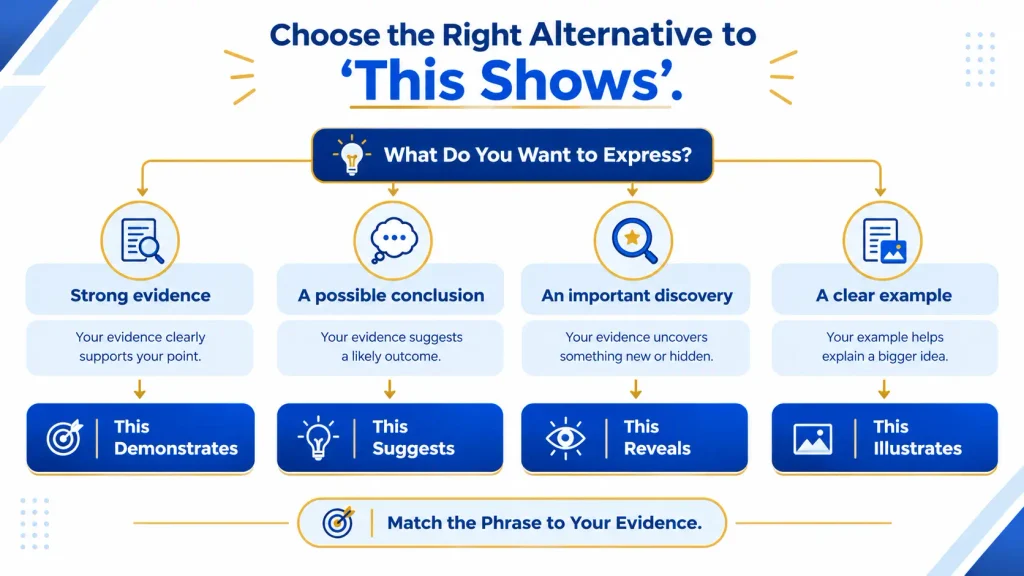
Using different expressions can make your writing more precise and engaging. The right alternative also helps readers understand how strongly your evidence supports your point.
Consider these benefits:
- Avoid repetition: Keep paragraphs from sounding repetitive.
- Improve clarity: Explain exactly what your evidence means.
- Strengthen arguments: Connect facts and conclusions more effectively.
- Adjust your tone: Choose language that fits academic, professional, or casual situations.
- Show careful reasoning: Distinguish between a proven fact and a reasonable interpretation.
The goal is not to replace every instance of “this shows.” Instead, choose a phrase that communicates your intended meaning more accurately.
10 Best Other Ways to Say “This Shows”
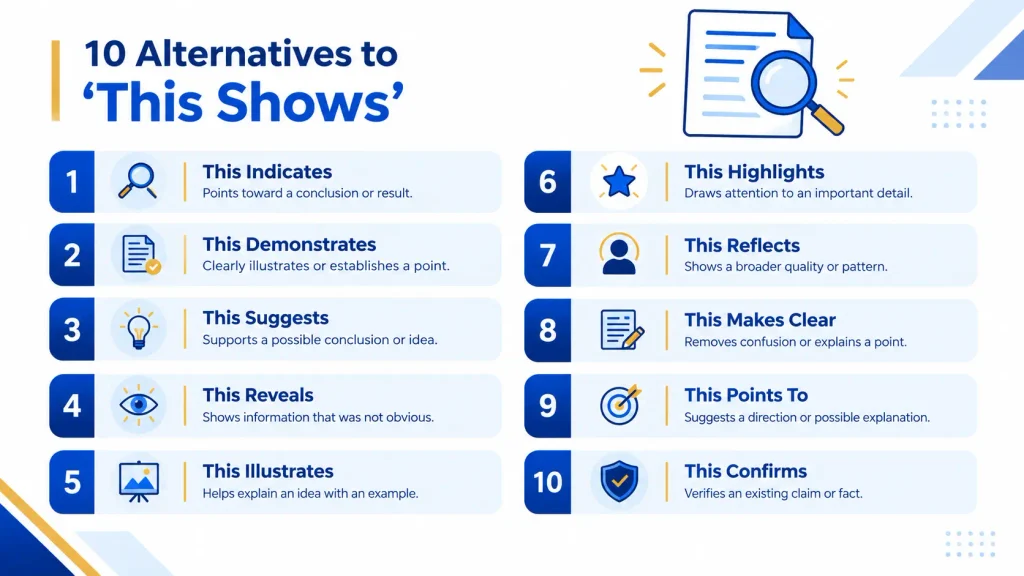
1. This Indicates
Meaning
“This indicates” means that a fact or piece of evidence points toward a particular conclusion. It works well when information supports an interpretation without necessarily proving it beyond doubt.
Best For: Professional, Formal
Example 1: The increase in website traffic indicates that the new marketing campaign is attracting more visitors.
Example 2: Her improved test scores indicate that the additional practice is helping.
Quick Tip: Use “this indicates” when your evidence points toward a conclusion but does not establish it with complete certainty.
2. This Demonstrates
Meaning
“This demonstrates” emphasizes that evidence clearly illustrates or establishes a point. It is particularly useful when discussing results, skills, methods, or arguments supported by strong evidence.
Best For: Professional, Formal
Example 1: The successful trial demonstrates that the updated process can reduce production time.
Example 2: His detailed explanation demonstrates a strong understanding of the subject.
Quick Tip: Choose “this demonstrates” when you can provide clear evidence that supports your claim.
3. This Suggests
Meaning
“This suggests” introduces an interpretation or possibility supported by available information. It is less definite than “this proves” and helps writers avoid making claims that go beyond their evidence.
Best For: Professional, Formal, Polite
Example 1: The survey suggests that employees would benefit from more flexible schedules.
Example 2: The character’s silence suggests that he is hiding something from his friends.
Quick Tip: Use this phrase when your evidence supports a reasonable interpretation but leaves room for other explanations.
4. This Reveals
Meaning
“This reveals” highlights information that becomes apparent through evidence, behavior, or closer examination. It is useful when discussing hidden details, unexpected findings, or a person’s motivations.
Best For: Formal, Professional
Example 1: The customer feedback reveals several problems with the checkout process.
Example 2: Her response reveals how much she values the team’s contribution.
Quick Tip: Use “this reveals” when the information uncovers something important that readers may not have noticed before.
5. This Illustrates
Meaning
“This illustrates” means that an example, situation, or detail helps explain a broader idea. It is especially effective when connecting a specific example to a general principle.
Best For: Formal, Professional, Friendly
Example 1: The case study illustrates how small businesses can benefit from customer feedback.
Example 2: This classroom activity illustrates the importance of teamwork.
Quick Tip: Choose “this illustrates” when you want an example to make an idea easier to understand.
6. This Highlights
Meaning
“This highlights” draws attention to a particular fact, issue, or feature. It works well when you want readers to focus on an important detail rather than simply understand a general conclusion.
Best For: Professional, Formal
Example 1: The final report highlights the need for better communication between departments.
Example 2: Her presentation highlights the benefits of investing in employee training.
Quick Tip: Use this expression to emphasize an important point that deserves attention.
7. This Reflects
Meaning
“This reflects” suggests that a fact, action, or result represents a broader condition, attitude, or pattern. It is common in professional reports, personal observations, and discussions about behavior.
Best For: Professional, Formal, Warm
Example 1: The team’s strong performance reflects months of careful preparation.
Example 2: His willingness to help reflects his commitment to the community.
Quick Tip: Use “this reflects” when connecting an observable result with a broader quality, attitude, or situation.
8. This Makes Clear
Meaning
“This makes clear” emphasizes that information removes confusion or helps readers understand a point. It works well when explaining a conclusion supported by straightforward evidence.
Best For: Professional, Formal, Polite
Example 1: The revised schedule makes clear which tasks must be completed before Friday.
Example 2: Her explanation makes clear why the original plan needed to change.
Quick Tip: Choose this phrase when you want to emphasize clarity rather than simply introduce another piece of evidence.
9. This Points To
Meaning
“This points to” means that available facts suggest a possible explanation, result, or direction. It is useful when identifying patterns or discussing findings that may need further investigation.
Best For: Professional, Formal, Casual
Example 1: The repeated delivery delays point to a problem with the current shipping process.
Example 2: These early results point to a possible improvement in customer satisfaction.
Quick Tip: Use “this points to” when evidence suggests a conclusion but further confirmation may be necessary.
10. This Confirms
Meaning
“This confirms” means that new information supports or verifies something already suspected, reported, or established. It communicates a stronger level of certainty than “this suggests,” so use it only when the evidence justifies that confidence.
Best For: Professional, Formal
Example 1: The final inspection confirms that the equipment meets the required safety standards.
Example 2: The latest figures confirm that sales increased during the second quarter.
Quick Tip: Reserve “this confirms” for evidence that verifies an existing claim rather than merely suggesting that it might be true.
Comparison Table
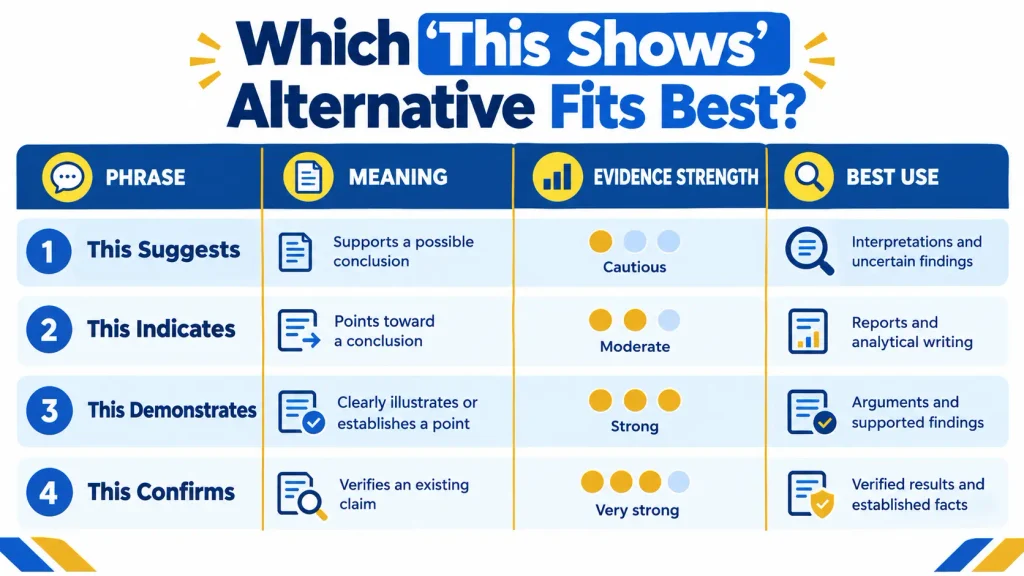
| Alternative | Best Used In | Tone |
| This indicates | Reports, essays, analysis | Neutral, professional |
| This demonstrates | Research, arguments, presentations | Confident, formal |
| This suggests | Essays, interpretations, reports | Cautious, analytical |
| This reveals | Literary analysis, findings | Insightful, formal |
| This illustrates | Explanations, examples, teaching | Clear, informative |
| This highlights | Reports, presentations | Emphatic, professional |
| This reflects | Performance reviews, observations | Thoughtful, professional |
| This makes clear | Instructions, explanations | Direct, confident |
| This points to | Investigations, trend analysis | Analytical, cautious |
| This confirms | Verified findings, final reports | Certain, authoritative |
Common Mistakes When Using Alternatives to “This Shows”
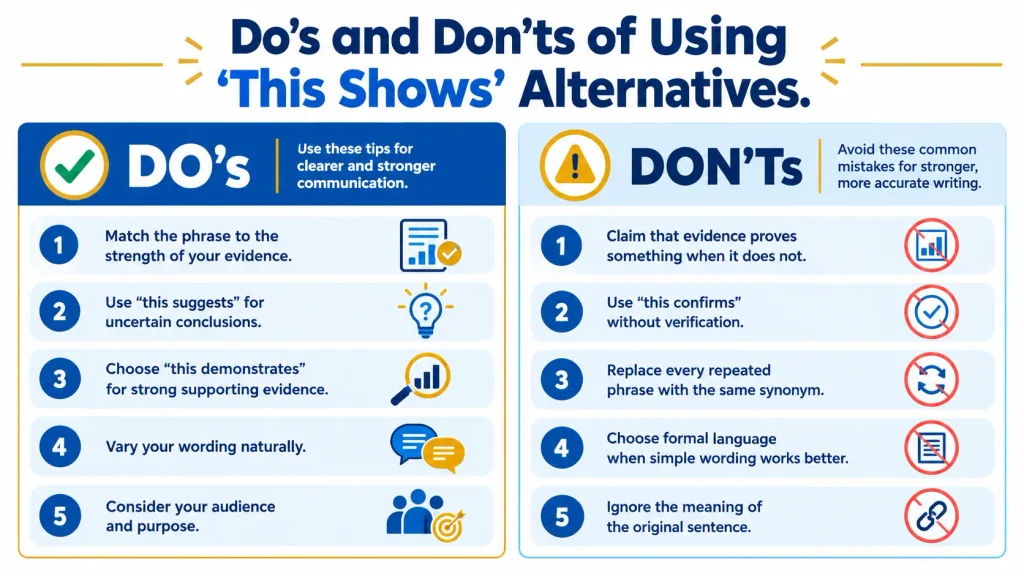
Choosing a synonym without considering its meaning can weaken your writing. Avoid these five common mistakes.
1. Using “This Confirms” Without Enough Evidence
“Confirms” implies verification. If your information only suggests a possibility, use “this suggests” or “this indicates” instead.
2. Choosing Overly Formal Language
Not every sentence needs a sophisticated expression. In a casual conversation, “this means” or “this tells us” may sound more natural than a formal alternative.
3. Repeating the Same Alternative
Replacing every instance of “this shows” with “this demonstrates” does not solve the repetition problem. Vary your wording when appropriate, but prioritize clarity over variety.
4. Ignoring the Context
A phrase that works in a scientific report may not fit a personal message. Consider your audience, purpose, and subject before choosing an alternative.
5. Making Claims Stronger Than the Evidence
“This proves” and “this confirms” communicate more certainty than “this suggests.” Do not use strong wording simply to make an argument sound convincing.
Frequently Asked Questions
1. What is the best alternative to “this shows”?
“This indicates” is a versatile alternative for explaining what evidence suggests. However, “this demonstrates” may be better when evidence clearly establishes a point, while “this suggests” is more appropriate for a possible interpretation. Choose the expression that matches the strength of your evidence.
2. How can I say “this shows” in an academic essay?
You can use “this indicates,” “this demonstrates,” “this suggests,” or “this illustrates” in an academic essay. Each phrase serves a slightly different purpose. Use “this illustrates” to connect an example to a broader idea and “this suggests” when discussing a conclusion that is not certain.
3. What is a formal way to say “this shows”?
Formal alternatives include “this demonstrates,” “this indicates,” “this reveals,” and “this highlights.” These phrases are useful in research papers, professional reports, and presentations. The best choice depends on whether you want to explain evidence, emphasize a finding, or draw attention to an important issue.
4. What can I use instead of “this shows” in an essay?
For essays, consider “this illustrates,” “this suggests,” “this indicates,” and “this demonstrates.” These expressions help you connect examples, quotations, and research findings to your main argument. Avoid choosing a phrase only for variety; make sure it accurately explains how your evidence supports your point.
5. Is “this indicates” the same as “this demonstrates”?
Not exactly. “This indicates” means that evidence points toward a conclusion, while “this demonstrates” suggests that the evidence clearly establishes or illustrates a point. For example, early sales figures may indicate a promising trend, whereas verified results may demonstrate that a strategy worked.
6. Can I use “this proves” instead of “this shows”?
Yes, but only when your evidence justifies a strong claim. “This proves” communicates a higher level of certainty than the more general expression “this shows.” In academic and professional writing, “this suggests” or “this indicates” may be more accurate when the available information supports a conclusion without establishing it conclusively.
7. How do I avoid repeating “this shows” in a paragraph?
Identify what each piece of evidence contributes to your argument. Then choose a phrase that describes that role, such as “this highlights” for an important issue or “this reveals” for a new insight. You can also explain the evidence directly without introducing every sentence with the same phrase.
8. What is a simple, everyday alternative to “this shows”?
“This means,” “this tells us,” and “this makes it clear” are natural alternatives for everyday communication. For example, instead of saying, “This shows that we need more time,” you could say, “This means we need more time.” These options keep your message simple and easy to understand.
For related wording choices, see another way to say “shows”, another way to say “like” and another way to say “more”.
Conclusion
Choosing another way to say “this shows” can make your writing clearer, more precise, and less repetitive. Expressions such as “this indicates,” “this demonstrates,” and “this suggests” work well when explaining evidence, while “this reveals,” “this highlights,” and “this illustrates” help emphasize important details or explain broader ideas.
The key is to consider what your evidence actually supports. Use “this demonstrates” when the evidence clearly establishes a point, “this suggests” when a conclusion remains uncertain, and “this confirms” when information verifies an existing claim. For everyday communication, simpler expressions such as “this means” may be more natural.
Before choosing an alternative, consider your audience, purpose, and intended level of certainty. The best phrase is not the most complicated one; it is the one that expresses your meaning accurately.

Editorial Desk
The Titan Standards Editorial Team develops, reviews, and maintains practical English-language resources. The team checks articles for clarity, accuracy, context, readability, and consistency with Titan Standards’ editorial guidelines.