Another way to say “by” depends on the sentence. You can use “through” or “via” to describe a method, “before” or “no later than” for a deadline, and “next to” for location.
The best alternative preserves the original meaning and fits the context, tone, and purpose of your sentence.
Key Takeaways
- “By” has several meanings, so the best alternative depends on context.
- Use “through,” “via,” or “using” to describe methods and communication channels.
- Choose “before” or “no later than” when talking about deadlines.
- Use “next to” or “beside” to describe physical location.
- Always check the sentence to make sure your replacement keeps the original meaning.
What Does “Another Way to Say By” Mean?
Looking for another way to say “by” means finding a word or phrase that communicates the same idea in a particular sentence. Because “by” has several meanings, its replacement must match the intended context.
For example, “Send the report by email” can become “Send the report via email.” However, “Finish the report by Friday” has a different meaning and may be rewritten as “Finish the report no later than Friday.”
People look for alternatives to avoid repetition, improve clarity, and choose language that fits everyday conversations, academic assignments, and professional writing.
Why Use Other Ways to Say “By”?
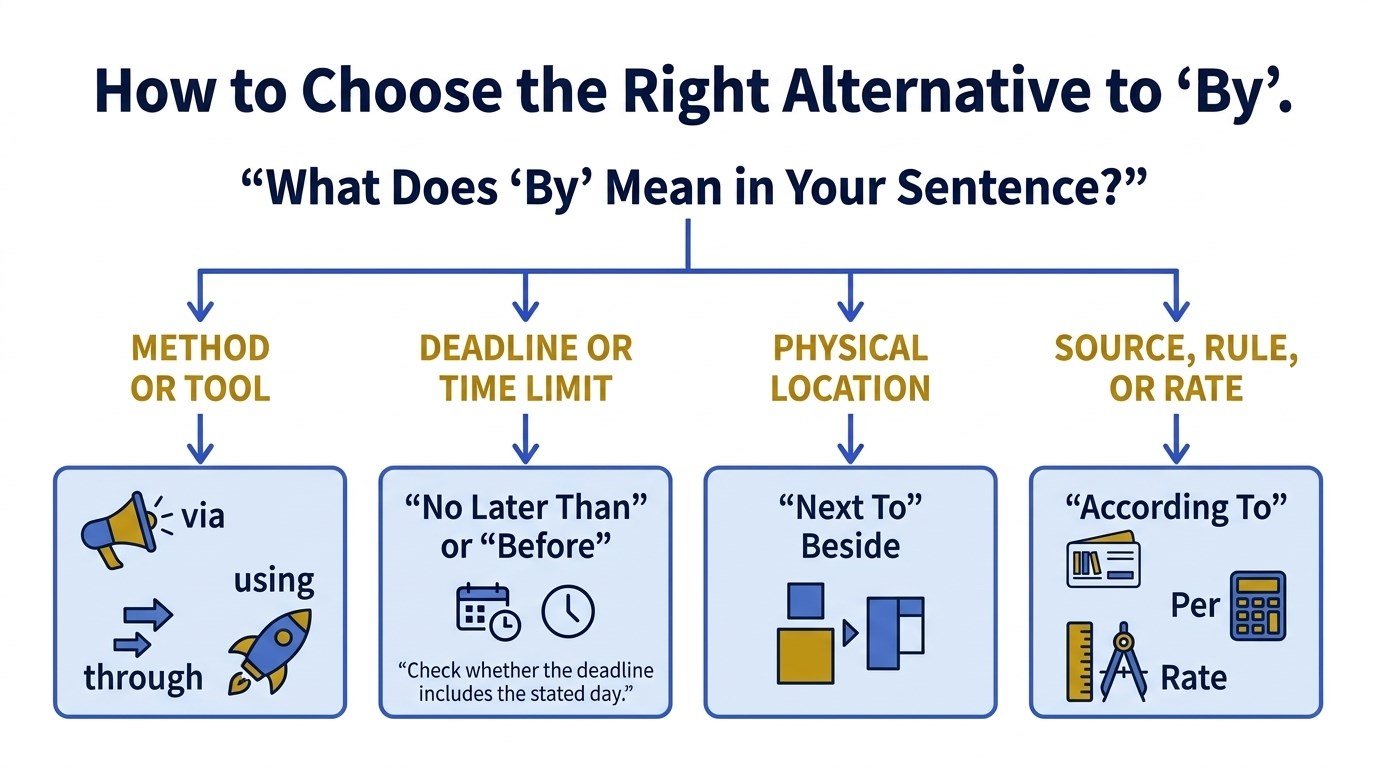
Although “by” is common and grammatically correct, repeating it too often can make writing feel less precise. Choosing a suitable alternative helps readers understand exactly what you mean.
Here are a few reasons to consider another phrase:
- Avoid repetition: Vary your wording when several sentences use “by” in the same way.
- Improve clarity: Explain a method, deadline, or location more precisely.
- Sound more professional: Use expressions that fit business emails and reports.
- Make instructions easier to follow: State deadlines and procedures directly.
- Improve natural flow: Choose wording that fits the sentence instead of forcing a synonym.
10 Best Other Ways to Say “By”
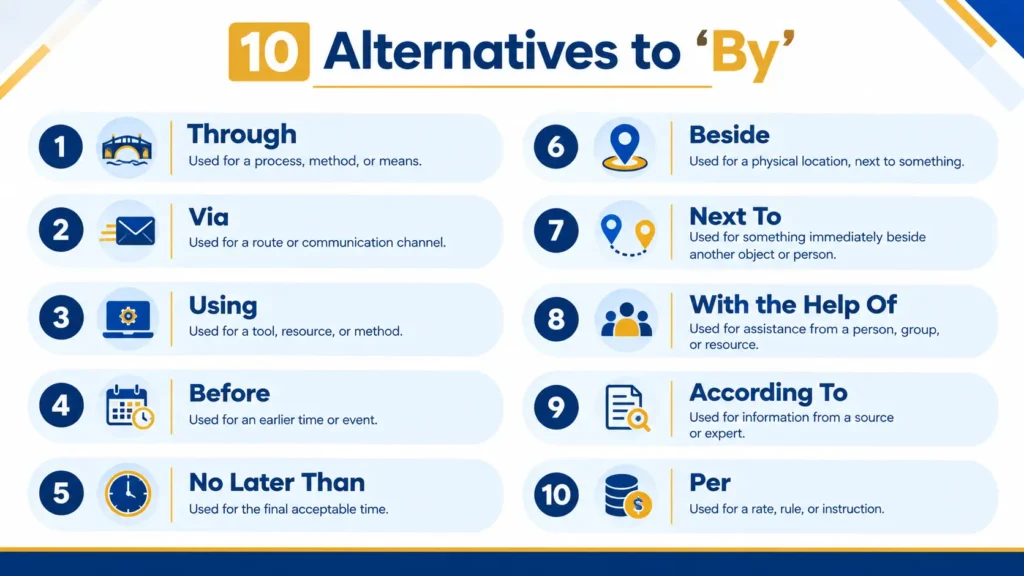
1. Through
Meaning
“Through” often describes the method, process, or means used to achieve something. It can also refer to movement from one side of something to another. It works well when you want to emphasize the process behind a result.
Best For: Professional, Formal, Casual
Example 1: She found a new job through a former colleague.
Example 2: We resolved the issue through careful planning.
Quick Tip: Use “through” when you want to emphasize a process, relationship, or means of achieving a result.
2. Via
Meaning
“Via” means by way of or using a particular route or channel. It is common in business communication, travel instructions, and digital messages. It often sounds concise and professional.
Best For: Professional, Formal
Example 1: Please send your application via the online portal.
Example 2: The package reached us via Chicago.
Quick Tip: Use “via” for communication channels, delivery routes, and concise professional writing.
3. Using
Meaning
“Using” explains the tool, resource, or method someone employs to complete an action. It is especially useful when you want to make a sentence direct and easy to understand.
Best For: Professional, Casual, Friendly
Example 1: He created the presentation using free design software.
Example 2: You can calculate the total using a spreadsheet.
Quick Tip: Choose “using” when you can name the specific tool or resource involved.
4. Before
Meaning
“Before” can replace “by” when you mean that something should happen earlier than a particular time or event. However, the two words do not always have identical meanings. “By Friday” normally includes Friday as the deadline, while “before Friday” usually means earlier than Friday.
Best For: Professional, Formal, Casual
Example 1: Please submit your application before the office closes.
Example 2: We need to leave before the meeting begins.
Quick Tip: Check the deadline carefully because “before” may set an earlier limit than “by.”
5. No Later Than
Meaning
“No later than” clearly states the latest acceptable time for completing an action. It is useful when instructions, appointments, or deadlines need to be understood without confusion.
Best For: Professional, Formal, Polite
Example 1: All registration forms must arrive no later than September 15.
Example 2: Please confirm your attendance no later than noon tomorrow.
Quick Tip: Use this phrase when you want to make a deadline explicit, especially in formal instructions.
6. Beside
Meaning
“Beside” means at the side of something or someone. It can replace “by” when “by” describes a physical location, such as an object placed near another object.
Best For: Casual, Friendly, Formal
Example 1: A small table stood beside the living room window.
Example 2: Please leave your shoes beside the front door.
Quick Tip: Use “beside” for physical placement, not to describe a method or deadline.
7. Next To
Meaning
“Next to” describes something positioned immediately beside another person or object. It is a natural choice in everyday American English and is often more conversational than “adjacent to.”
Best For: Casual, Friendly
Example 1: I saved a seat for you next to the aisle.
Example 2: The pharmacy is next to the grocery store.
Quick Tip: Choose “next to” when giving simple directions or describing nearby objects and places.
8. With the Help of
Meaning
“With the help of” emphasizes assistance from a person, group, or resource. It can replace “by” when the original sentence describes how someone completed a task with support.
Best For: Friendly, Warm, Professional
Example 1: She completed the research with the help of her classmates.
Example 2: We organized the fundraiser with the help of local volunteers.
Quick Tip: Use this phrase when you want to acknowledge support instead of suggesting that someone worked entirely alone.
9. According to
Meaning
“According to” identifies the source of information, an opinion, or a statement. It can sometimes replace “by” in sentences that refer to a report, expert, or published source, but the sentence may need restructuring.
Best For: Professional, Formal
Example 1: According to the latest report, customer satisfaction has improved.
Example 2: According to our instructor, the final project is due next week.
Quick Tip: Use “according to” to attribute information to a source, not to describe every action performed by someone.
10. Per
Meaning
“Per” means for each or in accordance with a stated rule or instruction. It appears frequently in business writing, rates, measurements, and formal directions. It can replace “by” in certain expressions, but it does not work as a universal substitute.
Best For: Professional, Formal
Example 1: The service costs $25 per person.
Example 2: Per company policy, all receipts must be submitted within 30 days.
Quick Tip: Use “per” for rates, quantities, and established rules. Avoid it when a simpler phrase would sound more natural.
Comparison Table
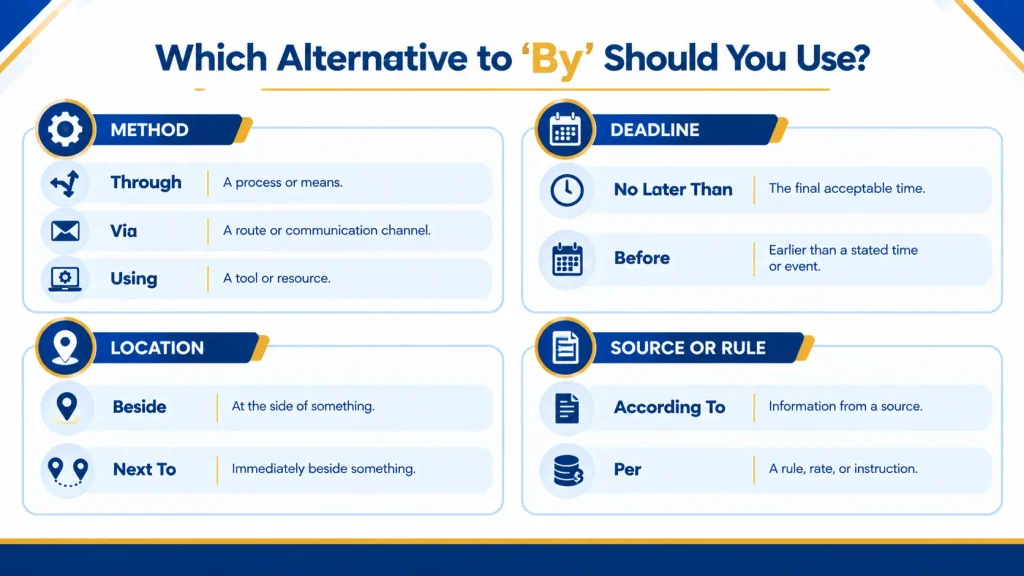
| Alternative | Best Used In | Tone |
| Through | Processes and methods | Neutral |
| Via | Routes and communication | Professional |
| Using | Tools and resources | Clear, conversational |
| Before | Earlier times or events | Neutral |
| No later than | Deadlines | Formal, precise |
| Beside | Physical location | Neutral |
| Next to | Nearby places or objects | Casual |
| With the help of | Assistance and teamwork | Warm, collaborative |
| According to | Sources and information | Formal |
| Per | Rates, rules, and instructions | Businesslike |
Common Mistakes When Replacing “By”
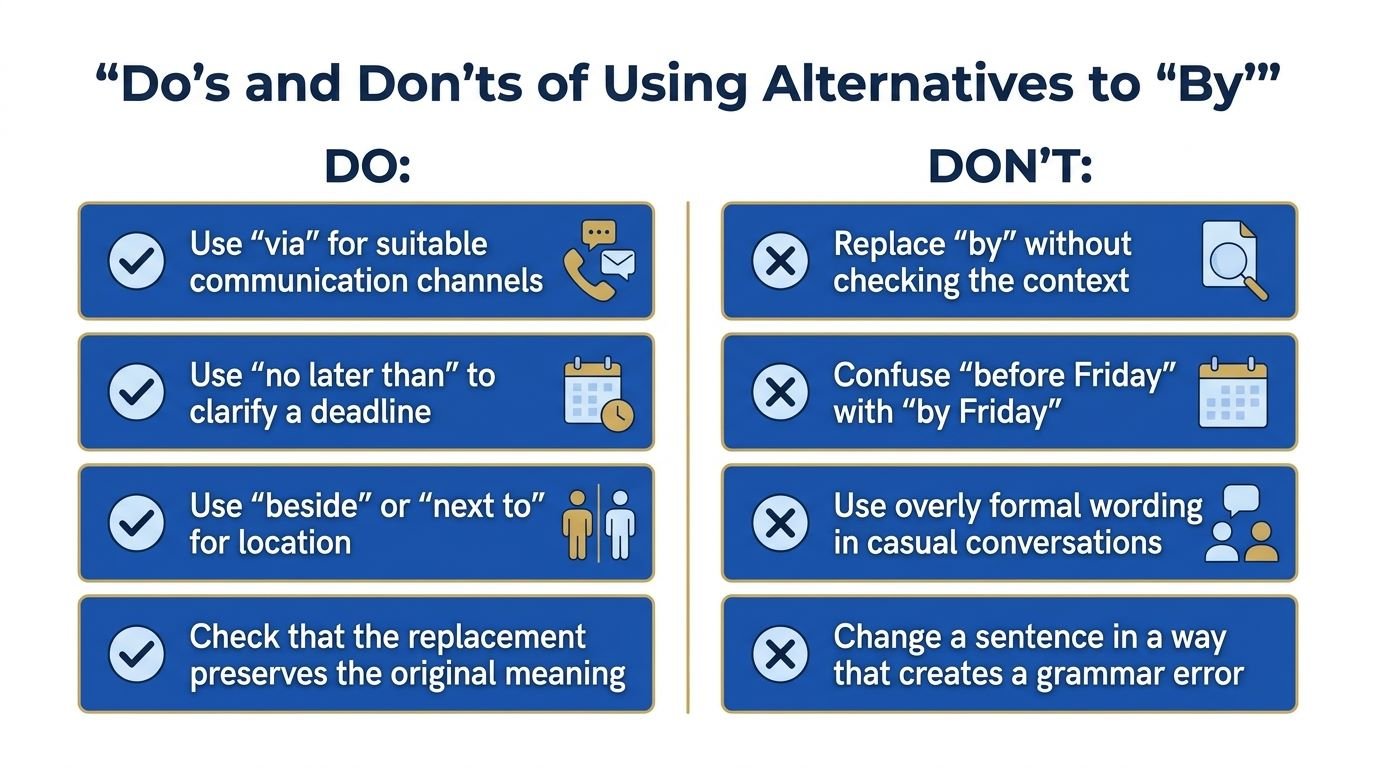
1. Treating every alternative as interchangeable
“By Friday” and “before Friday” can communicate different deadlines. Always check whether the replacement preserves the original meaning.
2. Using overly formal language
“Via” and “per” work in certain professional contexts, but they can sound stiff in casual conversation. Choose the phrase that suits your audience.
3. Confusing location with method
“Beside” and “next to” describe location, while “through” and “using” can describe methods. Replacing one meaning with another creates confusing sentences.
4. Making a sentence unnecessarily long
“With the help of” can be useful, but it may add extra words when a shorter expression works just as well. Prefer clear, direct wording.
5. Ignoring the grammar of the sentence
A replacement may require a different sentence structure. For example, “The novel was written by Maya” can become “Maya wrote the novel.” Sometimes rewriting the sentence is better than swapping one word.
Frequently Asked Questions
1. What is another word for “by”?
There is no single word that replaces “by” in every sentence. Depending on the meaning, you might use “through,” “via,” “using,” “beside,” or “before.” For deadlines, “no later than” may be more precise. Identify what “by” means in your sentence before selecting a replacement.
2. What is a more professional way to say “by”?
Professional alternatives include “via,” “through,” “no later than,” and “according to.” The best choice depends on the message. For example, “Submit the documents by email” can become “Submit the documents via email,” while “Send them by Monday” can become “Send them no later than Monday.”
3. How can I replace “by” in formal writing?
Start by identifying its function. Use “via” for a communication channel, “no later than” for a deadline, and “according to” when citing a source. In some sentences, changing the sentence structure produces a clearer result than replacing the preposition directly.
4. What can I say instead of “by” when talking about deadlines?
You can use “no later than” to state a clear final deadline. For example, “Finish the assignment by Tuesday” becomes “Finish the assignment no later than Tuesday.” You can also use “before,” but remember that it may indicate an earlier deadline than the original wording.
5. What is another way to say “by email”?
“Via email” and “through email” are possible alternatives, although “via email” is especially concise in professional writing. You can also say “using email” when emphasizing the method. For a natural business message, “Please send the document via email” is a clear option.
6. What can I use instead of “by” to describe location?
Use “beside” or “next to” when you mean that someone or something is positioned near another object. For example, “The chair is by the window” can become “The chair is beside the window.” “Next to” is particularly common in everyday American English.
7. Is “through” always a synonym for “by”?
No. “Through” can describe a method or process, but it cannot replace “by” in every context. For instance, “We solved it through teamwork” works naturally, while “The report was written through Sarah” does not communicate the intended meaning. Choose alternatives based on the role the original word plays.
8. How do I choose the right alternative to “by”?
Ask what you want to communicate. Are you describing a deadline, a method, a source, or a location? Then choose a phrase that expresses that meaning clearly. Read the revised sentence aloud to check whether it sounds natural, remains grammatically correct, and preserves your original message.
You may also find these guides useful: another way to say “during”, another way to say “even though” and another way to say “example”.
Conclusion
Choosing another way to say “by” starts with understanding the sentence. The word can describe a deadline, method, location, source, or person responsible for an action, so a suitable replacement must preserve that meaning.
Use “through” or “using” to explain a method, “via” for a communication channel, and “no later than” to make deadlines clear. When describing a location, “beside” and “next to” often sound natural. For sources and instructions, “according to” and “per” may fit better.
You do not need to replace “by” every time you use it. It is a common, correct, and useful English word. Instead, choose an alternative when it improves clarity, reduces repetition, or better matches your audience. The best word is the one that makes your meaning clear without changing what you want to say.

Editorial Desk
The Titan Standards Editorial Team develops, reviews, and maintains practical English-language resources. The team checks articles for clarity, accuracy, context, readability, and consistency with Titan Standards’ editorial guidelines.