Featured Snippet:
Looking for another way to say even though? Common alternatives include although, though, despite the fact that, in spite of the fact that, while, and notwithstanding the fact that. The best choice depends on your sentence, tone, and whether you want a casual, formal, or professional expression.
Key Takeaways
- Although is the closest common alternative to even though.
- Though sounds natural and conversational in everyday English.
- Despite and in spite of must normally be followed by a noun, pronoun, or gerund.
- While can show contrast, but its meaning depends on context.
- Formal phrases such as notwithstanding the fact that work better in formal writing than casual conversation.
What Does “Another Way to Say Even Though” Mean?
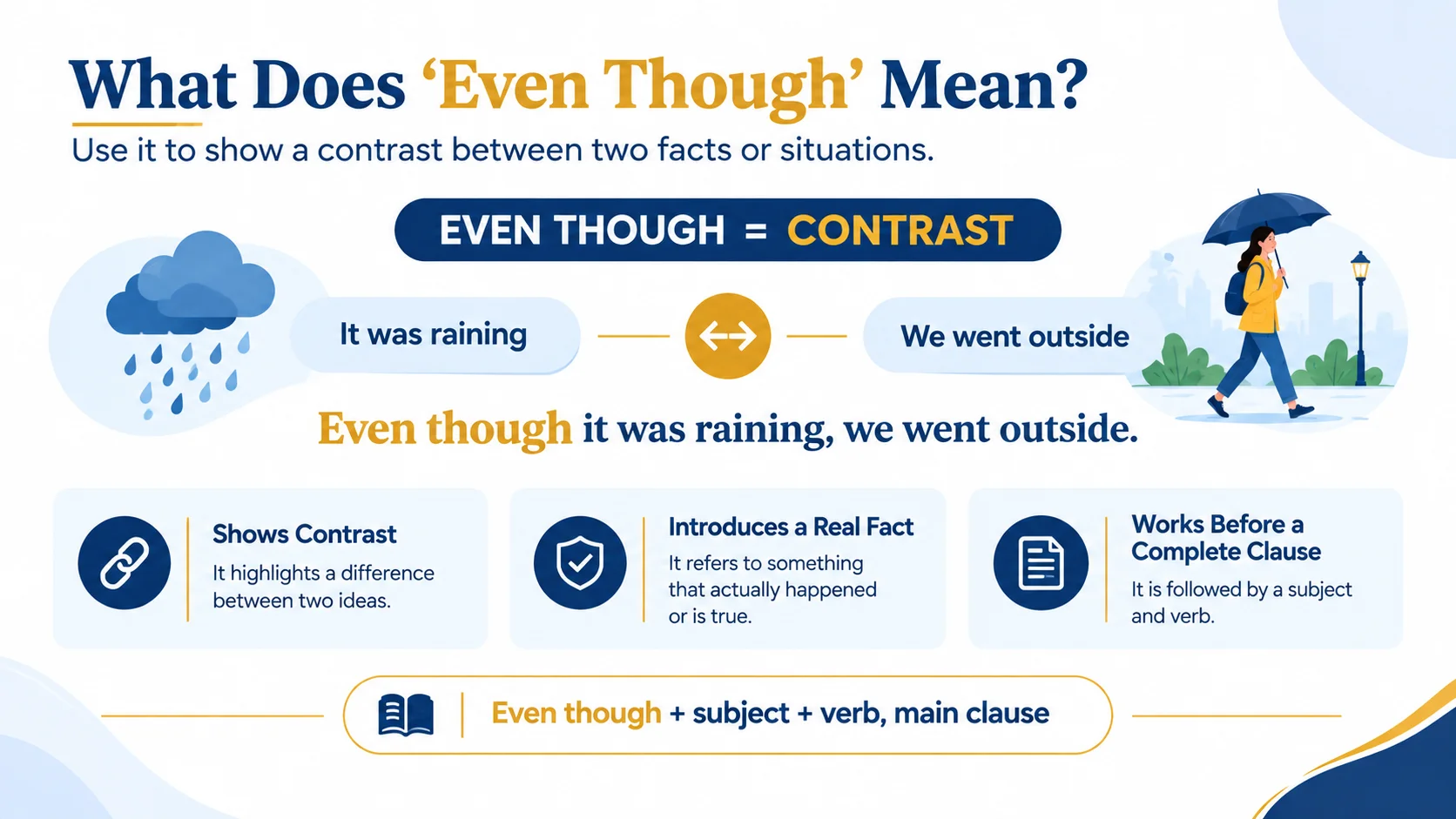
The phrase “another way to say even though” refers to different words or expressions that show contrast between two facts or situations.
Even though introduces something that might seem surprising compared with the main statement. For example: “Even though it was raining, we went for a walk.” The rain created an expected reason to stay inside, but the person went out anyway.
People look for alternatives to even though to avoid repetition, improve sentence flow, or match a specific tone. These alternatives are useful in everyday conversations, school writing, emails, essays, reports, and professional communication.
Why Use Other Ways to Say “Even Though”?
Using different contrast expressions can make your English more natural and precise. The right alternative can also help you adjust the tone of a sentence.
You may want another way to say even though to:
- Avoid repeating the same expression.
- Make your writing sound smoother.
- Choose a more formal or professional tone.
- Keep casual conversations natural.
- Make the relationship between two ideas clearer.
- Adapt your wording to essays, emails, or reports.
10 Best Other Ways to Say “Even Though”
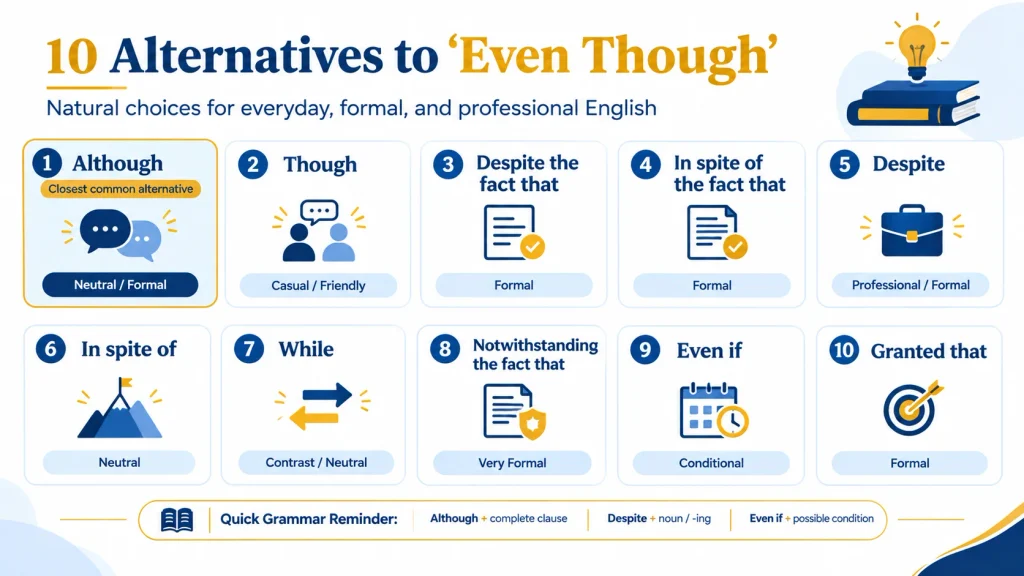
1. Although
Meaning:
Although is one of the closest alternatives to even though. It introduces a fact that contrasts with the main idea and works well in both everyday and professional English.
Best For:
- Professional
- Formal
- Polite
Example 1:
Although the project was difficult, the team completed it on time.
Example 2:
Although Sarah was tired, she stayed to help clean the office.
Quick Tip:
Use although when you want a clear, polished alternative that fits almost any type of writing.
2. Though
Meaning:
Though has almost the same meaning as although, but it often sounds more conversational. It is especially common in everyday speech and informal writing.
Best For:
- Casual
- Friendly
- Everyday English
Example 1:
Though I was nervous, I decided to give the presentation.
Example 2:
Though the restaurant was crowded, we found a table quickly.
Quick Tip:
Choose though when you want your sentence to sound relaxed and natural.
3. Despite the Fact That
Meaning:
Despite the fact that introduces a complete clause and highlights a strong contrast. It is more formal and often appears in academic, professional, or carefully written English.
Best For:
- Formal
- Professional
Example 1:
Despite the fact that sales were lower, the company continued its expansion.
Example 2:
Despite the fact that he had little experience, he performed well during the interview.
Quick Tip:
Use this phrase when you need despite but the next part of your sentence contains a subject and verb.
4. In Spite of the Fact That
Meaning:
In spite of the fact that has the same basic meaning as despite the fact that. It emphasizes that something happened despite an opposing circumstance.
Best For:
- Formal
- Professional
- Polite
Example 1:
In spite of the fact that the deadline was short, we finished the report.
Example 2:
In spite of the fact that the weather was poor, the event continued as planned.
Quick Tip:
Remember that in spite of is always written as three words.
5. Despite
Meaning:
Despite expresses contrast, but it is structured differently from even though. It is normally followed by a noun, pronoun, or verb ending in -ing, rather than a complete clause.
Best For:
- Professional
- Formal
- Polite
Example 1:
Despite the heavy traffic, we arrived before the meeting started.
Example 2:
Despite feeling exhausted, Maria finished her assignment.
Quick Tip:
Do not write “despite it was raining.” Instead, write “despite the rain” or use despite the fact that it was raining.
6. In Spite Of
Meaning:
In spite of has the same meaning and grammatical pattern as despite. It shows that an action or result happened despite an obstacle or unexpected condition.
Best For:
- Casual
- Friendly
- Professional
Example 1:
In spite of the long line, we waited for our turn.
Example 2:
In spite of being busy, James called his parents that evening.
Quick Tip:
Use in spite of before a noun or -ing form, not directly before a complete clause.
7. While
Meaning:
While can introduce a contrasting idea when it means “although” or “whereas.” It is useful when comparing two different facts, opinions, or situations.
Best For:
- Professional
- Formal
- Casual
Example 1:
While the apartment is small, its location is excellent.
Example 2:
While I understand your concern, I think we should consider another option.
Quick Tip:
Use while carefully because it can also refer to time. Context determines whether it means contrast or “during the time that.”
8. Notwithstanding the Fact That
Meaning:
Notwithstanding the fact that is a highly formal way to express contrast. It is more common in legal, official, or formal written contexts than in everyday conversation.
Best For:
- Formal
- Professional
Example 1:
Notwithstanding the fact that costs increased, the organization approved the proposal.
Example 2:
Notwithstanding the fact that demand was low, the store kept the product available.
Quick Tip:
Avoid this phrase in casual conversation because it can sound unnecessarily formal.
9. Even If
Meaning:
Even if is related to even though, but the two expressions are not interchangeable in every situation. Even if usually describes a condition that may or may not happen, while even though introduces a fact that is already true.
Best For:
- Casual
- Friendly
- Professional
Example 1:
Even if the weather gets worse, the team will continue practicing.
Example 2:
I will attend the meeting even if my schedule becomes busy.
Quick Tip:
Use even if for a possible or hypothetical condition, not simply for a known fact.
10. Granted That
Meaning:
Granted that acknowledges one fact before presenting a contrasting point. It is useful when you want to admit something is true while moving toward a different conclusion.
Best For:
- Formal
- Professional
Example 1:
Granted that the plan has some risks, it could still save the company money.
Example 2:
Granted that the course is challenging, the skills you gain are valuable.
Quick Tip:
Use granted that when you want to concede one point before making another point.
Comparison Table
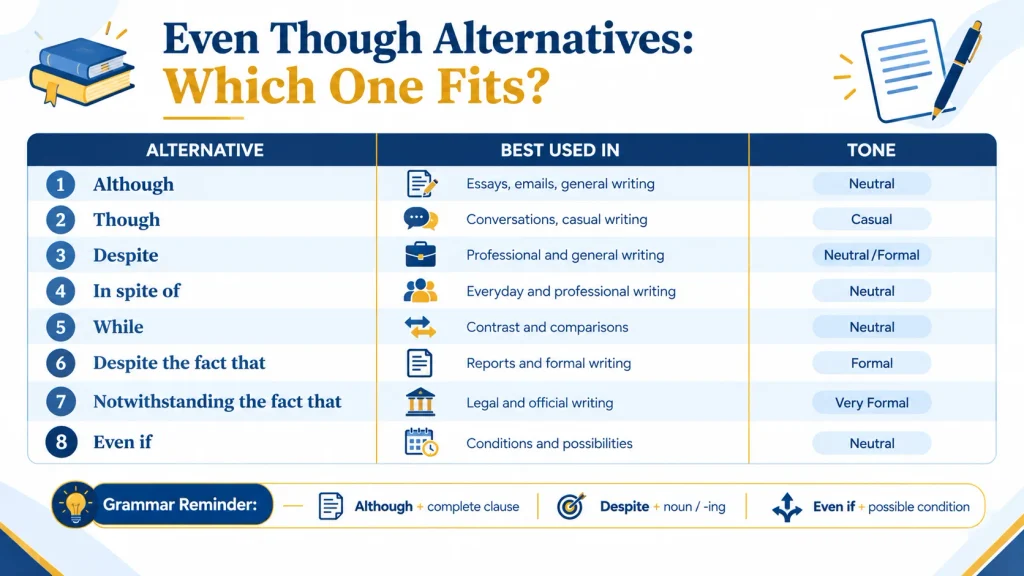
| Alternative | Best Used In | Tone |
| Although | Essays, emails, general writing | Neutral |
| Though | Conversations, casual writing | Casual |
| Despite the fact that | Formal writing, reports | Formal |
| In spite of the fact that | Formal writing | Formal |
| Despite | Professional and general writing | Neutral/Formal |
| In spite of | Everyday and professional writing | Neutral |
| While | Comparisons and contrast | Neutral |
| Notwithstanding the fact that | Legal and official writing | Very Formal |
| Even if | Conditions and possibilities | Neutral |
| Granted that | Arguments and formal discussion | Formal |
Common Mistakes
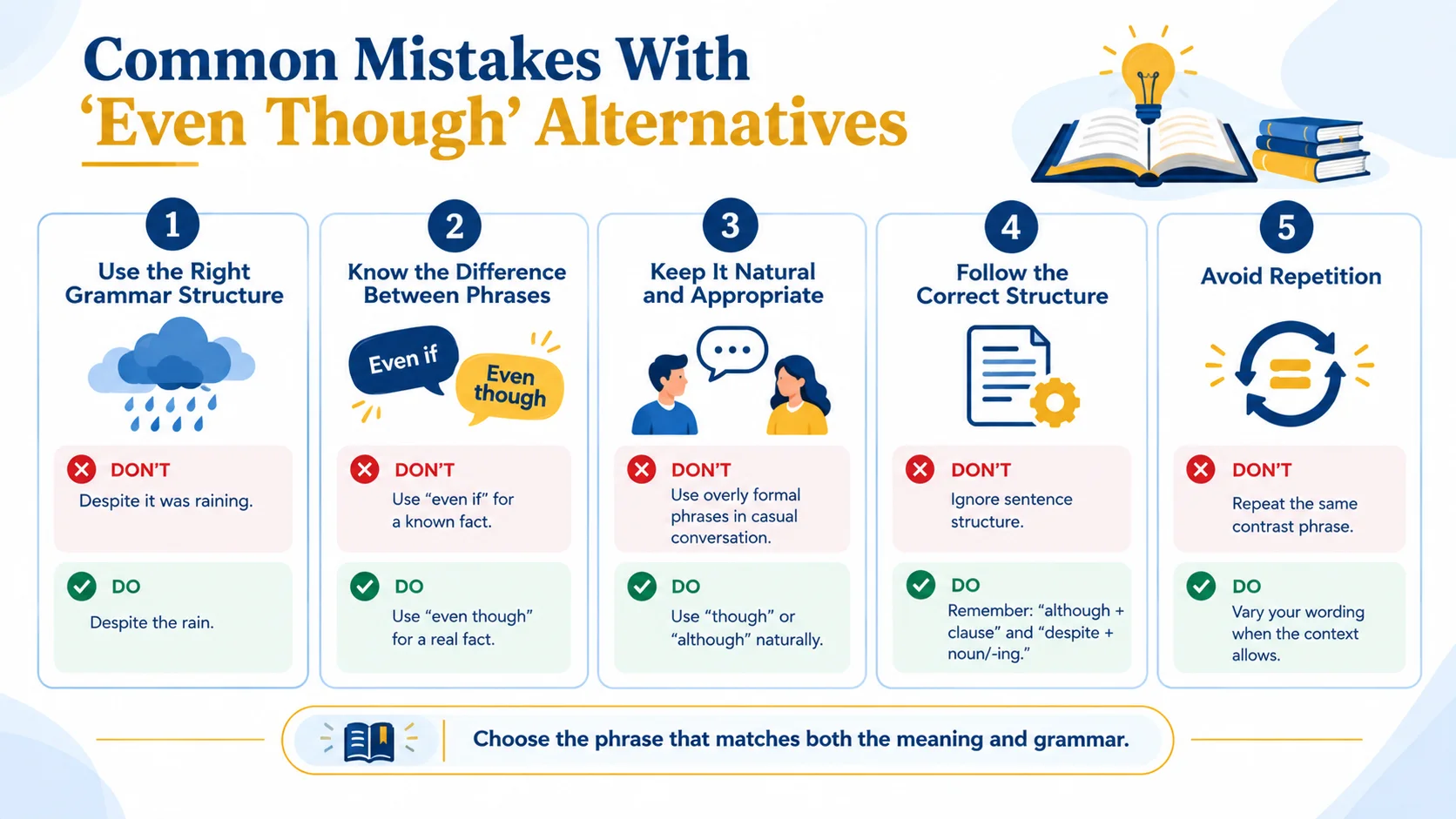
1. Using “Despite” Before a Complete Clause
A common mistake is writing “despite it was raining.” Despite normally needs a noun, pronoun, or -ing form.
Correct: “Despite the rain, we went outside.”
2. Treating “Even Though” and “Even If” as Exact Synonyms
These phrases have related meanings but different uses. Even though normally introduces a real or known fact, while even if introduces a possibility or condition.
3. Making Casual Sentences Too Formal
Phrases such as notwithstanding the fact that may be grammatically correct, but they can sound stiff in everyday conversation. Though or although will usually sound more natural.
4. Forgetting the Context
Not every alternative works with the same sentence structure. For example, despite can be followed by a noun, while although is followed by a clause.
5. Repeating the Same Contrast Word
Using although repeatedly can make an essay or article sound repetitive. When appropriate, vary your wording with though, despite, in spite of, or while.
Frequently Asked Questions
What is the closest synonym for “even though”?
Although is one of the closest and most useful alternatives to even though. Both introduce a contrast between two ideas and can usually be used before a complete clause. For example, “Even though she was tired, she worked” can become “Although she was tired, she worked.” The tone remains natural and neutral.
Is “although” the same as “even though”?
Although and even though are very similar because both introduce a contrasting fact. However, even though can place slightly stronger emphasis on the contrast. In most everyday sentences, you can replace one with the other without changing the basic meaning.
What is a formal way to say “even though”?
For formal writing, although, despite the fact that, and in spite of the fact that are useful choices. Although is usually the simplest option. More lengthy phrases can work in formal documents, but they should not be used simply to make writing sound more sophisticated.
Can I use “though” instead of “even though”?
Yes, though can often replace even though. It is especially natural in conversation and informal writing. For example, “Though it was late, we continued talking” has essentially the same meaning as “Even though it was late, we continued talking.” Though generally sounds less emphatic.
What is the difference between “despite” and “even though”?
The main difference is grammar. Even though is followed by a complete clause, such as “even though it was raining.” Despite is normally followed by a noun or -ing form, such as “despite the rain” or “despite being tired.” Both expressions show contrast.
Is “in spite of” a synonym for “even though”?
In spite of expresses a similar contrast, but its sentence structure is different. You normally use it before a noun, pronoun, or -ing form. For example, “In spite of the rain, we went hiking.” With a complete clause, use “in spite of the fact that.”
Is “while” a good replacement for “even though”?
While can be a good replacement when it introduces contrast. For example, “While the room is small, it is comfortable.” However, while can also refer to time, so make sure the intended meaning is clear from the sentence.
Which alternative should I use in professional writing?
Although is usually the safest choice for professional writing because it is clear, concise, and widely accepted. Despite is also useful when followed by a noun or -ing form. Avoid overly formal expressions unless the context, such as a legal or official document, calls for them.
Conclusion
There are several natural ways to say even though, but the best choice depends on your sentence and tone. Although is the most versatile option and works well in professional, academic, and everyday writing. Though sounds more conversational, while despite and in spite of offer concise ways to show contrast when followed by the right grammatical structure.
For formal documents, despite the fact that or notwithstanding the fact that may fit, although simpler wording is often clearer. If you are describing a possible condition rather than a known fact, consider even if instead.
The key is to choose an expression that matches both the meaning and the grammar of your sentence. When in doubt, although is a reliable, natural choice.

Professional English Editor
Caleb Wrenford specializes in professional English, workplace communication, business writing, and formal expressions. His work helps readers communicate with greater clarity and confidence across emails, professional conversations, and written correspondence.