
The word “crucial” helps you show that something matters a great deal. You might use it in a business email, a school assignment, a project update, or an everyday conversation.
However, repeating the same word can make your writing feel less natural.
Choosing another way to say crucial allows you to express importance more precisely. Some alternatives highlight necessity, while others emphasize urgency, influence, or value. Below are 10 useful options, with meanings, examples, and practical tips to help you choose the right phrase.
Key Takeaways
- Essential and vital are strong alternatives when something is necessary.
- Critical works well for urgent situations, risks, and important decisions.
- Pivotal describes something that plays a major role in an outcome.
- Significant and important suit general and professional writing.
- Choose synonyms based on context, tone, and the degree of importance you want to express.
What Does “Another Way to Say Crucial” Mean?
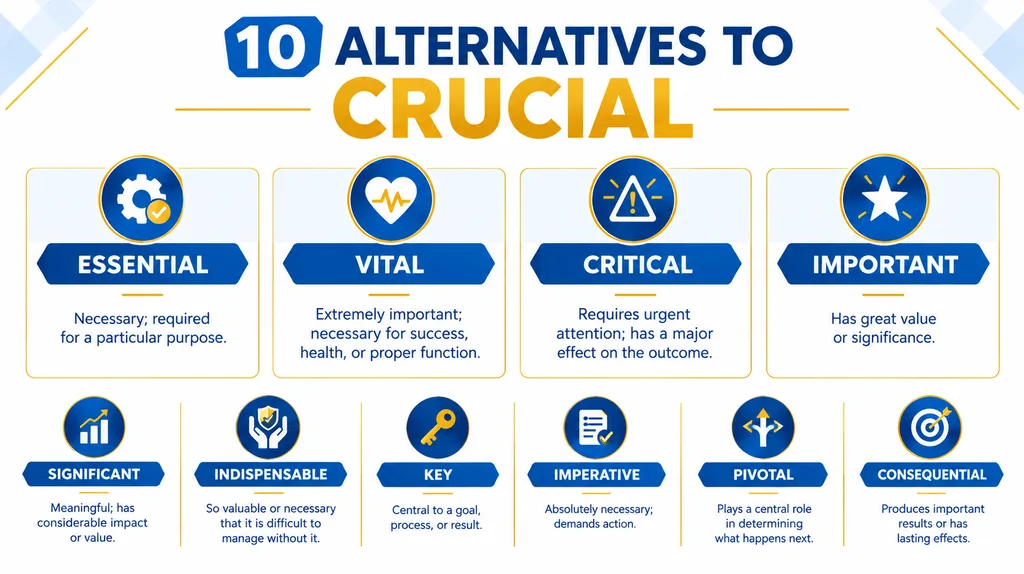
The phrase “another way to say crucial” refers to alternative words or expressions that communicate great importance. Common synonyms include essential, vital, critical, and significant.
People search for these alternatives to improve their vocabulary, avoid repetition, and make their writing more effective. These words appear frequently in professional emails, academic papers, business reports, presentations, and everyday conversations.
Although the alternatives share a similar meaning, they are not always interchangeable. For example, “critical” can suggest urgency, while “pivotal” highlights a turning point or a major influence on an outcome.
Why Use Other Ways to Say Crucial?
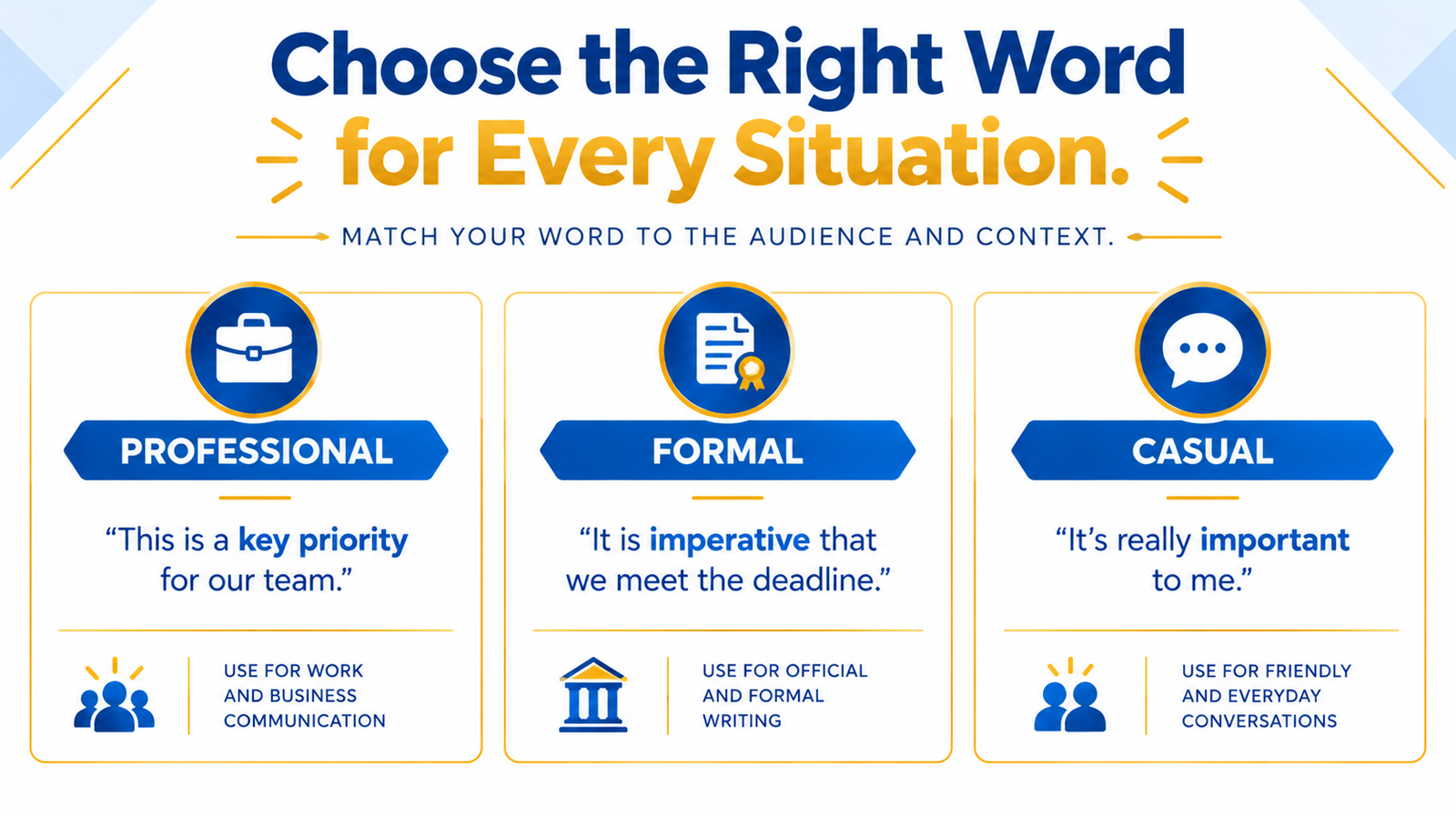
Using different words is crucial and helps you communicate clearly and match your language to the situation. The right alternative can make your message sound more natural, precise, and professional.
Here are the main benefits:
- Avoid repetition: Keep articles, reports, and emails interesting.
- Improve clarity: Explain whether something is necessary, urgent, or influential.
- Match your tone: Choose language that suits formal writing or casual conversation.
- Strengthen your message: Highlight the importance of a decision, task, or action.
- Expand your vocabulary: Learn expressions that work in different contexts.
10 Best Other Ways to Say Crucial
1. Essential
Meaning: Essential describes something absolutely necessary or required for a particular purpose. It often suggests that a task, resource, or action cannot be left out without causing a problem.
Best For: Professional, Formal, Polite
Example 1: Clear communication is essential for keeping our remote team organized.
Example 2: Regular practice is essential if you want to improve your writing skills.
Quick Tip: Use “essential” when you want to emphasize necessity rather than urgency.
2. Vital
Meaning: Vital means extremely important to the success, health, or proper functioning of something. It can carry more emotional weight than “important,” making it useful when the consequences really matter.
Best For: Professional, Formal
Example 1: Accurate data is vital to making informed business decisions.
Example 2: Getting enough sleep is vital for maintaining good health.
Quick Tip: Choose “vital” when the outcome depends heavily on a particular action, resource, or condition.
3. Critical
Meaning: Critical describes something that has a major effect on an outcome or requires immediate attention. It is common in business, technology, healthcare, and situations involving deadlines or potential risks.
Best For: Professional, Formal
Example 1: Fixing the security issue is critical before the software launch.
Example 2: The next two weeks will be critical to the project’s success.
Quick Tip: Use “critical” when urgency, risk, or serious consequences are part of the message.
4. Important
Meaning: Important is a broad, everyday alternative that communicates value or significance. It is less intense than “crucial” in many contexts, making it a good choice when you want to sound clear without overstating your point.
Best For: Professional, Casual, Friendly
Example 1: It’s important to confirm the meeting time with every participant.
Example 2: Building trust is important in any long-term relationship.
Quick Tip: Choose “important” for general statements when stronger language is unnecessary.
5. Significant
Meaning: Significant refers to something that has considerable meaning, value, or influence. It works particularly well when describing measurable progress, meaningful changes, research findings, or developments that deserve attention.
Best For: Professional, Formal
Example 1: The updated training program led to a significant improvement in employee performance.
Example 2: This policy change could have a significant effect on small businesses.
Quick Tip: Use “significant” to highlight meaningful impact rather than an urgent need.
6. Indispensable
Meaning: Indispensable describes someone or something that is so valuable or necessary that it is difficult to manage without it. The word emphasizes usefulness and the absence of a suitable replacement.
Best For: Professional, Formal, Warm
Example 1: Her experience has made her an indispensable member of our team.
Example 2: Reliable customer feedback is indispensable when improving a new product.
Quick Tip: Reserve “indispensable” for situations where something is truly difficult to replace or do without.
7. Key
Meaning: Key means central to a goal, process, or result. It is a concise, natural alternative that fits professional communication without sounding overly formal.
Best For: Professional, Casual, Friendly
Example 1: Customer satisfaction is a key factor in our company’s growth.
Example 2: Setting realistic goals is key to staying motivated throughout the semester.
Quick Tip: Use “key” in phrases such as “key factor,” “key role,” and “key priority.” Remember that “key to” is followed by a noun or a gerund.
8. Imperative
Meaning: Imperative means absolutely necessary or extremely important, often because a situation demands action. It sounds stronger and more formal than “important,” especially in instructions, policies, and official communications.
Best For: Formal, Professional
Example 1: It is imperative that all employees complete the security training by Friday.
Example 2: Protecting customer information is imperative for maintaining public trust.
Quick Tip: Use “imperative” when you need to communicate a firm requirement, not simply a preference.
9. Pivotal
Meaning: Pivotal describes something that plays a central role in determining what happens next. It often refers to a decision, event, person, or moment that can change the direction of a situation.
Best For: Professional, Formal
Example 1: Her presentation played a pivotal role in securing the partnership.
Example 2: The final interview was a pivotal moment in his career.
Quick Tip: Choose “pivotal” when the focus is on influence, turning points, or changes in direction.
10. Consequential
Meaning: Consequential describes something that produces important results or has lasting effects. Unlike “essential,” it does not necessarily mean something is required; instead, it emphasizes the seriousness or impact of what happens.
Best For: Formal, Professional
Example 1: The board made a consequential decision about the company’s future.
Example 2: Small changes to the contract could have consequential effects on both parties.
Quick Tip: Use “consequential” when discussing decisions, actions, or events with meaningful outcomes.
Comparison Table
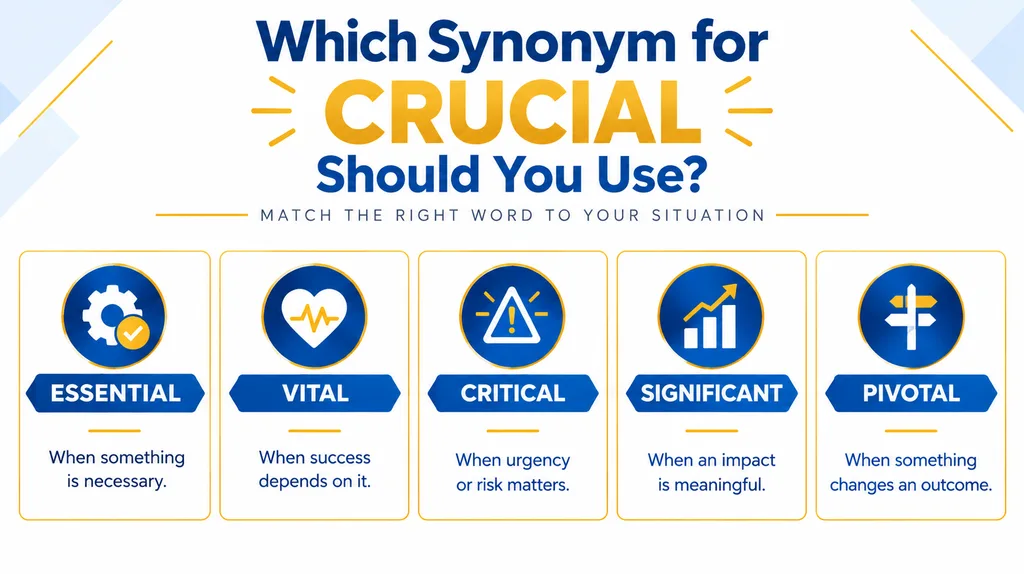
| Alternative | Best Used In | Tone |
| Essential | Requirements and instructions | Clear, direct |
| Vital | Health, success, and core needs | Strong, serious |
| Critical | Urgent tasks and risk management | Urgent, professional |
| Important | Everyday and workplace communication | Neutral |
| Significant | Reports, research, and major changes | Analytical |
| Indispensable | Essential people and resources | Strong, appreciative |
| Key | Goals, priorities, and business plans | Concise, practical |
| Imperative | Rules and urgent requirements | Formal, firm |
| Pivotal | Turning points and influential decisions | Emphatic |
| Consequential | Decisions with lasting effects | Formal, serious |
Common Mistakes When Using Alternatives to Crucial
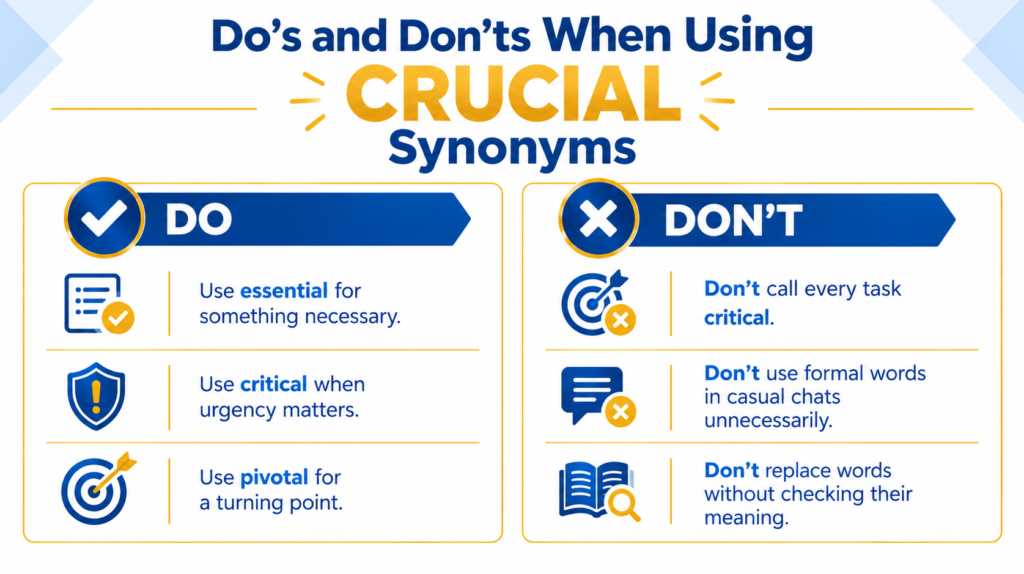
- Using casual phrases in formal writing: “Really important” may work in conversation, but “essential” or “critical” may be more suitable in a business report.
- Choosing overly formal language: Words such as “imperative” and “consequential” can make simple messages sound stiff. Use “important” or “key” when a straightforward tone works better.
- Repeating the same alternative: Replacing every instance of “crucial” with “essential” does not improve variety. Select synonyms based on the meaning of each sentence.
- Ignoring context: “Pivotal” suggests influence, while “indispensable” suggests necessity. Check whether you mean something is required, urgent, influential, or simply meaningful.
- Overstating importance: Calling every task “critical” can weaken your message. Save stronger words for situations where the consequences justify them.
Frequently Asked Questions
1. What is the best synonym for crucial?
The best synonym depends on the context. “Essential” works when something is necessary, “critical” suits urgent situations, and “vital” emphasizes great importance. For a general statement, “important” is a safe and natural choice. Consider what you want to communicate before selecting a replacement.
2. What is a professional way to say crucial?
“Essential,” “critical,” “key,” and “significant” are useful professional alternatives. For example, you could write, “Your feedback is essential to the success of this project.” In a workplace email, choose a word that reflects the actual level of importance without making the message sound unnecessarily dramatic.
3. What is another word for crucial in an academic essay?
“Significant,” “essential,” “pivotal,” and “critical” work well in academic writing. Use “significant” when discussing meaningful findings, “essential” for necessary elements, and “pivotal” for influential events or ideas. Always consider the argument and the specific meaning you want to express.
4. Is crucial stronger than important?
Generally, yes. “Crucial” usually suggests that something is extremely important to an outcome, while “important” can describe a wide range of priorities. For example, attending a meeting may be important, but submitting a required document before a strict deadline may be crucial.
5. What is a stronger word than crucial?
Words such as “vital,” “critical,” and “indispensable” can communicate strong importance, depending on the situation. However, none is automatically stronger in every sentence. “Indispensable” emphasizes necessity, while “critical” often highlights urgency or serious consequences. Choose the word that best matches your intended meaning.
6. Can I use essential and crucial interchangeably?
Sometimes. Both words can describe something necessary for success, as in “essential information” and “crucial information.” However, “essential” often emphasizes necessity, while “crucial” places more emphasis on how much something matters to the outcome. The best choice depends on the sentence.
7. What is a casual way to say crucial?
“Really important,” “key,” and “a big deal” can work in casual conversations. For example, “Getting enough rest is really important before the exam” sounds natural and friendly. Use informal alternatives with friends or colleagues when the situation does not require formal language.
8. How can I avoid repeating the word crucial in an essay?
First, identify what each sentence means. Replace “crucial” with “essential” when discussing necessity, “significant” when describing impact, and “pivotal” when explaining influence. You can also restructure sentences to remove unnecessary repetition. Prioritize accuracy and readability instead of changing words simply for variety.
Conclusion
Choosing another way to say crucial can make your writing clearer, more natural, and more effective. The best alternative depends on what you want to emphasize. Use “essential” when something is necessary, “vital” when the outcome depends on it, and “critical” when urgency or serious consequences matter. For professional emails and everyday communication, “important” and “key” are simple, reliable choices. Academic writing often benefits from “significant,” while “pivotal” works well for major decisions and turning points. Use “indispensable” to describe something difficult to replace and “consequential” to highlight lasting effects. Finally, reserve “imperative” for situations that demand action. Rather than choosing synonyms at random, consider your audience, tone, and intended meaning. A precise word will always communicate your point better than an unnecessarily complicated on