Sometimes, the phrase “a lot” feels too basic, especially when you want to write a professional email, improve an essay, or express an idea more clearly.
Although it works well in everyday conversations, choosing a more specific expression can make your message sound more natural.
The best alternative depends on what you mean. You might be describing a large quantity, a high number of people, strong feelings, or the extent of an action.
In this guide, you’ll discover 10 useful alternatives to “a lot,” along with meanings, examples, and practical tips to help you choose the right expression.
Key Takeaways
- Use “a great deal” for professional and formal communication.
- Choose “many” or “numerous” when referring to countable items.
- Use “plenty” to express that something is available in sufficient amounts.
- Choose “tons” for casual conversations with friends and family.
- Match your alternative to the sentence, audience, and intended meaning.
What Does “A Lot” Mean?
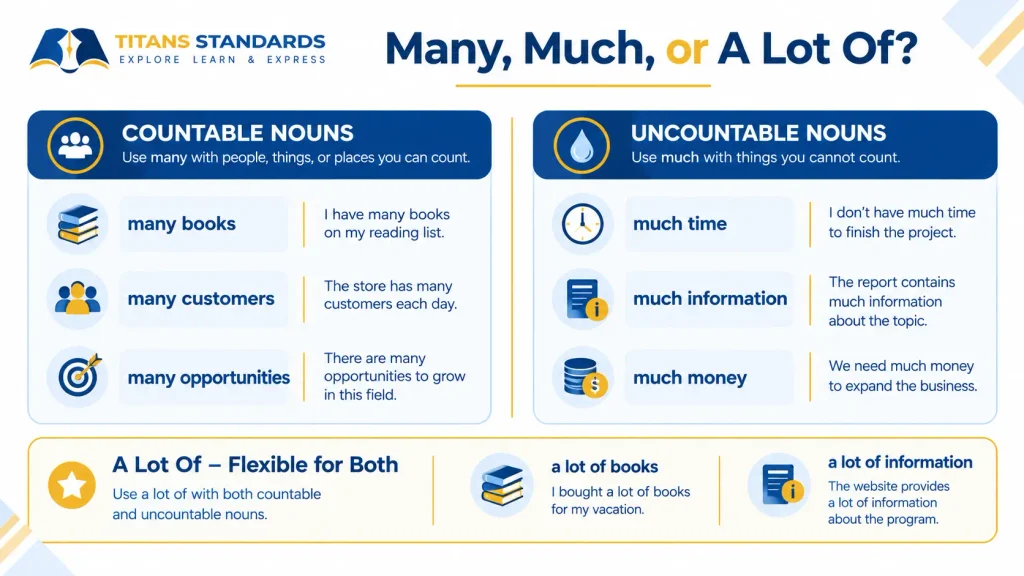
“A lot” means a large amount, a high number, or a considerable degree of something. People commonly use it in spoken English and informal writing to describe quantities, frequency, feelings, and actions.
For example, “I learned a lot from the workshop” means you gained a great deal of knowledge. Similarly, “We have a lot of customers” means the business serves many customers.
The phrase is versatile, but it can sound vague when used repeatedly. More precise alternatives help readers understand exactly what you mean.
Why Use Other Ways to Say “A Lot”?
Using different expressions can improve your vocabulary and make your writing more engaging. The right phrase also helps you communicate your meaning clearly in different situations.
Consider these benefits:
- Avoid repetition: Keep your writing interesting by varying your word choices.
- Sound professional: Use polished expressions in reports, business emails, and presentations.
- Improve clarity: Distinguish between a large number, a large quantity, and a high degree.
- Match your audience: Choose formal, friendly, or casual language when appropriate.
- Express meaning precisely: Communicate the size, frequency, or intensity of something more effectively.
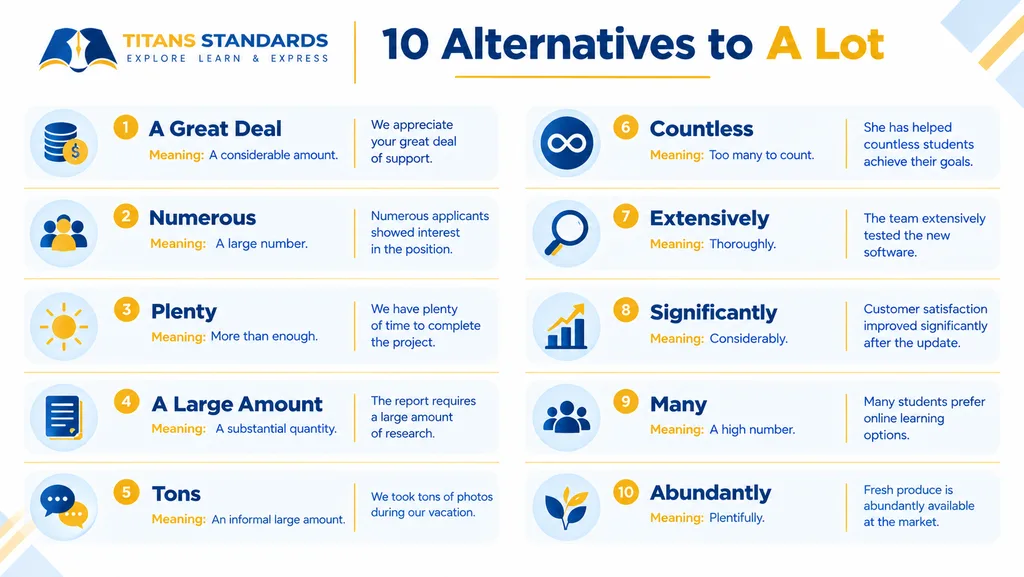
10 Best Other Ways to Say “A Lot”
1. A Great Deal
Meaning
“A great deal” means a large amount or a considerable degree. It works especially well when discussing knowledge, effort, importance, or uncountable things.
This expression sounds more polished than “a lot” and fits professional communication without feeling overly formal.
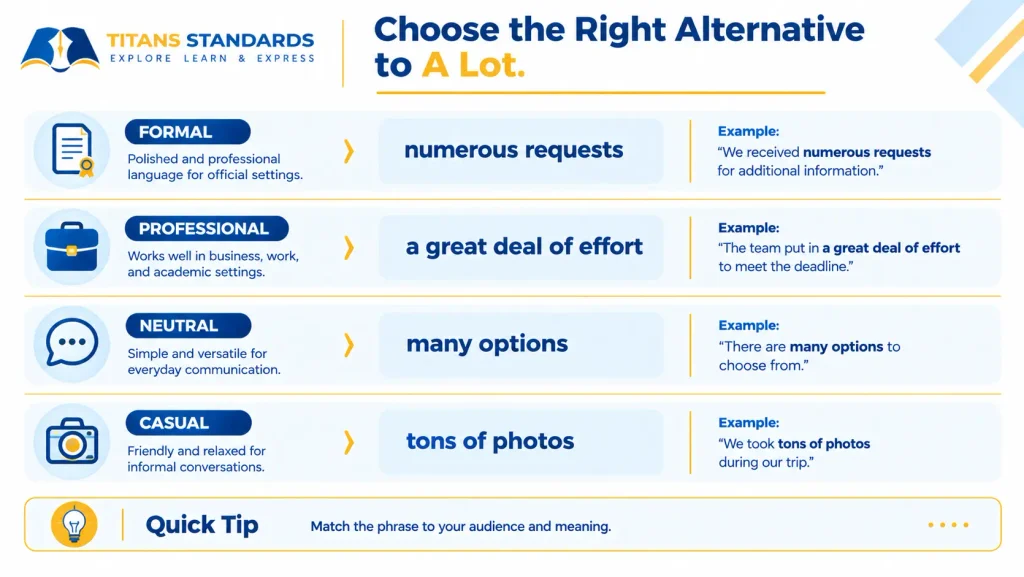
Best For: Professional, Formal, Polite
Example 1: We appreciate the great deal of effort you put into this project.
Example 2: The training program taught me a great deal about customer service.
Quick Tip: Use “a great deal of” before an uncountable noun, such as time, effort, or information.
2. Numerous
Meaning
“Numerous” means many or a large number of something. It is particularly useful when discussing people, opportunities, problems, examples, or other countable items.
It gives writing a more formal tone and works well in academic assignments, business reports, and professional documents.
Best For: Professional, Formal
Example 1: Our team received numerous applications for the open position.
Example 2: The report identifies numerous opportunities for improving customer satisfaction.
Quick Tip: Use “numerous” with plural countable nouns, not uncountable nouns such as water or advice.
3. Plenty
Meaning
“Plenty” means more than enough or a sufficient amount. It often creates a reassuring, positive tone when discussing resources, time, opportunities, or available choices.
The phrase “plenty of” is common in everyday American English and works in both casual and moderately professional situations.
Best For: Casual, Friendly, Warm
Example 1: We have plenty of time to review the proposal before Friday.
Example 2: There are plenty of opportunities to develop your writing skills.
Quick Tip: Use “plenty of” when you want to emphasize that something is available in a sufficient or generous amount.
4. A Large Amount
Meaning
“A large amount” describes a substantial quantity of something. It is useful when you want to sound clear and neutral without relying on informal language.
This expression commonly appears in reports, explanations, research summaries, and discussions about money, time, energy, or other uncountable nouns.
Best For: Professional, Formal
Example 1: The company invested a large amount of money in employee training.
Example 2: Preparing the presentation required a large amount of research.
Quick Tip: Use “a large amount of” with uncountable nouns. For countable items, “a large number of” is usually more appropriate.
5. Tons
Meaning
“Tons” is an informal expression that means a very large amount or number. It is common in American conversations, text messages, and friendly online communication.
Although it can make your language sound relaxed and enthusiastic, it is generally unsuitable for formal reports or highly professional correspondence.
Best For: Casual, Friendly
Example 1: Thanks for sharing tons of helpful advice before my interview.
Example 2: We took tons of photos during our weekend trip.
Quick Tip: Reserve “tons of” for relaxed settings where conversational language feels natural.
6. Countless
Meaning
“Countless” describes something so numerous that it is difficult to count. It can also add emphasis when discussing repeated experiences, possibilities, or memorable moments.
This expression is more vivid than “a lot” and often works well in storytelling, essays, and persuasive writing.
Best For: Formal, Friendly
Example 1: She has helped countless students prepare for their college applications.
Example 2: Countless hours of practice helped the team improve its performance.
Quick Tip: Use “countless” when you want to emphasize an exceptionally high number rather than an ordinary quantity.
7. Extensively
Meaning
“Extensively” means thoroughly, widely, or to a considerable extent. Unlike “a lot,” which often describes quantity, this adverb usually explains how thoroughly an action was performed.
It is particularly useful in professional, academic, and technical writing.
Best For: Professional, Formal
Example 1: The research team extensively reviewed the available evidence.
Example 2: We tested the software extensively before releasing the update.
Quick Tip: Use “extensively” to describe actions such as researching, reviewing, testing, or studying. It is not a direct replacement for every use of “a lot.”
8. Significantly
Meaning
“Significantly” means noticeably, considerably, or to an important degree. It works well when describing measurable changes, meaningful differences, or substantial improvements.
The word is especially useful in reports, presentations, research, and business communication.
Best For: Professional, Formal
Example 1: Customer satisfaction improved significantly after the support team introduced live chat.
Example 2: The new scheduling system significantly reduced waiting times.
Quick Tip: Use “significantly” when describing an important change or effect. Do not use it merely to indicate a large number of objects.
9. Many
Meaning
“Many” means a large number of people, things, or events. It is one of the simplest and most natural alternatives to “a lot” when referring to countable nouns.
Because it is widely understood and works in nearly every register, it is a dependable choice for everyday speech, emails, and academic writing.
Best For: Professional, Casual, Polite
Example 1: Many employees prefer having flexible working hours.
Example 2: We explored many options before choosing the final design.
Quick Tip: Use “many” with plural countable nouns, such as employees, books, questions, and opportunities.
10. Abundantly
Meaning
“Abundantly” means in a plentiful or more-than-sufficient way. It often emphasizes that something is clearly evident or available in generous quantities.
For example, “abundantly clear” means completely or unmistakably clear. This makes the word useful for emphasis, although it does not replace “a lot” in every sentence.
Best For: Formal, Professional
Example 1: The results make it abundantly clear that the new strategy is working.
Example 2: Fresh produce is abundantly available at the local farmers market during summer.
Quick Tip: Use “abundantly clear” when emphasizing certainty, or use “abundantly available” when describing plentiful resources.
Comparison Table
| Alternative | Best Used In | Tone |
| A great deal | Emails, reports, discussions | Professional |
| Numerous | Reports, essays, applications | Formal |
| Plenty | Conversations, friendly messages | Warm |
| A large amount | Reports, explanations | Neutral |
| Tons | Texts, casual conversations | Informal |
| Countless | Essays, storytelling | Emphatic |
| Extensively | Research, testing, reviews | Professional |
| Significantly | Reports, measurable changes | Formal |
| Many | Everyday and professional writing | Neutral |
| Abundantly | Formal explanations, emphasis | Formal |
Common Mistakes When Replacing “A Lot”
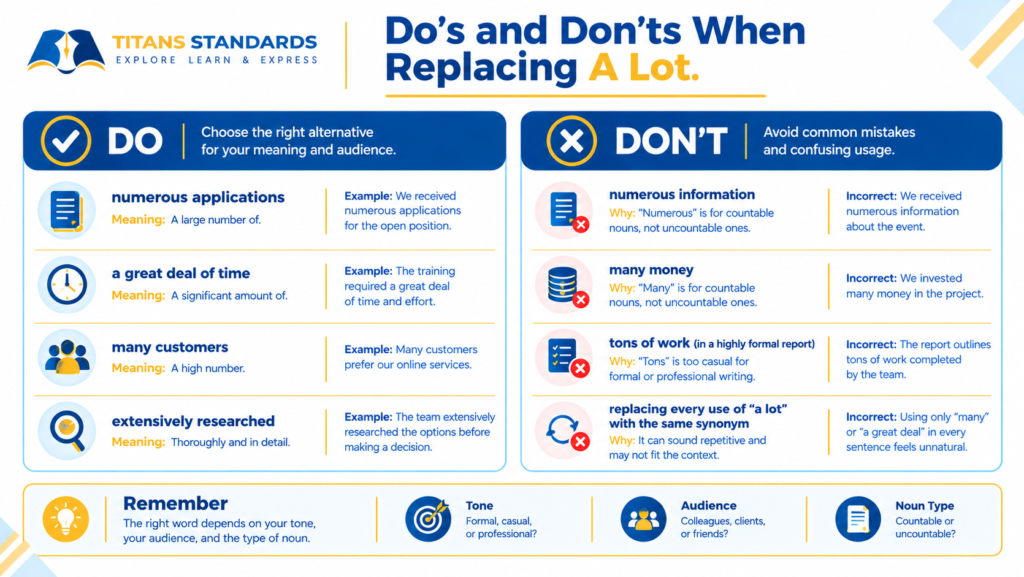
1. Using Casual Phrases in Professional Emails
Expressions such as “tons of” may sound too informal in a business proposal or formal report. Choose “a great deal,” “numerous,” or a more precise expression when writing professionally.
2. Choosing Overly Formal Language
Using words such as “abundantly” in every conversation can make your speech sound unnatural. Simple words like “many” and “plenty” are often better for everyday communication.
3. Ignoring Countable and Uncountable Nouns
“Many books” is correct, while “much books” is not. Use “many” for countable plural nouns and expressions such as “a large amount of” for uncountable nouns.
4. Replacing Every Meaning With the Same Word
“A lot” can describe quantity, frequency, or degree. “Numerous” describes a number, while “significantly” describes degree or impact. Select an alternative that preserves your original meaning.
5. Using Emphasis Without a Clear Reason
Words such as “countless” and “significantly” add emphasis. Overusing them can make your writing less convincing. Choose stronger expressions only when they accurately represent the situation.
Frequently Asked Questions
1. What is another word for “a lot”?
Common alternatives include many, numerous, plenty, a great deal, and a large amount. The best choice depends on your sentence. Use “numerous” for countable items in formal writing, “plenty” for a sufficient amount, and “a great deal” for considerable quantities or degrees.
2. What is a more professional way to say “a lot”?
“A great deal,” “numerous,” “extensively,” and “significantly” can sound more professional, depending on the meaning. For example, write “We conducted extensive research” instead of “We did a lot of research.” Specific wording often sounds clearer than a direct synonym.
3. What is a formal synonym for “a lot”?
“Numerous,” “a considerable amount,” and “a great deal” are useful formal alternatives. Choose “numerous” for countable nouns, such as applications or requests, and “a considerable amount” for uncountable nouns, such as time or money.
4. What is a casual way to say “a lot”?
“Tons,” “loads,” and “plenty” are common casual expressions. For example, you might say, “I have tons of work today” or “We have plenty of snacks.” These phrases sound natural in everyday American English but may be too informal for certain professional situations.
5. Can I use “many” instead of “a lot”?
Yes, when referring to plural countable nouns. For example, “I have a lot of books” can become “I have many books.” However, “many” does not work directly with uncountable nouns. Say “a lot of water” rather than “many water.”
6. What is another way to say “a lot of information”?
You can say “a great deal of information,” “a wealth of information,” or “extensive information,” depending on the sentence. For example, “The website provides a wealth of information about college admissions” sounds natural and emphasizes the usefulness of the available material.
7. How can I avoid repeating “a lot” in an essay?
Choose alternatives based on the meaning of each sentence. Use “numerous” for a high number, “substantially” for a large degree of change, and “extensively” for thorough actions. You can also rewrite sentences to make the quantity or impact more specific.
8. What is the difference between “a lot,” “many,” and “much”?
“A lot” works with both countable and uncountable nouns when used with “of.” “Many” refers to countable plural nouns, while “much” usually refers to uncountable nouns. For example, say “a lot of books,” “many books,” and “much time.” In positive everyday statements, “a lot of” often sounds more natural than “much.”
Conclusion
Choosing another way to say “a lot” can make your writing clearer, more natural, and better suited to your audience. The key is to understand what you want to express before selecting an alternative.
For professional emails and reports, consider “a great deal,” “numerous,” or “significantly.” In casual conversations, “tons” and “plenty” can sound friendly and relaxed. If you are describing a large number of items, “many” or “countless” may be more appropriate. When explaining research or detailed work, “extensively” can communicate the meaning more precisely.
Remember that these alternatives are not interchangeable in every sentence. Pay attention to whether you are describing quantity, frequency, or degree, and choose words that fit the context.