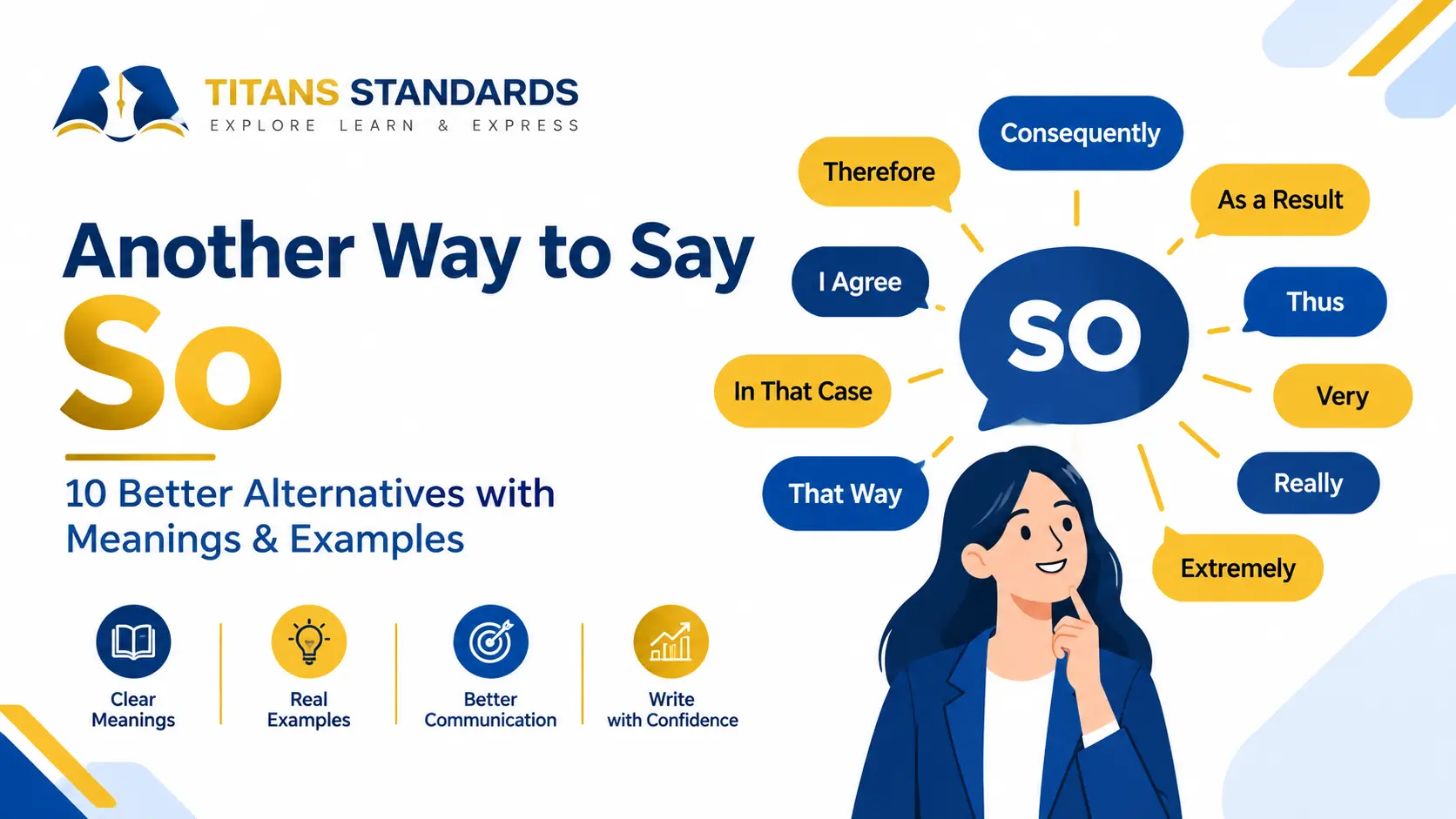
Another way to say “so” depends on the meaning and context. Use “therefore,” “consequently,” or “as a result” to show a conclusion.
Choose “very,” “really,” or “extremely” to add emphasis. For agreement, phrases like “I agree” or “that’s right” may work better. The best alternative makes your sentence clear and natural.
Key Takeaways
- Use “therefore” or “consequently” to connect ideas and explain results.
- Choose “really,” “very,” or “extremely” to express a high degree.
- Use “that way” when explaining a method or approach.
- Replace “so” with a more precise phrase in professional writing.
- Always consider the sentence’s meaning before choosing a synonym.
What Does “So” Mean?
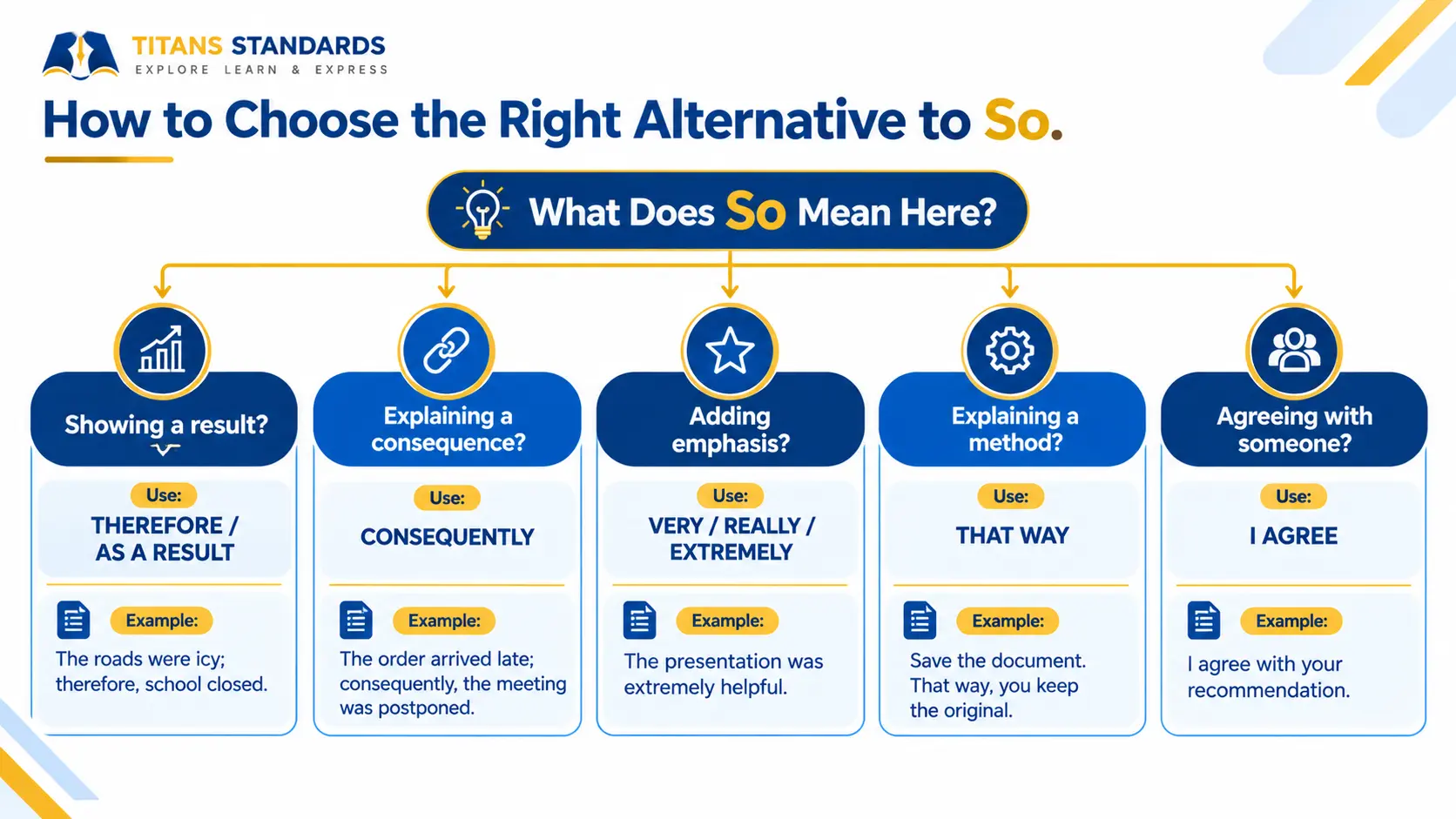
The word “so” has several meanings in American English. It can show a result, add emphasis, express agreement, or describe a way of doing something.
For example, “It was raining, so we stayed home” uses “so” to show a result. In “I’m so happy,” it adds emphasis. In “I think so,” it expresses agreement or a belief.
Because “so” serves different purposes, no single synonym works in every sentence. Choosing the right alternative depends on what you want to communicate.
Why Use Other Ways to Say “So”?
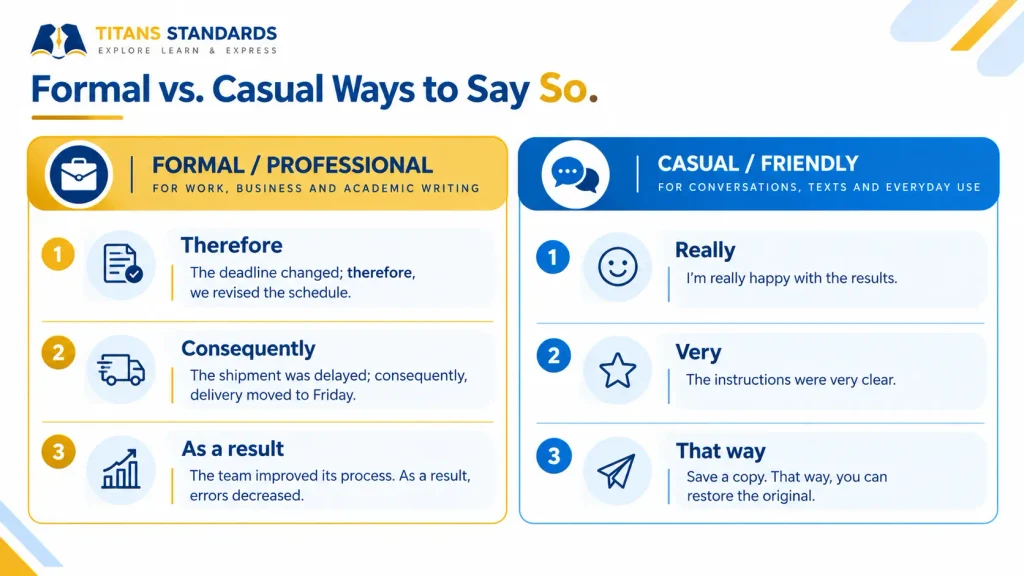
Although “so” is common and natural, using it repeatedly can make your writing sound less precise. The right alternative can improve clarity and help you match your audience.
Consider these benefits:
- Avoid repetition: Add variety to emails, essays, and conversations.
- Improve clarity: Show the exact relationship between two ideas.
- Sound professional: Choose language that suits business communication.
- Express emphasis: Describe feelings and experiences more accurately.
- Strengthen your writing: Make transitions between sentences smoother.
10 Best Alternatives to “So”
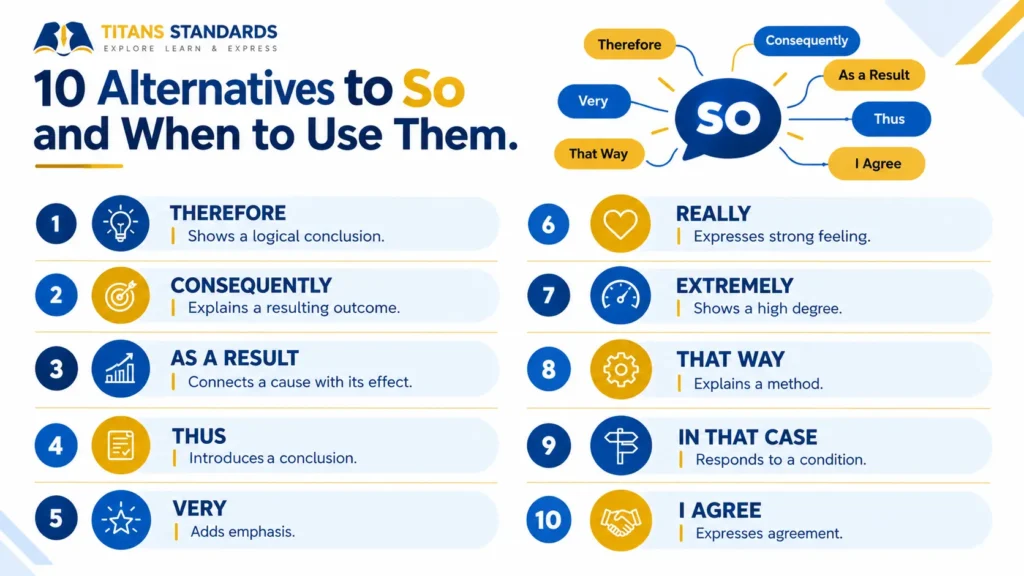
1. Therefore
Meaning: “Therefore” introduces a conclusion based on information already presented. It is a useful alternative when “so” connects a reason with a result.
Best For: Professional, Formal
Example 1: The report contains several errors; therefore, we need to revise it before publication.
Example 2: Sales declined this quarter; therefore, the team will review its marketing strategy.
Quick Tip: Use “therefore” in reports, essays, and business documents when you want to make a logical connection.
2. Consequently
Meaning: “Consequently” explains what happened because of a previous action or situation. It often sounds more formal than “so” and highlights the result of a decision or event.
Best For: Professional, Formal
Example 1: The supplier missed the deadline; consequently, production started two days late.
Example 2: The company reduced operating costs, consequently improving its overall financial performance.
Quick Tip: Choose “consequently” when the result follows clearly from the situation you described.
3. As a Result
Meaning: “As a result” introduces an outcome caused by something mentioned earlier. It works well in everyday explanations, professional emails, and informative articles.
Best For: Professional, Neutral
Example 1: Maya practiced her presentation every day. As a result, she delivered it with confidence.
Example 2: The road was closed for repairs. As a result, commuters had to take another route.
Quick Tip: Use this phrase when you want to explain cause and effect without sounding overly formal.
4. Thus
Meaning: “Thus” shows a conclusion or outcome. It is concise and often appears in academic writing, technical explanations, and formal discussions.
Best For: Formal, Professional
Example 1: The sample size was too small, thus limiting the study’s conclusions.
Example 2: The team combined the two databases, thus creating a single source of customer information.
Quick Tip: Use “thus” when a short, precise transition fits your writing. In casual conversation, “so” often sounds more natural.
5. Very
Meaning: “Very” emphasizes the degree of an adjective or adverb. It can replace “so” when the word expresses intensity rather than a result.
Best For: Neutral, Professional, Casual
Example 1: The instructions were very clear, even for first-time users.
Example 2: We are very pleased with the progress your team has made.
Quick Tip: Compare “The room is so quiet” with “The room is very quiet.” Both express intensity, but “so” can carry more emotion or surprise.
6. Really
Meaning: “Really” adds emphasis and can express sincerity, surprise, or a strong feeling. It is common in spoken American English and informal writing.
Best For: Casual, Friendly, Warm
Example 1: I really appreciate you staying late to help with the project.
Example 2: That was a really thoughtful gift, and I’ll remember it for a long time.
Quick Tip: Use “really” in friendly messages and natural conversations. In formal reports, a more precise description may be stronger.
7. Extremely
Meaning: “Extremely” describes a very high degree of something. It often sounds stronger than “very” and is useful when you want to communicate intensity clearly.
Best For: Professional, Formal, Neutral
Example 1: The new software is extremely useful for organizing large amounts of data.
Example 2: The hiking trail became extremely difficult after the rain.
Quick Tip: Reserve “extremely” for situations where strong emphasis is justified. Overusing it can make your writing sound exaggerated.
8. That Way
Meaning: “That way” describes a method or approach, often explaining how an action will help achieve a goal. It can replace “so” when the intended meaning is “by doing this.”
Best For: Casual, Friendly, Professional
Example 1: Save a copy of the file before editing it. That way, you can restore the original if needed.
Example 2: Let’s send the agenda today. That way, everyone has time to prepare.
Quick Tip: Use “that way” to explain the practical benefit of an action, especially when giving advice or instructions.
9. In That Case
Meaning: “In that case” introduces a response or decision based on new information. It is useful when circumstances change or you need to adjust a plan.
Best For: Polite, Professional, Casual
Example 1: If your flight arrives after midnight, in that case, we can arrange a later pickup.
Example 2: You already have a membership? In that case, you can access the course at no extra cost.
Quick Tip: Use this phrase when reacting to a condition or new detail. Avoid adding it when the situation is already obvious.
10. I Agree
Meaning: “I agree” communicates that you share someone’s opinion or support their point. It can replace “I think so” when you want to express agreement directly rather than uncertainty.
Best For: Professional, Polite, Friendly
Example 1: “Should we send the proposal before Friday?” “I agree; that gives the client enough time to review it.”
Example 2: “The new schedule is easier to manage.” “I agree, especially with the shorter meetings.”
Quick Tip: Use “I agree” when responding to an opinion or suggestion. If you are uncertain, phrases such as “I think that’s right” are more accurate.
Comparison Table
| Alternative | Best Used In | Tone |
| Therefore | Reports and arguments | Formal |
| Consequently | Explaining outcomes | Formal |
| As a Result | Everyday and business writing | Neutral |
| Thus | Academic and technical writing | Formal |
| Very | Describing intensity | Neutral |
| Really | Conversations and messages | Casual |
| Extremely | Strong emphasis | Professional |
| That Way | Advice and instructions | Friendly |
| In That Case | Responding to conditions | Polite |
| I Agree | Sharing an opinion | Direct |
Common Mistakes When Replacing “So”
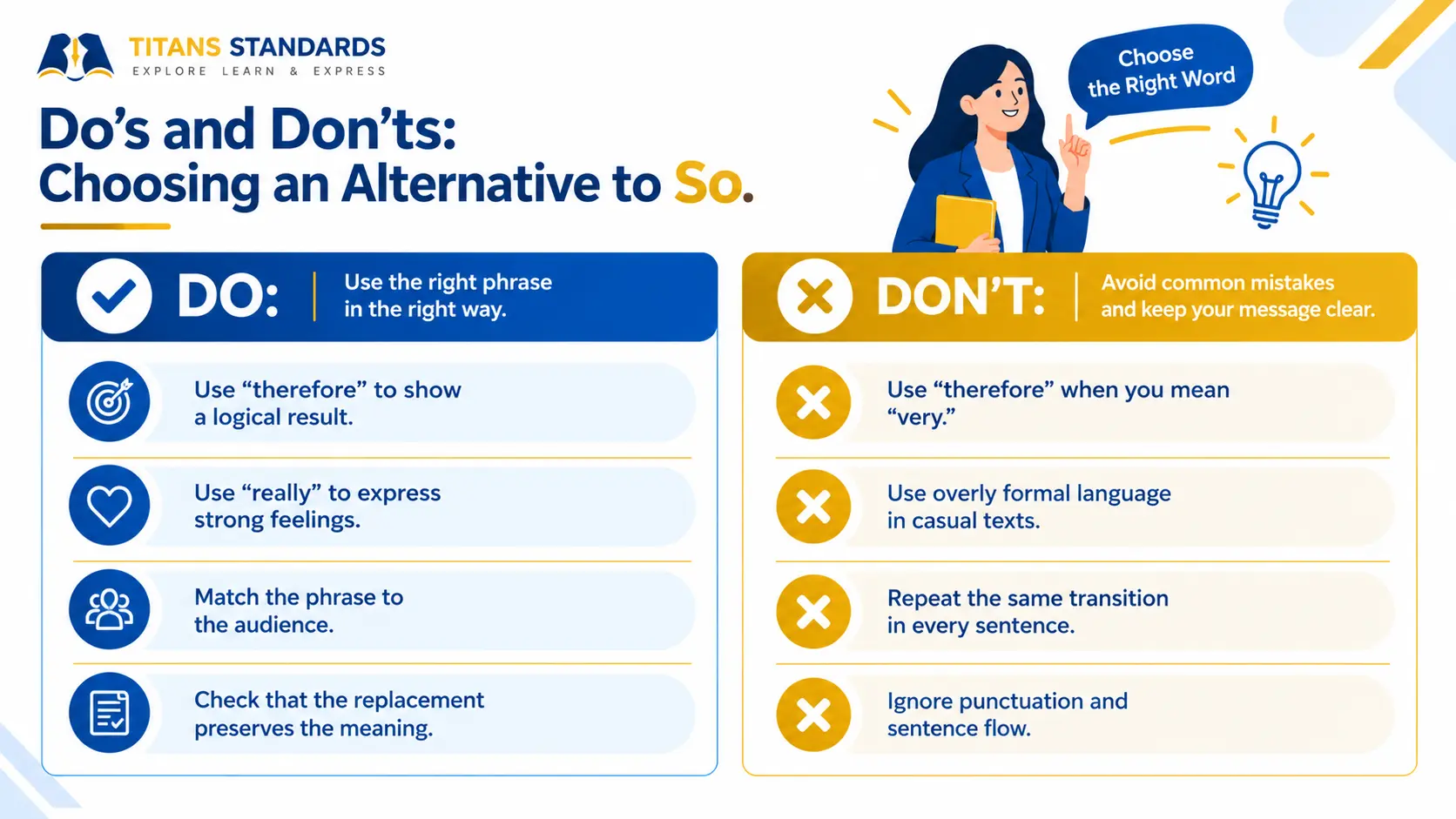
- Using a formal phrase in casual conversation: “Consequently” may sound stiff in a text to a friend. Choose language that matches the situation.
- Confusing results with emphasis: “Therefore” shows a conclusion, while “very” adds intensity. They are not interchangeable.
- Choosing a word that changes the meaning: “I agree” expresses a viewpoint, while “I think so” can indicate a belief with some uncertainty.
- Overusing synonyms: Replacing every instance of “so” with “therefore” or “really” can make writing repetitive in a different way. Vary your sentence structure.
- Ignoring punctuation and flow: Words such as “therefore” and “consequently” need careful punctuation. Read the sentence aloud to check that the transition sounds natural.
Frequently Asked Questions
1. What is another word for “so”?
The best alternative depends on the sentence. “Therefore,” “thus,” and “as a result” show a consequence. “Very,” “really,” and “extremely” add emphasis. If you are agreeing with someone, “I agree” may be clearer. Check the intended meaning before selecting a replacement.
2. What is a more professional way to say “so”?
“Therefore,” “consequently,” and “as a result” are useful professional alternatives when explaining outcomes. For example, instead of writing, “The deadline changed, so we updated the schedule,” you could write, “The deadline changed; therefore, we updated the schedule.” Choose the phrase that best reflects the relationship between the ideas.
3. What is a formal synonym for “so”?
“Therefore,” “thus,” and “consequently” are common formal alternatives when “so” means “as a result.” In academic writing, “thus” can be concise, while “consequently” emphasizes an outcome. Remember that “so” has other meanings, so these options will not work when it expresses intensity or agreement.
4. How can I replace “so” in an essay?
Use transitions that explain how your ideas connect. “Therefore” introduces a conclusion, “as a result” explains an outcome, and “consequently” emphasizes cause and effect. You can also restructure sentences to avoid unnecessary transitions. For example, replace “The evidence was limited, so the conclusion was cautious” with “Because the evidence was limited, the conclusion was cautious.”
5. What can I say instead of “so much”?
The best replacement depends on the noun and the meaning. Use “a great deal of” with uncountable nouns, as in “a great deal of effort.” Use “many” with countable plural nouns, as in “many opportunities.” “A lot of” works in both cases and is common in everyday American English.
6. What is another way to say “so happy”?
You can say “very happy,” “really happy,” “extremely happy,” or “delighted.” “Delighted” expresses strong pleasure and often sounds more polished. For example, “I’m delighted to hear about your promotion” works well in a professional or personal message. Choose an expression that matches the strength of your feeling.
7. Is “therefore” always interchangeable with “so”?
No. “Therefore” generally introduces a conclusion or result, while “so” can also express intensity, agreement, or a manner. “It was so cold” cannot normally become “It was therefore cold” without changing the meaning. Use “therefore” only when the sentence presents a logical relationship between ideas.
8. Is it okay to start a sentence with “so”?
Yes. Starting a sentence with “so” is common in American English, especially in conversations, presentations, and informal writing. It can introduce a conclusion, a new topic, or a response. In formal writing, consider whether “therefore,” “as a result,” or a direct opening would make the connection clearer.
Conclusion
Choosing another way to say “so” starts with understanding what the word means in your sentence. If you are explaining a result, “therefore,” “consequently,” and “as a result” can make your writing clearer. When you want to emphasize a feeling or description, “very,” “really,” and “extremely” offer different levels of intensity. For instructions, “that way” explains how an action helps, while “in that case” responds to a condition. When expressing agreement, “I agree” is often more direct.
The best choice depends on your audience, tone, and purpose. Professional emails may benefit from precise transitions, while friendly conversations usually sound more natural with everyday expressions. Rather than replacing every instance of “so,” focus on clarity and meaning. A useful rule is to choose the phrase that communicates your exact idea in the most natural way.

English Usage Specialist
Elliot Harrow specializes in English usage, grammar, phrasing, and word choice. His editorial work focuses on explaining subtle differences between similar words and helping readers choose language that is precise, natural, and appropriate for the context.