If you need another way to say “during,” the best replacement depends on what you mean.
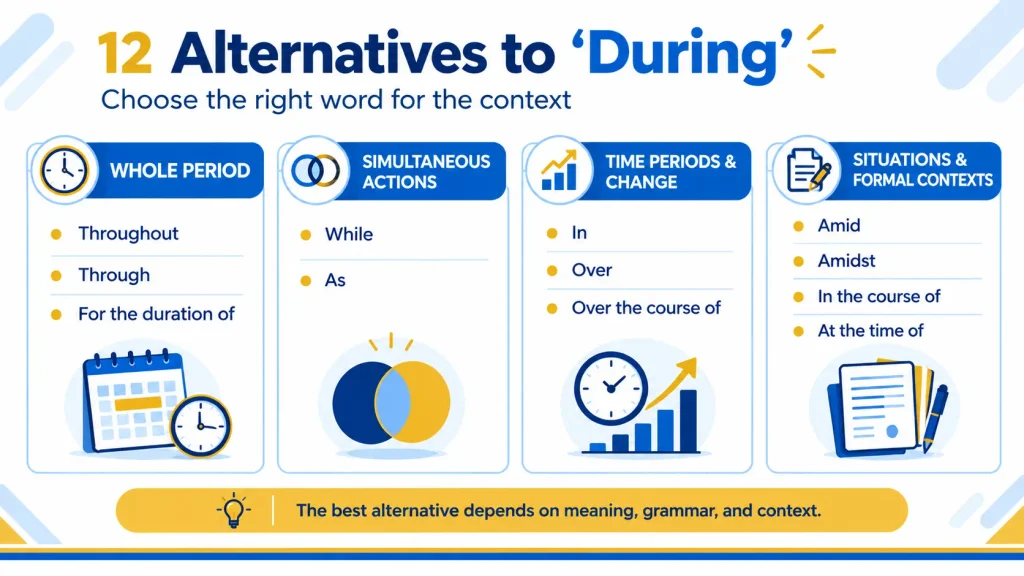
Use throughout when something continues across an entire period, while when two actions happen at the same time, in for broad time periods, and amid for a situation or surrounding condition. Other options include over, through, throughout the course of, in the course of, for the duration of, at the time of, and as.
Key Takeaways
- Throughout emphasizes an entire period rather than one point within it.
- While usually introduces another action or clause happening at the same time.
- In works naturally with broad periods such as years, months, seasons, and historical periods.
- Amid focuses on a situation or surrounding condition rather than simply marking time.
- For describes how long something lasts, so it is not a universal replacement for “during.”
What Does “During” Mean?
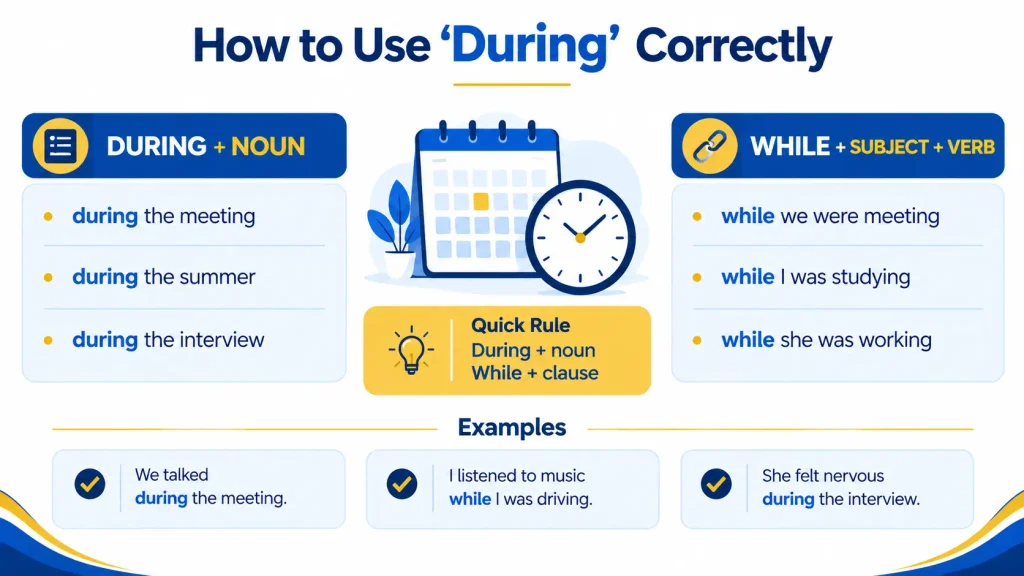
“During” is a preposition used to say when something happens within a particular period or event. It can describe something that happens throughout an event or something that occurs at an unspecified point within it. For example, “We talked during the meeting” means the conversation happened at some point within the meeting.
A key grammar point is that during normally comes before a noun or noun phrase:
- We talked during the meeting.
- She felt nervous during the interview.
- The store was busy during the holiday season.
You generally cannot put a complete clause directly after “during.” For example, “during I was studying” is incorrect; “while I was studying” is the natural construction.
Why Use Another Way to Say “During”?
“During” is already natural and useful, so there is no need to replace it simply for the sake of variety. An alternative helps when you want to make the meaning more precise.
You may want a different expression to:
- emphasize that something lasted for the whole period
- show that two actions happened simultaneously
- make a time reference more specific
- describe a surrounding situation rather than a time period
- avoid repetition in longer writing
- create a smoother sentence structure
The important point is that a synonym should match the intended meaning, not just resemble “during” in a thesaurus.
12 Best Ways to Say “During”
1. Throughout
Throughout is one of the closest alternatives when you mean that something happened across the entire period. Unlike “during,” it often emphasizes continuity from one part of the period to another.
- During the meeting, she remained calm.
- Throughout the meeting, she remained calm.
The second sentence more strongly suggests that her calmness continued across the meeting.
Best for: entire periods, events, or spans of time.
2. While
Use while when you are connecting two actions or events that happen at the same time. The grammar is different: “while” normally introduces a clause containing a subject and verb.
- During my commute, I listened to podcasts.
- While I was commuting, I listened to podcasts.
This makes “while” especially useful when you want to describe simultaneous actions.
Best for: actions happening at the same time.
3. In
“In” can replace “during” with many broad periods, especially months, years, seasons, and historical periods.
- During the summer, we usually visit the coast.
- In the summer, we usually visit the coast.
It can also work with periods such as “the 1990s,” “the afternoon,” and “the winter.”
Best for: broad time periods and dates.
4. Over
Over works well when something happens across a period of time. It can suggest repeated activity, change, or development rather than a single moment.
- During the past few months, sales have increased.
- Over the past few months, sales have increased.
It is particularly natural in everyday and professional writing when discussing trends.
Best for: periods involving change, progress, or repeated events.
5. Through
Through can emphasize continuation across a period, although it does not fit every sentence where “during” appears.
- The team worked through the night.
- She stayed focused through the final stage of the project.
It often sounds more active and can suggest movement from one part of a period toward another.
Best for: continuous activity across a period.
6. Amid
Amid means in the middle of or surrounded by a situation, condition, or event. It is useful when the surrounding circumstances matter as much as the timing.
- During the confusion, the manager remained calm.
- Amid the confusion, the manager remained calm.
“Amid” is not a direct substitute for every time expression. It works best when the noun describes a surrounding situation.
Best for: confusion, uncertainty, change, conflict, excitement, or other circumstances.
7. Amidst
Amidst has essentially the same core meaning as “amid,” but it tends to sound more literary or formal. In American English, amid is usually the simpler choice.
- During the celebrations, the streets were crowded.
- Amidst the celebrations, the streets were crowded.
Use it when its style fits the writing rather than treating it as a universal replacement.
Best for: formal or literary contexts.
8. In the Course of
In the course of refers to something that happens as part of a period, activity, or process. It is especially useful in formal, professional, and academic writing.
- During the investigation, several errors were discovered.
- In the course of the investigation, several errors were discovered.
The longer phrase can sound more deliberate and formal than the simple “during.”
Best for: investigations, projects, processes, professional writing, and formal explanations.
9. Over the Course of
Over the course of emphasizes development across a period rather than simply placing an event inside it.
- During the year, the company expanded its services.
- Over the course of the year, the company expanded its services.
It is particularly natural when discussing changes that happen gradually.
Best for: gradual change, progress, development, and longer periods.
10. For the Duration of
For the duration of explicitly emphasizes the full length of an event or period.
- During the conference, phones must remain silent.
- For the duration of the conference, phones must remain silent.
This phrase is more formal and can sound official, so it is often better suited to policies, instructions, notices, or formal documents.
Best for: formal rules, policies, instructions, and complete durations.
11. At the Time of
At the time of points to the period or circumstances surrounding a particular event. It can be useful when “during” feels too broad.
- During his retirement, he moved to Arizona.
- At the time of his retirement, he was living in Arizona.
The meaning is not always identical. “At the time of” often focuses on the circumstances existing when a particular event occurred.
Best for: specific events, dates, transitions, and historical references.
12. As
As can describe two events happening at the same time, especially when one action develops alongside another.
- During the sun set, the sky turned orange. ❌
- As the sun set, the sky turned orange. ✓
It is often a smoother choice when you want to connect two clauses rather than place a noun after a preposition. Cambridge notes that “as,” “when,” and “while” can all introduce subordinate clauses describing simultaneous events, with differences in emphasis and context.
Best for: simultaneous actions or events in connected clauses.
During vs. Its Closest Alternatives
| Alternative | Best Used In | Tone |
| Throughout | The entire period | Neutral |
| While | Two simultaneous actions | Neutral |
| In | Broad time periods | Neutral |
| Over | Change across a period | Neutral |
| Through | Continued activity | Neutral |
| Amid | Surrounding situations | Neutral/Formal |
| Amidst | Situations or surroundings | Formal/Literary |
| In the course of | Processes and formal contexts | Formal |
| Over the course of | Gradual development | Neutral/Formal |
| For the duration of | Full duration, rules, policies | Formal |
| At the time of | A particular event or point | Neutral/Formal |
| As | Simultaneous clauses | Neutral |
During vs. Throughout vs. While
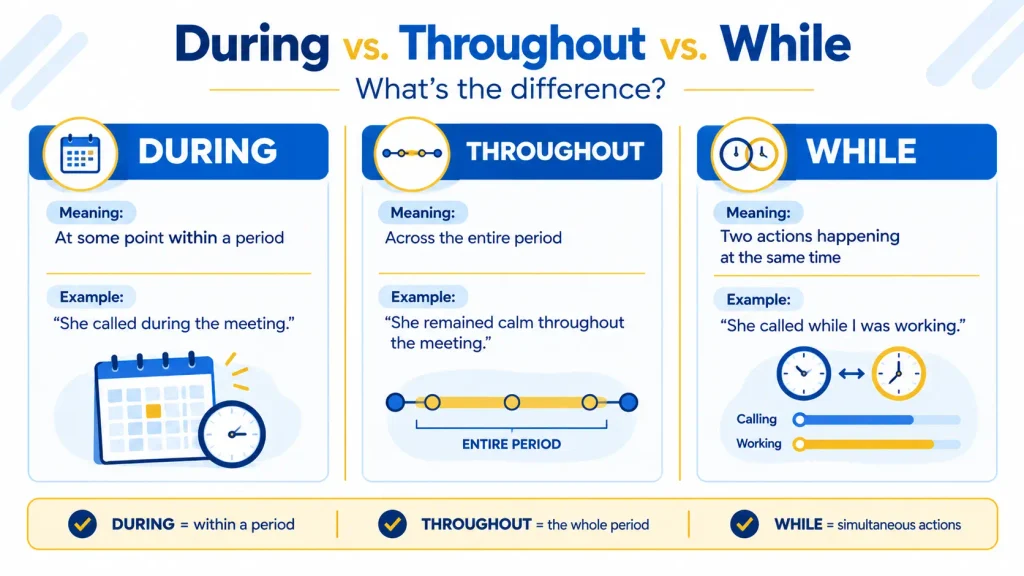
These three are easy to confuse because they can describe overlapping time relationships.
During places something within a period:
We received several calls during the afternoon.
Throughout emphasizes the whole period:
We received calls throughout the afternoon.
While connects simultaneous actions:
We received calls while we were working.
The grammar also matters. “During” normally takes a noun phrase, while “while” introduces a clause.
A useful shortcut is:
during + noun
while + subject + verb
throughout + period/event
Common Mistakes When Replacing “During”
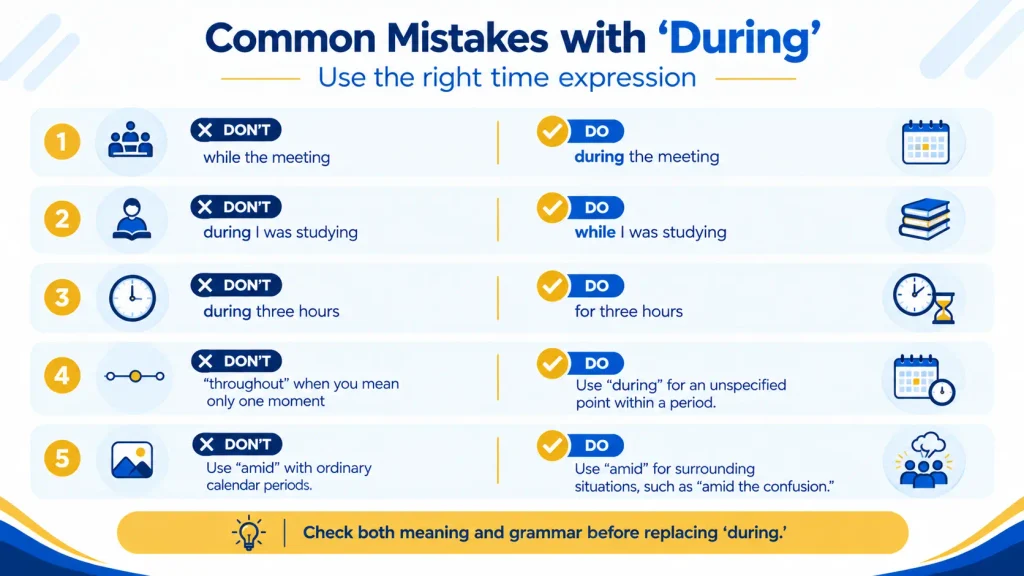
1. Using “while” before a noun
Incorrect:
We talked while the meeting.
Better:
We talked during the meeting.
Or:
We talked while the meeting was taking place.
“While” and “during” can express similar time relationships, but their grammatical structures differ.
2. Treating “throughout” and “during” as identical
“During” can refer to something that happens at one unspecified point within a period. “Throughout” normally gives a stronger sense of the entire period.
The alarm sounded during the night.
This does not necessarily mean it sounded continuously.
The alarm sounded throughout the night.
This suggests repeated or continuing activity across the night.
3. Using “for” when you mean “during”
“During” tells us when something happens. “For” tells us how long it happens.
We visited them during the summer.
We stayed there for three weeks.
“During three weeks” is not the normal way to express duration.
4. Using “amid” with an ordinary time period
“Amid” is better for surrounding circumstances than simple calendar periods.
Natural:
She remained calm amid the confusion.
Less natural:
She remained calm amid Tuesday.
For a day or date, “on” or another time expression will normally be more appropriate.
5. Choosing a formal phrase when a simple word is better
“In the course of” and “for the duration of” can be useful, but they may make a simple sentence unnecessarily heavy.
Instead of:
For the duration of the meeting, we discussed the proposal.
A normal sentence may simply be:
During the meeting, we discussed the proposal.
Use the longer expression when its extra emphasis or formal tone serves a purpose.
Related Alternatives Worth Exploring
If you are choosing among time expressions, these related words can also help:
- while — for simultaneous actions
- when — for a particular time or event
- as — for actions occurring together
- throughout — for an entire period
- until — for an endpoint
- before — for an earlier event
- after — for a later event
- for — for duration
These are related time expressions, but they are not interchangeable synonyms. For example, “until” focuses on an endpoint, while “during” simply identifies the period in which something happens.
Frequently Asked Questions
What is the most common synonym for “during”?
There is no single replacement that works in every sentence. Throughout is a strong choice when you mean the entire period, while in works well with broad time periods. While is appropriate when you introduce another action or clause happening at the same time. The correct choice depends on both meaning and grammar.
Can I use “while” instead of “during”?
Sometimes. Use while when it introduces a clause with a subject and verb: “I listened to music while I was driving.” Use during before a noun or noun phrase: “I listened to music during the drive.” The meanings overlap, but the grammatical structures are different.
Is “throughout” stronger than “during”?
Usually, yes in terms of duration. “Throughout” commonly suggests that something occurs across the whole period, while “during” can refer to any point within that period. “She called during the meeting” does not necessarily mean she called repeatedly or continuously; “she called throughout the meeting” gives a much stronger whole-period sense.
What is a formal way to say “during”?
Depending on the sentence, in the course of, over the course of, or for the duration of can work in formal writing. They are not identical, though. “In the course of” focuses on something happening as part of a process, while “for the duration of” emphasizes the full length of a period.
Is “amid” a synonym for “during”?
“Amid” can replace “during” in some contexts, but the emphasis changes. “During the confusion” simply places an event within a time period. “Amid the confusion” emphasizes that the event happened while surrounded by that confusing situation. It works especially well with nouns describing conditions, events, or circumstances.
What is the difference between “during” and “for”?
“During” tells you when something happens within a period. “For” tells you how long something lasts. For example, “We met during the conference” identifies the time period, while “We talked for two hours” identifies the duration. Cambridge specifically distinguishes “during” for time periods from “for” for length of time.
Can “in” replace “during”?
Often, especially with broad periods. “During the summer” and “in the summer” can both be natural. However, the two words do not work interchangeably in every sentence. “During the meeting” is natural, while “in the meeting” can have a different meaning depending on context. Always consider the exact noun and intended meaning.
Conclusion
“During” is already a natural and flexible word, so the best alternative depends on what you want to emphasize. Choose throughout for an entire period, while or as for simultaneous actions, in for broad time periods, and over for change across time. Amid works when the surrounding situation matters, while in the course of and for the duration of fit more formal contexts. The key is not to replace “during” automatically. First decide whether you mean a point within a period, the whole period, simultaneous action, or the length of time. Once that meaning is clear, the most natural alternative usually becomes obvious.

Communication Editor
Nadia Ellery is a communication editor focused on everyday English, conversational expressions, common phrases, and natural ways to communicate. She helps turn complicated language questions into practical guidance readers can use in everyday situations.