
If someone says “gracias” in Spanish, the standard response is de nada, meaning “you’re welcome.”
But Spanish offers several other natural replies depending on the situation, country, and tone. You can use con gusto for a warm response, no hay de qué for a polite “don’t mention it,” or a ti / a usted when you want to return the thanks.
What Does “You’re Welcome” Mean in Spanish?

When English speakers say “you’re welcome” after someone says “thank you,” they are usually acknowledging the thanks and signaling that the favor was willingly given.
In Spanish, the most common equivalent is:
De nada — “You’re welcome” / “It was nothing.”
For example:
—Gracias por tu ayuda.
—De nada.
—Thanks for your help.
—You’re welcome.
The important point is that “you’re welcome” in this situation is an idiomatic expression. It should not normally be translated word for word as eres bienvenido. Spanish uses different expressions to respond to gracias.
10 Ways to Say “You’re Welcome” in Spanish
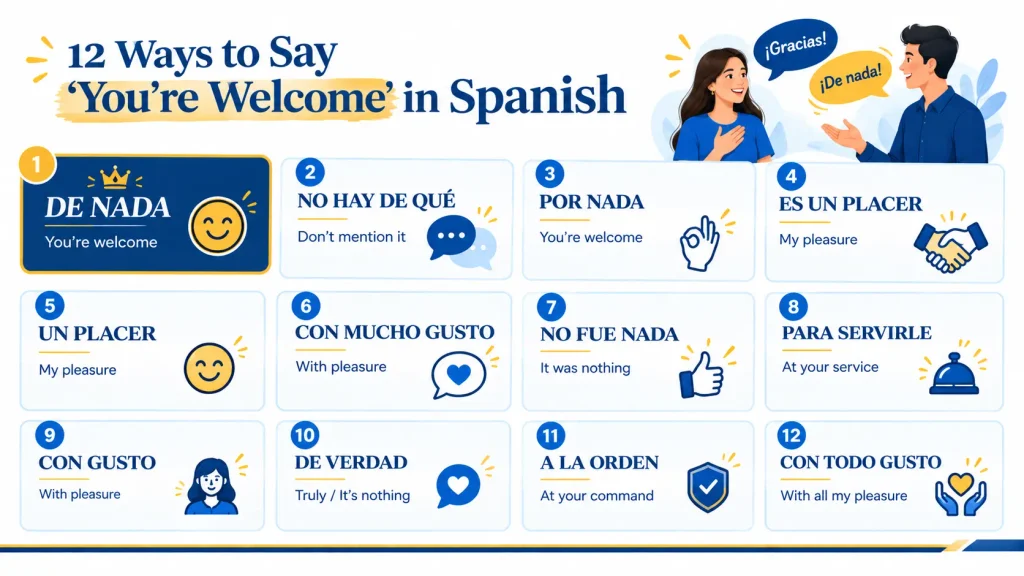
1. De nada — You’re welcome
De nada is the standard, neutral way to respond to gracias. It works in everyday conversations and is understood throughout the Spanish-speaking world.
—Muchas gracias por el consejo.
—De nada.
“Thank you very much for the advice.”
“You’re welcome.”
If you are unsure which expression to use, de nada is the safest choice.
2. No hay de qué — Don’t mention it
No hay de qué literally suggests that there is nothing to thank someone for. In natural English, it is close to “don’t mention it” or “you’re welcome.”
It can sound especially polite when someone gives you a sincere thank-you.
—Muchas gracias por tomarte el tiempo de ayudarme.
—No hay de qué.
“Thanks so much for taking the time to help me.”
“Don’t mention it.”
This expression is useful when you want something a little more expressive than the simple de nada.
3. Con gusto — With pleasure
Con gusto means “with pleasure” or “gladly.” It presents the help as something you were happy to provide.
—Gracias por explicarme cómo funciona.
—Con gusto.
“Thanks for explaining how it works.”
“With pleasure.”
You may hear con gusto often in friendly, polite, or service-related situations, particularly in Latin America.
4. Por nada — No problem / You’re welcome
Por nada is another expression that can be used in response to gracias. It is similar to de nada and can sound casual.
—Gracias por guardar mi asiento.
—Por nada.
“Thanks for saving my seat.”
“No problem.”
It is useful to recognize, but de nada remains the more universal default for learners.
5. A ti — Thank you / You’re welcome
A ti literally means “to you.” It is commonly used when the speaker feels that the other person deserves some of the thanks.
For example:
—Gracias por venir conmigo.
—A ti.
“Thanks for coming with me.”
“Thank you.”
This expression is informal because ti is associated with the familiar tú form.
6. A usted — Thank you / You’re welcome
A usted works similarly to a ti, but it uses the formal usted form.
—Muchas gracias por su ayuda.
—A usted.
“Thank you very much for your help.”
“Thank you.”
The exact English translation depends on the situation. Rather than functioning as a direct equivalent of you’re welcome in every context, a usted can acknowledge that the thanks are mutual or that the other person is also deserving of appreciation.
7. Es un placer — It’s a pleasure
Es un placer means “it’s a pleasure.” It emphasizes that you were pleased to help.
—Muchas gracias por recibirnos.
—Es un placer.
“Thank you very much for having us.”
“It’s a pleasure.”
This works especially well when you want your response to sound warm and courteous rather than brief.
8. No hay problema — No problem
No hay problema literally means “there’s no problem.” It can be used as a relaxed response to thanks.
—Gracias por llevarme a casa.
—No hay problema.
“Thanks for driving me home.”
“No problem.”
It is a good fit for casual conversations, although it shifts the focus slightly from gratitude to reassurance that the favor caused no inconvenience.
9. A la orden — At your service
A la orden can convey the idea of “at your service” or “anytime.” It is particularly associated with service and hospitality in parts of Latin America.
—Muchas gracias por su ayuda.
—A la orden.
“Thank you very much for your help.”
“At your service.”
This is a good expression to recognize if you are traveling or interacting with Spanish speakers in different Latin American regions. It is more regionally marked than de nada.
10. Cuando quieras — Anytime
Cuando quieras means “whenever you want” or, more naturally in some contexts, “anytime.”
—Gracias por ayudarme con el proyecto.
—Cuando quieras.
“Thanks for helping me with the project.”
“Anytime.”
It is especially natural when you want to suggest that you would be happy to help again.
Which Spanish Expression Should You Use?
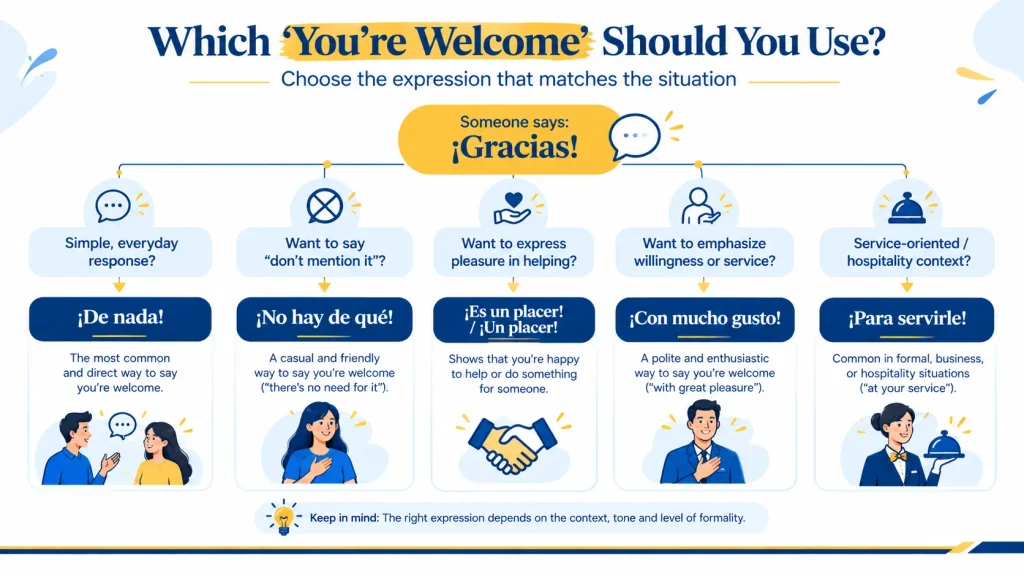
The best expression depends on how you want to sound.
| Alternative | Best Used In | Tone |
| De nada | General situations | Neutral |
| No hay de qué | Polite conversations | Polite |
| Con gusto | Friendly or service situations | Warm |
| Por nada | Casual conversations | Casual |
| A ti | Informal exchanges | Friendly |
| A usted | Formal or respectful exchanges | Polite |
| Es un placer | Courteous situations | Warm / formal |
| No hay problema | Everyday conversations | Relaxed |
| A la orden | Service and regional contexts | Courteous |
| Cuando quieras | Friends and familiar situations | Friendly |
“De Nada” vs. “Con Gusto” vs. “No Hay de Qué”
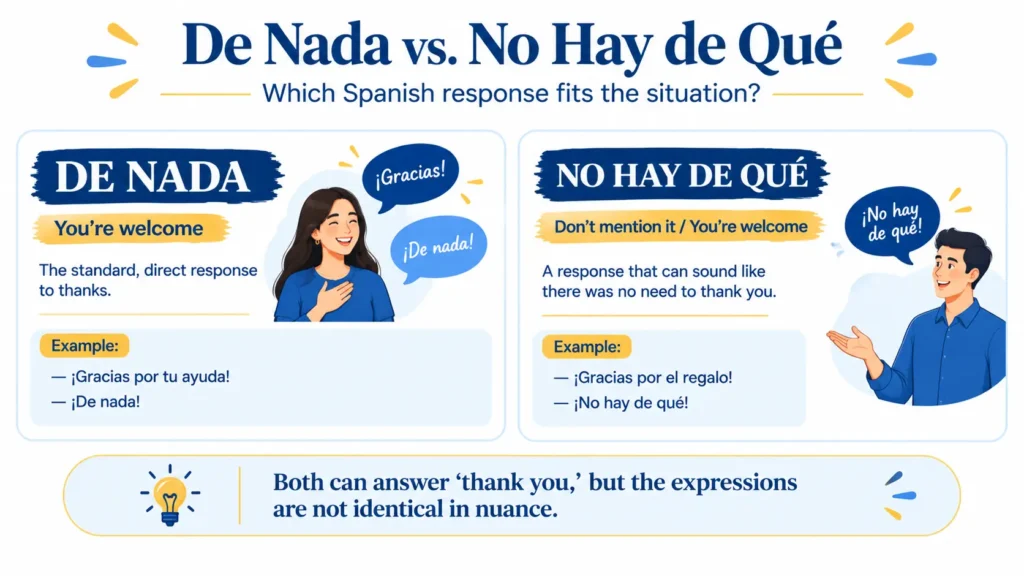
These three are easy to confuse because all can respond to gracias, but they do not create exactly the same impression.
De nada is the neutral default. Use it when you simply want to say “you’re welcome.”
Con gusto emphasizes willingness: you were happy to help.
No hay de qué emphasizes that the favor was not something the other person needs to worry about thanking you for.
Compare:
—Gracias por tu ayuda.
—De nada.
Simple and neutral.
—Gracias por tu ayuda.
—Con gusto.
Warm and willing.
—Muchas gracias por tu ayuda.
—No hay de qué.
Polite and reassuring.
Common Mistakes to Avoid
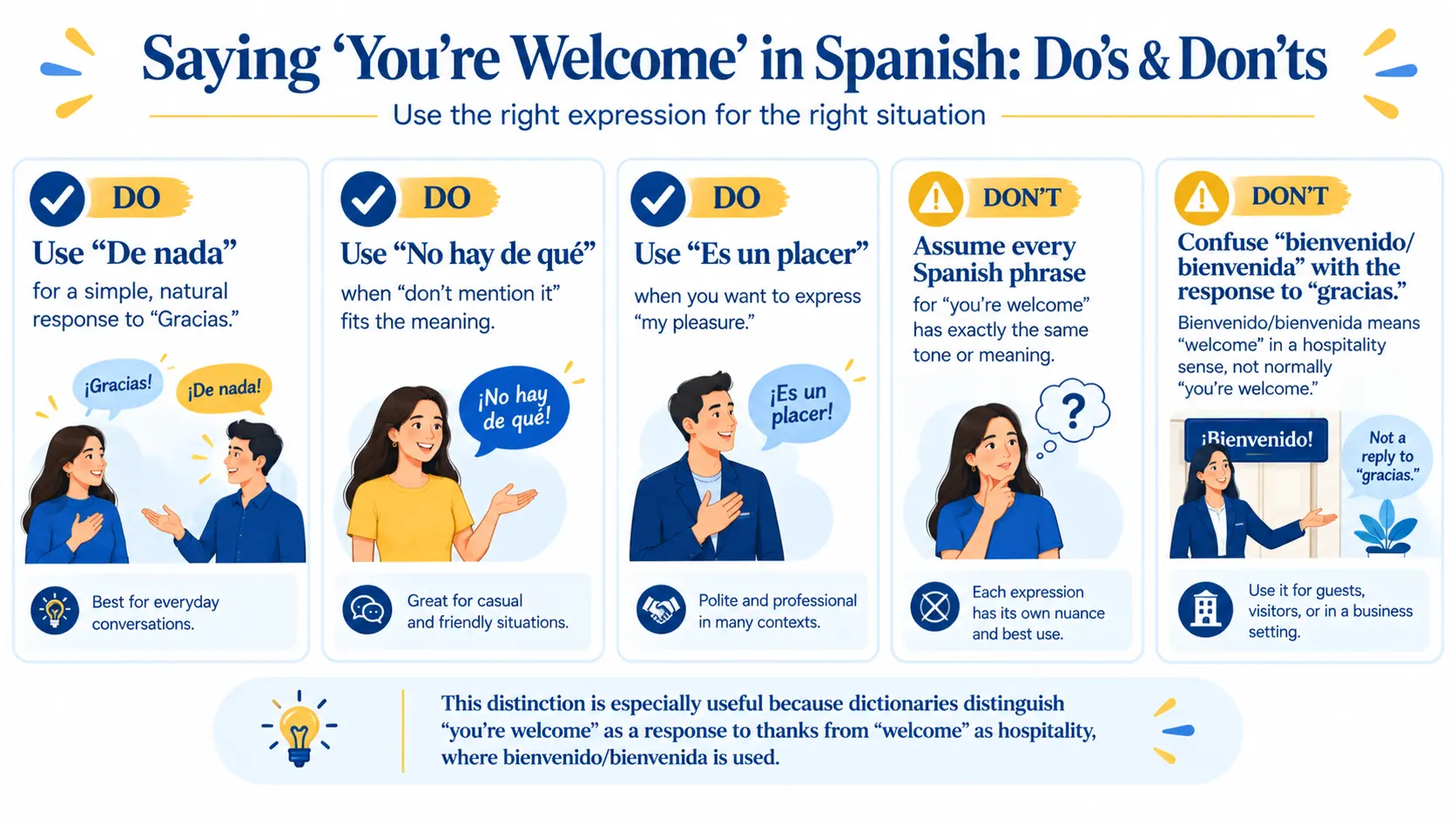
1. Using “bienvenido” as a response to “gracias”
This is one of the most important distinctions.
Bienvenido means “welcome” when welcoming someone to a place or situation. It does not normally mean “you’re welcome” as a response to gracias.
For example:
Bienvenido a mi casa.
“Welcome to my house.”
But after someone says:
Gracias.
A natural response is:
De nada.
2. Translating English expressions word for word
Idiomatic expressions do not always transfer directly between languages. “You’re welcome” does not mean that Spanish speakers should use the literal concept of welcome when responding to thanks.
Think in terms of the function of the phrase: someone says gracias, and you respond appropriately.
3. Using a regional expression everywhere
Expressions such as a la orden can be very natural in particular Spanish-speaking regions and contexts, but they are not interchangeable with de nada in every setting.
If you are learning general Spanish, start with de nada and then learn regional alternatives as you encounter them.
4. Treating every alternative as an exact synonym
A ti, a usted, es un placer, and cuando quieras can perform a similar conversational function, but their meanings are not identical to de nada.
Choose based on what you actually want to communicate.
5. Ignoring formality
A ti is familiar, while a usted is formal. The choice should match how you are addressing the other person.
Related Spanish Expressions Worth Exploring
If you are learning how to respond naturally in Spanish, these related expressions are also useful:
- Cómo responder a “gracias” en español
- Diferencia entre “de nada” y “con gusto”
- Formas de decir “gracias” en español
Frequently Asked Questions
What is the most common way to say “you’re welcome” in Spanish?
De nada is the standard and most widely understood way to respond to gracias. It works in casual and neutral situations and is a reliable choice for Spanish learners. Other expressions, such as con gusto and no hay de qué, add different shades of warmth, politeness, or regional usage.
Is “de nada” formal or informal?
De nada is neutral, so it works in both casual and many polite situations. You can use it with friends, coworkers, acquaintances, or strangers. Its neutrality is one reason it is such a useful expression for learners who want a response that does not sound overly formal or overly casual.
Can I say “con gusto” instead of “de nada”?
Yes. Con gusto can be used in response to gracias and means roughly “with pleasure” or “gladly.” It often sounds warm and willing, while de nada is more neutral. The expression is especially common in many Latin American contexts and can work well in customer-service interactions.
What is the difference between “de nada” and “no hay de qué”?
Both can respond naturally to gracias, but the nuance differs. De nada is the straightforward equivalent of “you’re welcome.” No hay de qué is closer to “don’t mention it” or “there’s nothing to thank me for.” The latter can sound more deliberate or courteous.
Can I say “por nada” in Spanish?
Yes. Por nada is used as a response to gracias and is similar to de nada. However, usage varies by region and context. For a Spanish learner looking for the safest general expression, de nada is the better default, while por nada is useful to recognize and use when it fits the variety of Spanish you are learning.
Is “bienvenido” another way to say “you’re welcome”?
Not when you’re welcome is a response to gracias. Bienvenido means “welcome” when receiving or greeting someone, such as Bienvenido a nuestra casa (“Welcome to our house”). After someone thanks you, use an expression such as de nada, con gusto, or no hay de qué.
How do you say “you’re welcome” politely in Spanish?
De nada is already polite and neutral. Depending on the situation, you can also use no hay de qué, con gusto, or es un placer. With formal usted interactions, a usted can also be appropriate when the context involves returning or acknowledging the thanks.
Conclusion
If you need another way to say “you’re welcome” in Spanish, start with de nada. It is the standard response to gracias and works across a wide range of everyday situations. Once you are comfortable with it, add con gusto for a warmer “with pleasure,” no hay de qué for “don’t mention it,” and por nada for another casual option.
In more specific situations, a ti, a usted, es un placer, a la orden, and cuando quieras can express slightly different meanings or regional styles. The key is not to translate you’re welcome literally: when someone says gracias, choose the Spanish response that matches your relationship, setting, and intended tone.

Senior Language Editor
Mara Whitcombe is a senior language editor specializing in English vocabulary, synonyms, word meanings, and semantic nuance. She focuses on helping readers understand not only what a word means, but how its meaning, tone, and context can change in real-world communication.