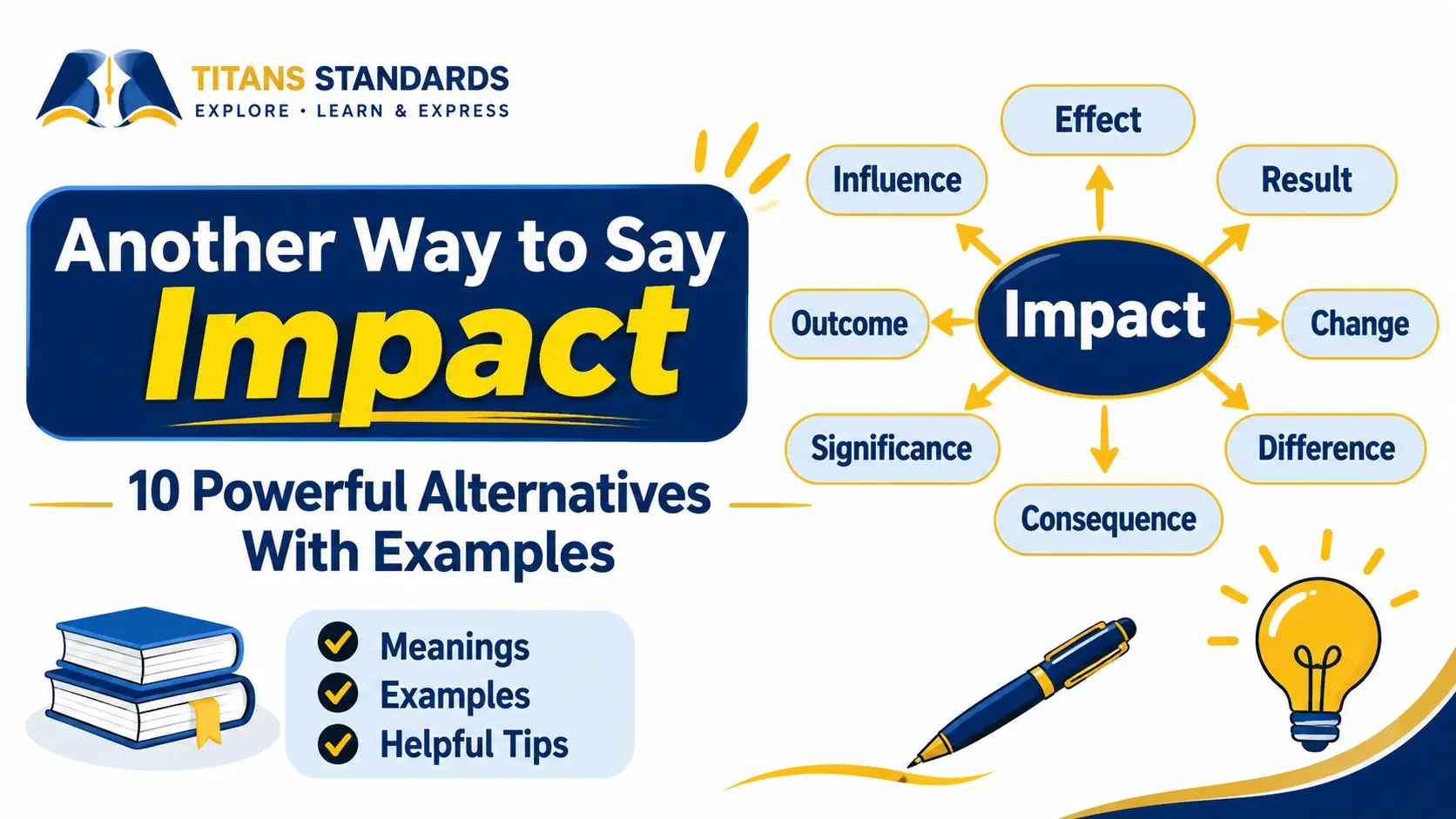
Another way to say impact includes effect, influence, consequence, impression, outcome, significance, and result.
These alternatives help you describe how something changes a situation, affects a person, or produces a particular result. The best choice depends on your meaning, audience, and whether you’re writing formally or speaking casually.
Key Takeaways
- Impact can describe an effect, influence, or noticeable change.
- Effect and result work well when describing outcomes.
- Influence is useful when discussing someone’s ability to shape decisions or behavior.
- Consequence often describes what happens because of an action.
- Choose an alternative that matches your sentence and intended meaning.
What Does “Another Way to Say Impact” Mean?
The phrase “another way to say impact” refers to different words and expressions that communicate the effect, influence, or result of something. People search for these alternatives when they want to avoid repeating impact or make their writing clearer.
The word impact works as both a noun and a verb. As a noun, it describes the effect something has on a person, situation, or decision. As a verb, it means to affect or influence something.
For example:
- Noun: The new policy had a positive impact on employees.
- Verb: Rising costs impact small businesses.
You commonly see this word in everyday conversations, business reports, academic essays, news articles, and professional emails.
For the full definition, see Cambridge Dictionary.
Why Use Other Ways to Say “Impact”?
Using different alternatives can make your writing more precise and natural. Although impact is a useful word, repeating it too often can make sentences sound predictable.
Here are some reasons to choose another expression:
- Avoid repetition: Keep your writing varied and engaging.
- Improve clarity: Explain exactly how something affects a situation.
- Match the tone: Choose suitable language for casual or professional settings.
- Express meaning accurately: Distinguish between an effect, influence, and consequence.
- Strengthen communication: Make your ideas easier for readers to understand.
10 Best Other Ways to Say Impact

1. Effect
Meaning
Effect describes a change or result caused by an action, event, or decision. It is one of the closest alternatives to impact when discussing what happens because of something.
Best For
- Professional
- Formal
- Academic
Example 1
The new training program had a positive effect on employee performance.
Example 2
We need to understand the effects of poor sleep on concentration.
Quick Tip
Use effect when you want to focus on the result rather than the process that caused it.
2. Influence
Meaning
Influence describes the power to affect someone’s behavior, opinions, choices, or decisions. It is especially useful when discussing people, leadership, social trends, and personal relationships.
Best For
- Professional
- Formal
- Academic
Example 1
Her leadership had a strong influence on the team’s success.
Example 2
Social media can influence how young people view themselves.
Quick Tip
Choose influence when something shapes a person’s thinking, behavior, or decisions.
3. Effectiveness
Meaning
Effectiveness refers to how successfully something produces its intended result. It is a useful alternative when discussing the impact of strategies, programs, tools, or methods.
Best For
- Professional
- Formal
Example 1
The company measured the effectiveness of its new marketing strategy.
Example 2
Regular feedback improved the effectiveness of the training sessions.
Quick Tip
Use effectiveness when evaluating how well an action or approach works, not simply what happens afterward.
4. Consequence
Meaning
A consequence is something that happens because of a particular action, decision, or event. It often refers to an important outcome and can have either a positive or negative meaning.
Best For
- Formal
- Professional
- Academic
Example 1
Ignoring customer feedback can have serious consequences for a business.
Example 2
One unexpected consequence of the decision was a longer delivery time.
Quick Tip
Use consequence when you want to emphasize what follows from a specific action.
5. Result
Meaning
Result describes what happens because of an action, situation, or process. It is a simple and versatile alternative that works in both everyday and professional communication.
Best For
- Casual
- Professional
- Academic
Example 1
The new advertising campaign produced impressive results.
Example 2
Better communication was the result of regular team meetings.
Quick Tip
Choose result when you want to highlight the final outcome of an action or decision.
6. Significance
Meaning
Significance describes the importance or meaning of something. It works well when you want to explain why an event, decision, discovery, or achievement matters.
Best For
- Formal
- Professional
- Academic
Example 1
The research highlights the significance of early childhood education.
Example 2
We discussed the significance of the agreement during the meeting.
Quick Tip
Use significance when discussing importance rather than a direct cause-and-effect relationship.
7. Impression
Meaning
Impression refers to the feeling, opinion, or effect that someone or something creates in another person’s mind. It is particularly useful when discussing first encounters, communication, and public perception.
Best For
- Casual
- Friendly
- Professional
Example 1
Her confident presentation made a lasting impression on the audience.
Example 2
The restaurant’s welcoming atmosphere created a positive impression.
Quick Tip
Choose impression when describing how someone or something is perceived by others.
8. Outcome
Meaning
Outcome refers to the final result of an action, process, or situation. It is commonly used in business, education, healthcare, and everyday discussions about decisions and plans.
Best For
- Professional
- Formal
- Academic
Example 1
The team hopes the new strategy will lead to a better outcome.
Example 2
The outcome of the negotiations surprised both companies.
Quick Tip
Use outcome when focusing on the final state or conclusion of a process.
9. Change
Meaning
Change describes a difference in the condition, behavior, appearance, or development of something. It works when the impact you are discussing involves a noticeable shift from an earlier situation.
Best For
- Casual
- Professional
- Friendly
Example 1
The new schedule brought a noticeable change to our daily routine.
Example 2
Her advice made a real change in how I approached the problem.
Quick Tip
Use change when you want to emphasize what became different rather than simply describing an effect.
10. Difference
Meaning
Difference describes how one thing changes, improves, or affects another compared with its previous condition or an alternative. It is especially useful in everyday conversations and situations involving comparison.
Best For
- Casual
- Friendly
- Professional
Example 1
A little extra preparation can make a big difference in your performance.
Example 2
The updated software made a noticeable difference in how quickly we completed the task.
Quick Tip
Use difference when emphasizing a noticeable improvement, contrast, or change.
Comparison Table: Alternatives to Impact
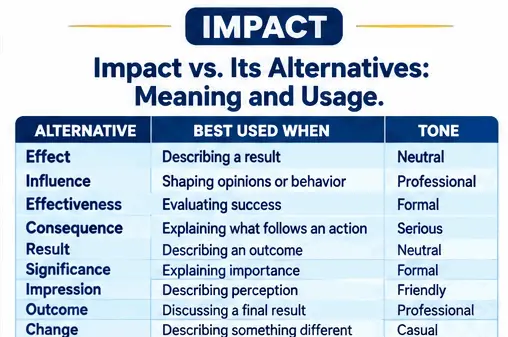
| Alternative | Best Used In | Tone |
|---|---|---|
| Effect | Reports and essays | Neutral |
| Influence | Leadership and behavior | Professional |
| Effectiveness | Evaluations and reviews | Formal |
| Consequence | Decisions and actions | Serious |
| Result | Everyday and business writing | Neutral |
| Significance | Research and academic writing | Formal |
| Impression | Personal experiences | Friendly |
| Outcome | Plans and processes | Professional |
| Change | Everyday situations | Casual |
| Difference | Comparisons and improvements | Neutral |
Common Mistakes When Using Alternatives to Impact
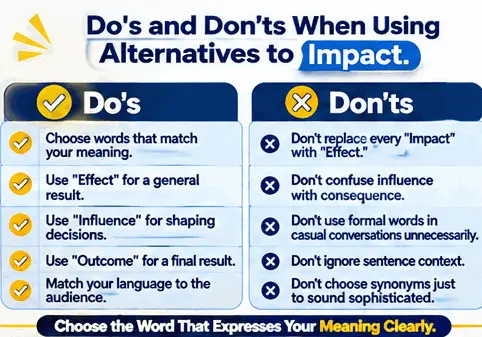
Choosing a synonym without considering its meaning can make your sentence confusing. Avoid these five common mistakes.
1. Using Effect and Influence Interchangeably
Although both words describe how something affects another thing, they have different meanings. Effect usually describes a result, while influence focuses on the power to shape behavior, opinions, or decisions.
2. Using Consequence for Every Situation
Consequence often suggests an outcome caused by an action, sometimes a negative one. Avoid using it when you simply want to describe a positive effect or general improvement.
3. Choosing Overly Formal Words in Casual Conversations
Words such as significance and effectiveness may sound unnatural in everyday discussions. Choose simpler alternatives such as effect, change, or difference when appropriate.
4. Repeating the Same Alternative
Replacing every occurrence of impact with effect does not improve variety. Select different expressions based on what each sentence actually communicates.
5. Ignoring the Context
Not every alternative fits every sentence. For example, impression describes how something is perceived, while outcome describes the final result of a process.
Frequently Asked Questions
1. What is another word for impact?
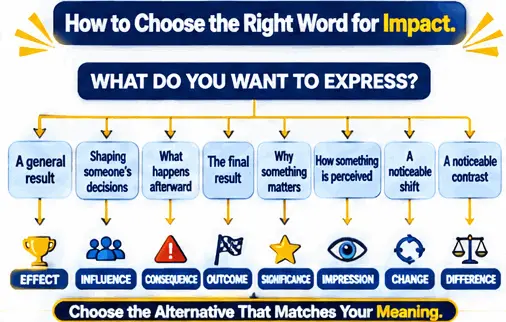
Some common alternatives to impact include effect, influence, consequence, result, outcome, impression, significance, and change. Each word has a slightly different meaning. Choose effect for a general result, influence for someone’s ability to shape decisions, and outcome when discussing the final result of a situation.
2. What is a more professional word for impact?
Influence, effect, consequence, and significance are useful professional alternatives. For example, instead of writing “The project had a major impact on sales,” you could say, “The project significantly influenced sales performance.” Choose the expression that best communicates the intended meaning.
3. What is another way to say positive impact?
You can replace positive impact with beneficial effect, favorable influence, positive outcome, meaningful difference, or valuable contribution. These expressions work well in business reports, professional emails, and academic writing. For example, “The program had a beneficial effect on employee satisfaction.”
4. What is another way to say negative impact?
Common alternatives to negative impact include harmful effect, adverse consequence, damaging influence, and unfavorable outcome. These expressions help describe unwanted results in different situations. For example, “The policy had an adverse effect on small businesses.”
5. What is a formal synonym for impact?
Formal synonyms for impact include effect, consequence, significance, and influence. These words are suitable for research papers, business documents, reports, and professional presentations. However, the best choice depends on whether you are discussing an outcome, importance, or the ability to affect something.
6. What is another way to say major impact?
You can use significant effect, substantial influence, considerable effect, profound impact, or far-reaching consequences. These expressions emphasize that something has produced an important or noticeable change. For example, “The new technology had a substantial effect on workplace productivity.”
7. What is the difference between impact and effect?
Impact often emphasizes the strength or importance of an effect, while effect refers more generally to a result caused by something. For example, “The decision had a major impact on the company” highlights its importance, while “The effect was immediate” focuses on the result.
8. Can I use impact in academic writing?
Yes, impact is widely used in academic writing when discussing the effects of research, policies, events, or social changes. However, alternatives such as effect, influence, consequence, and significance can make your writing more precise. Select the word that accurately represents your argument.
For related wording choices, see another way to say “appreciate”, another way to say “learn” and another way to say “figure out”.
Conclusion
Finding another way to say impact can make your writing clearer, more engaging, and more precise. Although impact works in many situations, choosing the right alternative helps you communicate your message more effectively.
Use effect when describing a general result, influence when discussing someone’s ability to shape decisions, and consequence when explaining what happens because of an action. For academic and professional writing, significance and outcome are also useful choices.
In everyday conversations, simpler expressions such as change and difference often sound more natural. Remember that synonyms are not always interchangeable. Consider your audience, sentence structure, and intended meaning before choosing a replacement.
The best alternative is not necessarily the most sophisticated word. It is the one that expresses your idea accurately and naturally.
Looking for more ways to refresh everyday phrases? Explore our guides to fresher ways to say said and done, or find a better way to say he says.

Editorial Desk
The Titan Standards Editorial Team develops, reviews, and maintains practical English-language resources. The team checks articles for clarity, accuracy, context, readability, and consistency with Titan Standards’ editorial guidelines.