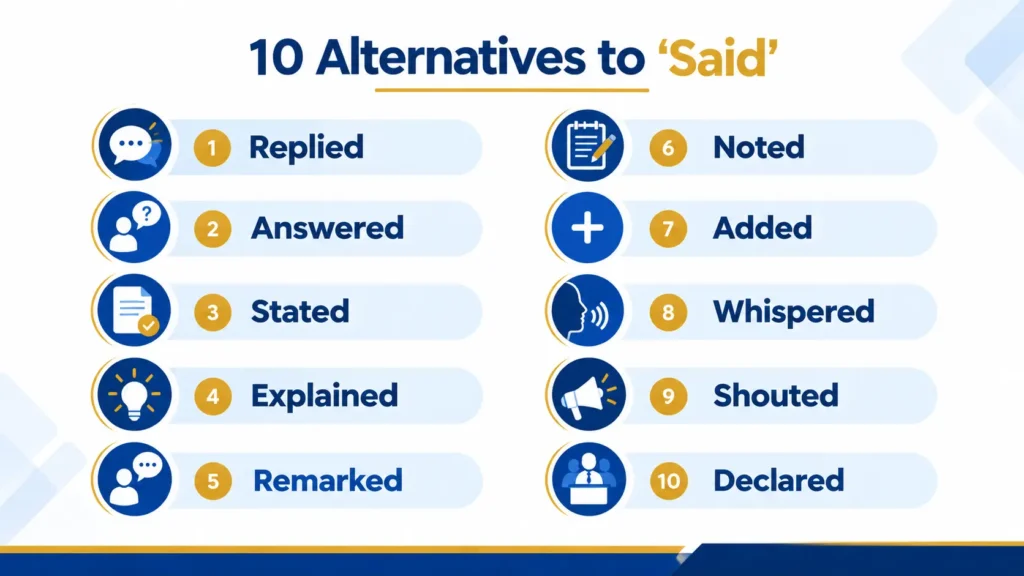
Another way to say said depends on the context and the speaker’s intention. Useful alternatives include replied, answered, stated, explained, remarked, noted, added, whispered, shouted, and declared. These words help you avoid repetition, describe how someone speaks, and make stories, conversations, emails, and professional writing more precise.
Key Takeaways
- Use replied or answered when someone responds to a question or statement.
- Choose stated or declared for clear, direct, or formal communication.
- Use explained when a speaker makes an idea easier to understand.
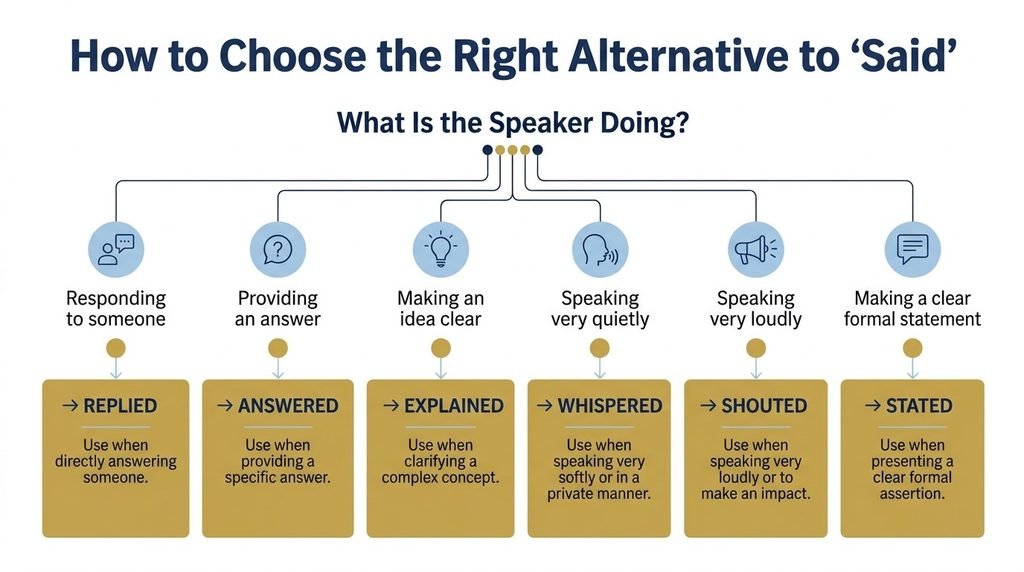
- Try whispered or shouted to show how loudly someone speaks.
- Match every alternative to the sentence’s meaning, tone, and context.
What Does “Another Way to Say Said
” Mean?
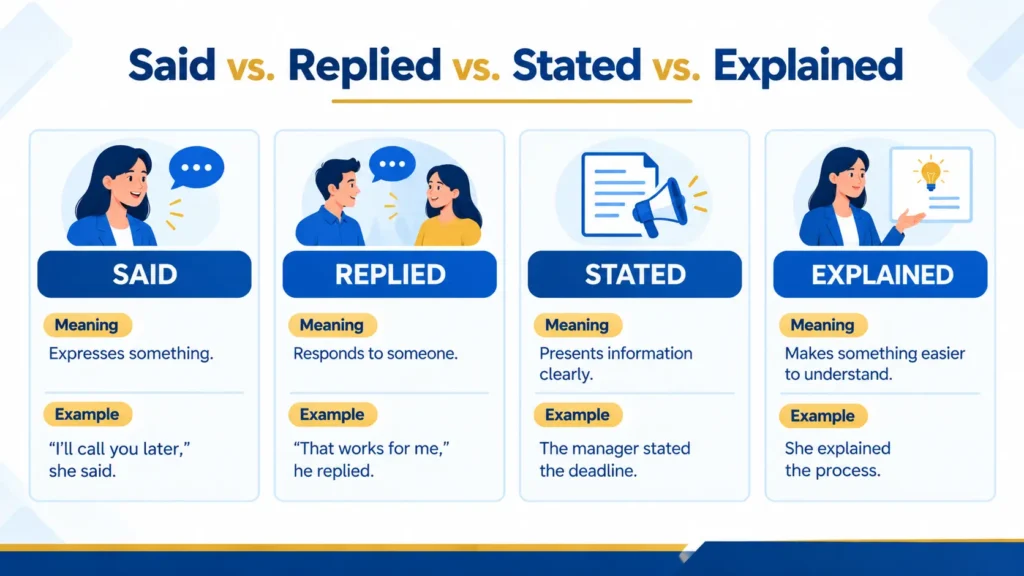
The phrase “another way to say said” refers to alternative words that communicate the same general idea as said. Writers use these words to describe speech more clearly, avoid repetitive dialogue tags, and show how a person delivers a message.
For example, instead of writing, “She said she needed help,” you could write, “She explained that she needed help.” The second sentence suggests that she provided information or clarification.
These alternatives appear in fiction, school assignments, workplace emails, articles, reports, and everyday conversations. However, they are not always interchangeable. The best choice depends on what the speaker communicates and how the message is delivered.
Why Use Other Ways to Say Said?
Using different speech verbs makes your writing more natural and informative. Repeating said in every sentence can make a long conversation feel monotonous, while choosing precise alternatives helps readers understand the exchange.
Here are the main benefits:
- Avoid repetition: Keep dialogue from sounding repetitive.
- Show intention: Make it clear whether someone is answering, explaining, or making an announcement.
- Describe delivery: Show whether a person whispers, shouts, or speaks normally.
- Improve professional communication: Choose words that suit reports, presentations, and formal statements.
- Make stories more engaging: Help readers understand the mood and purpose of a conversation.
Remember that said remains a useful and natural word. You do not need to replace it every time; use alternatives when they add meaningful information.
10 Best Other Ways to Say Said
1. Replied
Meaning
Replied means to respond to something another person has said, asked, or written. It works well when a conversation involves a clear response.
Best For: Casual, Friendly, Professional, Polite
Example 1: “I’ll send you the updated schedule this afternoon,” Maria replied.
Example 2: “That sounds like a great idea,” he replied with a smile.
Quick Tip: Use replied when the sentence focuses on a response rather than the original statement.
2. Answered
Meaning
Answered means to respond to a question, request, or situation. It is especially useful when a character provides specific information or resolves someone’s uncertainty.
Best For: Casual, Friendly, Professional, Polite
Example 1: “The meeting starts at nine,” Daniel answered.
Example 2: “I chose the blue one because it matches the room,” she answered.
Quick Tip: Choose answered when someone directly addresses a question or provides the information another person needs.
3. Stated
Meaning
Stated means to express information clearly and directly. It often sounds more formal than said, making it appropriate for professional communication, official records, and factual statements.
Best For: Professional, Formal
Example 1: The manager stated that all reports must be submitted by Friday.
Example 2: “Our office will remain closed on Monday,” the announcement stated.
Quick Tip: Use stated for clear information, policies, or positions rather than casual conversation.
4. Explained
Meaning
Explained means to make something easier to understand by providing details, reasons, or clarification. It is a strong choice when a speaker helps someone understand a process, decision, or idea.
Best For: Professional, Friendly, Polite
Example 1: “You need to restart the computer before installing the update,” the technician explained.
Example 2: Olivia explained why the team needed an extra day to finish the project.
Quick Tip: Choose explained when the speaker gives reasons or details, not merely when someone makes a brief statement.
5. Remarked
Meaning
Remarked means to make a comment or observation about something. It can sound conversational, thoughtful, or slightly formal, depending on the surrounding sentence.
Best For: Formal, Casual, Friendly
Example 1: “The new library looks much brighter,” the teacher remarked.
Example 2: He remarked that the restaurant had changed considerably since his last visit.
Quick Tip: Use remarked when someone comments on a situation, detail, or observation.
6. Noted
Meaning
Noted means to mention or point out something worth attention. It works well in professional writing and situations where a speaker highlights an important fact or detail.
Best For: Professional, Formal, Polite
Example 1: “The final report includes the revised figures,” the analyst noted.
Example 2: The supervisor noted that two documents were missing from the application.
Quick Tip: Choose noted when the information is relevant or noteworthy, especially in reports and business discussions.
7. Added
Meaning
Added means to contribute another thought or piece of information to something already being discussed. It is useful when a speaker continues an explanation or introduces an additional point.
Best For: Professional, Casual, Friendly
Example 1: “We should review the budget before approving the plan,” James added.
Example 2: “Don’t forget to bring your identification,” the receptionist added.
Quick Tip: Use added when a person contributes something extra to an ongoing conversation.
8. Whispered
Meaning
Whispered means to speak very softly, usually so that only nearby people can hear. It can suggest secrecy, privacy, nervousness, or a desire not to disturb others.
Best For: Casual, Friendly, Warm
Example 1: “The baby is finally asleep,” Emma whispered.
Example 2: He whispered that he had planned a surprise for her birthday.
Quick Tip: Choose whispered when the volume or quiet nature of the speech matters to the scene.
9. Shouted
Meaning
Shouted means to speak in a very loud voice, often to be heard over noise or from a distance. Depending on the situation, it may communicate excitement, urgency, anger, or fear.
Best For: Casual, Friendly
Example 1: “The bus is leaving!” Sarah shouted from the doorway.
Example 2: “We won the championship!” the captain shouted to the crowd.
Quick Tip: Use shouted when loudness is important. Do not automatically use it to suggest anger because people also shout with excitement or urgency.
10. Declared
Meaning
Declared means to announce something firmly or confidently. It often suggests a strong position, an official announcement, or a statement intended to make the speaker’s intentions clear.
Best For: Formal, Professional
Example 1: “We will complete this project before the deadline,” the director declared.
Example 2: “I am ready to take responsibility for my decision,” she declared.
Quick Tip: Use declared when the statement sounds firm, important, or decisive. For ordinary conversation, said or stated may sound more natural.
Comparison Table
| Alternative | Best Used In | Tone |
| Replied | Conversations and responses | Natural, conversational |
| Answered | Questions and requests | Direct, clear |
| Stated | Reports and official statements | Formal, neutral |
| Explained | Instructions and clarification | Informative, helpful |
| Remarked | Comments and observations | Conversational, thoughtful |
| Noted | Reports and important details | Professional, precise |
| Added | Continuing a discussion | Natural, informative |
| Whispered | Quiet or private speech | Soft, intimate |
| Shouted | Loud or urgent speech | Forceful, emotional |
| Declared | Firm statements and announcements | Strong, decisive |
Common Mistakes When Replacing Said
1. Using the Wrong Word for the Situation
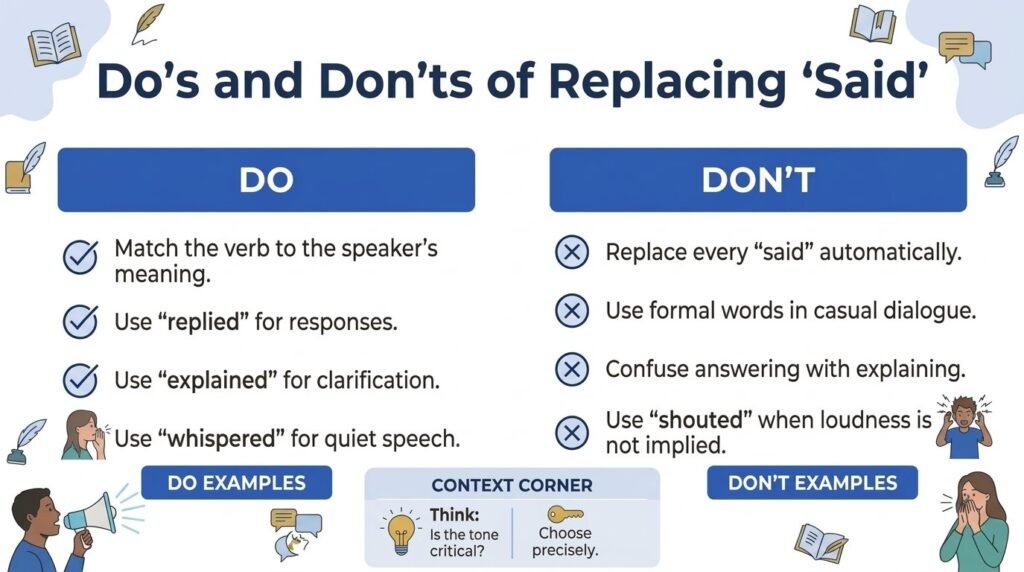
Not every alternative describes the same action. For example, answered suggests a response, while explained suggests clarification. Choose the word that accurately describes what the speaker does.
2. Making Every Dialogue Tag Unusual
Replacing said with a different verb in every sentence can distract readers. Use familiar words when they work best, and introduce alternatives when they add useful meaning.
3. Using Formal Words in Casual Conversations
Words such as declared and stated may sound stiff in ordinary conversations. For example, “I’ll be there soon,” he stated may sound unnecessarily formal compared with “I’ll be there soon,” he said.
4. Ignoring the Speaker’s Tone
A word can change how readers imagine a scene. Whispered suggests quiet speech, while shouted indicates loudness. Avoid choosing a verb that conflicts with the intended mood.
5. Using Alternatives That Do Not Match the Meaning
Some speech verbs describe more than the act of speaking. Admitted suggests acknowledging something, promised indicates a commitment, and claimed may signal an assertion that has not been established as true. Use these words only when their meanings fit the context.
Frequently Asked Questions
What is the best alternative to said?
There is no single best alternative for every situation. Replied works well for responses, explained for clarification, and stated for formal information. If the sentence does not need extra detail about the speaker’s intention or delivery, said may remain the clearest choice.
What are 10 synonyms for said?
Ten useful alternatives are replied, answered, stated, explained, remarked, noted, added, whispered, shouted, and declared. Each has a slightly different meaning. Some describe the purpose of the statement, while others show how the person speaks, so choose one that fits the sentence.
How can I avoid repeating said in a story?
Vary your dialogue tags when a different verb adds useful information. You can also use character actions, facial expressions, or the surrounding dialogue to show emotion. Keep said where it reads naturally, and avoid replacing it simply to make every sentence different.
What is a formal word for said?
Stated is a useful formal alternative when someone expresses information directly. Declared works for firm announcements, while noted is appropriate when a speaker highlights a relevant detail. Choose the word according to the purpose of the statement and the level of formality required.
What is another way to say said in an essay?
In an essay, stated, explained, noted, and argued may work, depending on the meaning. Use argued when an author presents a reasoned position, explained when clarifying an idea, and noted when pointing out a detail. For academic writing, accuracy matters more than variety.
What can I use instead of said in dialogue?
For dialogue, you can use replied, answered, whispered, shouted, or remarked. Select the verb based on what the character is doing. For instance, whispered communicates low volume, while replied shows that a character is responding to someone.
Is said better than other dialogue tags?
Often, yes. Said is simple and unobtrusive, so readers can focus on the conversation itself. Alternatives are useful when they clarify the meaning, tone, or delivery of a statement. Good writing uses variety with purpose instead of treating every occurrence of said as a problem.
What is the difference between said, stated, and declared?
Said is a general word for expressing something. Stated suggests a clear, direct statement and often sounds more formal. Declared usually communicates a firm position or an important announcement. The right choice depends on the speaker’s intention and the effect you want the sentence to create.
Writing something similar? Try another way to say “affect”, another way to say “impact” or another way to say “appreciate”.
Conclusion
Choosing another way to say said can make your writing clearer, more expressive, and easier to read. The best alternative depends on what the speaker means and how the message is delivered. Use replied or answered for responses, explained for clarification, and stated or noted for professional communication. When writing stories, whispered and shouted can help readers imagine how a character speaks, while declared adds a sense of firmness or importance.
However, you do not need to replace said every time it appears. The word is natural, familiar, and often the best choice for dialogue. Focus on accuracy rather than variety, and choose alternatives only when they add useful information.
The key takeaway: Match your speech verbs to the meaning, tone, and situation. Clear, natural writing is more effective than using complicated words just to avoid repetition

Editorial Desk
The Titan Standards Editorial Team develops, reviews, and maintains practical English-language resources. The team checks articles for clarity, accuracy, context, readability, and consistency with Titan Standards’ editorial guidelines.