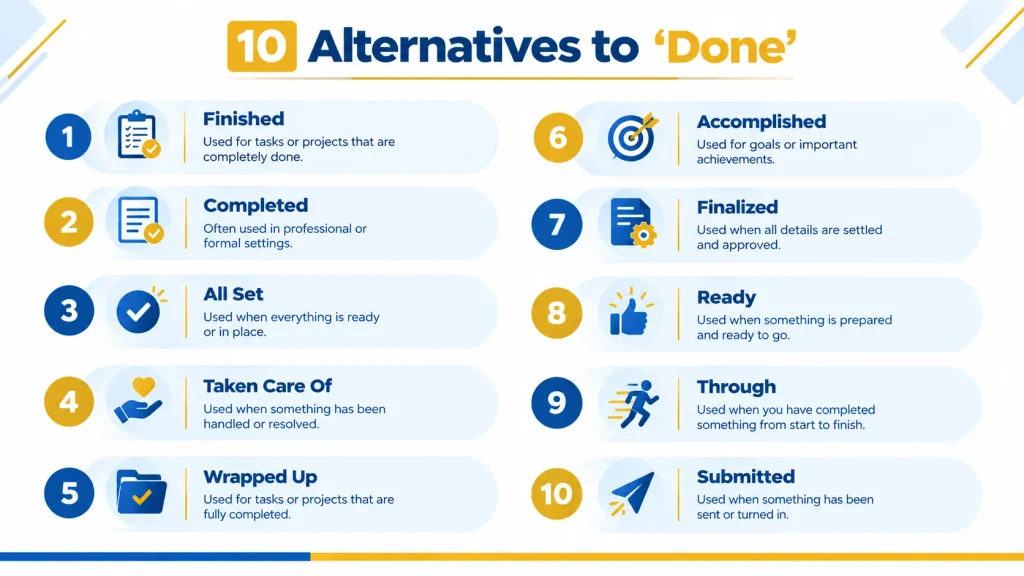
Another way to say done includes finished, completed, all set, taken care of, wrapped up, accomplished, finalized, ready, through, and submitted.
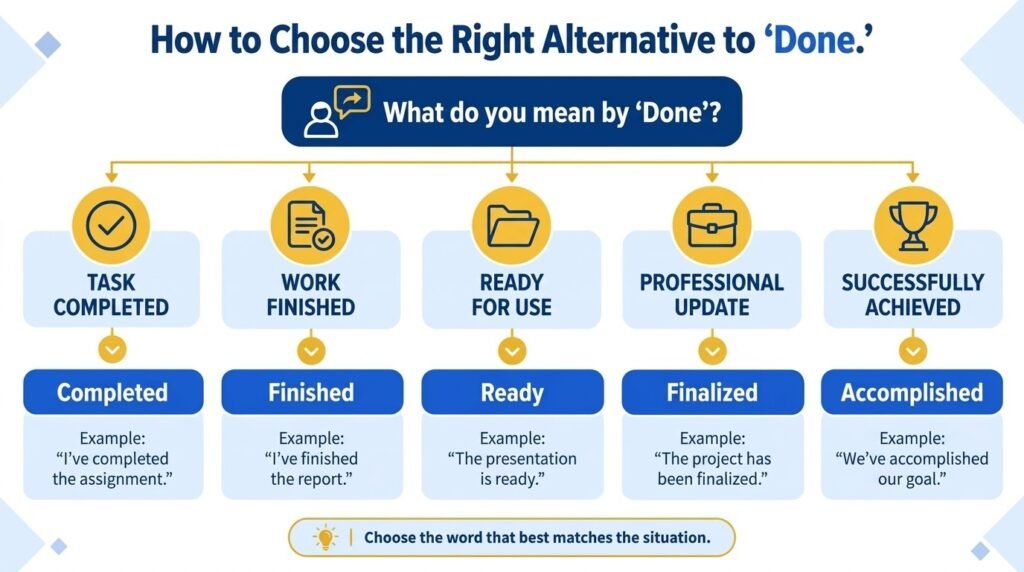
The best alternative depends on the context. Use “completed” for professional tasks, “all set” in casual conversations, and “finalized” when you have made a decision or finished the last details of a project.
Key Takeaways
- Use finished or completed to say that a task is over.
- Choose all set for friendly, everyday conversations.
- Use taken care of when you have handled a responsibility or solved an issue.
- Choose finalized for decisions, plans, and official documents.
- Consider your audience and context before replacing “done” with another phrase.
What Does “Another Way to Say Done” Mean?
The phrase “another way to say done” refers to alternative words and expressions that communicate completion, readiness, or the end of a task. People often search for these alternatives to avoid repeating the same word or to find language that fits a particular situation.
“Done” is a common word in American English. You might say, “I’m done with my homework,” “The report is done,” or “Are you done?” However, the best replacement changes with the meaning. A completed assignment, a prepared meal, and a finalized business agreement may each call for a different expression.
You will hear these alternatives in everyday conversations, text messages, school assignments, workplace emails, and business meetings.
Why Use Other Ways to Say “Done”?
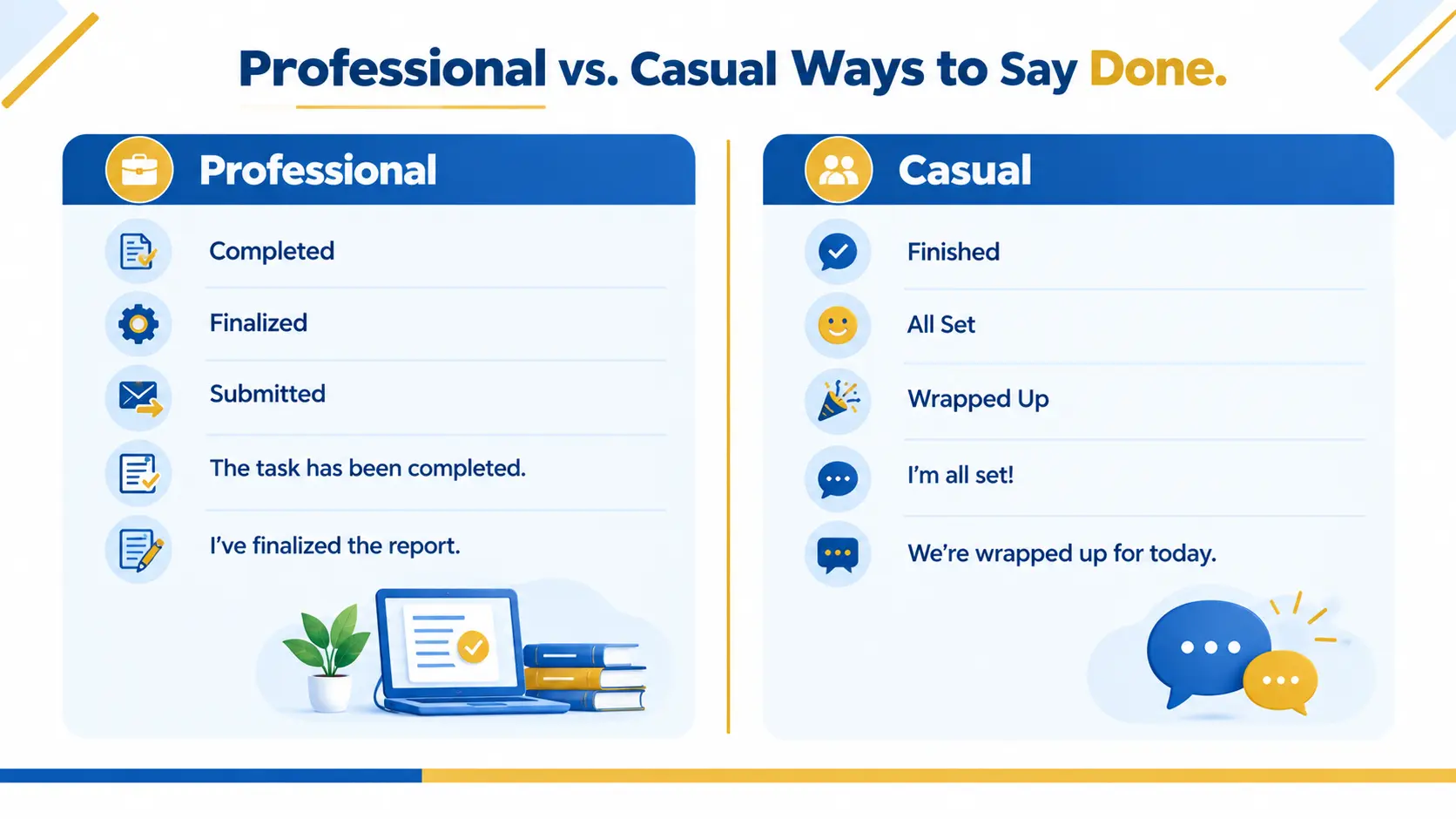
Although “done” is clear and natural, using different expressions can make your communication more precise. The right phrase can also help you sound more professional, friendly, or confident.
Consider these benefits:
- Avoid repetition: Use different expressions when discussing several completed tasks.
- Sound more professional: “The report has been completed” may fit a formal update better than “The report is done.”
- Show the exact meaning: “Finalized” suggests that the last details are settled, while “submitted” means something has been sent for review.
- Match your audience: “All set” works well in casual conversations, while “accomplished” can emphasize an achievement.
- Communicate clearly: A specific phrase helps people understand whether you finished, prepared, or delivered something.
10 Best Other Ways to Say “Done”
1. Finished
Meaning
“Finished” means you have completed an activity, task, or process. It is one of the closest and most natural alternatives to “done” in everyday American English.
Best For: Casual, Friendly, Professional
Example 1: I’ve finished the presentation, so we can review it this afternoon.
Example 2: She finished her book before the flight landed.
Quick Tip: Use “finished” when you want a simple, direct expression that works in most situations.
2. Completed
Meaning
“Completed” means that you have carried out all the required parts of a task or activity. It sounds slightly more formal than “finished,” making it useful for workplace updates, schoolwork, and official communication.
Best For: Professional, Formal, Polite
Example 1: I completed the employee training course yesterday.
Example 2: The team completed its review of the customer feedback.
Quick Tip: Choose “completed” for reports, project updates, and other situations where you need a clear, professional tone.
3. All Set
Meaning
“All set” means you are ready, prepared, or have everything you need. People also use it to indicate that a task or arrangement is taken care of.
Best For: Casual, Friendly, Polite
Example 1: I’m all set for the interview tomorrow.
Example 2: Your table is ready, and you’re all set for dinner.
Quick Tip: Use “all set” in conversations and friendly messages, but choose a more precise phrase when documenting formal work.
4. Taken Care Of
Meaning
“Taken care of” means that a responsibility, problem, or practical matter has been handled. It often communicates that someone has addressed an issue and that no further action is needed from the listener.
Best For: Professional, Casual, Polite
Example 1: Don’t worry about the hotel reservation; I’ve taken care of it.
Example 2: The billing issue has been taken care of by our support team.
Quick Tip: Use this phrase when you want to reassure someone that you have handled a specific responsibility.
5. Wrapped Up
Meaning
“Wrapped up” means that an activity, meeting, project, or discussion has come to an end. It is conversational and often suggests that the work has reached a natural stopping point.
Best For: Casual, Friendly, Professional
Example 1: We wrapped up the meeting ten minutes ahead of schedule.
Example 2: I’ll send the files once I’ve wrapped up the final edits.
Quick Tip: This expression works particularly well for meetings, projects, and activities. Avoid it in highly formal writing when “completed” would be clearer.
6. Accomplished
Meaning
“Accomplished” emphasizes that you achieved something through effort or action. Unlike “done,” which simply indicates completion, this word can highlight the value or success of the result.
Best For: Formal, Professional, Warm
Example 1: The team accomplished its main goal before the deadline.
Example 2: She felt proud of everything she had accomplished during the semester.
Quick Tip: Choose “accomplished” when you want to emphasize an achievement rather than merely state that a task has ended.
7. Finalized
Meaning
“Finalized” means that the details of a plan, document, decision, or agreement have been settled. It is especially useful when a project has moved beyond drafting or discussion and is ready for its next stage.
Best For: Professional, Formal, Polite
Example 1: We finalized the event schedule after reviewing everyone’s availability.
Example 2: The legal team finalized the agreement on Friday.
Quick Tip: Use “finalized” when the last details have been resolved. Do not use it if a document is merely drafted or still awaiting approval.
8. Ready
Meaning
“Ready” means prepared for use, action, or the next step. It can sometimes replace “done,” but it focuses on preparedness rather than the act of completing a task.
Best For: Casual, Friendly, Professional
Example 1: The updated website is ready for testing.
Example 2: Your coffee is ready, so you can pick it up at the counter.
Quick Tip: Use “ready” when the important point is that something can now be used or acted on, not simply that work has ended.
9. Through
Meaning
“Through” can mean that you have finished an activity, reached the end of a process, or completed a difficult experience. In American English, “I’m through with this assignment” is a natural way to say you have finished it.
Best For: Casual, Friendly
Example 1: I’m through with the paperwork and can finally take a break.
Example 2: Once we’re through with the inspection, we can reopen the office.
Quick Tip: Use “through” in informal speech. In a professional report, “completed” may sound more neutral and precise.
10. Submitted
Meaning
“Submitted” means that you have sent or formally presented something to another person or organization for review, approval, or consideration. It does not always mean the work has been approved or fully processed.
Best For: Professional, Formal, Polite
Example 1: I’ve submitted my application for the marketing position.
Example 2: The students submitted their final projects before midnight.
Quick Tip: Use “submitted” when you have delivered work to the appropriate person or system. If you only finished writing it but haven’t sent it, “completed” is more accurate.
Comparison Table
| Alternative | Best Used In | Tone |
| Finished | Daily tasks and activities | Neutral |
| Completed | Reports, assignments, and work updates | Professional |
| All set | Conversations and messages | Friendly |
| Taken care of | Responsibilities and problems | Reassuring |
| Wrapped up | Meetings and projects | Conversational |
| Accomplished | Goals and achievements | Positive |
| Finalized | Plans, agreements, and decisions | Formal |
| Ready | Prepared items and next steps | Helpful |
| Through | Completed activities or experiences | Casual |
| Submitted | Applications, assignments, and documents | Formal |
Common Mistakes When Choosing an Alternative to “Done”
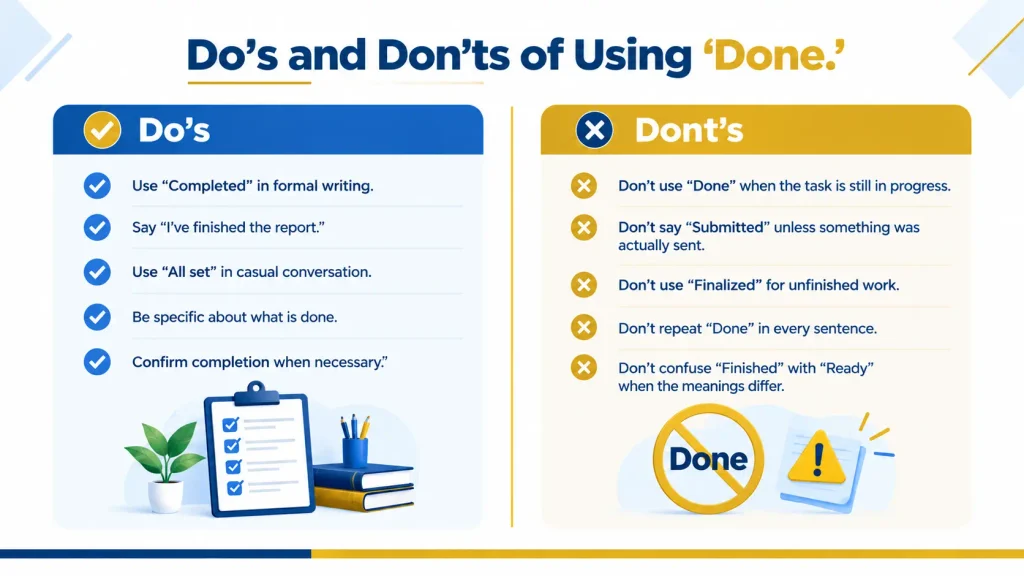
- Using casual expressions in formal emails. Phrases such as “all set” and “wrapped up” can sound too conversational in certain official reports. Choose “completed” or “finalized” when the context calls for a formal tone.
- Treating every alternative as an exact synonym. “Ready” means prepared, while “submitted” means delivered for consideration. Choose a phrase that reflects what actually happened.
- Using “finalized” too early. A draft may be complete without being final. Use “finalized” only when the relevant details have been settled.
- Sounding vague in workplace updates. Saying “It’s done” may leave colleagues wondering what you completed. Identify the task or deliverable, such as “I’ve completed the budget review.”
- Choosing a word that changes the intended meaning. “Accomplished” often highlights achievement, while “through” can suggest reaching the end of an experience. Match the expression to the message you want to convey.
Frequently Asked Questions
1. What is the most professional way to say “done”?
“Completed” is one of the most versatile professional alternatives to “done.” You can write, “I’ve completed the requested revisions” or “The report has been completed.” Use “finalized” when the final details are settled and “submitted” when you have sent the work for review or approval.
2. What is a polite way to say “I’m done”?
You can say “I’ve finished,” “I’m all set,” or “I’ve completed the task,” depending on the situation. For example, “I’ve finished the requested updates” sounds polite and professional. If you are speaking to a colleague, “I’m all set on my end” can sound friendly without being too casual.
3. What is another word for “done” in an email?
“Completed” is a reliable choice for most work emails. For example, write, “I’ve completed the requested changes and attached the updated file.” If you have already sent the file, “submitted” may be more accurate. If you have settled the final details of a plan, use “finalized.”
4. How do you say “done” in a formal way?
Formal alternatives include “completed,” “finalized,” and “accomplished,” although they are not interchangeable in every sentence. “The review has been completed” is appropriate for a status report, while “The agreement has been finalized” communicates that the terms have been settled. Choose the word that best describes the result.
5. What is a casual way to say “done”?
In everyday American English, you can say “finished,” “all set,” “wrapped up,” or “through.” For example, “I’m all set” works when you’re ready to leave, while “I’m finished with my homework” clearly indicates that the assignment is complete. The best choice depends on what you mean.
6. Is “completed” better than “done”?
Neither word is always better. “Done” is shorter and more conversational, while “completed” often sounds more formal and precise. You might tell a friend, “I’m done with lunch,” but write, “I’ve completed the quarterly report” in a business email. Consider the audience, purpose, and level of formality.
7. Can I use “all set” instead of “done”?
Yes, when you mean that you are ready or have everything taken care of. For example, “I’m all set for the presentation” suggests that you are prepared. However, “all set” does not always mean that a particular task has been completed, so use “finished” or “completed” when that distinction matters.
8. How do I say a project is done professionally?
You can write, “The project has been completed,” “We’ve wrapped up the project,” or “The project is finalized,” depending on its status. Use “completed” when the work is finished, “wrapped up” for a conversational update, and “finalized” when the last details have been settled. Mention any remaining approvals or next steps when relevant.
Readers who checked this guide also looked at another way to say “support”, another way to say “stop” and another way to say “motivated”.
Conclusion
Choosing another way to say done helps you communicate more clearly in everyday conversations, schoolwork, and professional settings. The best alternative depends on what you have finished and what you want your listener to understand.
Use “finished” for a simple, natural statement, “completed” for professional updates, and “all set” when you want to sound friendly and relaxed. If you have handled a responsibility, “taken care of” can reassure someone. For plans and agreements, “finalized” is more precise, while “submitted” tells the reader that you have sent something for review.
Remember that these expressions are related, but they do not always mean exactly the same thing. Before choosing a replacement, consider your audience, tone, and the status of the task. The clearest word is the one that accurately describes what you have done.

Editorial Desk
The Titan Standards Editorial Team develops, reviews, and maintains practical English-language resources. The team checks articles for clarity, accuracy, context, readability, and consistency with Titan Standards’ editorial guidelines.