Featured Snippet Answer
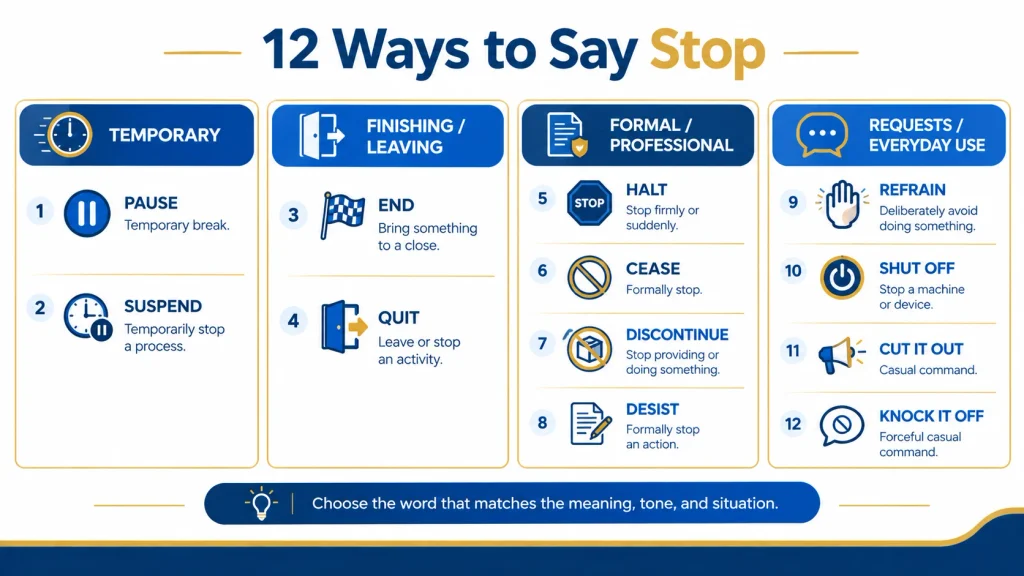
Another way to say stop depends on the situation. Use halt for a firm command, pause for a temporary break, quit for leaving an activity or habit, end for bringing something to a close, and cease for formal writing.
Other useful choices include discontinue, refrain, desist, suspend, shut off, cut it out, and knock it off.
Key Takeaways
- Pause suggests a temporary break, while end usually suggests completion.
- Halt is firm and often used for commands, movement, or urgent situations.
- Quit works well for activities, habits, jobs, and things you choose to leave.
- Cease, desist, and refrain are more formal and need the right context.
- Casual phrases such as cut it out and knock it off can sound too blunt in professional settings.
What Does “Stop” Mean?
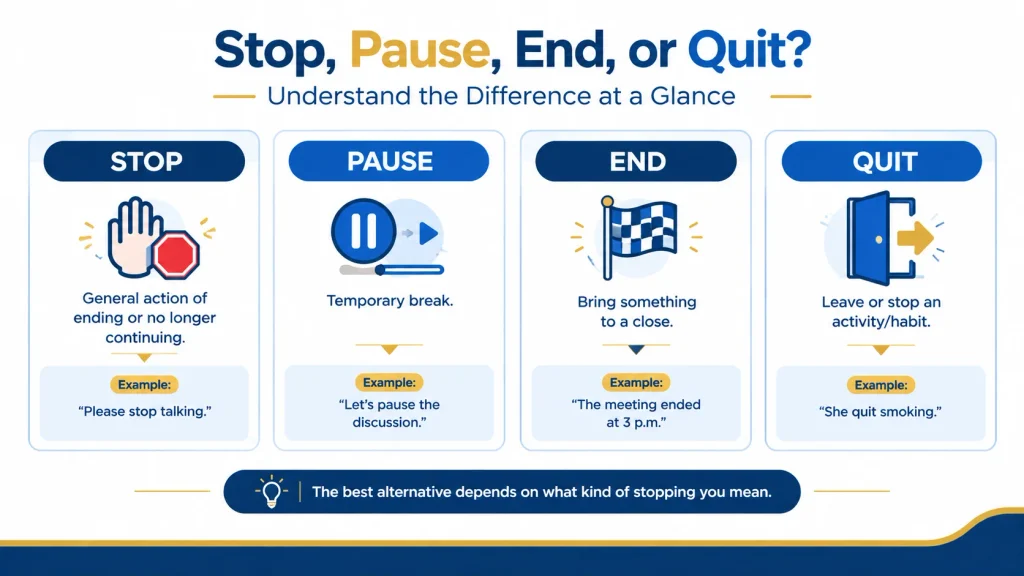
Stop is a broad and flexible verb that can mean to end an action, prevent movement, discontinue an activity, or no longer continue something.
For example:
- Stop talking during the movie.
- The bus stopped at the corner.
- Please stop the machine.
- She stopped checking her phone.
Because stop covers so many situations, there is no single replacement that works everywhere. The best alternative depends on what is stopping, how long the interruption lasts, and how formal or direct you want to sound.
That distinction matters when choosing vocabulary. Pause does not usually mean permanent ending. Quit often suggests voluntarily leaving something. Halt can sound like a firm command, while cease is more common in formal writing.
Why Use Another Way to Say “Stop”?
Sometimes you need more precision than the word stop provides.
You may want to:
- Make a request sound softer.
- Give a firm or urgent command.
- Describe a temporary interruption.
- Explain that an activity has ended permanently.
- Use more formal language in professional writing.
- Tell someone to stop a particular behavior without repeating the same word.
For example, “Pause the meeting” suggests that the meeting may continue later. “End the meeting” suggests that it is finished. The basic idea is similar, but the meaning is not identical.
12 Best Ways to Say “Stop
1. Halt
Halt means to stop something, especially movement or an activity. It is stronger and more formal than ordinary stop.
It works especially well for commands, official instructions, or situations involving movement.
Example:
“The officer ordered the driver to halt.”
You can also use it in writing: “Construction was halted because of the safety inspection.”
2. Pause
Use pause when you want something to stop temporarily rather than end completely.
It is one of the most useful alternatives when an activity will continue later.
Example:
“Let’s pause the discussion and come back to it after lunch.”
You can pause a video, meeting, conversation, presentation, or process. Unlike quit or terminate, it normally leaves the possibility of continuing.
3. Quit
Quit often means to stop doing something, leave an activity, or give up a habit. It can also mean leaving a job.
Example:
“He decided to quit smoking.”
You can also say, “She quit her job last month.”
Be careful with tone. Quit it is an informal way to tell someone to stop doing something, but it can sound impatient or annoyed.
4. End
End is useful when something reaches its conclusion.
It is natural for meetings, conversations, events, relationships, activities, and periods of time.
Example:
“We should end the meeting before everyone gets too tired.”
Unlike pause, end usually indicates that the activity is finished rather than temporarily interrupted.
5. Cease
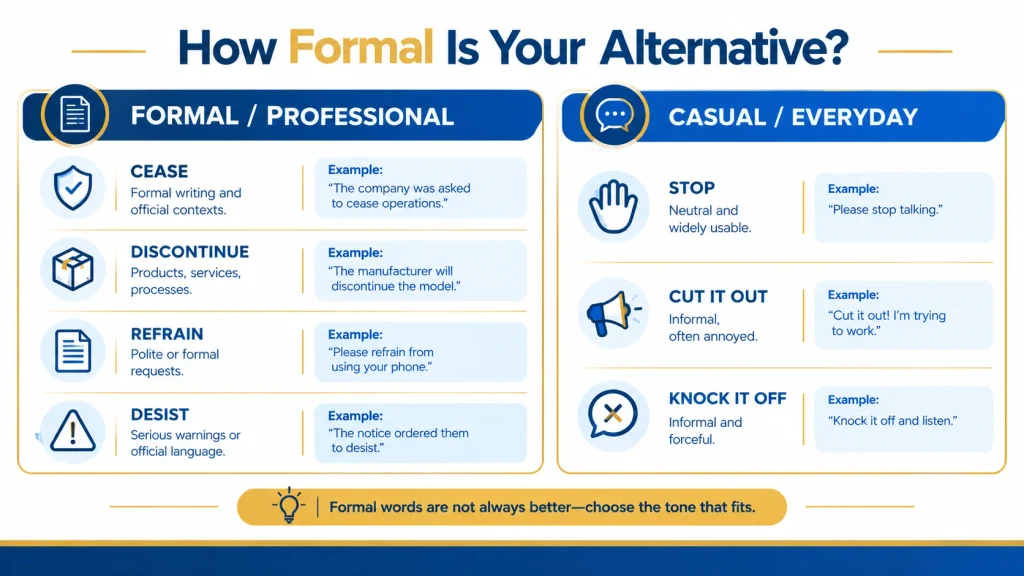
Cease means to stop or no longer continue. It is more formal than stop and is particularly useful in professional, official, legal, or written contexts.
Example:
“The company was asked to cease operations until the issue was resolved.”
Although grammatically correct in everyday speech, cease can sound stiff in casual conversation. In most ordinary situations, stop is more natural.
6. Discontinue
Discontinue means to stop providing, producing, using, or doing something, often as a deliberate decision.
It is especially common in business, product, service, and organizational contexts.
Example:
“The manufacturer will discontinue the older model next year.”
You might also see it in notices such as “This service has been discontinued.”
It is not usually the best replacement when telling a person to stop an immediate action.
7. Refrain
Refrain from means to deliberately avoid doing something.
This choice is especially useful when making a polite or formal request.
Example:
“Please refrain from using your phone during the presentation.”
It does not simply mean “stop” in every situation. It focuses on choosing not to perform an action, which gives it a different nuance.
8. Desist
Desist means to stop doing something, especially after being told or warned to stop. It is highly formal and is most natural in serious, official, or legal-style language.
Example:
“The notice instructed the company to desist from using the copyrighted material.”
In a casual conversation, “Please desist” can sound unusually formal. For everyday communication, stop, quit it, or cut it out may be more natural.
9. Suspend
Suspend means to stop something temporarily, often until a condition changes or a decision is made.
It is common in professional, institutional, and administrative contexts.
Example:
“The school suspended the program while the policy was reviewed.”
The temporary aspect is important. If something has been suspended, it may resume later.
10. Shut Off
Shut off is commonly used for machines, devices, utilities, and systems.
Example:
“Please shut off the lights before you leave.”
You can also say shut off the computer, shut off the water, or shut off the engine.
It is not a universal substitute for stop. For example, “shut off the conversation” sounds unnatural in most contexts.
11. Cut It Out
Cut it out is a casual expression used to tell someone to stop an annoying, inappropriate, or unwanted behavior.
Example:
“Cut it out! I’m trying to concentrate.”
It is natural among friends, family members, or in other informal situations. Because it can sound irritated or commanding, it is usually not appropriate for formal workplace communication.
12. Knock It Off
Knock it off is another informal way to tell someone to stop doing something, especially something irritating.
Example:
“Knock it off and give your sister some space.”
It is more forceful than a neutral request such as “Please stop.” Use it carefully because the phrase can sound annoyed, confrontational, or parental depending on the situation.
Stop vs. Pause vs. Halt vs. Quit vs. Cease
| Alternative | Best Used In | Tone |
| Pause | Temporary interruptions or breaks | Neutral, soft |
| Halt | Commands, movement, urgent action | Firm, formal |
| Quit | Activities, habits, jobs | Direct |
| End | Bringing something to a close | Neutral |
| Cease | Formal or official writing | Formal, serious |
| Discontinue | Services, products, processes | Professional |
| Refrain | Polite or formal requests | Polite, formal |
| Desist | Serious warnings or official language | Very formal |
| Suspend | Temporary institutional or procedural stops | Formal, neutral |
| Shut off | Machines, devices, utilities | Everyday, direct |
| Cut it out | Annoying behavior | Casual, firm |
| Knock it off | Irritating or unwanted behavior | Casual, forceful |
How to Choose the Right Alternative
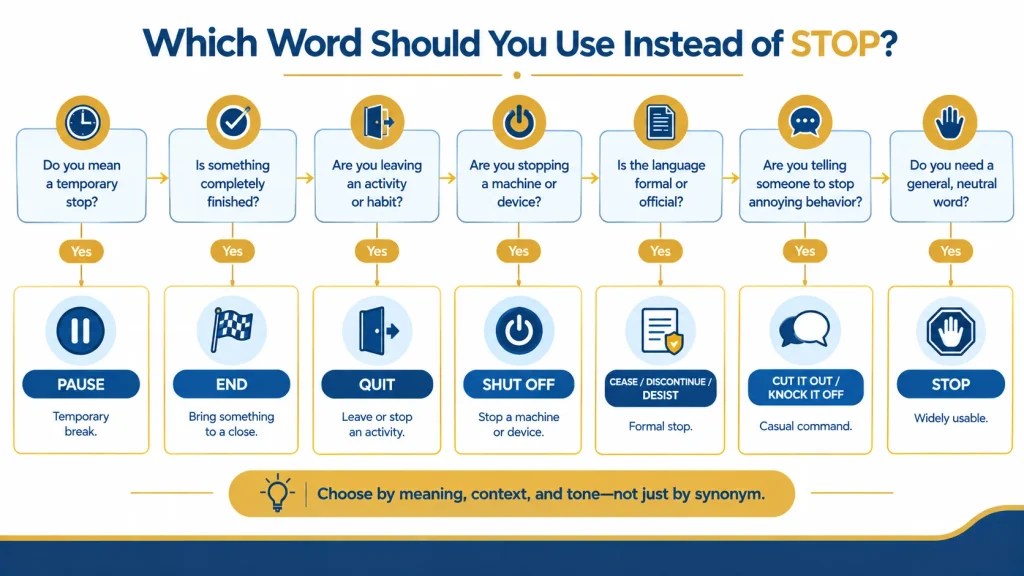
The easiest way to choose is to ask what kind of stopping you mean.
If it is temporary: use pause or suspend.
“Let’s pause the project until we have more information.”
If something is completely finished: use end.
“The event ended at 9 p.m.”
If someone is leaving an activity or habit: use quit.
“She quit playing after the injury.”
If you need a firm command: use halt.
“Halt! Do not cross the barrier.”
If you are writing formally: consider cease, discontinue, refrain, or desist, depending on the sentence.
If someone is behaving annoyingly: cut it out or knock it off may fit, but these are casual expressions.
Common Mistakes When Using Alternatives to “Stop”
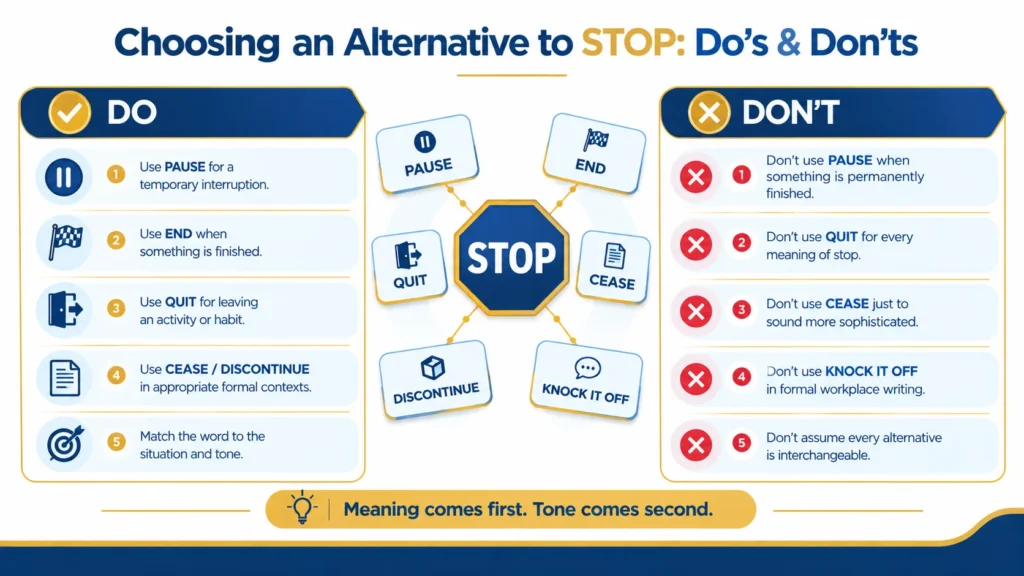
1. Using “cease” in casual conversation
“Cease talking and pass the salt” sounds unnecessarily formal.
In everyday speech, “Stop talking” is much more natural.
2. Treating “pause” and “end” as identical
A pause is temporary. An ending normally means the activity is finished.
Pause the meeting means the meeting may continue.
End the meeting means the meeting is over.
3. Using “quit” for every type of stopping
Quit works well for activities, habits, jobs, and similar situations. It is not always a natural substitute.
“Quit the meeting for five minutes” is not the same as “Pause the meeting for five minutes.”
4. Using casual commands in professional writing
Phrases such as “knock it off” and “cut it out” can sound rude or overly familiar in a workplace email.
A professional alternative might be:
“Please stop sending duplicate files.”
5. Assuming “refrain” means exactly the same thing as “stop”
Refrain from focuses on deliberately avoiding an action.
“Please refrain from using your phone” is a formal request not to engage in the behavior. It does not work as a universal replacement for every meaning of stop.
Related Alternatives Worth Exploring
Depending on the sentence, other words may also express a related idea without being direct synonyms of stop.
- Prevent — keep something from happening.
- Block — prevent movement, access, or progress.
- Restrain — hold someone or something back.
- Interrupt — break the continuity of an activity.
- Prohibit — officially say that something is not allowed.
- Finish — complete something that is already underway.
These words should not automatically be treated as interchangeable with stop. For example, prevent often means stopping something before it happens, while interrupt means breaking something that is already happening.
FAQs
What is a polite way to say “stop”?
A polite option depends on the situation. “Please stop” is direct but respectful, while “Please refrain from…” sounds more formal. If you only want a temporary interruption, “Could we pause for a moment?” is softer because it does not suggest that the activity should end permanently.
What is a professional way to say “stop”?
Professional alternatives include cease, discontinue, suspend, refrain, and halt, but each has a different use. For many workplace situations, however, simple language is best. “Please stop sending duplicate reports” can be clearer and more natural than replacing stop with a highly formal word.
What is another word for “stop” temporarily?
Pause is usually the clearest choice for a temporary stop. Suspend can also work when an activity, service, process, or program is temporarily stopped, especially in professional or institutional settings. For example, you can pause a meeting or suspend a service.
What is a stronger way to say “stop”?
Halt can sound stronger and more commanding than ordinary stop. For informal situations, knock it off or cut it out can also sound forceful, but they may communicate irritation. The strongest appropriate choice depends on whether you need authority, urgency, or simply a firm request.
Is “cease” a synonym for “stop”?
Yes, cease can mean stop or no longer continue, but it is more formal. It is common in official, professional, legal, and written contexts. In casual conversation, stop is usually more natural. Saying “The noise finally ceased” is grammatical, but “The noise finally stopped” sounds more conversational.
Is “quit” the same as “stop”?
Not always. Quit commonly means to stop doing an activity, abandon a habit, or leave a job. Stop has a much wider range of meanings. For example, “quit smoking” is natural, but you would normally say “stop the car,” not “quit the car.”
What is a casual way to tell someone to stop?
“Cut it out” and “knock it off” are common casual expressions. Both can sound annoyed or forceful, so they are best used with people and in situations where that tone is appropriate. With coworkers, customers, or unfamiliar people, “Please stop” is generally safer and clearer.
Conclusion
The best alternative to “stop” depends on what you want to communicate. Use pause when something will continue later, end when something is finished, and quit when someone leaves an activity, habit, or job. For formal writing, cease, discontinue, refrain, and desist can provide greater precision, while halt works well for firm commands. In casual conversations, cut it out and knock it off can express irritation or urgency.
The key is not to replace stop simply because another word sounds more advanced. Choose the word that accurately describes the action, duration, tone, and setting. When no special nuance is needed, stop remains the clearest choice.

Senior Language Editor
Mara Whitcombe is a senior language editor specializing in English vocabulary, synonyms, word meanings, and semantic nuance. She focuses on helping readers understand not only what a word means, but how its meaning, tone, and context can change in real-world communication.