Featured Snippet Answer
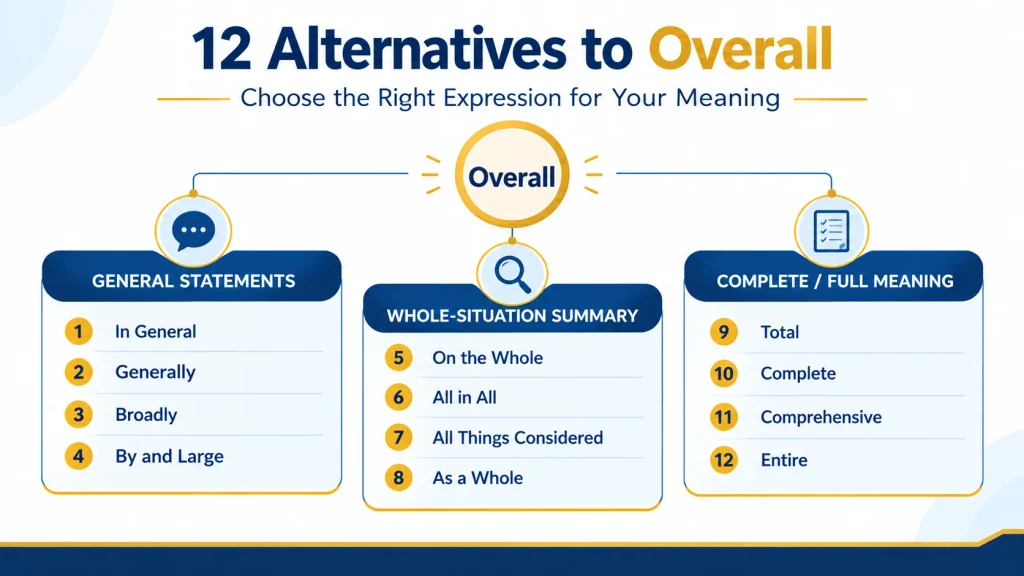
Another way to say “overall” depends on the sentence. Useful alternatives include in general, generally, on the whole, all in all, all things considered, by and large, as a whole, broadly, total, complete, comprehensive, and entire.
Some work as adverbs, while others replace “overall” as an adjective, so context matters.
Key Takeaways
- Overall can function as both an adjective and an adverb.
- In general and generally work well when making a broad statement.
- On the whole and all in all are useful for summarizing an overall impression.
- Comprehensive, total, complete, and entire are better when “overall” describes something as a whole.
- Choose the alternative based on meaning rather than simply replacing the word.
What Does “Overall” Mean?
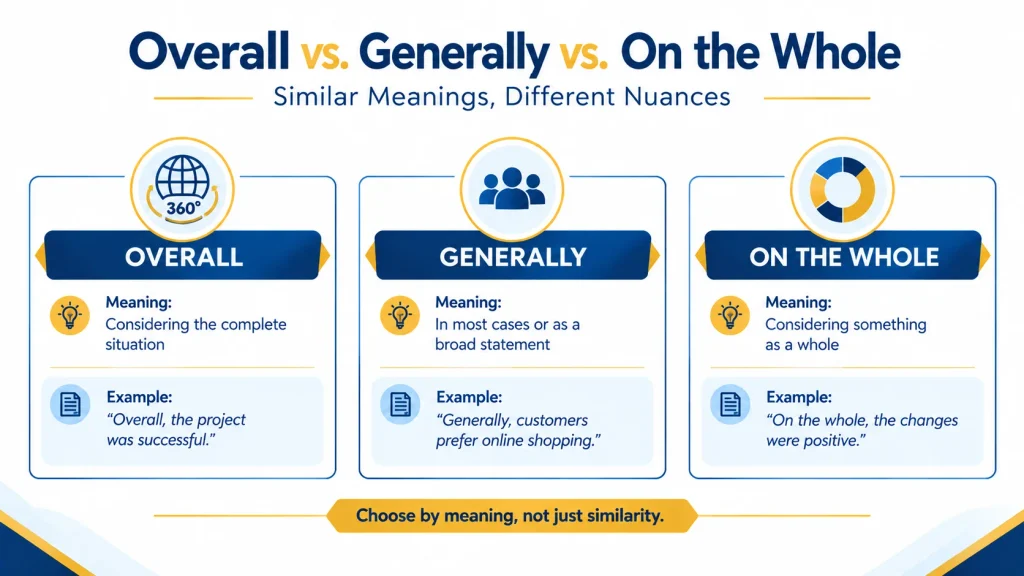
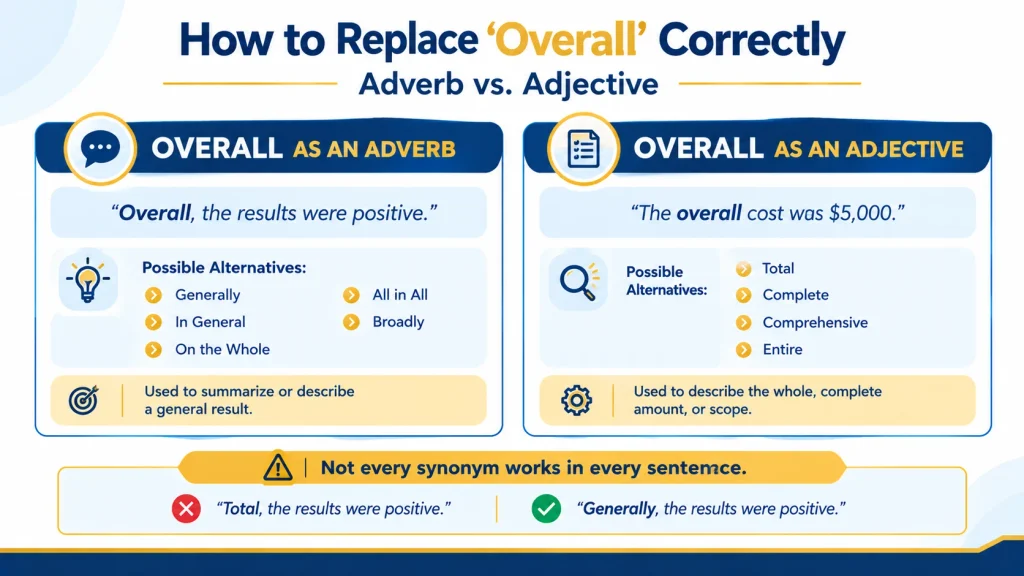
“Overall” has two common uses. As an adjective, it refers to something considered as a whole or including all relevant parts. For example, “the overall cost” means the total cost when the relevant expenses are considered together.
As an adverb, “overall” means generally or when everything is considered together:
Overall, the presentation was successful.
This distinction matters because not every synonym works in both positions. Major English dictionaries likewise distinguish the adjective meaning from the adverbial meaning.
For example, you can say:
- “The overall quality was excellent.”
- “Overall, the quality was excellent.”
But you cannot automatically replace “overall” with “total” in the second sentence. Total is normally an adjective, while generally is normally an adverb.
Why Use Another Way to Say “Overall”?
“Overall” is useful and natural, so there is no need to replace it simply for the sake of variety. However, another expression may be better when you want to:
- make a general statement
- summarize several points
- emphasize that everything has been considered
- describe something as complete or comprehensive
- avoid repeating “overall” in nearby sentences
- make your meaning more precise
The best replacement depends on what you actually mean.
12 Best Ways to Say “Overall”
1. In General
In general is one of the most useful alternatives when “overall” means “generally” or “as a broad statement.”
It works especially well when you are discussing a group, topic, or situation without focusing on individual details.
Example:
“Overall, customers were satisfied with the service.”
→ “In general, customers were satisfied with the service.”
Use in general when you are making a broad statement rather than adding up specific factors.
2. Generally
Generally is a concise alternative to “overall” when you mean “in most cases” or “as a general observation.”
It is common in everyday, professional, and academic writing.
Example:
“Overall, the results were positive.”
→ “Generally, the results were positive.”
There is a small difference to keep in mind: generally can suggest that something is true in most cases, while overall often refers to the total impression or result.
3. On the Whole
On the whole means considering something as a complete unit rather than focusing on individual details.
Example:
“Overall, the project was successful despite a few delays.”
→ “On the whole, the project was successful despite a few delays.”
This expression is particularly useful when there are both positive and negative details, but your general assessment remains clear. Collins lists “on the whole” among the adverbial alternatives related to “overall.”
4. All in All
All in all is a natural, conversational way to summarize a situation after considering its different parts.
Example:
“Overall, it was a good experience.”
→ “All in all, it was a good experience.”
It works well in personal writing and everyday conversation. For highly formal writing, overall, on the whole, or all things considered may sound more appropriate depending on the sentence.
5. All Things Considered
Use all things considered when your conclusion comes after weighing several factors.
Example:
“Overall, buying the house was the right decision.”
→ “All things considered, buying the house was the right decision.”
This phrase is more specific than a simple synonym. It tells the reader that different factors have been taken into account before reaching the conclusion.
6. By and Large
By and large means generally or for the most part. It can replace “overall” when you are making a broad assessment.
Example:
“Overall, the changes have been positive.”
→ “By and large, the changes have been positive.”
It is natural English, but it has a more conversational feel than some alternatives. Collins includes by and large among expressions related to “overall” in the sense of a general conclusion.
7. As a Whole
As a whole emphasizes looking at something as one complete unit.
Example:
“The overall team performed well.”
Depending on the sentence, you could write:
“The team performed well as a whole.”
This is especially useful when discussing groups, organizations, systems, books, projects, or other things made up of separate parts.
8. Broadly
Broadly works when “overall” means taking a broad view rather than examining every detail.
Example:
“Overall, the report supports the proposed changes.”
→ “Broadly, the report supports the proposed changes.”
It can also appear in phrases such as broadly speaking, which signals that a statement is intentionally general rather than absolute.
9. Total
When “overall” is an adjective meaning the complete amount, total can often be a direct replacement.
Example:
“The overall cost was $5,000.”
→ “The total cost was $5,000.”
Here, total is more precise because the sentence concerns the complete amount.
Do not use total as a general replacement for the adverb “overall.” You would not normally write, “Total, the project was successful.”
10. Complete
Complete can replace “overall” when the intended meaning is that something includes all necessary parts.
Example:
“We need an overall picture of the situation.”
Depending on context:
“We need a complete picture of the situation.”
The two expressions are close, but complete puts more emphasis on nothing important being missing.
11. Comprehensive
Comprehensive is useful when “overall” refers to broad coverage of a subject.
Example:
“The report provides an overall analysis of the issue.”
→ “The report provides a comprehensive analysis of the issue.”
This word is particularly useful in professional, academic, and business contexts. It suggests that the analysis covers the important parts of the subject rather than merely offering a general impression.
12. Entire
Entire means the whole of something, with no part excluded.
Example:
“The overall process took three weeks.”
Depending on the intended meaning, you might instead say:
“The entire process took three weeks.”
Be careful with this substitution. Entire emphasizes the whole duration or object, while overall can simply provide a general assessment.
Overall vs. Its Closest Alternatives
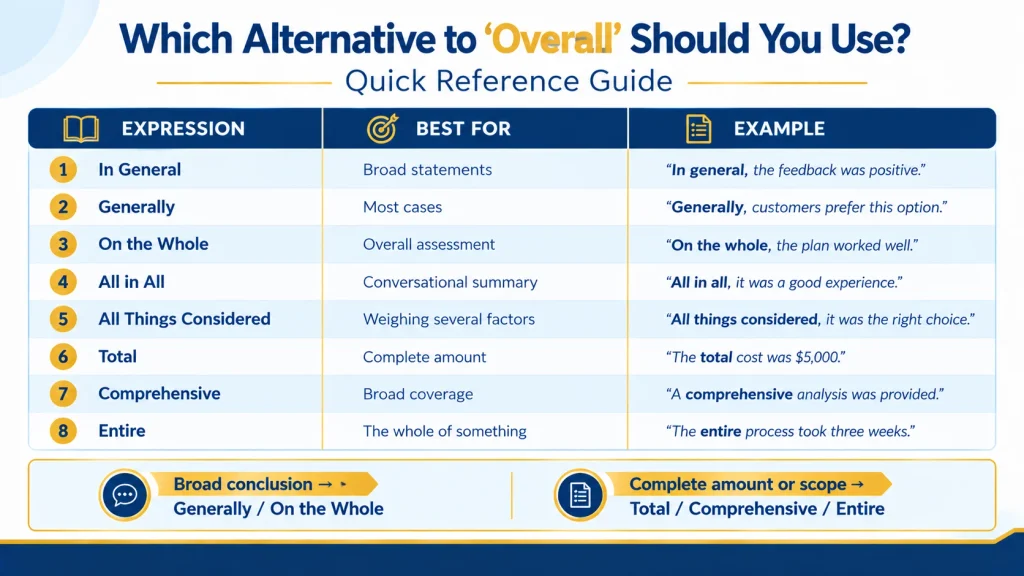
| Alternative | Best Used In | Tone |
| In general | Broad statements | Neutral |
| Generally | General observations | Neutral |
| On the whole | Summarizing a situation | Neutral |
| All in all | Informal summaries | Conversational |
| All things considered | Conclusions after weighing factors | Neutral/Formal |
| By and large | Broad generalizations | Conversational |
| As a whole | Groups or complete units | Neutral |
| Broadly | Broad descriptions | Neutral/Formal |
| Total | Complete amounts | Neutral |
| Complete | Nothing important missing | Neutral |
| Comprehensive | Broad coverage or analysis | Professional/Formal |
| Entire | The whole of something | Neutral |
The distinction between the first eight alternatives and the last four is important. The first group generally relates to adverbial “overall”, while words such as total, complete, comprehensive, and entire are more useful when “overall” functions as an adjective. Dictionary sources similarly separate the adjective and adverb senses.
Common Mistakes When Replacing “Overall”
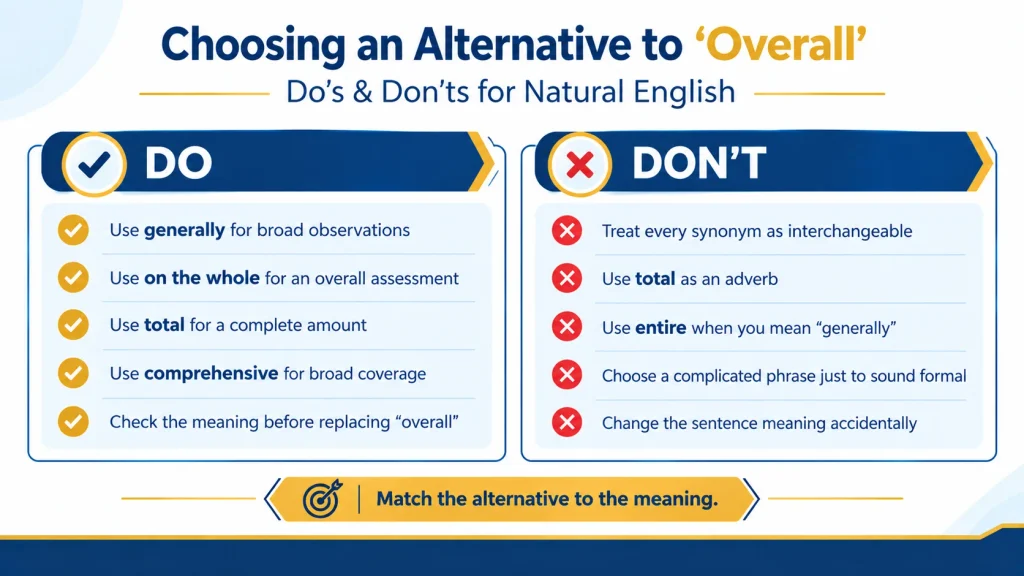
1. Treating Every Synonym as Interchangeable
Words that appear in a thesaurus are not necessarily interchangeable in every sentence. Generally and total, for example, serve different grammatical and semantic functions.
2. Using “Total” as an Adverb
“Total” can describe a complete amount, but it does not normally replace adverbial “overall.”
Incorrect:
“Total, the results were encouraging.”
Better:
“Overall, the results were encouraging.”
Or:
“Generally, the results were encouraging.”
3. Confusing “Generally” With “Overall”
Generally can mean “usually” or “in most cases.” Overall often refers to the general result or impression after considering the situation as a whole.
Compare:
“Generally, employees arrive before 9 a.m.”
“Overall, employee attendance has improved.”
The first describes a usual pattern. The second summarizes a broader result.
4. Using “Entire” When You Mean a General Impression
“Entire” refers to the whole of something. It does not normally mean “in general.”
Instead of:
“Entire, the movie was enjoyable.”
Use:
“Overall, the movie was enjoyable.”
5. Choosing a More Complicated Phrase Without a Reason
You do not need to replace “overall” with a longer expression just to sound sophisticated. If overall clearly expresses your meaning, it is often the best choice.
Related Alternatives Worth Exploring
If your goal is to vary your writing, these expressions may also be useful depending on the sentence:
- In summary — when briefly summarizing information
- In short — when reducing an explanation to its main point
- To sum up — when giving a concise conclusion
- Taken together — when considering multiple pieces of information collectively
- For the most part — when something is true in most cases
- On balance — when comparing positive and negative factors
- Altogether — when emphasizing the combined result
These are not perfect substitutes for “overall” in every sentence. They introduce slightly different meanings, so they should be selected according to context.
Frequently Asked Questions
What is the most common alternative to “overall”?
In general, generally, and on the whole are among the closest alternatives when “overall” is used as an adverb meaning “considering the situation broadly.” The best option depends on the sentence. Generally can emphasize what is usually true, while on the whole emphasizes the situation considered as a whole.
What is another way to say “overall” in professional writing?
In professional writing, overall, generally, in general, on the whole, and comprehensive can all be useful, depending on the grammatical role and intended meaning. For example, “overall performance” could become “total performance” only in some contexts, while “overall assessment” may become “comprehensive assessment.”
What is a formal synonym for “overall”?
There is no single formal synonym that works in every sentence. On the whole, all things considered, comprehensive, and broadly can work in formal contexts, but they express slightly different ideas. If “overall” already sounds clear and appropriate, keeping it is often preferable to forcing a more formal substitute.
Is “generally” the same as “overall”?
Not always. Generally often means “usually” or “in most cases,” while overall commonly means considering the complete situation or total effect. For example, “Generally, the store is busy on weekends” describes a usual pattern, while “Overall, the store performed well this year” summarizes the broader result.
Can I use “all in all” instead of “overall”?
Often, yes, when “overall” introduces a general conclusion. For example, “Overall, the trip was enjoyable” can become “All in all, the trip was enjoyable.” All in all has a more conversational feel, so it may be less suitable when you want a very formal or concise style.
What is the difference between “overall” and “on the whole”?
They are often interchangeable when both mean considering something as a whole. However, on the whole is usually a phrase used to summarize a general impression, while overall is more flexible because it can function as both an adjective and an adverb.
What is another way to say “overall” in an essay?
For an essay, generally, in general, on the whole, broadly, or all things considered may work depending on the sentence. Avoid changing “overall” automatically. First determine whether you are summarizing an argument, describing a general pattern, or referring to the complete scope of something.
Conclusion
The best way to replace “overall” depends on what you want the sentence to communicate. Use in general or generally for broad statements, on the whole or all in all for general impressions, and all things considered when your conclusion reflects several factors. When “overall” describes the full scope of something, total, complete, comprehensive, or entire may be more precise.
The key is not simply finding a synonym. Check the grammar and meaning first. If you are summarizing a result, overall may remain the clearest choice; if you want to emphasize completeness, a more specific alternative can make the sentence stronger.

Professional English Editor
Caleb Wrenford specializes in professional English, workplace communication, business writing, and formal expressions. His work helps readers communicate with greater clarity and confidence across emails, professional conversations, and written correspondence.