
The word “some” is one of the most flexible quantity words in English. It can refer to an unspecified number, an unspecified amount, or an unspecified part of a group.
Because it is so broad, replacing it with another word can make your sentence more precise.
For example, “Some employees attended the meeting” does not tell us how many. “A few employees attended the meeting” suggests a small number, while “several employees attended the meeting” suggests more than a few but still fewer than many. Cambridge defines several as an imprecise amount that is fewer than many, while Collins similarly describes it as a number greater than two but not large.
The right alternative therefore depends on what you actually want to communicate.
What Does “Some” Mean?
Some usually refers to an unspecified number or amount. It is commonly used before plural countable nouns and uncountable nouns.
- Some students stayed after class.
- I need some information about the program.
- She bought some apples.
- We still have some time.
The important feature of some is its lack of precision. It does not normally tell the reader exactly how many or how much.
That makes it useful when the exact quantity is unknown, unimportant, or intentionally left unstated. However, if you know that the amount is small, the group contains different types, or only part of something is involved, a more specific expression may communicate your meaning better.
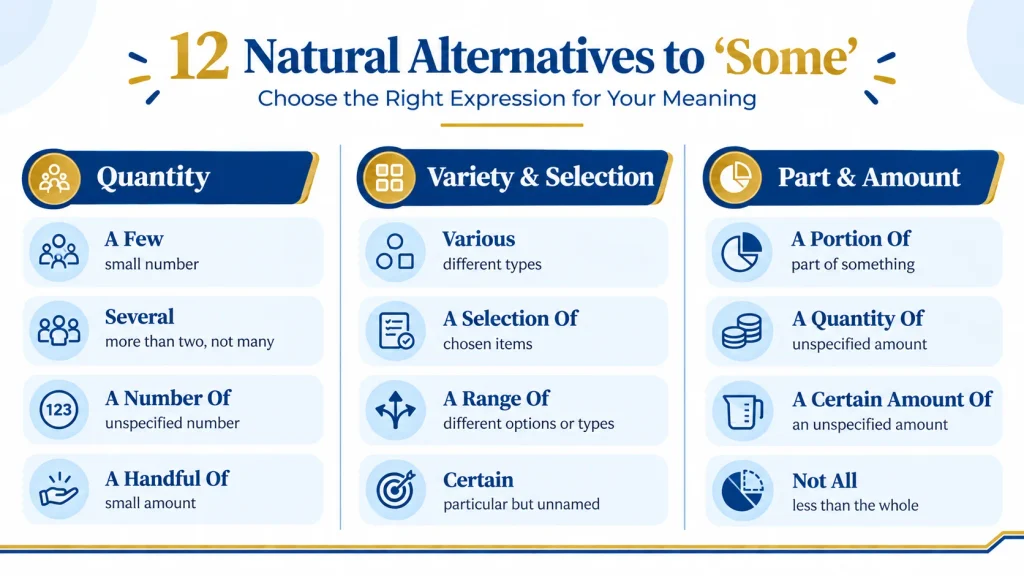
12 Best Ways to Say “Some”
1. A Few
A few is a natural alternative when you mean a small number of countable people or things.
- Some students asked questions.
- A few students asked questions.
The second sentence suggests that the number was small. It is therefore more specific than some. A few is commonly associated with a small number, although the exact number depends on context.
Best for: small numbers of people or things.
2. Several
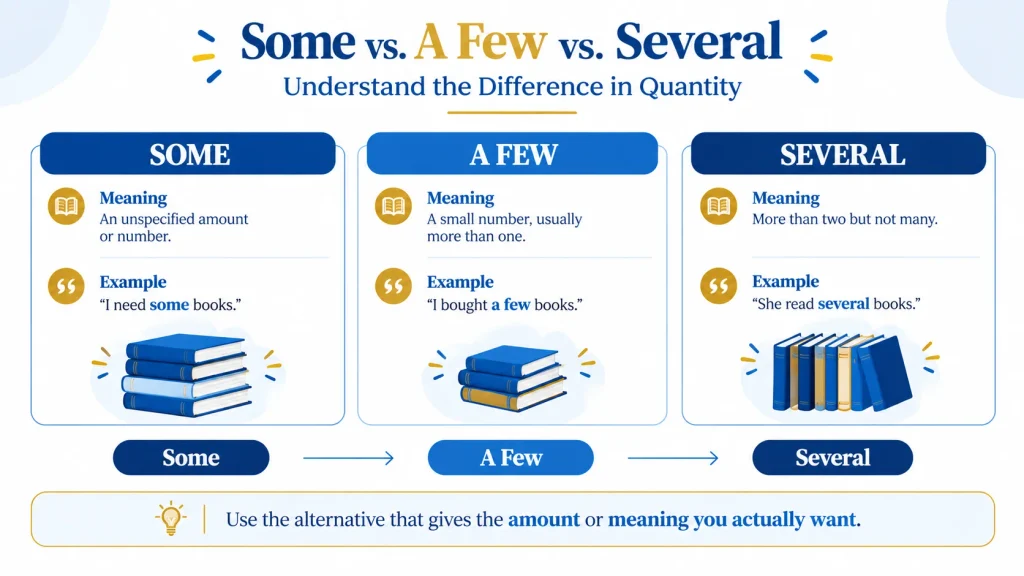
Use several when you mean an unspecified number that is more than a few but still not many in the context.
- Some customers contacted us about the issue.
- Several customers contacted us about the issue.
The exact number is still unstated, but several gives the reader a stronger sense of quantity. Cambridge and Collins both describe several as an imprecise number below “many.”
Best for: an unspecified but moderately small number.
3. A Number of
A number of works naturally with plural countable nouns when you want to refer to multiple people or things without giving an exact figure.
- Some employees requested additional training.
- A number of employees requested additional training.
This phrase is common in professional and formal writing. It can sound slightly more formal than some, but it does not necessarily tell the reader exactly how large the group is.
Best for: professional, neutral, or formal writing.
4. Certain
Certain can replace some when you mean particular people or things that are not being specifically identified.
- Some conditions must be met before approval.
- Certain conditions must be met before approval.
There is an important difference here. Certain often focuses on specific but unnamed items, rather than simply quantity.
Best for: formal writing when referring to particular but unnamed people, conditions, cases, or factors.
5. Various
Use various when the important idea is that there are different kinds or types within the group.
- Some methods can improve productivity.
- Various methods can improve productivity.
Various is not simply a stronger version of some. It emphasizes variety or difference. Cambridge lists various among words related to several, but the meanings are not identical.
Best for: different methods, options, reasons, examples, products, or types.
6. A Portion of
A portion of is useful when you mean part of a larger whole.
- Some of the budget was used for equipment.
- A portion of the budget was used for equipment.
This replacement changes the focus from an unspecified amount to a part of a whole. It is particularly useful for money, food, resources, data, land, or other quantities that can be viewed as parts of something larger.
Best for: describing part of a larger amount or whole.
7. A Selection of
Use a selection of when you mean a chosen group from a larger set.
- Some products are available online.
- A selection of products is available online.
The phrase can imply that the items represent a particular choice or subset rather than simply an unspecified quantity.
Best for: products, items, examples, resources, or options chosen from a larger group.
8. A Range of
A range of works when you want to emphasize different options, types, or possibilities.
- Some services are available to members.
- A range of services is available to members.
Unlike some, a range of suggests variety. It is especially common in business, marketing, education, and informational writing.
Best for: services, products, choices, topics, solutions, or possibilities.
9. A Quantity of
A quantity of is appropriate when discussing an amount of something, especially an uncountable noun.
- Some water remained in the bottle.
- A quantity of water remained in the bottle.
It is more formal and less conversational than some. In everyday English, some water will usually sound more natural.
Best for: formal or technical contexts involving measurable or uncountable substances.
10. A Certain Amount of
A certain amount of is useful when the amount is not specified but is known to exist.
- The project requires some funding.
- The project requires a certain amount of funding.
This phrase is particularly useful with uncountable nouns such as money, time, effort, patience, information, and energy.
Best for: unspecified amounts in neutral or formal writing.
11. Not All
Sometimes the clearest alternative to some is not all, particularly when the sentence contrasts part of a group with the whole.
- Some employees supported the proposal.
- Not all employees supported the proposal.
These sentences can overlap in meaning, but not all makes the contrast explicit. It tells the reader that the entire group did not share the same response.
Best for: emphasizing that only part of a group has a particular quality, opinion, or action.
12. A Handful of
A handful of is a more conversational way to describe a small number of people or things.
- Some people complained about the change.
- A handful of people complained about the change.
It should not normally be treated as an exact numerical measurement. The expression is useful when the speaker wants to emphasize that the group was small.
Best for: casual or conversational writing.
How to Choose the Right Alternative
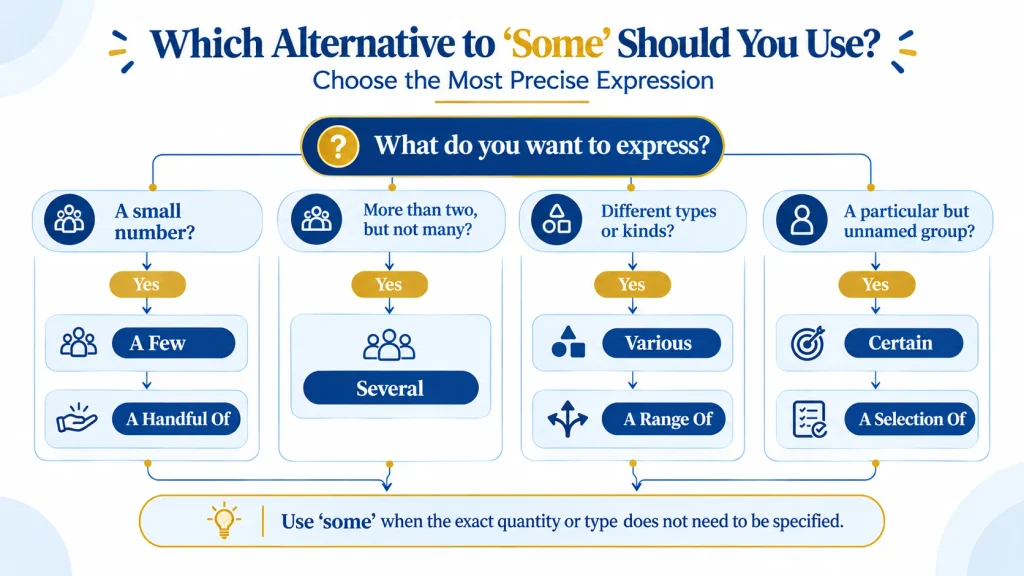
The easiest way to replace some is to first ask what information you want the sentence to emphasize.
| Alternative | Best Used In | Main Meaning |
| A few | Everyday English | A small number |
| Several | Neutral English | More than a few, but not many |
| A number of | Professional/formal | An unspecified group |
| Certain | Formal/precise | Particular but unnamed |
| Various | General/professional | Different types |
| A portion of | Formal/neutral | Part of a whole |
| A selection of | Business/general | Chosen items from a group |
| A range of | Professional/business | Different options or types |
| A quantity of | Formal/technical | An unspecified amount |
| A certain amount of | Formal/neutral | An unspecified amount |
| Not all | Contrastive statements | Part rather than the whole |
| A handful of | Casual | A small number |
Common Mistakes When Replacing “Some”
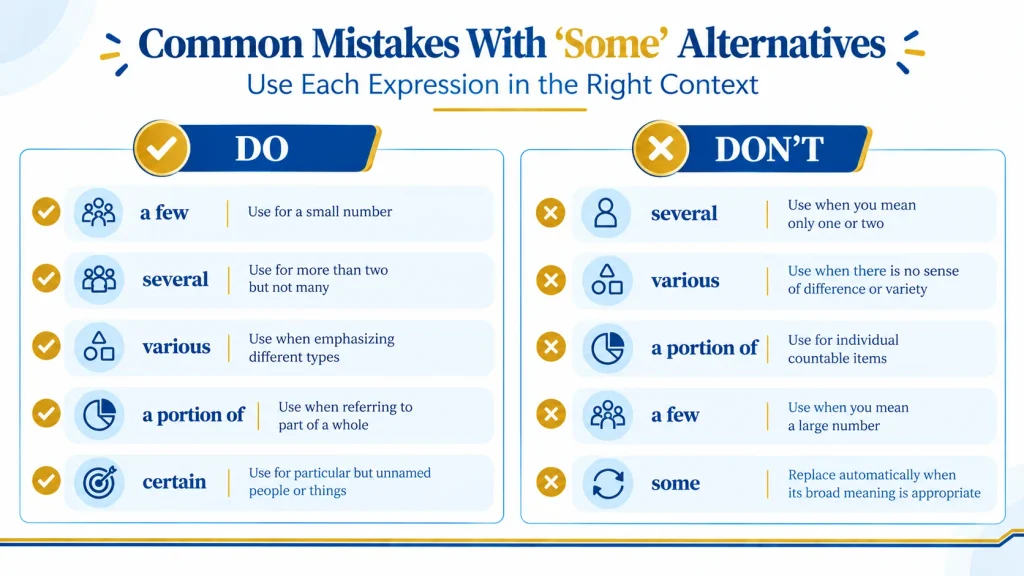
1. Using “a few” for an uncountable noun
A few is used with plural countable nouns.
Incorrect:
- A few information was missing.
Better:
- Some information was missing.
- A small amount of information was missing.
2. Assuming “several” means exactly a specific number
Several does not give an exact number. Its meaning is context-dependent, although standard American English commonly uses it for an amount greater than two and fewer than many.
3. Using “various” when quantity is the main point
Various emphasizes difference or variety.
- Various solutions were discussed.
This tells us that different solutions were discussed. If you simply mean an unspecified number, some solutions may be more accurate.
4. Using “certain” when you mean “a small number”
Certain does not necessarily mean a small number.
- Certain employees received additional training.
Here, certain means particular or specified-but-unnamed employees. If you mean only a small number, a few employees is clearer.
5. Making casual sentences unnecessarily formal
Phrases such as a quantity of or a certain amount of can sound formal.
- Natural: I need some help.
- More formal: I require a certain amount of assistance.
The second version is grammatically possible, but the first is more natural in everyday American English.
Related Alternatives Worth Exploring
If your goal is to make your writing more precise, these related quantity expressions can also be useful:
- A few — small number
- Several — more than a few, but not many
- Many — large number
- A lot of — large quantity or number
- A little — small amount of an uncountable noun
- A portion of — part of a whole
- A majority of — more than half
- A minority of — less than half
These expressions should not be treated as interchangeable. The quantity or relationship they communicate can be quite different.
Frequently Asked Questions
What is the best synonym for “some”?
There is no single best synonym for some because the word is intentionally broad. A few works for a small number, several for an unspecified number that is not large, various for different types, and a portion of for part of a whole. Choose the alternative that preserves the exact meaning you want.
Is “a few” the same as “some”?
A few and some can overlap, but a few usually suggests a relatively small number. Some is broader and does not necessarily indicate how large the number is. For example, “some customers complained” gives no clear sense of quantity, while “a few customers complained” suggests that the group was small.
Is “several” another word for “some”?
Yes, several can function as a contextual alternative to some, especially with plural countable nouns. However, it adds a quantity implication: several generally refers to more than a few but fewer than many. The exact number remains unspecified.
What is a formal way to say “some”?
Depending on the sentence, formal alternatives include a number of, certain, a portion of, a selection of, a range of, and a certain amount of. The best choice depends on the meaning. For example, certain factors focuses on particular factors, while a portion of the budget focuses on part of a whole.
How can I say “some” without repeating it?
First determine what some means in your sentence. If it means a small number, use a few. If it means different types, use various. If it means part of something, use a portion of. If it refers to particular unnamed items, certain may work. This approach creates more precise variation than simply replacing the word with a random synonym.
Can “various” replace “some”?
Sometimes, but not always. Various emphasizes differences among people or things, while some mainly indicates an unspecified number or amount. “Some options are available” simply leaves the number unclear. “Various options are available” suggests that the available options differ in type or character.
Conclusion
The best way to say “some” depends on what you want the reader to understand. Use a few when the number is small, several when it is more than a few but not many, and a number of for a neutral or professional reference to multiple items.
Choose various when differences matter, certain when you mean particular unnamed items, and a portion of when you mean part of a whole. For uncountable nouns, a certain amount of or a quantity of may provide greater precision.
The key is not simply to replace some, but to choose an expression that communicates the quantity, variety, or relationship your sentence actually me

English Usage Specialist
Elliot Harrow specializes in English usage, grammar, phrasing, and word choice. His editorial work focuses on explaining subtle differences between similar words and helping readers choose language that is precise, natural, and appropriate for the context.