“Additionally” is a useful transition when you want to introduce another fact, idea, reason, or benefit.
It is especially common in professional, academic, technical, and formal writing. But repeating it can make your writing feel mechanical.
As an American English editor, I recommend choosing the replacement based on the relationship between your ideas—not simply swapping in the most formal-sounding word. Some alternatives simply add information, while others add emphasis or create a more conversational tone.
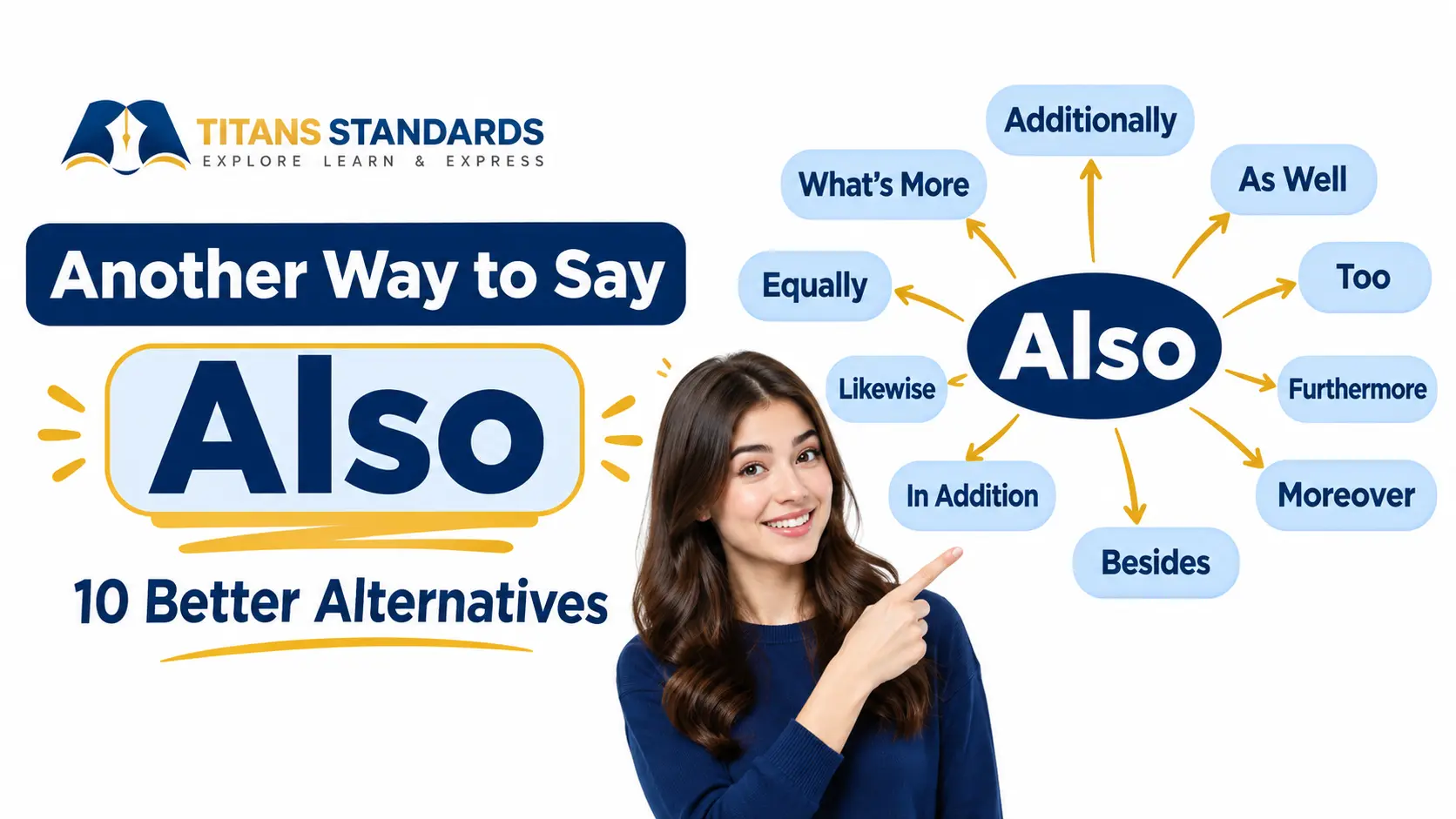
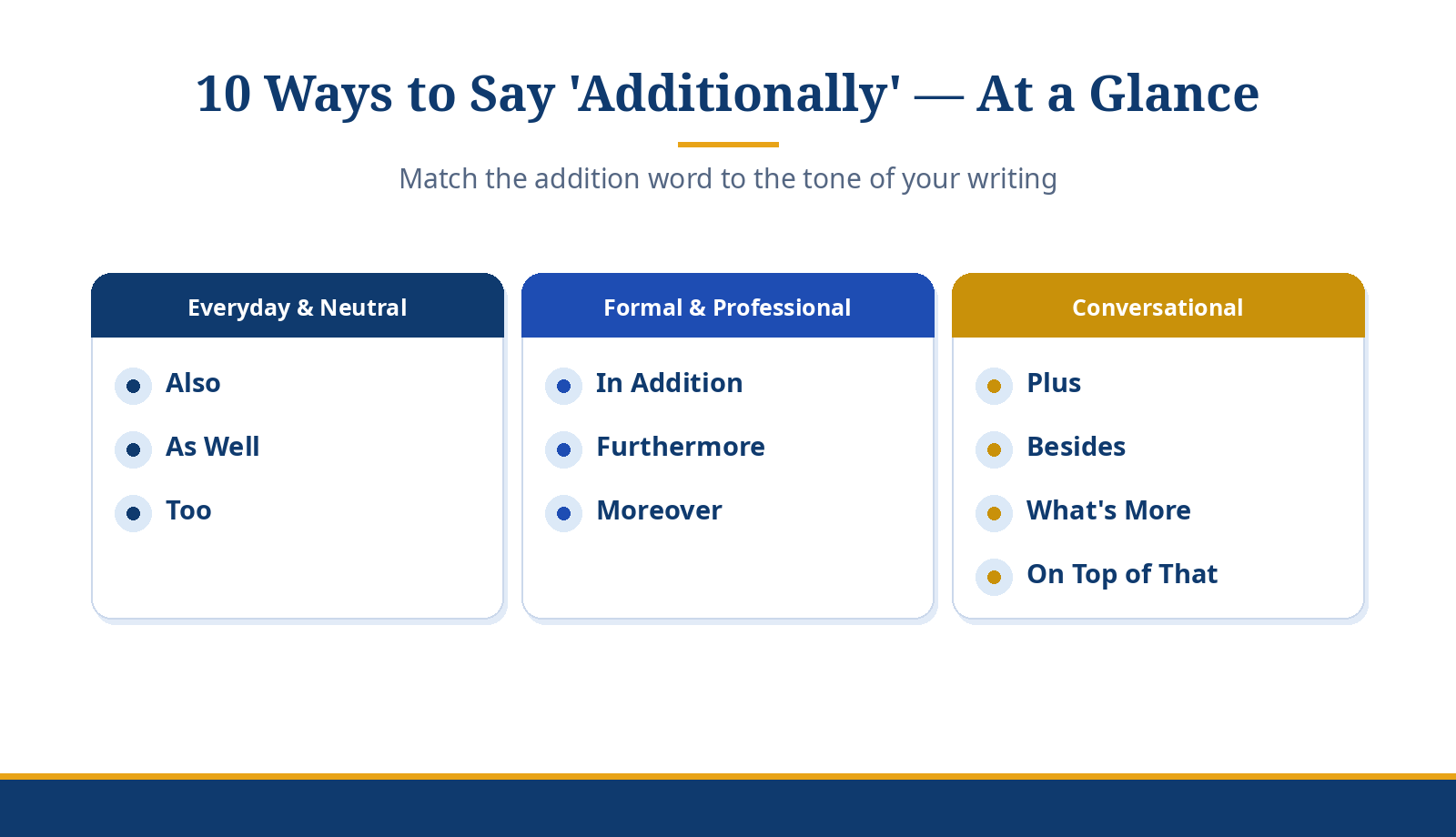
Another way to say “additionally” includes also, in addition, furthermore, moreover, as well, too, besides, plus, what’s more, and on top of that. The best choice depends on your tone and purpose. Use “also” for general English, “furthermore” or “moreover” for formal writing, and “plus” or “on top of that” for casual contexts.
Key Takeaways
- Also is the most flexible everyday alternative to “additionally.”
- In addition adds information in a neutral, slightly formal way.
- Besides and what’s more create a more conversational tone.
- Furthermore and moreover work well when building a formal argument.
- As well and too are natural when you want a lighter, less formal addition.
- Plus and on top of that sound more conversational and should be used selectively in formal writing.
What Does “Additionally” Mean?
“Additionally” is an adverb that means “in addition” or “also.” It signals that the information that follows is another point connected to what was just mentioned.
For example:
The software is affordable. Additionally, it is easy to use.
Here, “additionally” introduces a second benefit. It does not necessarily say that the second benefit is more important than the first.
“Additionally” is commonly used at the beginning of a sentence, often followed by a comma:
Additionally, the company offers free training.
It can also appear within a sentence:
The program additionally provides access to online resources.
For many everyday sentences, however, also sounds more natural and less formal.
For the full definition, see Cambridge Dictionary.
Why Use Another Way to Say “Additionally”?
There are several good reasons to replace “additionally”:
- To sound more natural: “Also” often feels easier and more conversational.
- To match your audience: A casual message may call for “plus” rather than “furthermore.”
- To control emphasis: “Moreover” can give the added point more rhetorical weight.
- To avoid repetition: Using the same transition repeatedly can make paragraphs feel formulaic.
- To improve precision: “Similarly” or “likewise,” for example, may be better when the new idea is specifically parallel to the previous one.
The goal is not to use a more complicated word. It is to use the expression that accurately shows how the new idea relates to the previous one.
10 Best Ways to Say “Additionally”
1. Also
Also is the most versatile alternative. It simply adds another fact, action, quality, or idea without making the sentence especially formal.
The new plan saves money. Also, it reduces processing time.
Use also in everyday English, emails, workplace communication, and most general writing. Unlike “additionally,” it can fit naturally in several positions:
She also speaks Spanish.
For a simple addition, also is usually the safest choice.
2. In Addition
In addition has almost the same basic meaning as “additionally,” but it often sounds slightly more deliberate or formal.
The course includes video lessons. In addition, students receive practice exercises.
It works particularly well in reports, essays, presentations, and professional writing.
Be careful with the related construction in addition to:
In addition to the video lessons, students receive practice exercises.
“In addition” and “in addition to” do not have the same grammatical structure.
3. Furthermore
Furthermore is a formal transition used to add another point, especially when that point supports or extends an argument. Oxford and Cambridge both identify it as a formal additive connector.
The proposal would reduce costs. Furthermore, it would simplify the reporting process.
It fits academic essays, formal reports, analytical writing, and professional arguments better than casual conversation.
If you are simply listing information, “also” or “in addition” may sound more natural.
4. Moreover
Moreover is another formal alternative, but it often gives the added statement extra rhetorical weight.
The product is affordable. Moreover, it comes with a three-year warranty.
Use it when the second point strengthens the overall argument rather than merely adding an unrelated fact.
For example:
The evidence is limited. Moreover, several important sources contradict the claim.
In casual conversation, however, “moreover” can sound unnecessarily formal.
5. As Well
As well is a natural alternative when the additional information is placed at the end of a clause or sentence.
The package includes installation as well.
You can also use it after an object:
The company provides training as well.
It is useful in everyday and professional communication when you want something less formal than “furthermore” but still polished.
6. Too
Too is short, familiar, and conversational. It usually appears toward the end of a clause.
The new system is faster, and it is easier to use too.
It works best when the added point is simple and the tone is relaxed.
Compare:
Additionally, the system is easier to use.
with:
The system is easier to use too.
The first sounds more formal; the second sounds more natural in ordinary conversation.
7. Besides
Besides can introduce an additional reason, fact, or consideration, but it often carries more attitude than “additionally.” It can suggest that the new point is another reason to support a position.
I don’t want to take the car. Besides, the weather is getting worse.
Because of this nuance, “besides” is not always a perfect replacement for “additionally.” It works especially well in conversational writing and persuasive everyday speech.
8. Plus
Plus is a casual way to add another benefit, reason, or fact.
The apartment is affordable. Plus, it is close to the train station.
It is common in conversation, informal emails, social posts, and marketing copy. It can sound too casual for academic papers or highly formal documents.
When the tone is relaxed, though, plus can be much more natural than “additionally.”
9. What’s More
What’s more adds another point while often giving it some extra emphasis.
The restaurant has excellent food. What’s more, the service is outstanding.
It works well in conversational and semi-formal writing. It is more expressive than the neutral “also” and less formal than “furthermore” or “moreover.”
Use it when you want the second point to feel like an appealing or noteworthy addition.
10. On Top of That
On top of that is a conversational expression meaning that another fact or problem is added to the situation.
The flight was delayed. On top of that, our luggage was lost.
It is especially natural in speech, informal writing, storytelling, and personal messages.
Because it is strongly conversational, it usually does not belong in a formal academic essay or highly polished business report.
Comparing Alternatives to “Additionally”
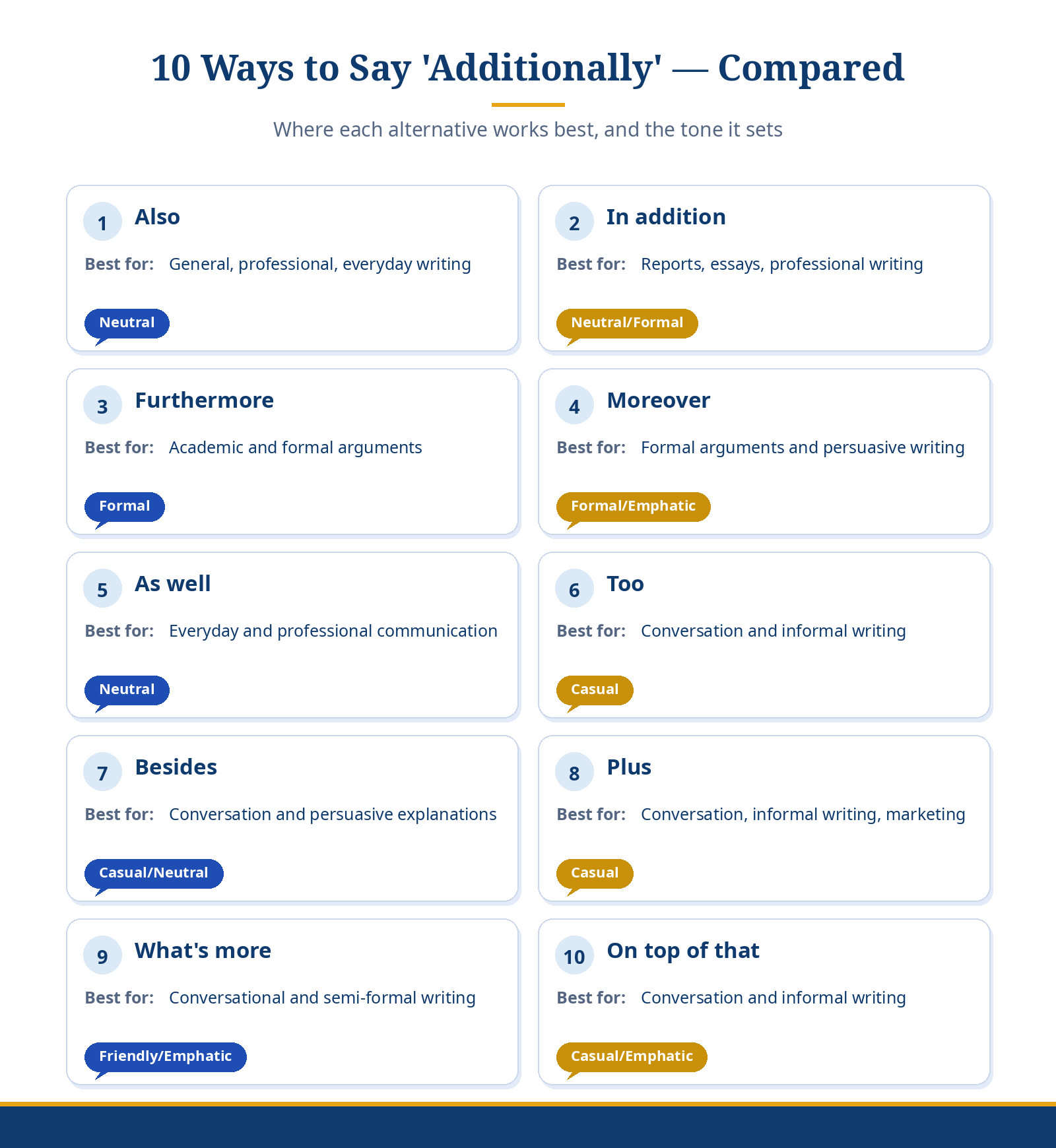
| Alternative | Best Used In | Tone |
| Also | General, professional, everyday writing | Neutral |
| In addition | Reports, essays, professional writing | Neutral/Formal |
| Furthermore | Academic and formal arguments | Formal |
| Moreover | Formal arguments and persuasive writing | Formal/Emphatic |
| As well | Everyday and professional communication | Neutral |
| Too | Conversation and informal writing | Casual |
| Besides | Conversation and persuasive explanations | Casual/Neutral |
| Plus | Conversation, informal writing, marketing | Casual |
| What’s more | Conversational and semi-formal writing | Friendly/Emphatic |
| On top of that | Conversation and informal writing | Casual/Emphatic |
The key distinction is that these expressions are not perfectly interchangeable. Furthermore and moreover are formal connectors, while plus and on top of that are much more conversational. Similarly and likewise can also connect ideas, but they emphasize similarity rather than simple addition, so they should not automatically replace “additionally.”
Common Mistakes When Using “Additionally”
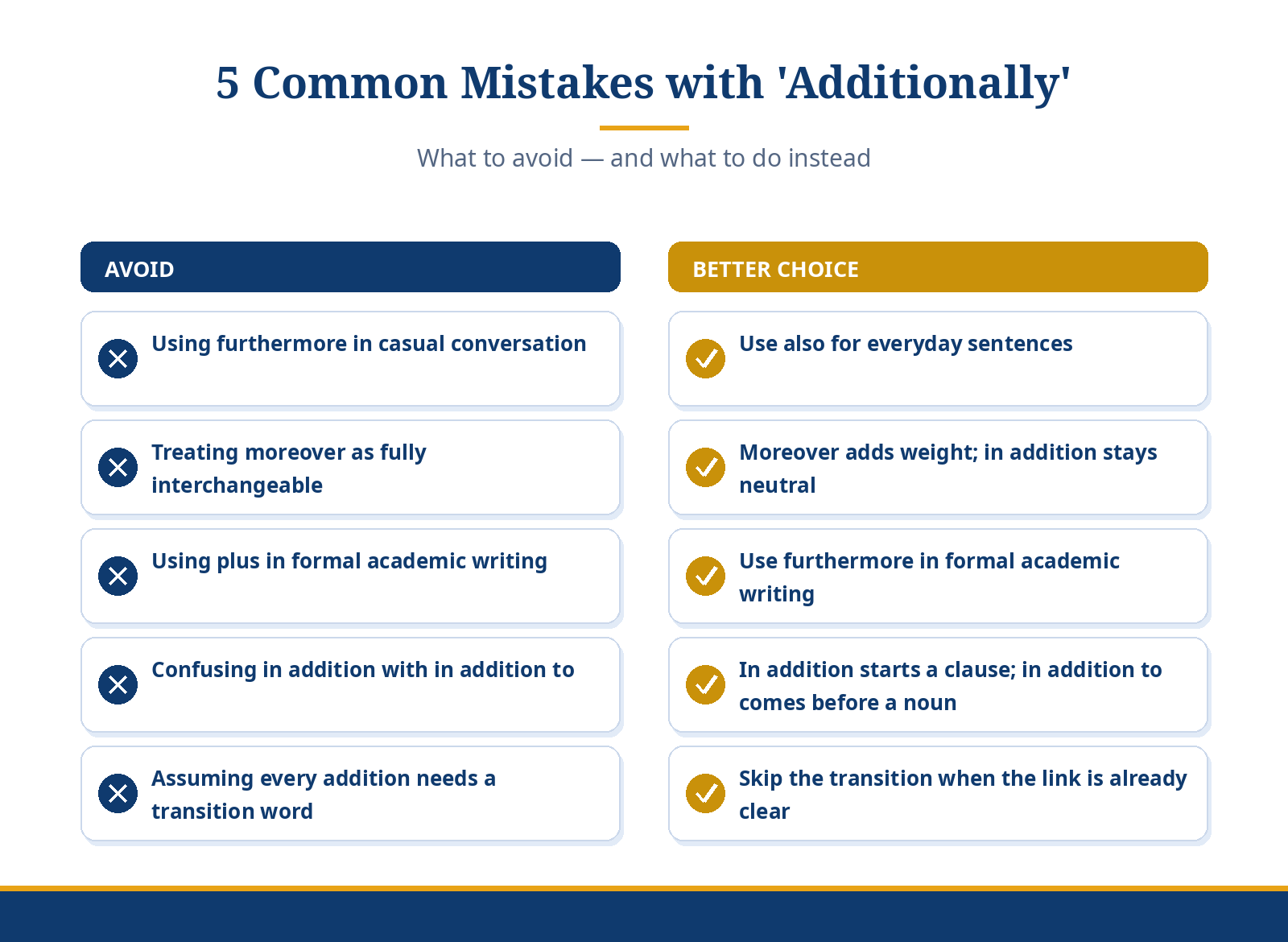
1. Using “furthermore” in casual conversation
❌ Furthermore, we need to buy some milk.
This is grammatically possible but sounds overly formal in an ordinary conversation.
✓ Also, we need to buy some milk.
2. Treating “moreover” as completely interchangeable
“Moreover” does more than add information. It can emphasize that the next point strengthens the previous statement.
The plan is affordable. Moreover, it can be implemented quickly.
If you simply want to add a neutral detail, in addition may be a better fit.
3. Using “plus” in formal academic writing
❌ The study has several limitations. Plus, the sample was relatively small.
For a formal paper:
✓ The study has several limitations. Furthermore, the sample was relatively small.
4. Confusing “in addition” with “in addition to”
Use in addition when introducing another clause:
In addition, the report contains financial data.
Use in addition to before a noun or gerund:
In addition to the financial data, the report contains market research.
5. Assuming every addition needs a transition word
Not every sentence needs “additionally,” “also,” or “furthermore.” Sometimes a simple sentence connection is clearer:
The company reduced prices and expanded its support team.
Adding a transition when the relationship is already obvious can make writing feel heavier than necessary.
Related Alternatives Worth Exploring
If you are choosing transitions for different kinds of writing, these topics are closely related:
- Another Way to Say Also
- Another Way to Say Furthermore
- Another Way to Say Moreover
Frequently Asked Questions
What is the best alternative to “additionally”?
Also is the most flexible alternative for general English. In addition works well in formal and professional writing, while furthermore and moreover are useful when building a formal argument. For casual conversation, plus, too, or on top of that may sound more natural.
Is “additionally” formal or informal?
“Additionally” is generally associated with neutral-to-formal written English. It is common in professional, academic, technical, and business writing. In casual conversation, people often choose simpler expressions such as also, too, or plus. The choice depends on the surrounding tone and how formal the communication needs to be.
What is a more formal word for “additionally”?
Furthermore and moreover are common formal alternatives. In addition is also well suited to formal writing. The choice depends on the relationship between the ideas: “in addition” is relatively neutral, while “furthermore” and “moreover” can give the added point greater rhetorical emphasis.
Can I start a sentence with “additionally”?
Yes. Additionally can naturally begin a sentence when you are introducing another related point:
Additionally, the company provides technical support.
A comma normally follows the introductory “additionally.” The same pattern works with “furthermore,” “moreover,” and “in addition.”
What is the difference between “additionally” and “also”?
Both can introduce additional information, but also is more flexible and common across everyday English. “Additionally” has a more formal written feel and is often used as a sentence transition. Compare: “She also manages the team” with “Additionally, she manages the team.” The first is more natural in ordinary sentences; the second emphasizes the transition.
Is “moreover” stronger than “additionally”?
Often, yes in rhetorical effect, although the words do not have a simple grammatical “strength” scale. “Additionally” usually adds information neutrally. “Moreover” often signals that the following point is important to the argument or reinforces what came before. That makes “moreover” better suited to formal persuasive or analytical writing.
Can “besides” replace “additionally”?
Sometimes, but not in every sentence. Besides can add another reason or consideration, often with a conversational or argumentative feel. For example, “I don’t want to go. Besides, it’s too late.” This is different from simply adding neutral information with “additionally.” Choose “besides” when that extra point has the appropriate conversational or persuasive nuance.
Conclusion
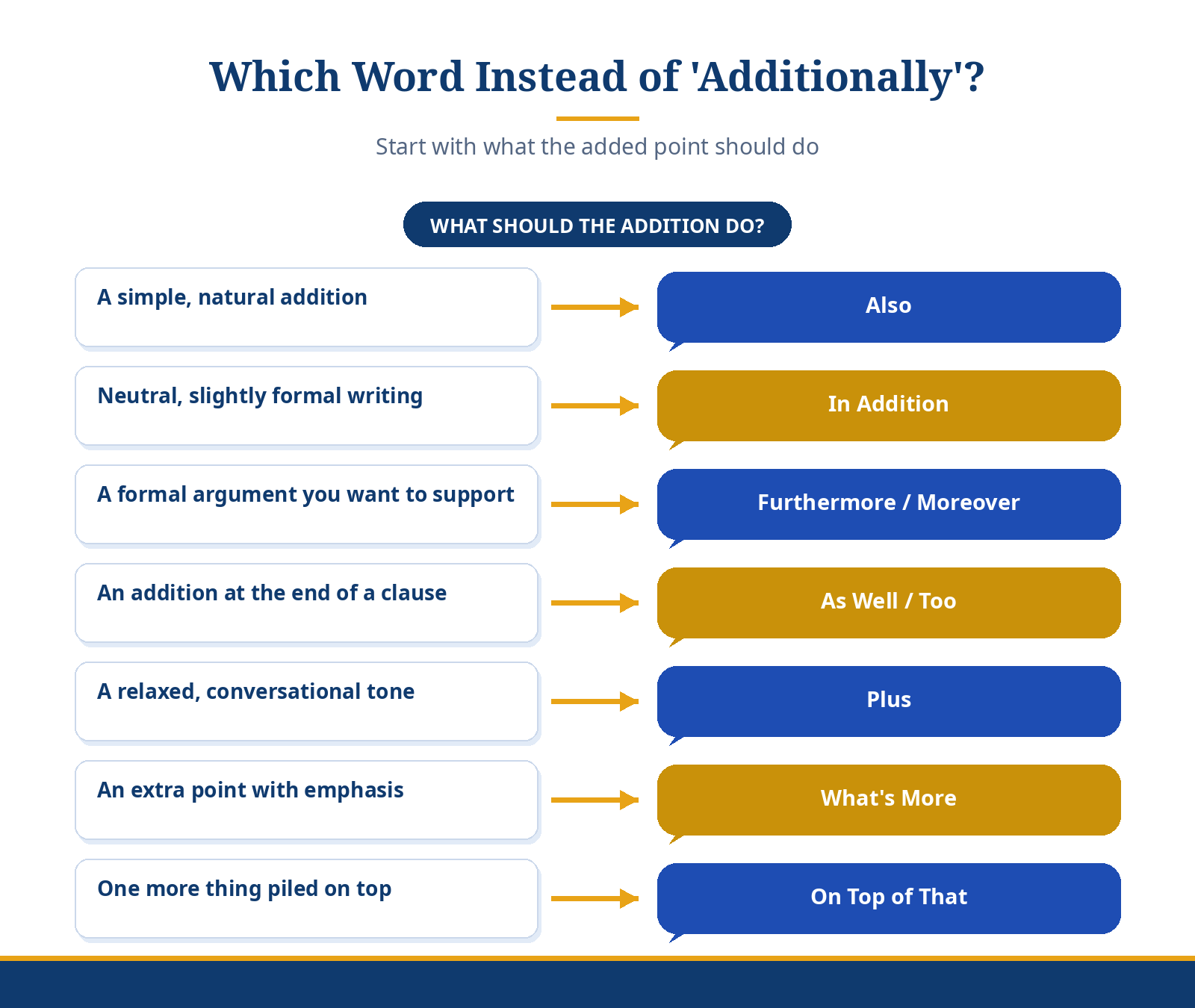
The best way to replace “additionally” is to consider what you want the transition to do. Choose also when you need a simple, natural addition. Use in addition for neutral formal writing, and choose furthermore or moreover when the new point supports or strengthens a formal argument. For relaxed communication, too, plus, besides, and on top of that can sound more natural.
The important point is that a synonym should match the relationship between your ideas, not just replace a repeated word. If the second idea is simply another fact, also or in addition is usually enough; if it carries extra rhetorical weight, a more emphatic connector may fit better.
Looking for more ways to refresh everyday phrases? Explore our guides to fresher ways to say said and done, or find a better way to say he says.

Editorial Desk
The Titan Standards Editorial Team develops, reviews, and maintains practical English-language resources. The team checks articles for clarity, accuracy, context, readability, and consistency with Titan Standards’ editorial guidelines.