Looking for another way to say person? The best alternative depends on your meaning and context.
Common choices include individual, human being, someone, somebody, adult, citizen, and character. Some sound more formal, while others work better in casual conversation or specific situations.
Key Takeaways
- Individual is the best general alternative for formal or professional writing.
- Human being emphasizes someone’s humanity or existence.
- Someone and somebody work naturally in everyday English.
- Citizen is useful when discussing a person’s relationship to a country or community.
- Always choose an alternative based on context, tone, and the specific meaning you want.
What Does “Another Way to Say Person” Mean?
“Another way to say person” means looking for a different word or phrase that refers to a human individual. People often search for alternatives to avoid repetition, make writing more precise, or choose language that better matches a particular situation.
For example, individual can sound more professional than “person,” while someone sounds natural in everyday conversation.
Why Use Other Ways to Say “Person”?
Using alternatives can make your writing clearer and more natural. The best choice depends on what you are describing and how formal you want to sound.
- Avoid repeating “person” too often.
- Make professional writing sound more precise.
- Choose a word that fits the context.
- Create more natural everyday sentences.
- Express a specific meaning more accurately.
10 Best Other Ways to Say “Person”
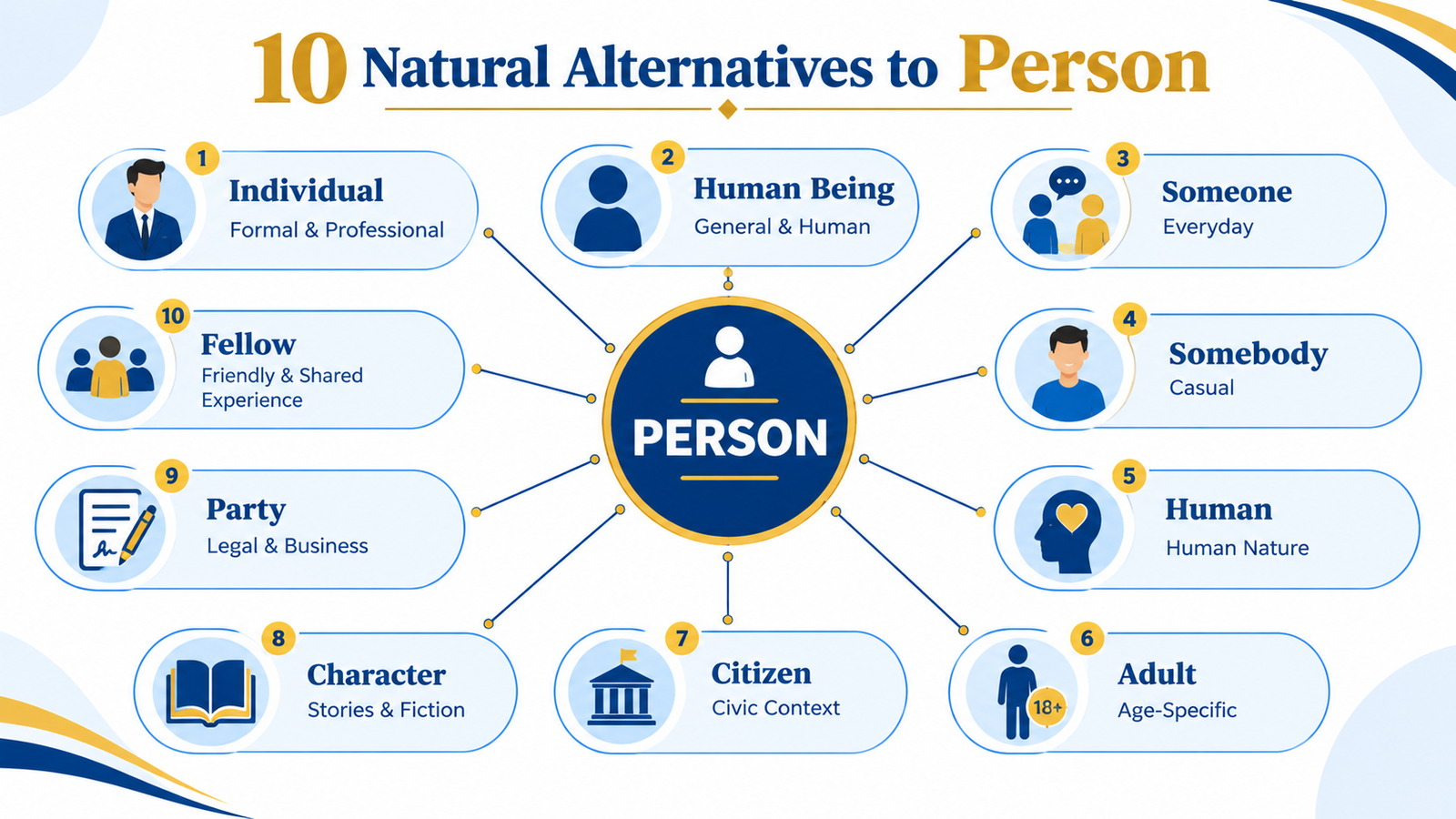
1. Individual
Meaning
Individual refers to one particular person. It is a useful replacement for “person” when you want your writing to sound neutral, precise, or professional.
Best For
- Professional
- Formal
- Polite
Example 1
Each individual is responsible for completing the registration form.
Example 2
The program gives every individual an opportunity to develop new skills.
Quick Tip
Use individual in professional, academic, and official writing when “person” feels too general.
2. Human Being
Meaning
Human being emphasizes that someone is a member of the human species. It often appears when discussing human nature, behavior, emotions, or basic human experiences.
Best For
- Formal
- Warm
- Friendly
Example 1
Every human being deserves to be treated with respect.
Example 2
As a human being, she understood how difficult the situation was.
Quick Tip
Choose human being when you want to emphasize humanity rather than someone’s role or identity.
3. Someone
Meaning
Someone means an unspecified person. It is one of the most natural alternatives to “person” in everyday American English.
Best For
- Casual
- Friendly
- Polite
Example 1
Someone left a jacket on the chair.
Example 2
If someone needs help, they can contact the front desk.
Quick Tip
Use someone when you are talking about an unknown or unspecified person.
4. Somebody
Meaning
Somebody also means an unspecified person and is very common in casual conversation. It usually has the same basic meaning as “someone.”
Best For
- Casual
- Friendly
Example 1
Somebody called while you were away.
Example 2
I think somebody forgot to close the window.
Quick Tip
Somebody is slightly more conversational, while someone can fit both casual and neutral writing.
5. Human
Meaning
Human can refer to a person when the focus is on humanity, behavior, or human characteristics. It is often used as a noun in specific contexts rather than as a direct replacement in every sentence.
Best For
- Formal
- Casual
- Warm
Example 1
Every human makes mistakes from time to time.
Example 2
The story explores what it means to be human.
Quick Tip
Use human when the sentence focuses on human nature or characteristics, not simply as a replacement for “person.”
6. Adult
Meaning
Adult specifically refers to a grown person rather than a child. It is a more precise choice when age matters in the sentence.
Best For
- Professional
- Formal
- Casual
Example 1
Each adult must show identification before entering the event.
Example 2
The course is designed for adults who want to improve their writing.
Quick Tip
Do not use adult as a general synonym for “person” if the person’s age is unknown or irrelevant.
7. Citizen
Meaning
Citizen refers to a person who legally belongs to a particular country. It can also describe someone as a member of a community in certain contexts.
Best For
- Formal
- Professional
Example 1
Every citizen has certain rights and responsibilities.
Example 2
The new policy affects citizens across the state.
Quick Tip
Use citizen only when nationality, legal status, or civic membership is relevant.
8. Character
Meaning
Character can refer to a person, especially in a story, play, movie, or fictional setting. It can also describe someone’s personality, so context is important.
Best For
- Casual
- Friendly
- Formal
Example 1
The main character changes significantly throughout the novel.
Example 2
The film introduces several memorable characters.
Quick Tip
Use character for people in stories or fictional works rather than as a universal replacement for “person.”
9. Party
Meaning
Party can mean a person involved in an agreement, legal matter, transaction, or dispute. It is common in business and legal language.
Best For
- Professional
- Formal
Example 1
Both parties agreed to the terms of the contract.
Example 2
The injured party may be entitled to compensation.
Quick Tip
Use party when someone is participating in a formal agreement, case, transaction, or proceeding.
10. Fellow
Meaning
Fellow can refer to a person, often with a friendly or informal tone. It commonly appears before a noun, such as “fellow employee,” “fellow traveler,” or “fellow student.”
Best For
- Casual
- Friendly
- Warm
Example 1
A fellow traveler helped me find the correct platform.
Example 2
She asked a fellow student for advice about the assignment.
Quick Tip
Fellow works best when you are describing someone who shares an activity, group, experience, or situation with you.
Comparison Table
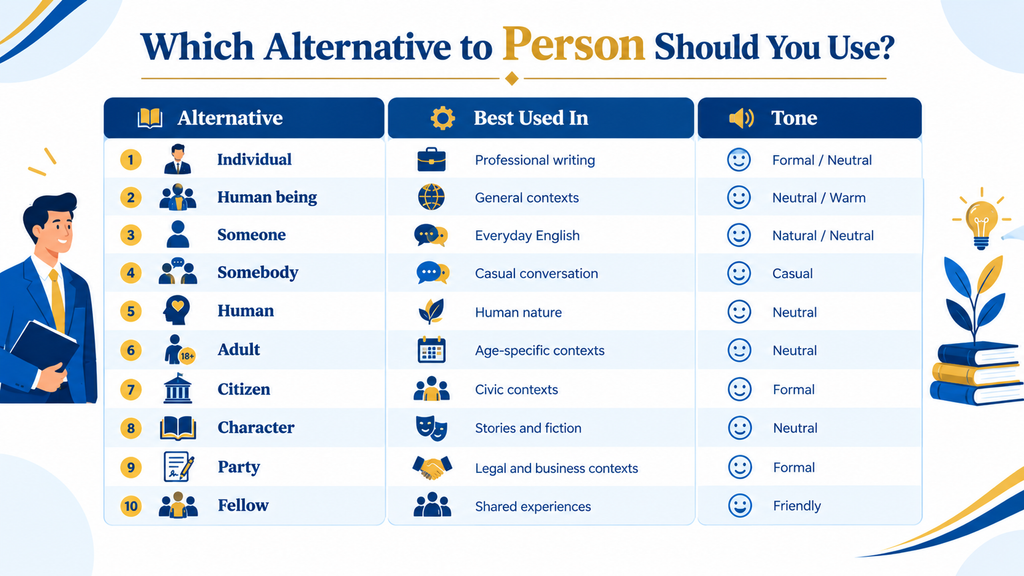
| Alternative | Best Used In | Tone |
| Individual | Professional writing | Formal, neutral |
| Human being | General or philosophical contexts | Warm, neutral |
| Someone | Everyday conversation | Natural, neutral |
| Somebody | Casual conversation | Casual |
| Human | Human nature and behavior | Neutral |
| Adult | Age-specific contexts | Neutral |
| Citizen | Civic or legal contexts | Formal |
| Character | Stories and fictional works | Neutral |
| Party | Legal and business contexts | Formal |
| Fellow | Shared experiences or groups | Friendly |
Common Mistakes
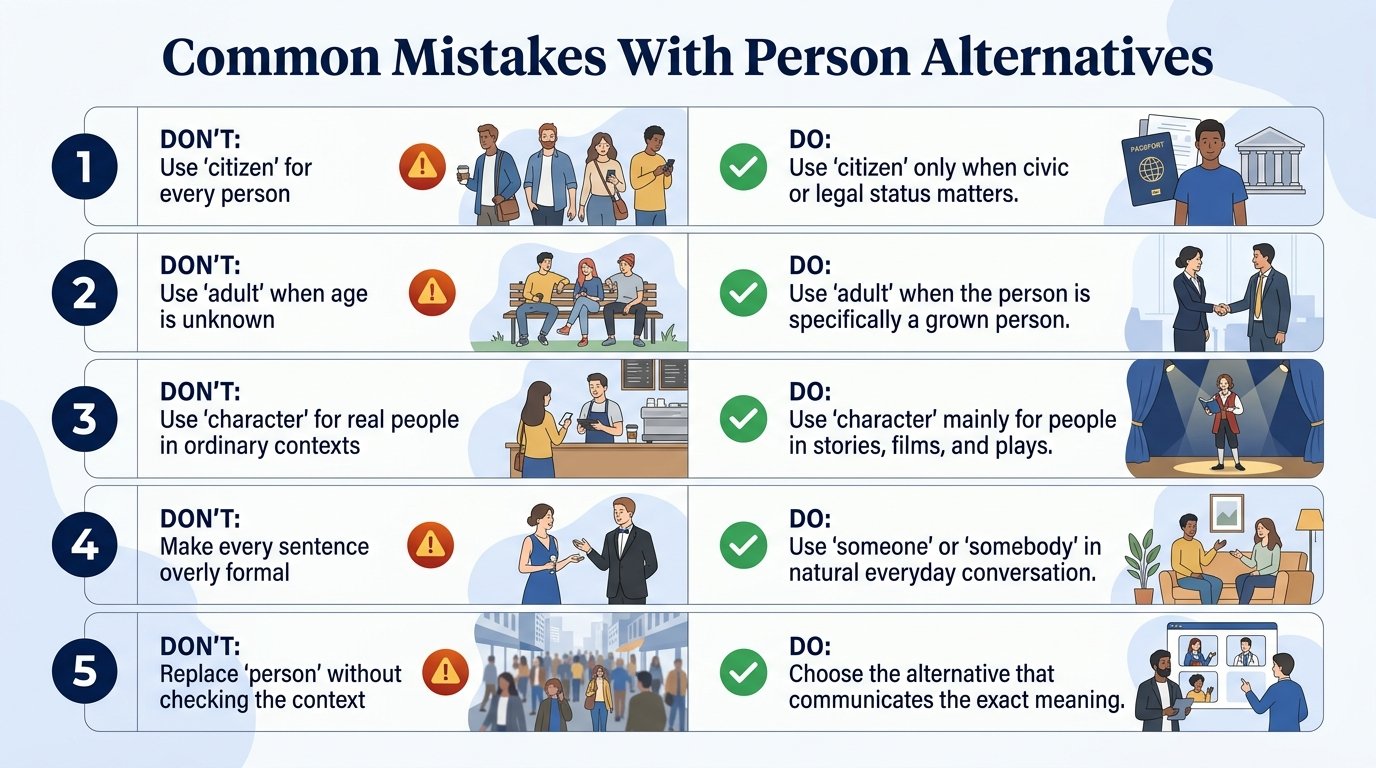
1. Using a context-specific word everywhere
Words such as citizen, adult, character, and party have specific meanings. They should not automatically replace “person” in every sentence.
2. Making professional writing too casual
Words like somebody can sound conversational. In formal documents, individual may be a better choice.
3. Using “human” when you simply mean “person”
“Human” often focuses on humanity or human characteristics. If you only mean one particular person, individual may be clearer.
4. Ignoring age
Adult specifically means a grown person. Avoid using it when you do not know whether the person is an adult.
5. Choosing a synonym without considering tone
Not every alternative sounds the same. Individual sounds professional, while fellow feels more friendly and conversational.
Frequently Asked Questions
What is the best formal word for person?
Individual is usually the best formal alternative to “person.” It works well in professional emails, reports, academic writing, and official documents. For example, “Each individual must complete the form” sounds more formal and precise than “Each person must complete the form.”
What is a synonym for person in everyday English?
Someone and somebody are two of the most natural everyday alternatives. Both refer to an unspecified person. “Someone is waiting outside” and “Somebody is waiting outside” are both grammatically correct and common in American English.
Is individual a better word than person?
Not always. Individual is often better when you want a formal or precise tone, but “person” is more natural in many everyday sentences. Choose based on context rather than replacing every occurrence of “person” with “individual.”
What is another word for person in professional writing?
Individual is a strong choice for professional writing. Depending on the context, employee, client, customer, applicant, participant, representative, or professional may be even more precise because these words identify the person’s specific role.
What is a synonym for person in a story?
Character is usually the best choice when referring to a person in a fictional story, movie, play, or novel. For example, you might say, “The main character is a young teacher.” However, “character” can also refer to personality, so context matters.
Can human be used instead of person?
Yes, but the two words are not always interchangeable. Human often emphasizes humanity or human nature, while person simply identifies an individual. For example, “Every human makes mistakes” focuses on human nature, while “That person made a mistake” identifies someone specific.
What is a more polite way to say person?
In many situations, individual is a neutral and polite alternative. However, the most respectful word often depends on the person’s role. For example, “customer,” “guest,” “student,” or “participant” may be more appropriate than either “person” or “individual.”
How do I choose the right alternative to person?
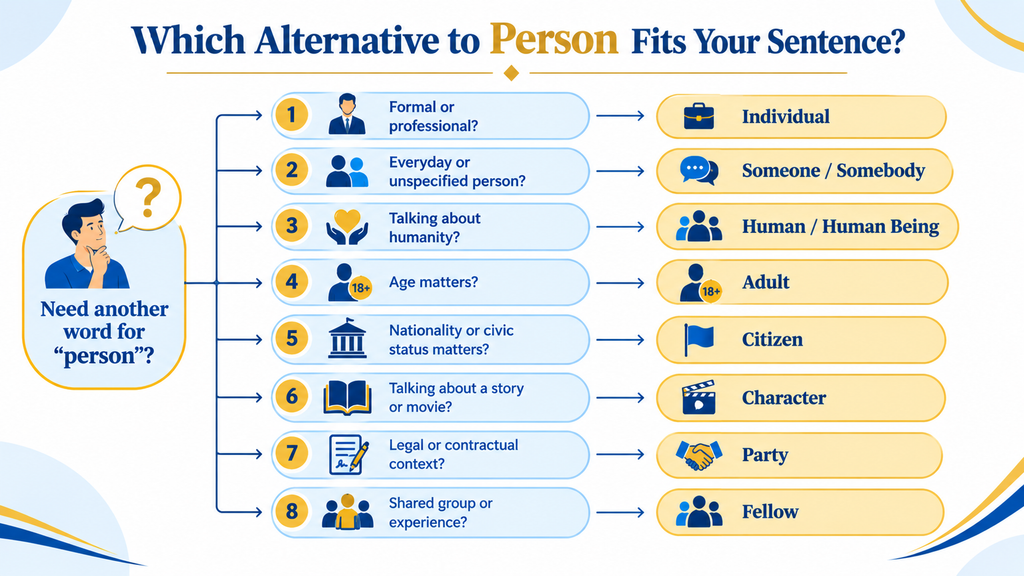
Start by identifying the context. Use individual for formal writing, someone or somebody for everyday situations, adult when age matters, citizen for civic contexts, character for stories, and party for legal or contractual situations.
Conclusion
There are many natural ways to say “person,” but the best alternative depends on your sentence and intended tone. Individual is a reliable choice for professional and formal writing, while someone and somebody sound natural in everyday American English.
For more specific situations, choose a word that adds useful information. Adult identifies age, citizen identifies civic status, character works for fictional people, and party fits legal or business contexts. Fellow is useful when someone shares an experience or group with you.
The key is not to replace “person” simply for the sake of variety. Choose the word that makes your meaning clearer, sounds natural, and fits the situation.

Communication Editor
Nadia Ellery is a communication editor focused on everyday English, conversational expressions, common phrases, and natural ways to communicate. She helps turn complicated language questions into practical guidance readers can use in everyday situations.