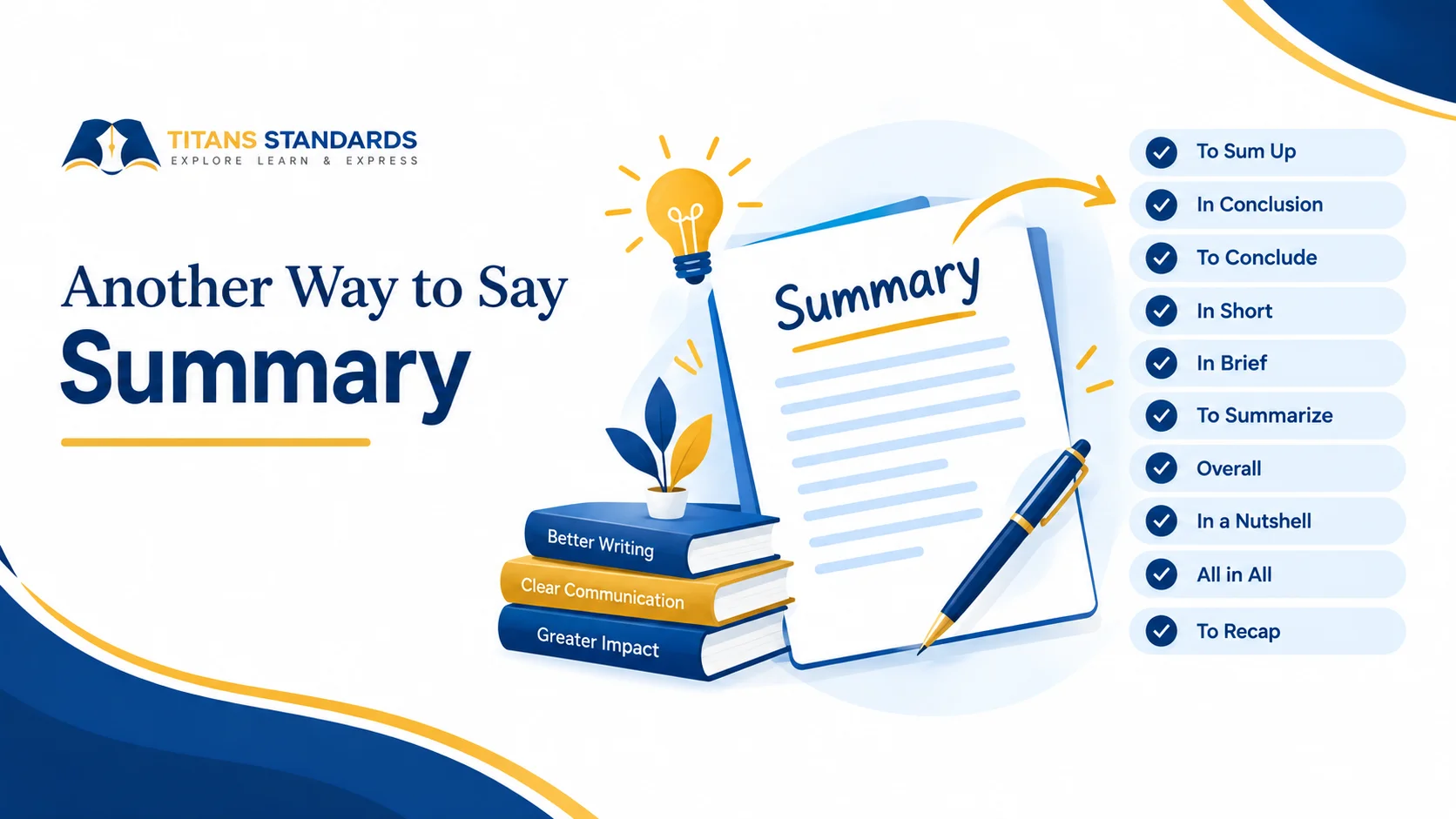
If you want another way to say “in summary,” you can use phrases such as “to sum up,” “in conclusion,” “in short,” “in brief,” “to summarize,” and “overall.”
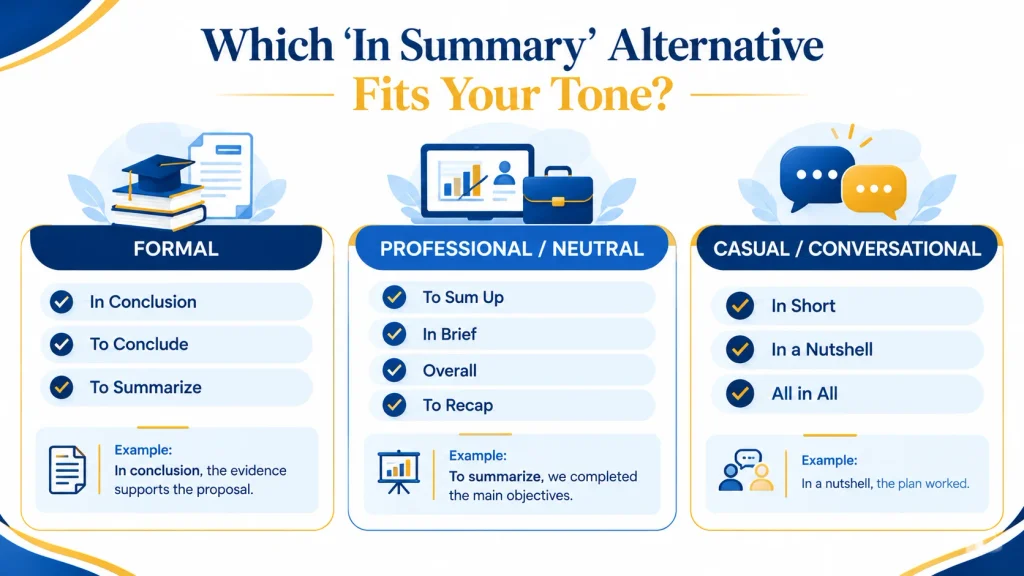
The best choice depends on your context, tone, and whether you are writing an essay, email, report, presentation, or casual message.
What Does “Another Way to Say In Summary” Mean?
“In summary” is a transition phrase used to introduce the main points or final idea of something that has already been discussed. It signals to the reader or listener that you are about to give a short version of the most important information.
For example: “In summary, the project was completed on time and stayed within budget.”
People often look for other ways to say “in summary” because repeating the same transition can make writing feel predictable. Using a suitable alternative can make your writing smoother, clearer, and better matched to the situation.
You commonly see these phrases in essays, reports, business communication, presentations, articles, emails, and everyday conversations.
Why Use Other Ways to Say “In Summary”?
Using different concluding phrases can make your communication more natural and precise.
- Avoid repetition when you summarize several points.
- Match the tone to a formal, professional, or casual situation.
- Make writing smoother by varying your transitions.
- Improve clarity when introducing a final point.
- Choose a phrase that fits the context instead of using the same expression every time.
The key is not simply to find a synonym. Choose the phrase that communicates the right level of formality and meaning.
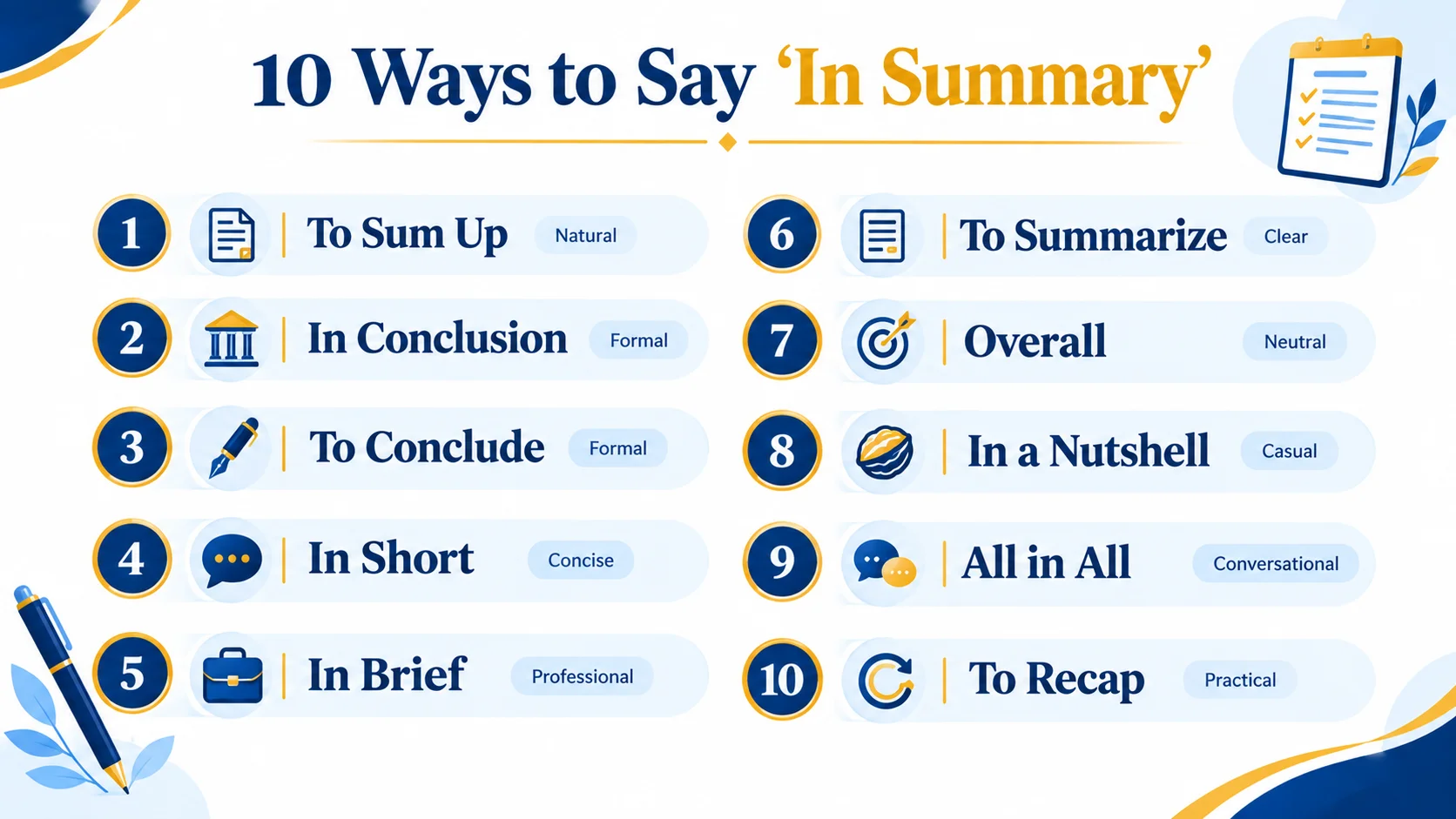
10 Best Other Ways to Say “In Summary”
1. To Sum Up
Meaning
“To sum up” introduces a brief statement of the main points that were just discussed. It is natural, clear, and slightly less formal than “in summary.”
Best For
- Professional
- Friendly
- Polite
- Casual
Example 1
To sum up, we need more time to test the new system before launch.
Example 2
To sum up, the trip was affordable, comfortable, and easy to organize.
Quick Tip
Use “to sum up” when you want a natural transition that works well in both speech and writing.
2. In Conclusion
Meaning
“In conclusion” introduces the final thoughts or judgment after discussing several points. It is especially common in essays, reports, academic writing, and formal presentations.
Best For
- Formal
- Professional
- Polite
Example 1
In conclusion, the research shows that regular exercise can improve overall well-being.
Example 2
In conclusion, the proposal offers a practical solution to the current staffing problem.
Quick Tip
Use “in conclusion” when you are ending a structured piece of writing rather than simply giving a quick recap.
3. To Conclude
Meaning
“To conclude” serves a similar purpose to “in conclusion” and signals that you are presenting your final thoughts. It has a formal and polished tone.
Best For
- Formal
- Professional
- Polite
Example 1
To conclude, both options have advantages, but the second plan is more affordable.
Example 2
To conclude, our findings support the need for additional training.
Quick Tip
“To conclude” works particularly well at the beginning of the final paragraph of a formal document.
4. In Short
Meaning
“In short” means “in a few words” or “to state the main point briefly.” It is useful when you want to reduce a longer explanation to its most important idea.
Best For
- Casual
- Friendly
- Professional
Example 1
In short, the new policy gives employees more flexibility.
Example 2
In short, we spent less money and achieved better results.
Quick Tip
Choose “in short” when brevity is the main goal rather than a formal conclusion.
5. In Brief
Meaning
“In brief” introduces a shortened version of information. It is concise and slightly more formal than “in short,” making it useful in professional and written communication.
Best For
- Professional
- Formal
- Polite
Example 1
In brief, the company plans to expand its services next year.
Example 2
In brief, the agreement protects both parties from unexpected costs.
Quick Tip
Use “in brief” when summarizing information in reports, business communication, or other concise written formats.
6. To Summarize
Meaning
“To summarize” directly tells the reader that you are about to restate the main points. It is clear and straightforward without sounding overly formal.
Best For
- Professional
- Formal
- Polite
Example 1
To summarize, the team met all three major project goals.
Example 2
To summarize, customers want faster delivery and simpler payment options.
Quick Tip
Use “to summarize” when clarity matters more than stylistic variety.
7. Overall
Meaning
“Overall” gives a general judgment or broad view after considering several details. Unlike “in summary,” it does not always introduce a complete recap.
Best For
- Professional
- Casual
- Friendly
Example 1
Overall, the conference was well organized and informative.
Example 2
Overall, sales improved despite a difficult start to the quarter.
Quick Tip
Use “overall” when you want to give a general assessment rather than repeat every major point.
8. In a Nutshell
Meaning
“In a nutshell” means “in a very brief form.” It has a conversational tone and is useful when explaining a complicated idea in simple terms.
Best For
- Casual
- Friendly
- Warm
Example 1
In a nutshell, the new software saves time and reduces errors.
Example 2
In a nutshell, we need a better plan before we move forward.
Quick Tip
Avoid “in a nutshell” in highly formal academic or corporate writing because it can sound too conversational.
9. All in All
Meaning
“All in all” gives an overall judgment after considering different aspects of a situation. It often sounds natural and conversational.
Best For
- Casual
- Friendly
- Warm
Example 1
All in all, the weekend was relaxing and enjoyable.
Example 2
All in all, the changes have made the process much easier.
Quick Tip
Use “all in all” when giving a broad opinion, especially in conversational or personal writing.
10. To Recap
Meaning
“To recap” means to briefly review the important information that has already been covered. It is especially useful in meetings, presentations, lessons, and conversations.
Best For
- Professional
- Casual
- Friendly
Example 1
To recap, the meeting starts at 9 a.m., and everyone should bring the updated reports.
Example 2
To recap, we chose the cheaper option because it offered better long-term value.
Quick Tip
Use “to recap” when you are reviewing previously discussed information rather than presenting a final conclusion.
Comparison Table
| Alternative | Best Used In | Tone |
| To Sum Up | General writing and speech | Natural |
| In Conclusion | Essays and formal writing | Formal |
| To Conclude | Reports and formal writing | Formal |
| In Short | Everyday communication | Concise |
| In Brief | Business and professional writing | Professional |
| To Summarize | Reports and explanations | Clear |
| Overall | Reviews and general opinions | Neutral |
| In a Nutshell | Casual explanations | Conversational |
| All in All | Personal opinions and conversations | Casual |
| To Recap | Meetings and presentations | Practical |
Common Mistakes
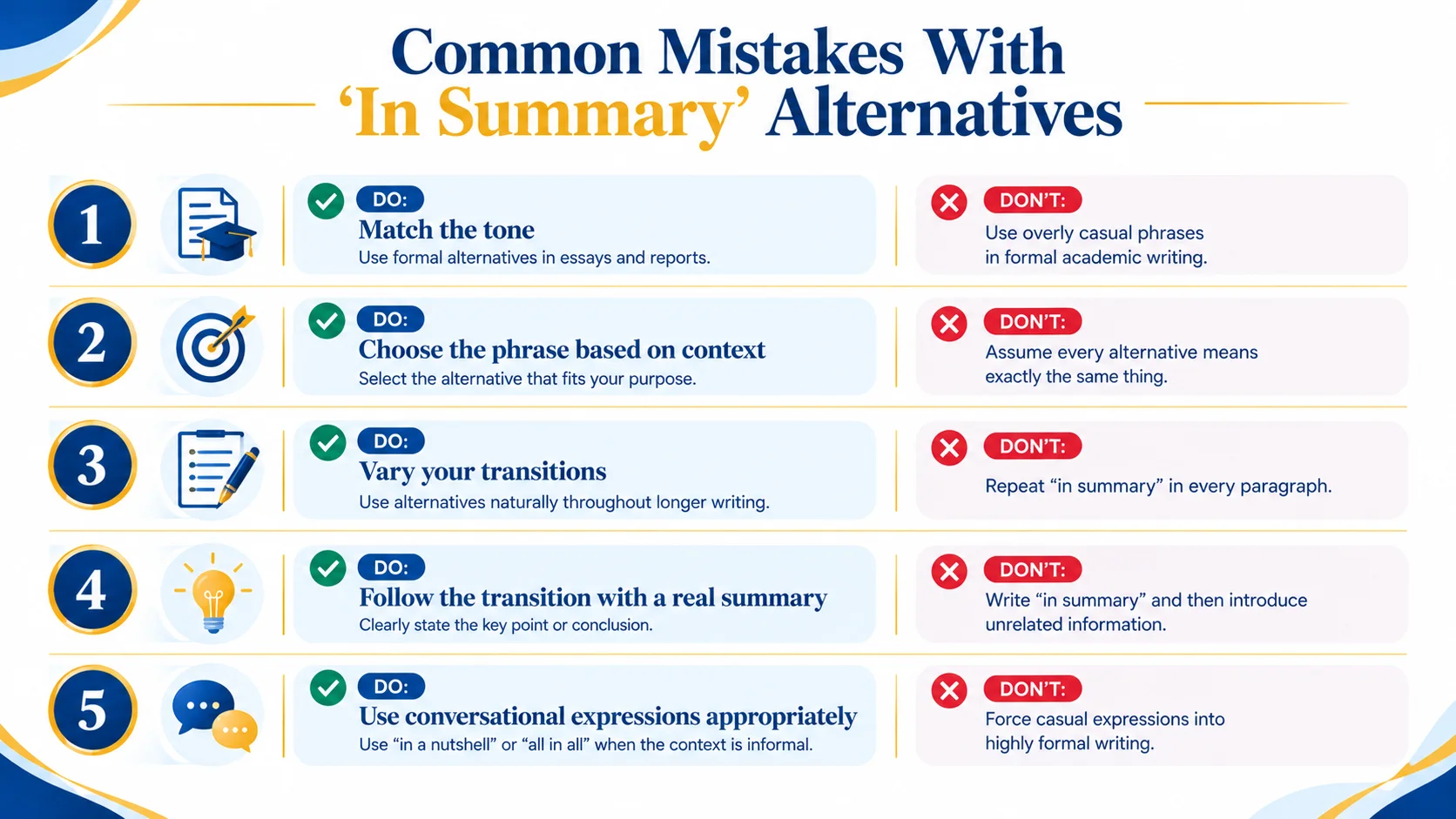
1. Using Casual Phrases in Formal Writing
Phrases such as “in a nutshell” and “all in all” can sound too conversational in academic papers or highly formal reports. Choose “in conclusion,” “to conclude,” or “to summarize” when a formal tone is expected.
2. Choosing an Overly Formal Expression
Not every situation needs “in conclusion.” Using formal language in a casual conversation can make your message sound stiff or unnatural.
3. Repeating the Same Transition
Using “in summary” at the end of every paragraph can make your writing repetitive. Vary your transitions when the context allows it.
4. Ignoring the Context
Not every alternative has exactly the same function. For example, “to recap” usually reviews information, while “overall” often gives a general judgment.
5. Using a Summary Phrase Without Actually Summarizing
A phrase such as “in short” should introduce a concise version of the main idea. Do not use it simply because you need a transition to the next sentence.
Frequently Asked Questions
What is another way to say “in summary”?
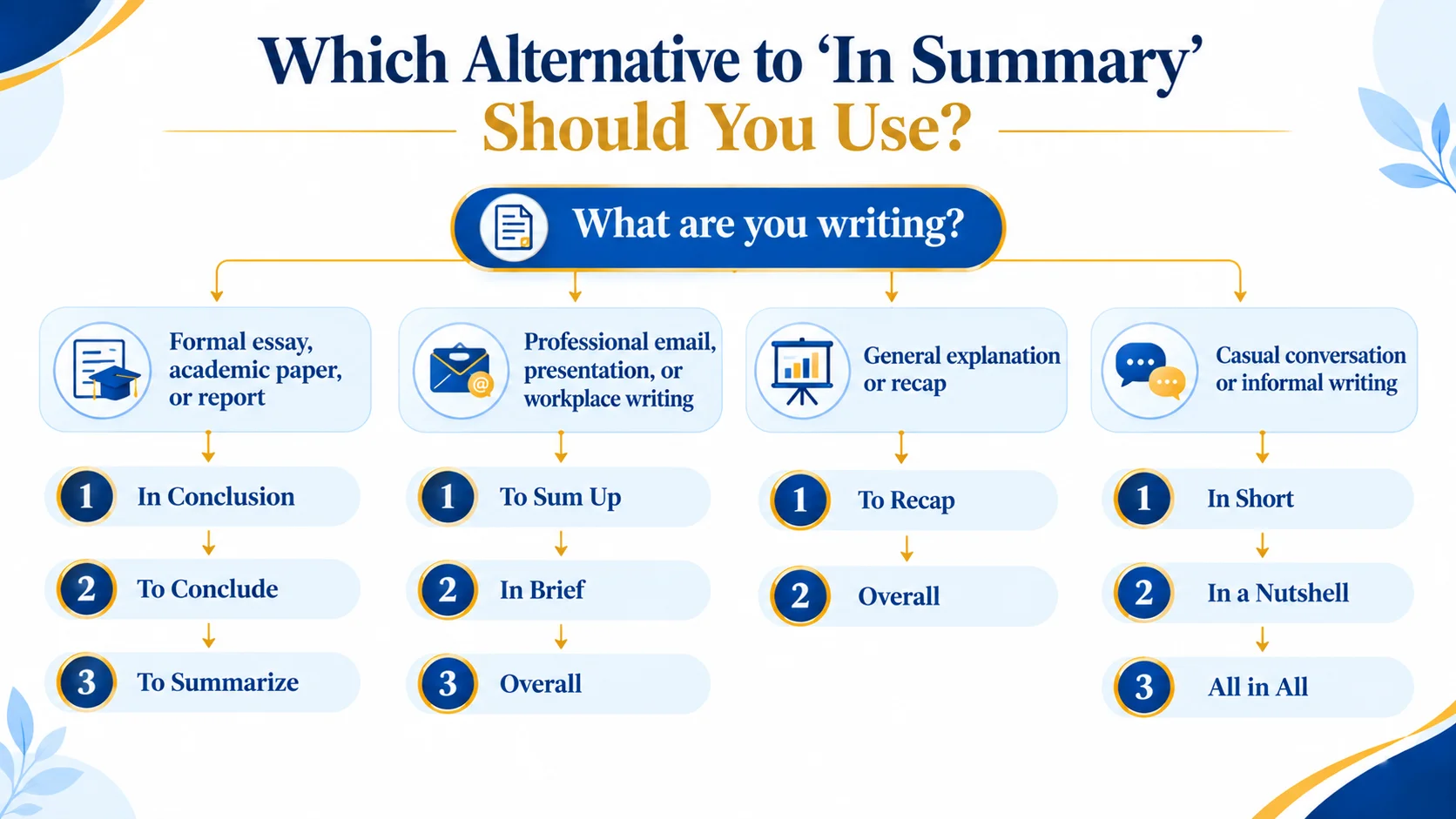
Common alternatives include “to sum up,” “in conclusion,” “to summarize,” “in short,” “in brief,” and “overall.” The best option depends on your context. For formal essays and reports, “in conclusion” or “to summarize” usually works well. For casual communication, “in short” or “to sum up” sounds more natural.
What is a professional way to say “in summary”?
For professional communication, you can use “to summarize,” “in brief,” “to sum up,” or “in conclusion.” “To summarize” is especially clear in reports and presentations, while “in brief” works well when you want to introduce a concise overview. Choose the phrase based on how formal your document needs to sound.
What is a formal synonym for “in summary”?
“In conclusion” and “to conclude” are among the most formal alternatives to “in summary.” “To summarize” is also appropriate in formal writing. These expressions work well in academic essays, research papers, business reports, and formal presentations where a polished transition is important.
Is “to sum up” the same as “in summary”?
“To sum up” and “in summary” have very similar meanings because both introduce a brief review of the main points. However, “to sum up” often sounds more natural and conversational. “In summary” can feel slightly more neutral and is common in structured writing, reports, and professional communication.
Can I use “overall” instead of “in summary”?
Yes, but the meaning is not always identical. “Overall” usually introduces a general judgment or assessment based on several details, while “in summary” directly signals a recap. For example, “Overall, the event was successful” gives an evaluation rather than summarizing every major point.
What is the best alternative to “in summary” in an essay?
“In conclusion” is usually the strongest choice when ending an essay because it clearly signals the final section or final thought. “To summarize” can also work when you want to review the main arguments. Avoid overly casual expressions such as “in a nutshell” in formal academic writing.
Is “in a nutshell” a good alternative to “in summary”?
“In a nutshell” can replace “in summary” when the situation is informal or conversational. It means that you are presenting something in a very brief form. However, it may sound too casual for academic papers, formal reports, or professional documents where “in brief” or “to summarize” would be more appropriate.
What is the difference between “to recap” and “to summarize”?
“To recap” usually means reviewing information that has already been discussed, while “to summarize” can introduce a concise version of a larger explanation, argument, or document. “To recap” is common in meetings, presentations, and conversations. “To summarize” is more flexible and works well in formal and professional writing.
Conclusion
There are many natural ways to say “in summary,” but the best choice depends on your audience and purpose. Use “in conclusion” or “to conclude” for formal essays and reports, while “to summarize” and “in brief” are strong choices for professional communication.
For everyday conversations, “to sum up,” “in short,” and “to recap” sound clear and natural. If you want a more conversational expression, “in a nutshell” or “all in all” can work well.
The most important point is to choose a phrase that matches your meaning, not simply replace “in summary” with any synonym. A well-chosen transition makes your writing clearer, smoother, and more natural.

Communication Editor
Nadia Ellery is a communication editor focused on everyday English, conversational expressions, common phrases, and natural ways to communicate. She helps turn complicated language questions into practical guidance readers can use in everyday situations.