“Additionally” is a transition word used to introduce another piece of information. It is similar to also, in addition, and furthermore, but it often has a more formal tone.
You may want another way to say “additionally” when you are trying to avoid repetition, make your writing sound natural, or match a particular level of formality.
Featured Snippet:
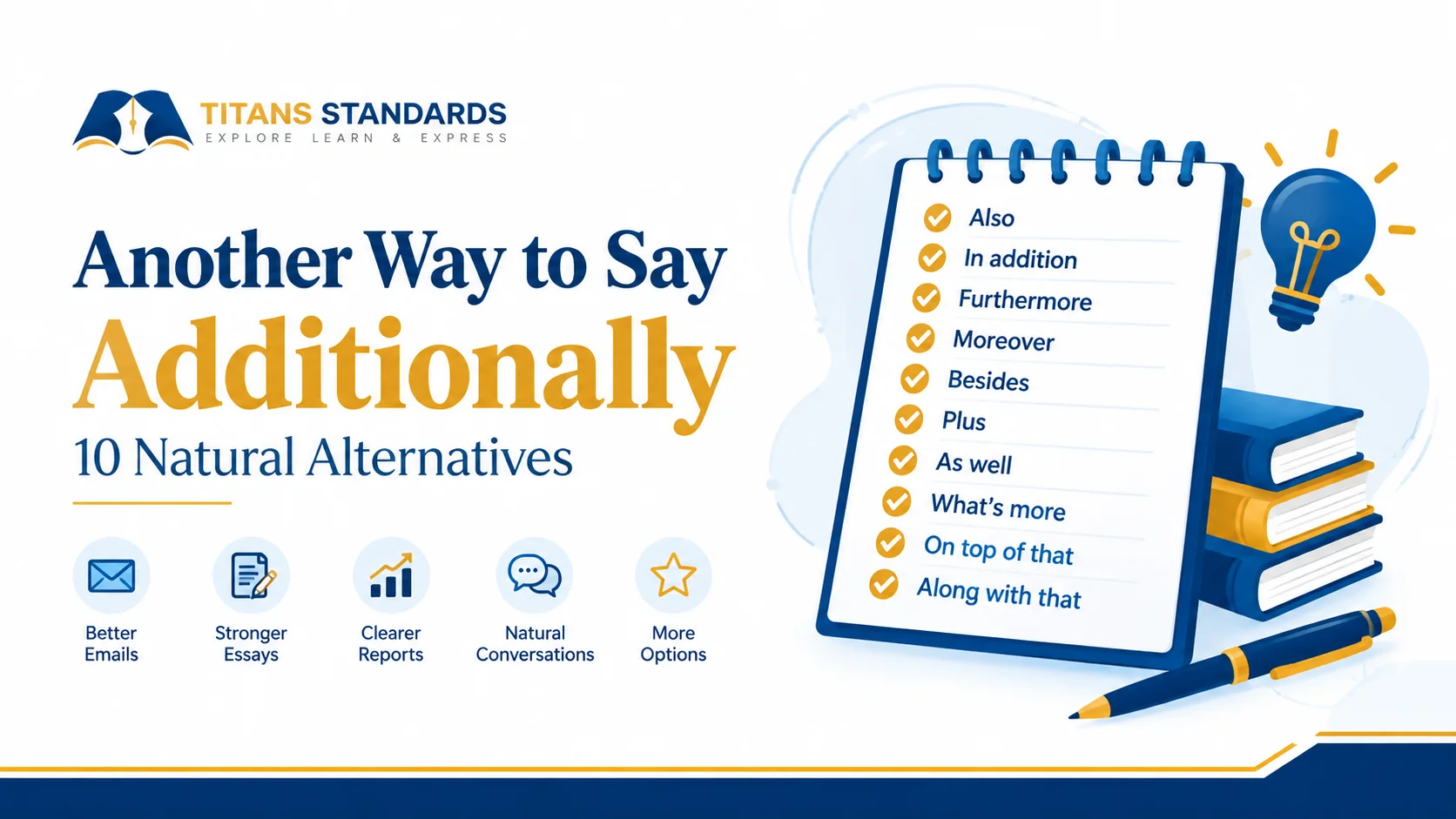
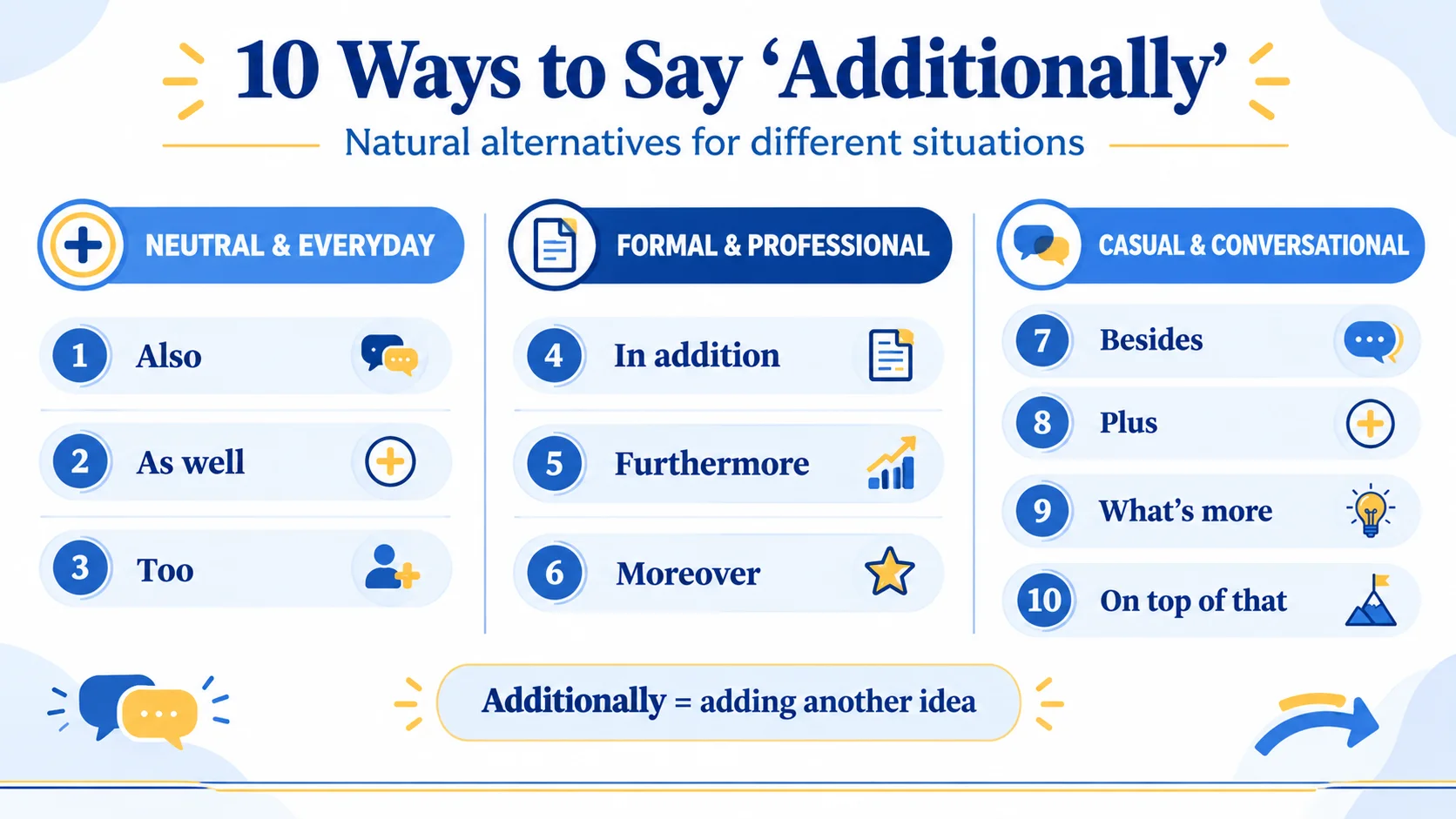
Looking for another way to say additionally? Common alternatives include also, in addition, furthermore, moreover, besides, as well, plus, what’s more, on top of that, and along with that. The best choice depends on your tone, sentence structure, and whether you are writing an email, essay, report, or casual message.
Key Takeaways
- Also is the simplest everyday alternative to “additionally.”
- In addition works well in professional and formal writing.
- Furthermore and moreover suit formal arguments and reports.
- Besides, plus, and on top of that sound more conversational.
- Choose the alternative based on your audience, tone, and sentence structure.
What Does “Another Way to Say Additionally” Mean?
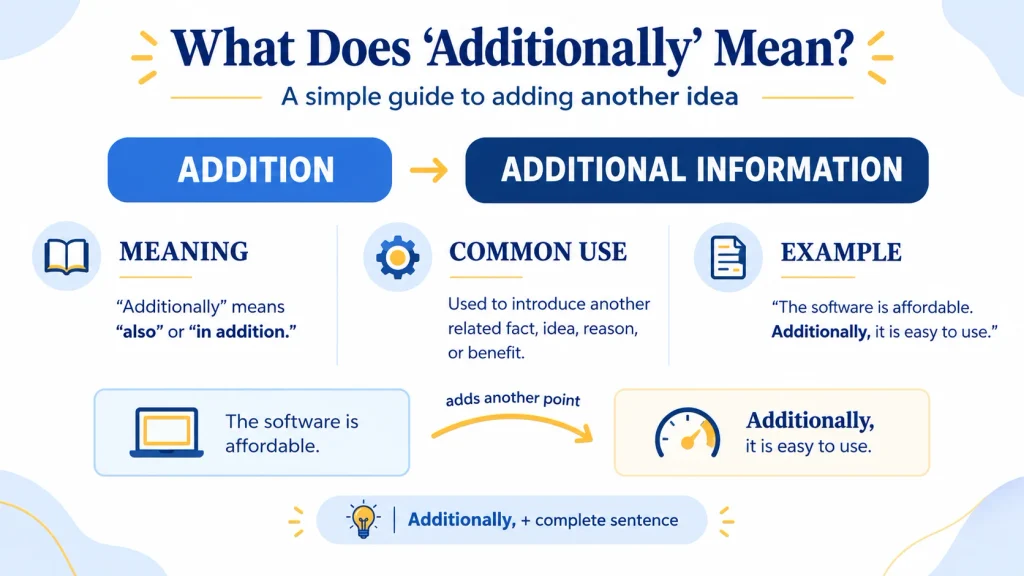
The phrase “another way to say additionally” means you are looking for a different word or phrase that adds information to something already stated.
For example:
The hotel offers free breakfast. Additionally, guests receive free parking.
You could replace “additionally” with also, in addition, or furthermore, depending on the tone.
“Additionally” is common in professional emails, academic writing, reports, presentations, essays, and formal explanations. In casual conversation, shorter choices such as “also” or “plus” often sound more natural.
Why Use Other Ways to Say “Additionally”?
Using different transition words can make your writing smoother and more precise. Repeating “additionally” several times can make a paragraph feel mechanical.
Other alternatives can help you:
- Avoid repeating the same transition.
- Sound more natural and conversational.
- Match formal or casual situations.
- Improve the flow of professional writing.
- Connect related ideas more clearly.
- Add emphasis when introducing another point.
10 Best Other Ways to Say “Additionally”
1. Also
Meaning:
“Also” means that something else is true or that another point should be added. It is one of the most natural and flexible alternatives to “additionally.”
Best For:
- Casual
- Friendly
- Professional
- Polite
Example 1:
The apartment is close to downtown and also has a private parking space.
Example 2:
Please send the completed form and also include a copy of your ID.
Quick Tip:
Use “also” when you want a simple alternative that works in both everyday and professional English.
2. In Addition
Meaning:
“In addition” introduces another related fact, reason, or point. It is slightly more formal than “also” and works especially well in organized writing.
Best For:
- Professional
- Formal
- Polite
Example 1:
The position offers health insurance. In addition, employees receive paid vacation.
Example 2:
In addition to reducing costs, the new system saves employees valuable time.
Quick Tip:
Use “in addition to + noun” when connecting an additional thing directly to another part of the sentence.
3. Furthermore
Meaning:
“Furthermore” adds another point that supports or strengthens the previous statement. It is common in formal and academic writing.
Best For:
- Formal
- Professional
Example 1:
The proposal would reduce operating costs. Furthermore, it could improve customer service.
Example 2:
The study provides useful data. Furthermore, it identifies several areas for future research.
Quick Tip:
Choose “furthermore” when the second point builds on the importance of the first one.
4. Moreover
Meaning:
“Moreover” adds information that gives additional support or emphasis to an argument. It usually sounds more formal than “also.”
Best For:
- Formal
- Professional
Example 1:
The software is affordable. Moreover, it is easy for new users to learn.
Example 2:
The plan could increase efficiency. Moreover, it would require little additional training.
Quick Tip:
Use “moreover” when the added point is especially relevant to the argument you are making.
5. Besides
Meaning:
“Besides” can introduce another reason, fact, or consideration. It is generally more conversational than “furthermore” or “moreover.”
Best For:
- Casual
- Friendly
- Warm
Example 1:
I don’t think we should leave yet. Besides, the weather is getting worse.
Example 2:
She decided to take the course. Besides learning new skills, she wanted to meet other professionals.
Quick Tip:
“Besides” can sometimes suggest that the additional point is a reason for making a decision.
6. Plus
Meaning:
“Plus” adds another benefit, fact, or reason in a relaxed and conversational way. It is common in everyday American English.
Best For:
- Casual
- Friendly
Example 1:
The restaurant is affordable, plus it has a great outdoor patio.
Example 2:
You should bring a jacket. Plus, the temperature may drop tonight.
Quick Tip:
Use “plus” in casual writing and conversation rather than formal reports or academic papers.
7. As Well
Meaning:
“As well” means “also” or “too.” It commonly appears at the end of a sentence and provides a natural way to add another point.
Best For:
- Casual
- Friendly
- Polite
Example 1:
The package includes free installation as well.
Example 2:
Please let me know if you need any additional information as well.
Quick Tip:
“As well” often sounds more natural at the end of a sentence than at the beginning.
8. What’s More
Meaning:
“What’s more” introduces an additional point, often one that makes the previous statement more convincing or interesting.
Best For:
- Friendly
- Professional
- Formal
Example 1:
The course is flexible. What’s more, you can complete it entirely online.
Example 2:
The product is easy to use. What’s more, it comes with a two-year warranty.
Quick Tip:
Use “what’s more” when the new information adds extra emphasis or makes the previous point stronger.
9. On Top of That
Meaning:
“On top of that” means that another fact or situation should be added to what has already been mentioned. It is informal and expressive.
Best For:
- Casual
- Friendly
- Warm
Example 1:
The flight was delayed for three hours. On top of that, our luggage was missing.
Example 2:
The project has a tight deadline, and on top of that, two team members are out sick.
Quick Tip:
Use this phrase in conversation or informal writing when the added information has noticeable impact.
10. Along With That
Meaning:
“Along with that” introduces something that accompanies or adds to a previous idea. It can sound natural when discussing several features, actions, or benefits.
Best For:
- Casual
- Friendly
- Professional
Example 1:
The company offers flexible hours along with that benefit package.
Example 2:
You will receive training along with that additional support during your first month.
Quick Tip:
Use “along with that” when the second idea is closely connected to the first rather than simply being another unrelated point.
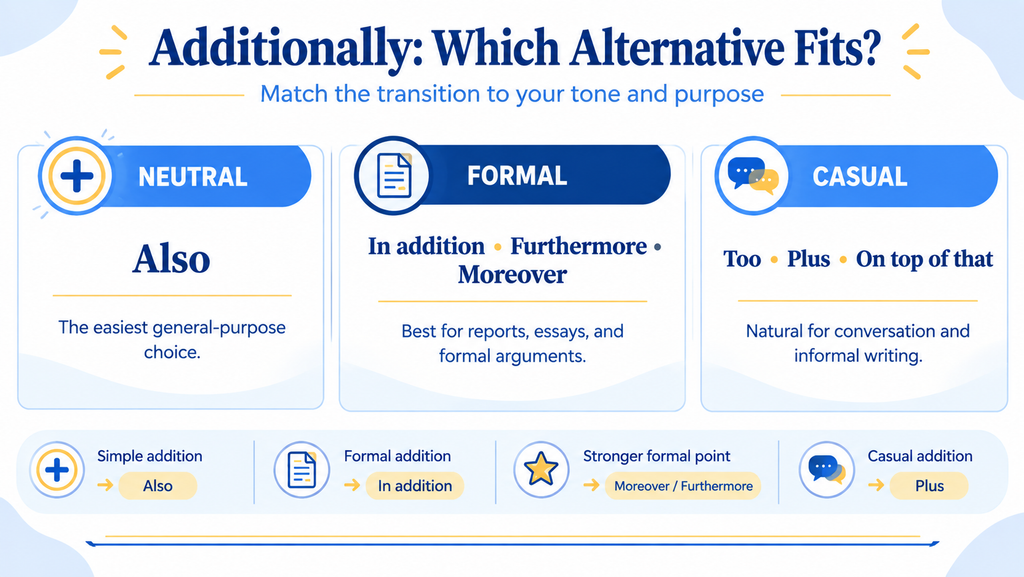
Comparison Table
| Alternative | Best Used In | Tone |
| Also | Everyday writing, emails, conversation | Neutral |
| In addition | Reports, emails, formal writing | Professional |
| Furthermore | Essays, reports, arguments | Formal |
| Moreover | Academic and professional writing | Formal |
| Besides | Conversation, informal writing | Conversational |
| Plus | Texts, conversation, casual writing | Casual |
| As well | Everyday and professional communication | Neutral |
| What’s more | Explanations, persuasive writing | Friendly/Formal |
| On top of that | Conversation, informal writing | Casual |
| Along with that | Everyday and professional contexts | Neutral |
Common Mistakes
1. Using Casual Phrases in Formal Writing
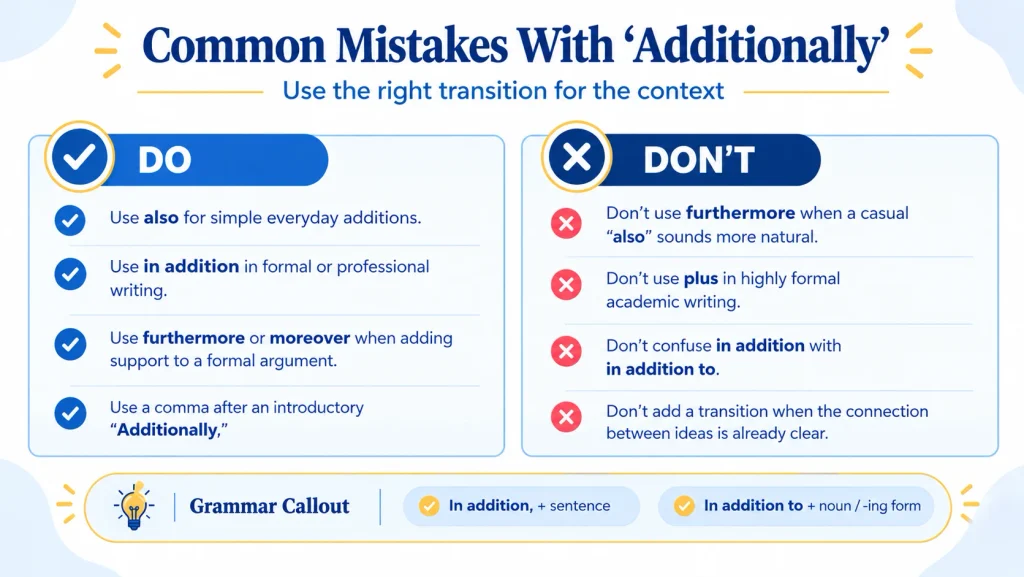
Words such as “plus” and “on top of that” may sound too informal in academic papers or formal reports. Choose “in addition,” “furthermore,” or “moreover” when a formal tone is expected.
2. Making Every Sentence Start With “Additionally”
Repeating the same transition can make your writing sound predictable. Vary your transitions when the context allows, but do not replace “additionally” simply for the sake of variety.
3. Choosing an Overly Formal Alternative
“Moreover” and “furthermore” are useful, but they may sound stiff in a casual text or friendly email. In those situations, “also,” “plus,” or “as well” may fit better.
4. Ignoring Sentence Structure
Not every alternative works in exactly the same grammatical position. For example, “as well” commonly appears at the end of a sentence, while “in addition” can introduce a sentence or work with “to.”
5. Adding a Transition When It Is Not Needed
A transition should clarify the relationship between ideas. If two sentences already connect naturally, adding “moreover,” “furthermore,” or another transition may make the writing feel unnecessary or forced.
Frequently Asked Questions
What is the best alternative to “additionally”?
“Also” is the most versatile alternative because it works in casual conversation, emails, and many professional situations. For more formal writing, “in addition,” “furthermore,” or “moreover” may be more appropriate. The best choice depends on the sentence, audience, and level of formality.
Is “also” the same as “additionally”?
“Also” and “additionally” both introduce extra information, so they often have the same basic meaning. However, “also” is more common in everyday English, while “additionally” tends to sound more formal and is frequently used in reports, professional writing, and structured explanations.
What is a professional way to say “additionally”?
“In addition” is a strong professional alternative to “additionally.” “Furthermore” and “moreover” are also suitable when you are adding a supporting point in a report, proposal, presentation, or other formal document.
What is a formal word for “additionally”?
“Furthermore” and “moreover” are common formal alternatives. Both can introduce another point, especially when the new information supports an argument. “In addition” is also formal but tends to be more neutral and flexible across different types of professional writing.
Can I use “plus” instead of “additionally”?
Yes, but “plus” is much more casual. It works naturally in conversations, texts, informal emails, and friendly writing. In a formal business report or academic essay, “in addition” or “furthermore” would usually create a more appropriate tone.
Is “in addition” better than “additionally”?
Neither is always better. Both are correct ways to introduce additional information. “In addition” can sound slightly more natural in many professional sentences, while “additionally” is useful when you want a concise transition at the beginning of a sentence.
What can I say instead of “additionally” in an email?
For a professional email, you can use “also,” “in addition,” “furthermore,” or “as well.” For example, “In addition, please review the attached document” sounds professional and clear without being overly formal.
What is a casual way to say “additionally”?
Common casual alternatives include “also,” “plus,” “besides,” and “on top of that.” “Also” is the safest everyday choice, while “plus” and “on top of that” create a more conversational tone.
Conclusion
There are many natural ways to say “additionally,” but the right choice depends on your audience and purpose. For everyday communication, “also” and “as well” are simple and natural. In professional writing, “in addition” is clear and polished, while “furthermore” and “moreover” work well when adding support to an argument.
For casual conversations, “plus,” “besides,” and “on top of that” can make your language sound more relaxed. The key is not to replace “additionally” every time, but to choose a transition that fits the sentence and tone. When in doubt, “also” is usually the most flexible choice.

Communication Editor
Nadia Ellery is a communication editor focused on everyday English, conversational expressions, common phrases, and natural ways to communicate. She helps turn complicated language questions into practical guidance readers can use in everyday situations.