The word ‘also’ helps you add information, connect ideas, and make your writing flow naturally. However, using it repeatedly can make your sentences sound predictable.
Learning another way to say also can help you express additional information more clearly in everyday conversations, professional emails, academic writing, and formal documents.
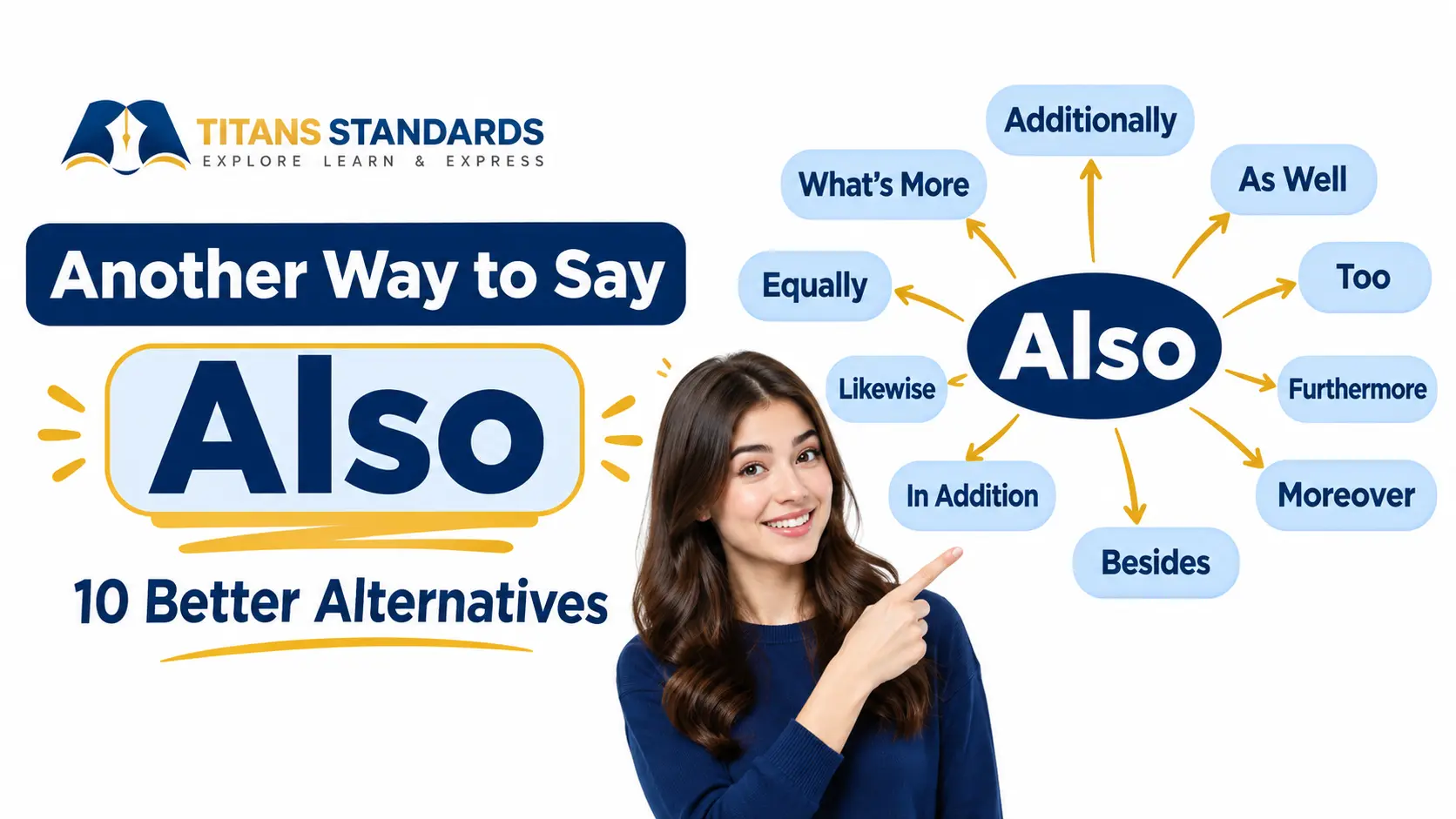
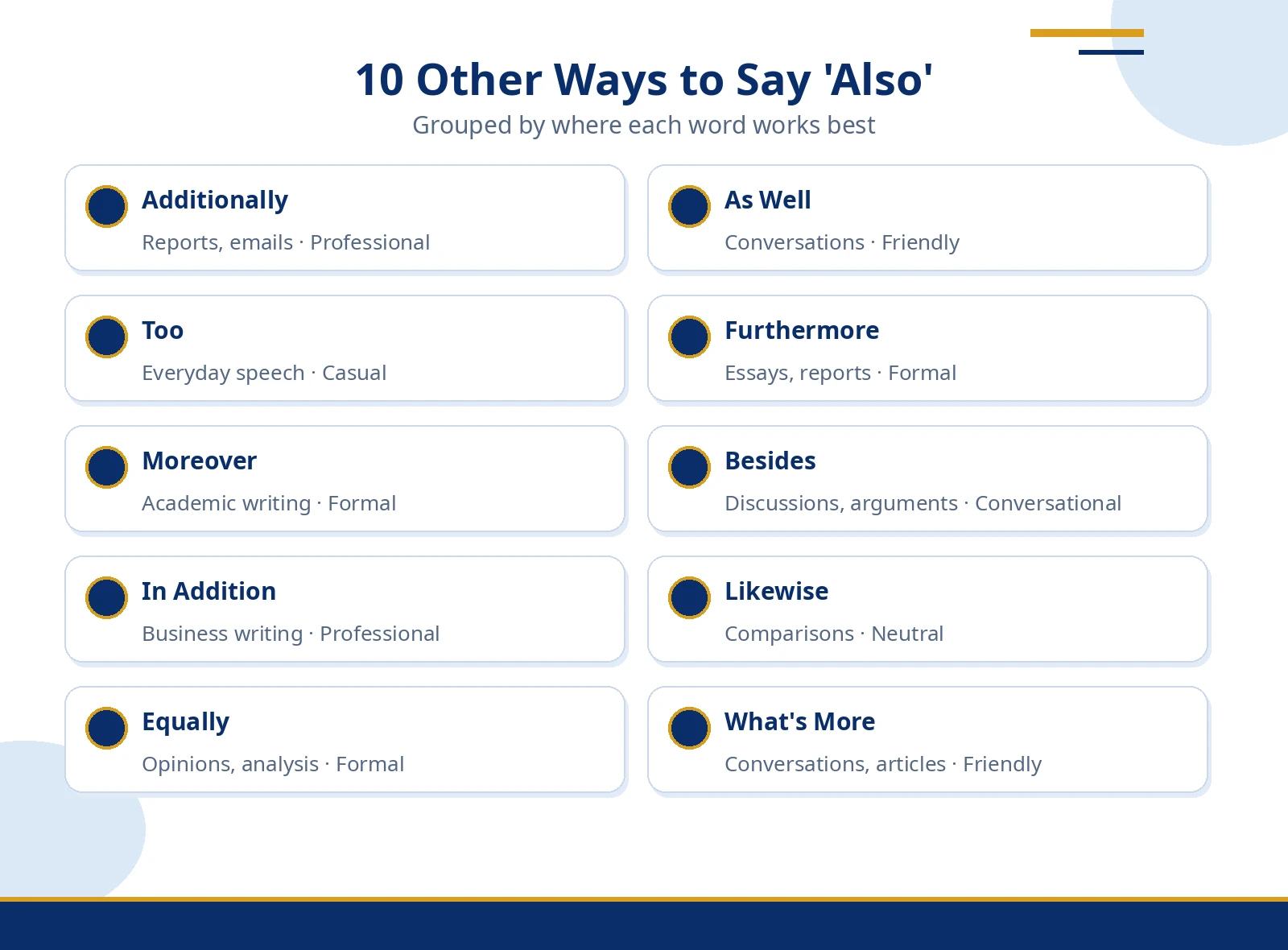
Another way to say also includes additionally, as well, too, furthermore, moreover, besides, in addition, likewise, equally, and what’s more. These alternatives help you add information, connect related ideas, and avoid repetition. Choose the right expression based on your sentence, writing style, and level of formality.
Key Takeaways
- Use additionally and in addition to introduce extra information.
- Choose too and as well for natural, conversational English.
- Use furthermore and moreover in formal and academic writing.
- Try besides when adding another reason or point.
- Select alternatives based on context, sentence structure, and tone.
What Does “Another Way to Say Also” Mean?
The phrase ‘another way to say also’ refers to different words and expressions that communicate the same basic idea as ‘also.’ The word ‘also’ means that something is included, added, or true in addition to something already mentioned.
People use ‘also’ to connect related information without starting an entirely new topic. For example, you might say, ‘She speaks English and also understands Spanish.’
This word appears in everyday conversations, school assignments, business emails, reports, and formal documents. However, repeating it too often can make your writing feel less varied.
For the full definition, see the Cambridge Dictionary entry for ‘also’.
Why Use Other Ways to Say Also?
Using alternatives to ‘also’ makes your communication more natural and helps you connect ideas effectively. Although ‘also’ works in many situations, other expressions can provide a better fit for your sentence.
Here are some reasons to use different alternatives:
- Avoid repetition: Keep your writing fresh by varying your vocabulary.
- Improve sentence flow: Connect ideas without using the same word repeatedly.
- Sound more professional: Choose expressions that suit workplace communication.
- Add emphasis: Highlight an additional point or supporting argument.
- Match the tone: Use casual, friendly, or formal expressions when appropriate.
Here are 10 useful alternatives to ‘also,’ along with their meanings, suitable contexts, and natural examples.
10 Best Other Ways to Say Also
1. Additionally
Meaning: ‘Additionally’ introduces extra information that supports or expands on a previous statement. It works well in professional and academic settings.
Best For: Professional, Formal
Example 1: Additionally, our team will provide free training to all new employees.
Example 2: The apartment has a spacious kitchen. Additionally, it includes a private balcony.
Quick Tip: Use ‘additionally’ at the beginning of a sentence when introducing a separate but related point.
2. As Well
Meaning: ‘As well’ means that something is included along with another thing. It sounds natural and friendly, and it often appears at the end of a sentence.
Best For: Casual, Friendly, Polite
Example 1: I’ll bring some snacks as well.
Example 2: She wants to attend the conference as well.
Quick Tip: Place ‘as well’ near the end of a sentence in most everyday situations.
3. Too
Meaning: ‘Too’ is a short and common alternative to ‘also.’ It shows that another person, thing, or situation shares the same experience or quality.
Best For: Casual, Friendly
Example 1: My brother enjoys playing basketball, and I do too.
Example 2: We’re planning to visit Chicago next summer, too.
Quick Tip: Use ‘too’ at the end of a sentence for a natural conversational tone.
4. Furthermore
Meaning: ‘Furthermore’ introduces another point that strengthens or supports an existing argument. It is especially common in formal and academic writing.
Best For: Formal, Professional
Example 1: The new software saves time. Furthermore, it reduces the risk of human error.
Example 2: The proposal fits our budget. Furthermore, it supports our long-term goals.
Quick Tip: Choose ‘furthermore’ when your additional point builds on the importance of the previous one.
5. Moreover
Meaning: ‘Moreover’ adds information that makes a previous statement stronger or more convincing. It often appears in formal essays and reports.
Best For: Formal, Professional
Example 1: The school offers affordable tuition. Moreover, it provides excellent career support.
Example 2: The product is easy to use. Moreover, it comes with a two-year warranty.
Quick Tip: Use ‘moreover’ when your next point adds meaningful support to your argument.
6. Besides
Meaning: ‘Besides’ introduces another reason, fact, or consideration. It can sound conversational or persuasive, depending on how it is used.
Best For: Casual, Friendly, Professional
Example 1: Besides being affordable, the hotel is close to the airport.
Example 2: I don’t want to drive tonight. Besides, parking is difficult downtown.
Quick Tip: Use ‘besides’ when adding another reason to support your opinion or decision.
7. In Addition
Meaning: ‘In addition’ introduces another piece of information that complements what you have already said. It is clear, polite, and widely used in professional and academic contexts.
Best For: Professional, Formal, Polite
Example 1: In addition, all employees will receive updated safety guidelines.
Example 2: The course includes video lessons. In addition, students receive weekly practice exercises.
Quick Tip: Use ‘in addition’ to introduce a new sentence or an extra point in a list.
8. Likewise
Meaning: ‘Likewise’ shows that something is similar or applies in the same way to another person, situation, or group. It is useful when you want to show agreement or comparison.
Best For: Formal, Professional, Friendly
Example 1: Our customers appreciate fast service. Likewise, they value friendly support.
Example 2: Sarah enjoys reading historical novels. Likewise, her sister prefers books about the past.
Quick Tip: Use ‘likewise’ when you want to express similarity rather than simply add unrelated information.
9. Equally
Meaning: ‘Equally’ emphasizes that another person, thing, or consideration has the same importance or value. It is commonly used in formal and analytical writing.
Best For: Formal, Professional
Example 1: Experience matters, but communication skills are equally important.
Example 2: We must consider the project’s cost and, equally, its long-term benefits.
Quick Tip: Choose ‘equally’ when emphasizing the same level of importance, not just adding another idea.
10. What’s More
Meaning: ‘What’s more’ introduces an additional point that makes the previous statement more interesting, important, or persuasive. It works well in articles and conversations.
Best For: Casual, Friendly, Professional
Example 1: The restaurant serves delicious food. What’s more, the prices are reasonable.
Example 2: The job offers flexible hours. What’s more, employees can work remotely twice a week.
Quick Tip: Use ‘what’s more’ when your additional information makes the previous point even stronger.
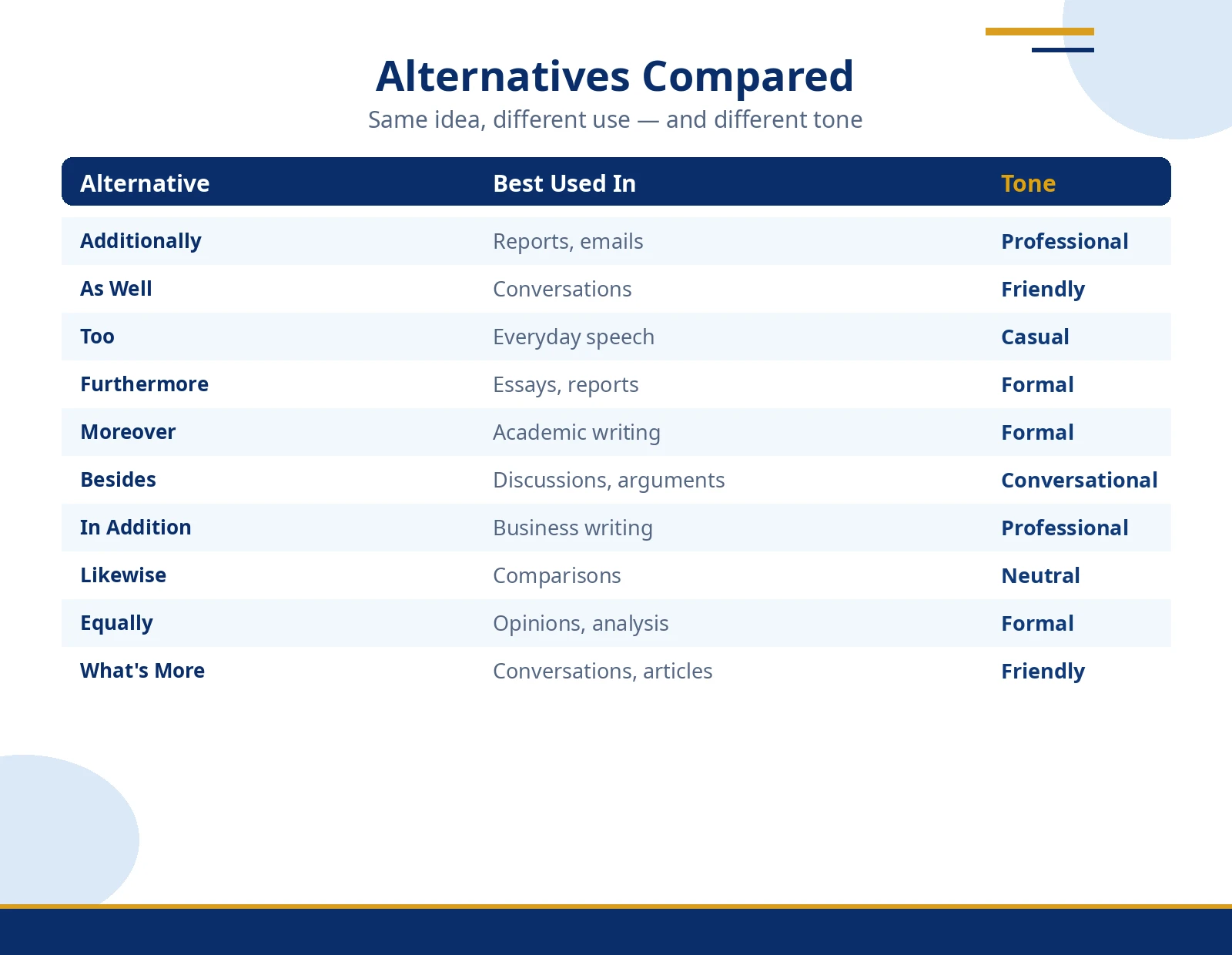
Comparison Table: Alternatives to Also
| Alternative | Best Used In | Tone |
|---|---|---|
| Additionally | Reports, emails | Professional |
| As well | Conversations | Friendly |
| Too | Everyday speech | Casual |
| Furthermore | Essays, reports | Formal |
| Moreover | Academic writing | Formal |
| Besides | Discussions, arguments | Conversational |
| In addition | Business writing | Professional |
| Likewise | Comparisons | Neutral |
| Equally | Opinions, analysis | Formal |
| What’s more | Conversations, articles | Friendly |
Common Mistakes When Using Alternatives to Also
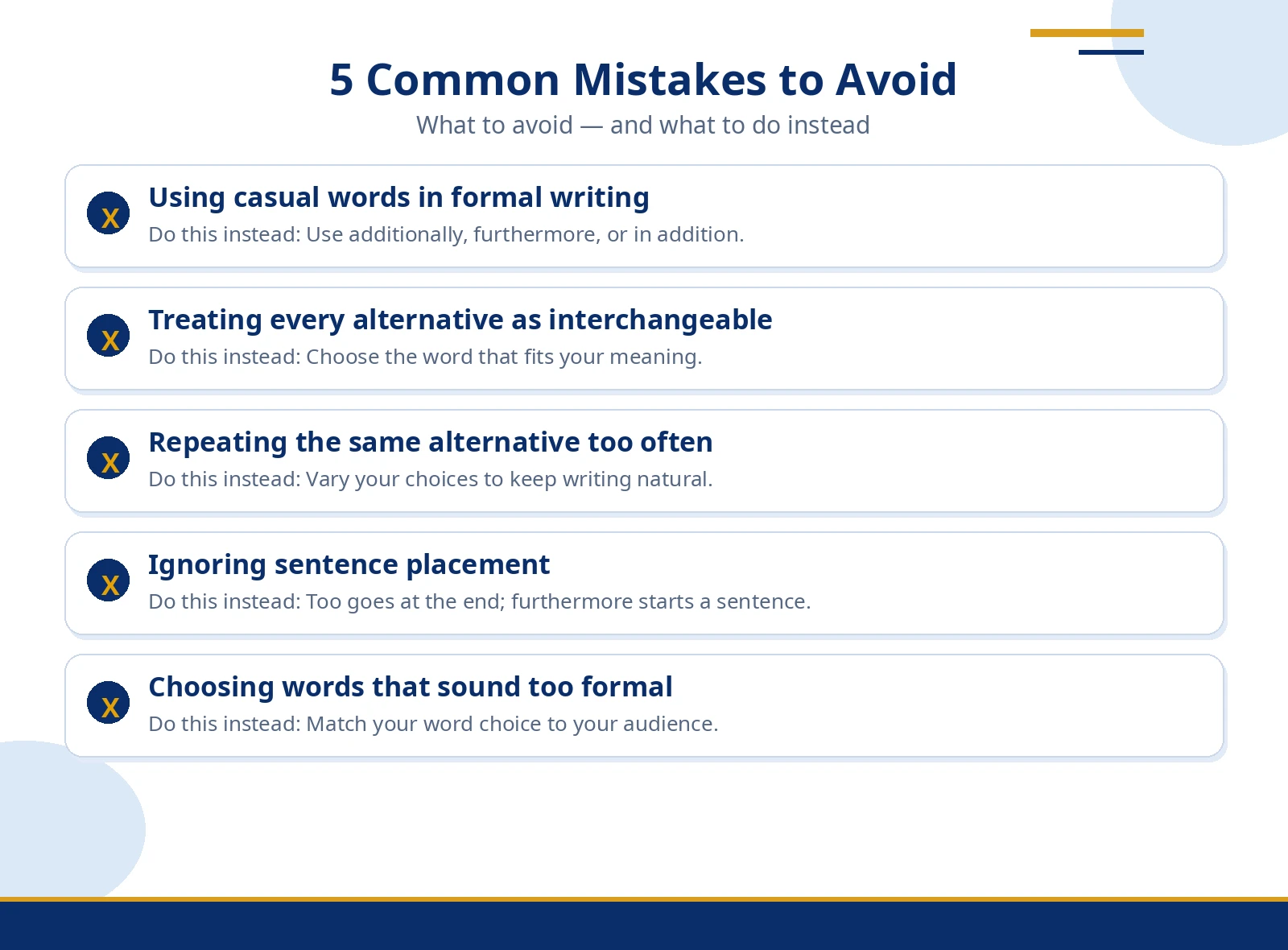
Choosing the wrong alternative can make your sentences sound unnatural or change their intended meaning. Here are the most common mistakes to avoid.
1. Using Casual Expressions in Formal Writing
Words like ‘too’ and ‘what’s more’ work well in everyday conversations. However, ‘additionally,’ ‘furthermore,’ or ‘in addition’ are better choices for reports and academic papers.
2. Treating Every Alternative as Interchangeable
Not every alternative has exactly the same meaning. For example, ‘likewise’ expresses similarity, while ‘additionally’ simply adds information. Choose the word that fits your intended meaning.
3. Repeating the Same Alternative Too Often
Replacing ‘also’ with ‘additionally’ in every sentence does not solve the repetition problem. Vary your choices to keep your writing interesting and natural.
4. Ignoring Sentence Placement
Some alternatives have specific placement patterns. For instance, ‘too’ usually appears at the end of a sentence, while ‘furthermore’ normally begins a new sentence. Incorrect placement can make your writing sound awkward.
5. Choosing Words That Sound Too Formal
Using expressions like ‘moreover’ in every casual conversation can make your speech sound stiff. Match your word choice to your audience and the situation.
Frequently Asked Questions
1. What is another word for also?
Some common alternatives to ‘also’ include additionally, too, as well, furthermore, moreover, besides, in addition, likewise, equally, and what’s more. These words help you add information in a natural way.
2. What is a more professional way to say also?
‘Additionally’ and ‘in addition’ are excellent professional alternatives to ‘also.’ You can use them in emails, reports, and business documents to sound more polished.
3. What is a formal synonym for also?
Formal synonyms for ‘also’ include ‘furthermore,’ ‘moreover,’ ‘additionally,’ and ‘in addition.’ These words are commonly used in academic essays, reports, and formal writing.
4. How can I say also in an essay?
You can replace ‘also’ in an essay with ‘furthermore,’ ‘moreover,’ ‘additionally,’ or ‘in addition.’ Choose the word based on your sentence structure and the level of formality.
5. Is furthermore the same as also?
‘Furthermore’ and ‘also’ both introduce additional information, but they have slightly different tones. ‘Furthermore’ is more formal and often adds a point that strengthens an argument.
6. What is the difference between also and as well?
Both expressions communicate that something is included in addition to something else. However, ‘also’ usually appears before the main verb, while ‘as well’ often comes at the end of a sentence.
7. Can I use too instead of also?
Yes, you can use ‘too’ instead of ‘also’ in many sentences. Both words indicate that something applies to another person or situation. ‘Too’ usually appears at the end of a sentence and sounds more conversational.
8. How do I avoid repeating the word also?
To avoid repeating ‘also,’ use alternatives such as ‘additionally,’ ‘as well,’ ‘too,’ and ‘in addition.’ Vary your choices based on tone, audience, and sentence structure.
You may also find these guides useful: another way to say “another”, another way to say “but” and another way to say “by”.
Conclusion
Choosing another way to say also can make your writing clearer, more natural, and more engaging. Alternatives such as additionally, too, as well, furthermore, and in addition help you express extra information with confidence.
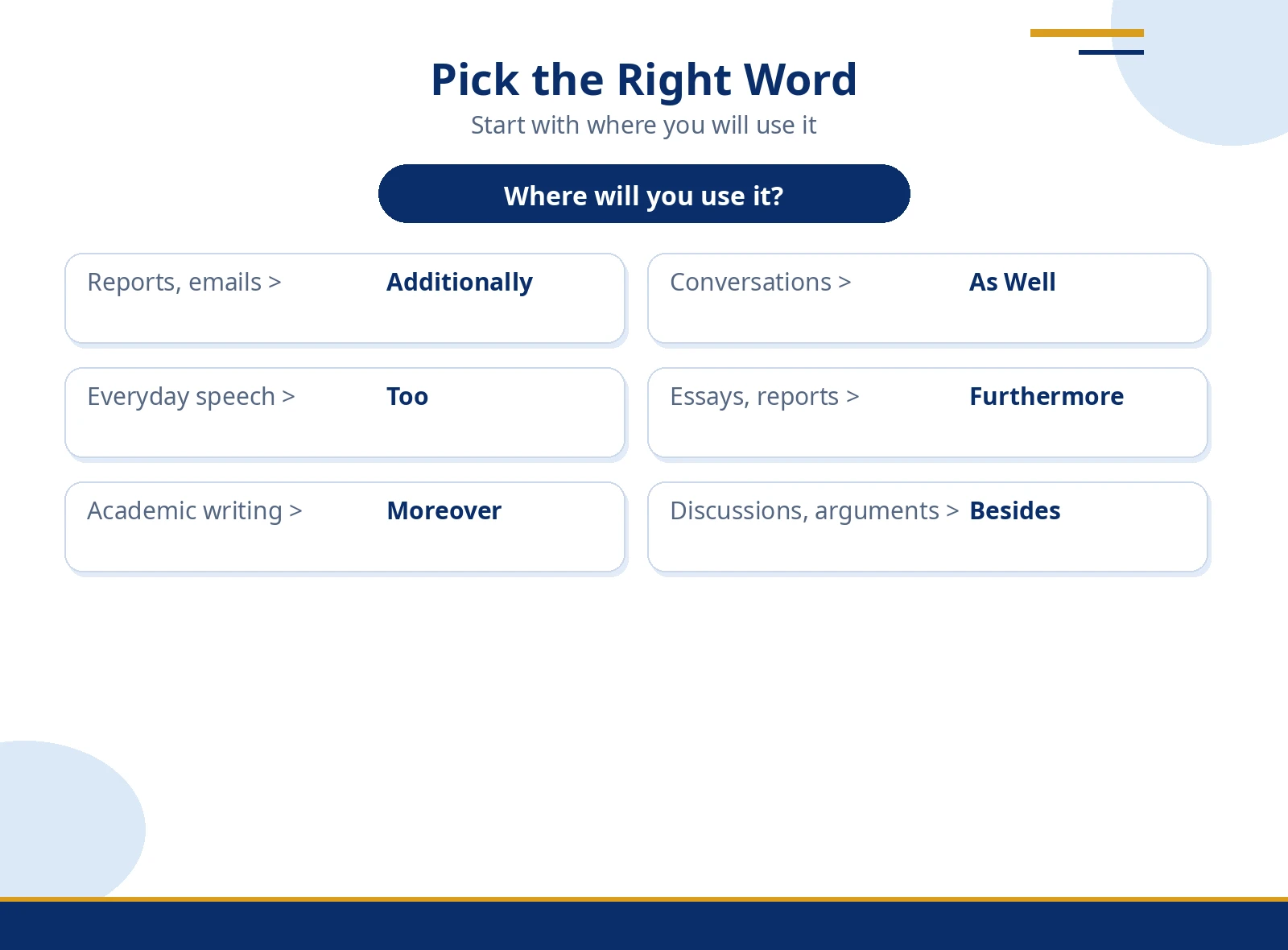
For everyday conversations, try simple alternatives such as ‘too’ and ‘as well.’ When writing professionally, use expressions such as ‘additionally’ and ‘in addition.’ For essays and formal reports, ‘furthermore’ and ‘moreover’ are strong choices.
The most important thing is to consider your audience, sentence structure, and intended meaning before choosing one.
Looking for more ways to refresh everyday phrases? Explore our guides to fresher ways to say said and done, or find a better way to say he says.

Editorial Desk
The Titan Standards Editorial Team develops, reviews, and maintains practical English-language resources. The team checks articles for clarity, accuracy, context, readability, and consistency with Titan Standards’ editorial guidelines.