Looking for another way to say another? Words like additional, different, extra, alternative, and one more can help you express the same idea without repeating yourself.
The best choice depends on your sentence, tone, and meaning. Some alternatives work well in everyday conversations, while others sound more natural in professional emails, academic writing, and formal communication.
Key Takeaways
- Use additional when referring to something extra.
- Choose different when describing something that is not the same.
- Use alternative when offering another choice or option.
- Choose one more for simple, casual conversations.
- Consider your sentence and intended meaning before replacing another.
What Does “Another” Mean?
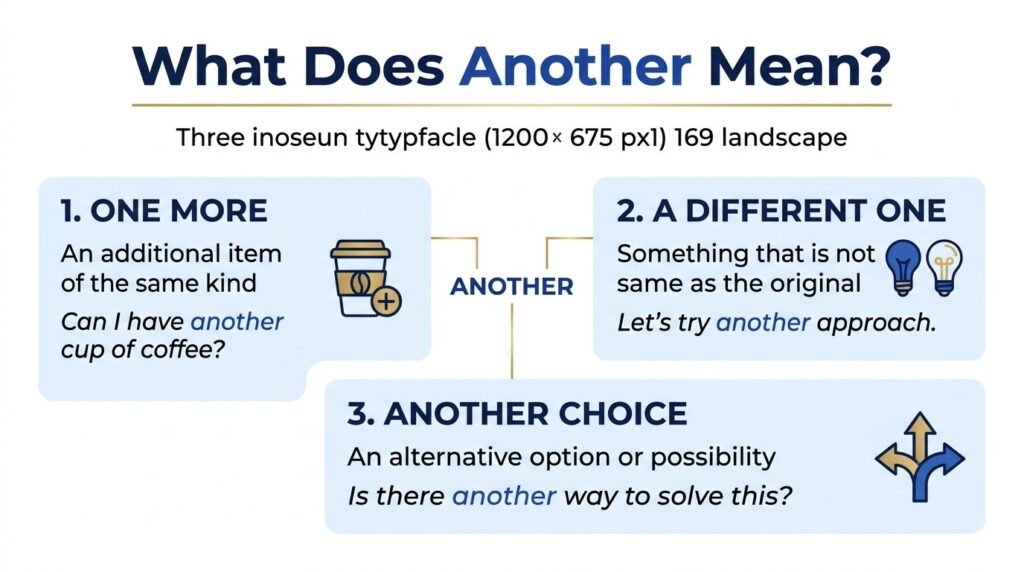
The word another refers to one more person or thing of the same general kind, or a different one from the one already mentioned. It combines the meaning of “an” and “other.”
People commonly use another when requesting an additional item, suggesting a different option, or referring to something beyond what they already have.
For example:
- Can I have another cup of coffee?
- Let’s try another approach.
- She wants another opportunity.
The word appears frequently in everyday conversations, workplace communication, academic writing, and informal messages. However, using it repeatedly can make writing sound less varied.
Why Use Other Ways to Say “Another”?
Choosing suitable alternatives can make your writing clearer, more natural, and less repetitive. Different words can also communicate slightly different meanings.
Here are some benefits:
- Avoid repetition: Keep your sentences interesting by varying your vocabulary.
- Improve clarity: Choose a word that expresses your exact meaning.
- Sound more natural: Use conversational alternatives when speaking with friends and family.
- Improve professional communication: Select appropriate words for emails, reports, and presentations.
- Express different ideas: Distinguish between something extra and something completely different.
10 Best Other Ways to Say “Another”
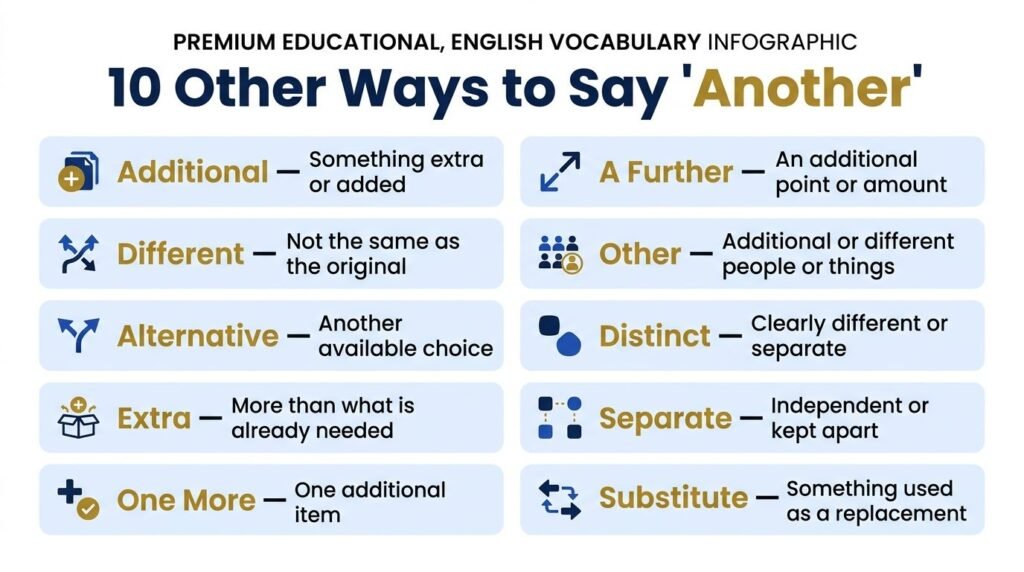
Here are 10 useful alternatives to another, along with their meanings, examples, and practical usage tips.
1. Additional
Meaning
Additional refers to something extra or added to what already exists. It works particularly well when discussing resources, information, tasks, or items.
Best For: Professional, Formal, Polite
Example 1: Please provide additional information about your recent experience.
Example 2: We need additional staff to complete the project on time.
Quick Tip: Use additional in professional emails, business reports, and formal documents when you mean something extra.
2. Different
Meaning
Different describes something that is not the same as another person, object, idea, or situation. It is especially useful when suggesting a change or comparing options.
Best For: Casual, Professional, Friendly
Example 1: Let’s try a different strategy to solve this problem.
Example 2: She decided to wear a different dress for the party.
Quick Tip: Choose different when you want to emphasize a change rather than simply adding something.
3. Alternative
Meaning
Alternative refers to another available choice or possibility. It is commonly used when someone wants to consider different solutions, plans, or options.
Best For: Professional, Formal, Polite
Example 1: We should consider an alternative solution before making a decision.
Example 2: Is there an alternative route to the airport?
Quick Tip: Use alternative when presenting another option instead of the original one.
4. Extra
Meaning
Extra means more than what is usual, necessary, or already available. It is a simple and natural replacement when discussing additional quantities or items.
Best For: Casual, Friendly, Professional
Example 1: Could you bring an extra chair for our guest?
Example 2: I always keep an extra phone charger in my car.
Quick Tip: Extra works best in everyday conversations and situations involving additional amounts or supplies.
5. One More
Meaning
One more refers to an additional single item, person, or opportunity. It is a straightforward expression that sounds natural in everyday American English.
Best For: Casual, Friendly, Polite
Example 1: Can I ask you one more question before you leave?
Example 2: Let’s watch one more episode tonight.
Quick Tip: Use one more when you specifically mean a single additional item or action.
6. A Further
Meaning
A further introduces an additional point, amount, step, or development. It often appears in formal and professional writing, especially when discussing information or progress.
Best For: Formal, Professional
Example 1: We need a further discussion before approving the proposal.
Example 2: The company announced a further investment in employee training.
Quick Tip: A further usually comes before a singular noun, such as a further discussion or a further opportunity.
7. Other
Meaning
Other refers to additional or different people or things within a group. It helps distinguish something from the person or item already mentioned.
Best For: Casual, Professional, Friendly
Example 1: Do you have other suggestions for the presentation?
Example 2: Some students prefer other methods of learning.
Quick Tip: Use other when referring to additional people or things, particularly when the noun is plural or uncountable.
8. Distinct
Meaning
Distinct describes something that is clearly different or separate from something else. It is useful when you want to emphasize that two things have their own characteristics.
Best For: Formal, Professional
Example 1: Each department has a distinct role in the organization.
Example 2: The two products have distinct features and benefits.
Quick Tip: Choose distinct when you want to highlight clear differences rather than simply suggest an extra item.
9. Separate
Meaning
Separate refers to something kept apart or treated independently from another thing. It is useful when discussing different categories, arrangements, documents, or responsibilities.
Best For: Professional, Formal, Casual
Example 1: Please send the remaining documents in a separate email.
Example 2: We created a separate account for business expenses.
Quick Tip: Use separate when you mean something independent or apart from an existing item.
10. Substitute
Meaning
A substitute is a person or thing used in place of another. It works when the original option is unavailable or when you need a replacement.
Best For: Professional, Formal, Casual
Example 1: We used olive oil as a substitute for butter in the recipe.
Example 2: The coach selected a substitute player during the second half.
Quick Tip: Use substitute when something replaces an original item, person, or choice rather than simply adding another one.
Comparison Table
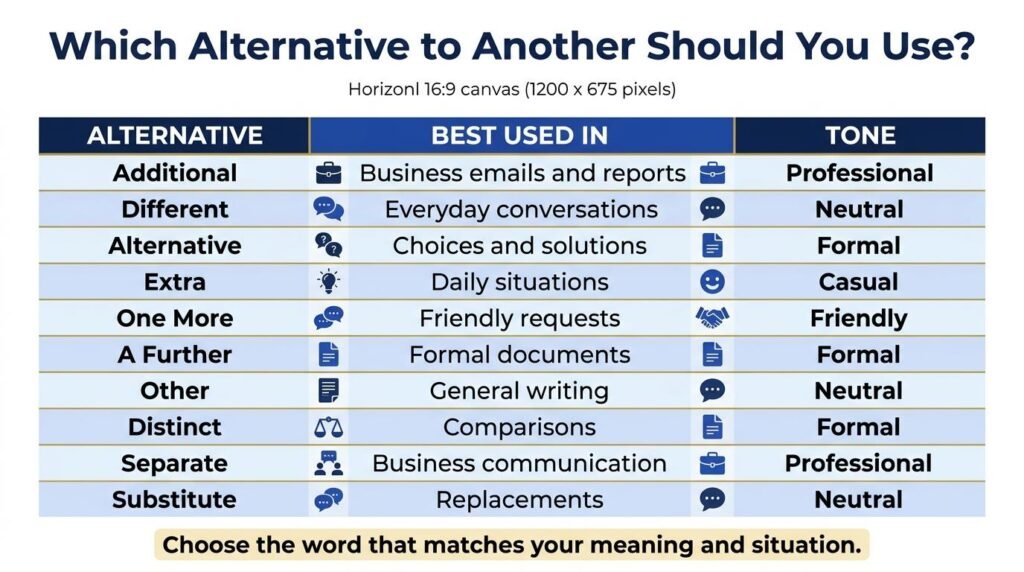
| Alternative | Best Used In | Tone |
|---|---|---|
| Additional | Reports and emails | Professional |
| Different | General conversations | Neutral |
| Alternative | Choices and solutions | Formal |
| Extra | Everyday situations | Casual |
| One More | Requests and conversations | Friendly |
| A Further | Formal documents | Formal |
| Other | General writing | Neutral |
| Distinct | Comparisons and descriptions | Formal |
| Separate | Business and organization | Professional |
| Substitute | Replacements and options | Neutral |
Common Mistakes When Using Alternatives to Another
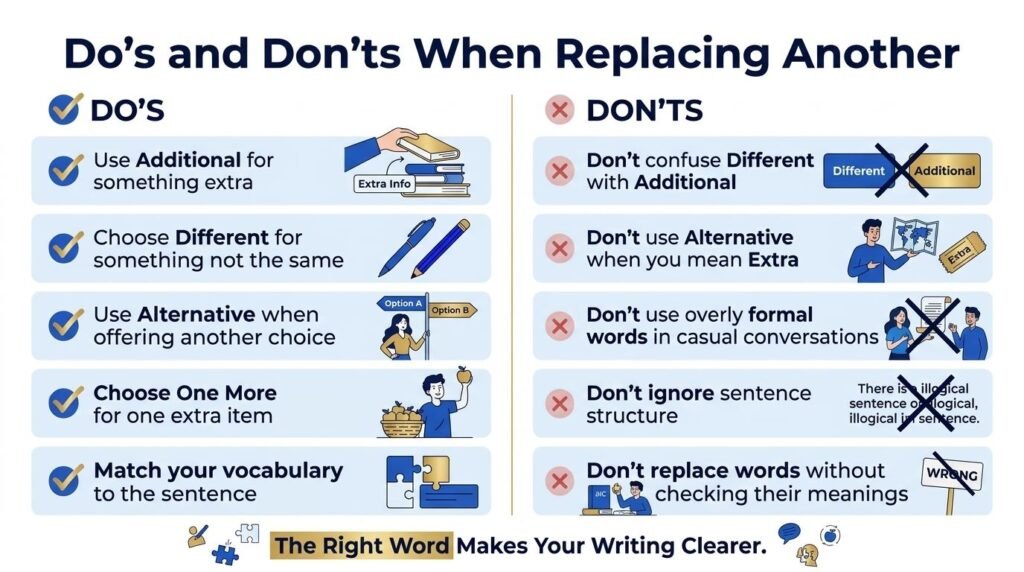
Choosing a synonym without considering its meaning can make a sentence confusing. Avoid these five common mistakes.
1. Using Different When You Mean Additional
Different describes something that is not the same, while additional means something extra. For example, “additional information” means more information, not necessarily different information.
2. Using Alternative When You Mean Extra
Alternative usually suggests another choice rather than an added item. Use extra or additional when you want to describe something beyond what is already available.
3. Ignoring the Sentence Structure
Not every alternative fits naturally into every sentence. For example, “Can I have a further coffee?” sounds less natural than “Can I have one more coffee?”
4. Choosing Overly Formal Words in Casual Conversations
Words like distinct and substitute can sound unnecessarily formal in everyday situations. Simple expressions such as one more and different often work better.
5. Replacing Words Without Checking the Meaning
Some alternatives have specific meanings. Substitute means a replacement, while separate describes something independent. Always check whether the replacement communicates your intended message.
Frequently Asked Questions
1. What is another word for another?
Some common alternatives include additional, different, extra, alternative, other, and separate. The right choice depends on your sentence. Use additional when you mean something extra, different when you mean something unlike the original, and alternative when referring to another available choice.
2. What is the best synonym for another?
Additional is one of the best synonyms when another means one more or something extra. However, different may be better when discussing a change, while alternative works when offering another option. There is no single perfect synonym because the meaning depends on context.
3. How can I say another in a formal way?
You can use additional, alternative, further, or distinct in formal writing. For example, instead of saying “We need another meeting,” you could write “We need an additional meeting.” Choose the word that best matches your intended meaning and the tone of your document.
4. What is another way to say another one?
You can say one more, an additional one, a different one, or an alternative. For example, “I don’t like this design. Can you show me another one?” could become “Can you show me a different one?” The best option depends on whether you want an extra item or a replacement.
5. Is additional the same as another?
Additional and another have similar meanings when referring to something extra. However, they are not always interchangeable. Additional often describes extra amounts or information, while another can refer to either one more item or a different item.
6. What is the difference between another and alternative?
Another is a general word for one more or a different item. Alternative specifically refers to another choice or possibility. For example, “another cup” means one more cup, while “an alternative solution” means a different way to solve a problem.
7. Can I use different instead of another?
Yes, but only when the context supports it. Different emphasizes that something is not the same, while another can mean either an additional item or a different one. For example, “Try another restaurant” and “Try a different restaurant” are both natural suggestions.
8. How do I avoid repeating the word another in writing?
Use alternatives that match your intended meaning, such as additional, extra, different, other, or alternative. You can also restructure your sentences to improve flow. Instead of replacing every occurrence with a synonym, focus on making your writing clear and natural.
You may also find these guides useful: another way to say “but”, another way to say “by” and another way to say “during”.
Conclusion
Finding another way to say another can make your writing more natural, varied, and precise. Words such as additional, extra, and one more work well when you mean something beyond what already exists. However, different and distinct are better when describing something that is not the same, while alternative is useful when presenting another choice. In professional writing, additional and further can create a more polished tone. For everyday conversations, extra and one more usually sound more natural. Remember that synonyms are not always interchangeable. Consider your sentence, audience, and intended meaning before choosing a replacement. The best alternative is not simply a different word; it is the word that communicates your idea clearly and naturally.

Editorial Desk
The Titan Standards Editorial Team develops, reviews, and maintains practical English-language resources. The team checks articles for clarity, accuracy, context, readability, and consistency with Titan Standards’ editorial guidelines.