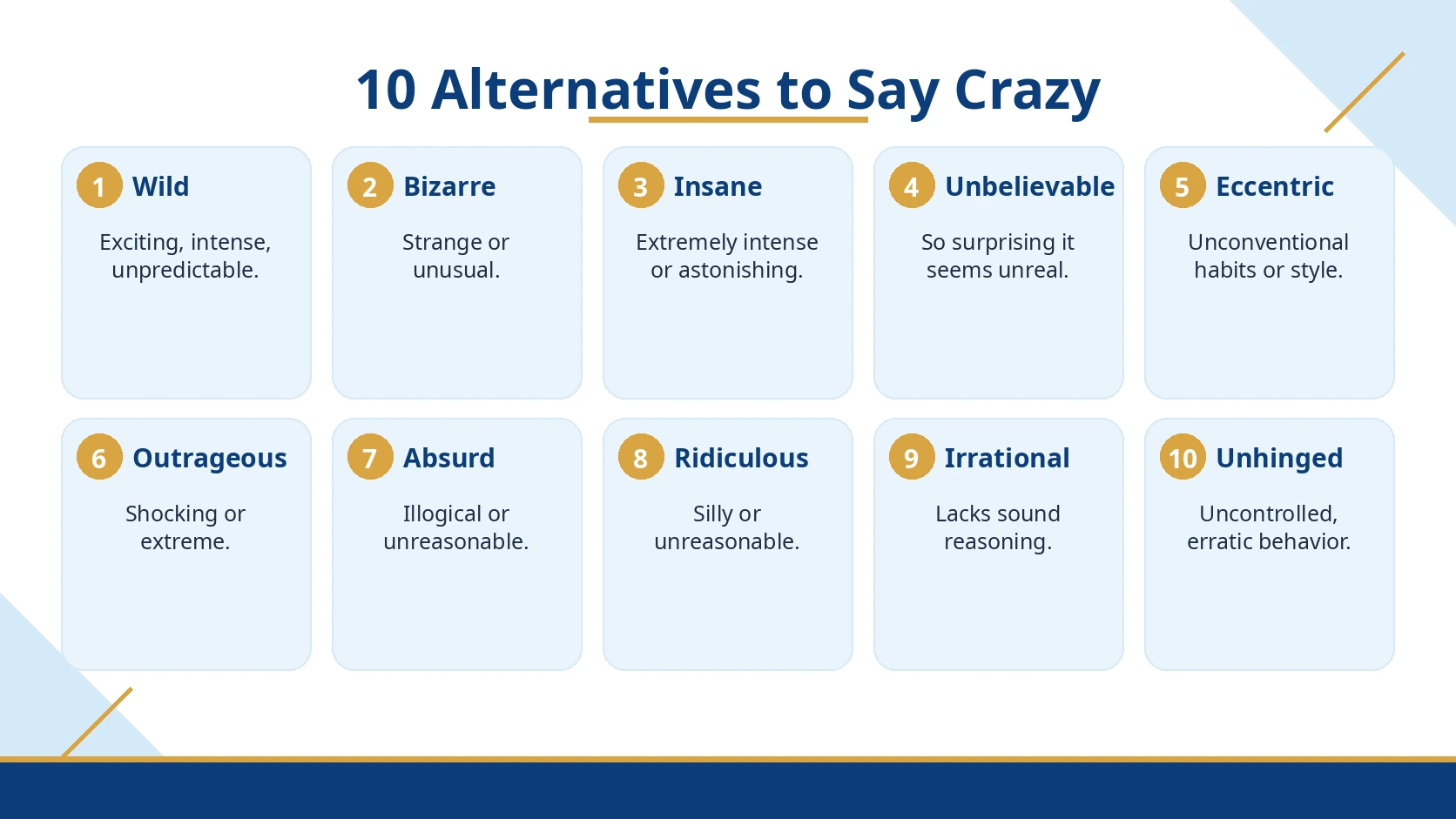
Another way to say crazy is wild, bizarre, insane, ridiculous, unbelievable, eccentric, outrageous, irrational, absurd, or unhinged.
The best alternative depends on your meaning and tone. Use “wild” for exciting situations, “bizarre” for something unusual, and “unbelievable” for something surprising. Choose respectful wording when discussing a person’s behavior or mental health.
Key Takeaways
- Use wild to describe exciting, intense, or unpredictable situations.
- Choose bizarre when something seems strange or unusual.
- Use unbelievable to express surprise or amazement.
- Choose eccentric for someone with unusual but harmless habits.
- Consider your audience before using slang or harsh expressions.
The word “crazy” appears in everyday conversations, text messages, social media posts, and informal writing. People use it to describe surprising events, unusual behavior, exciting experiences, and situations that seem difficult to believe.
However, repeating “crazy” can make your writing sound vague. A more specific word can help you express excitement, surprise, disbelief, or unusual behavior more clearly.
For example, you might describe a concert as “wild,” an unusual coincidence as “bizarre,” or an incredible achievement as “unbelievable.” Each alternative communicates a slightly different meaning.
This guide explains 10 alternatives to “crazy,” including their meanings, appropriate uses, and examples.
What Does “Another Way to Say Crazy” Mean?
The phrase “another way to say crazy” refers to finding a different word or expression that communicates a similar idea to “crazy.”
The exact meaning depends on the context. In casual American English, “crazy” can mean extremely exciting, very unusual, unreasonable, or hard to believe.
For example:
- Exciting: That concert was crazy!
- Unusual: That’s a crazy idea.
- Surprising: The price increase is crazy.
- Unreasonable: It would be crazy to ignore the warning.
Because these meanings differ, no single synonym works in every situation. Choosing the right alternative makes your message clearer and helps you avoid unintended offense.
For the full definition, see Cambridge Dictionary.
Why Use Other Ways to Say Crazy?
Using alternatives to “crazy” can make your English more expressive, precise, and appropriate for different audiences.
Here are a few reasons to choose another word:
- Avoid repetition: Use different expressions when describing several unusual events.
- Express your meaning clearly: Distinguish between something exciting, strange, or unreasonable.
- Match your audience: Choose casual language for friends and more precise wording for professional communication.
- Improve your writing: Replace vague expressions with words that describe the situation accurately.
- Use respectful language: Describe specific behavior without making assumptions about someone’s mental health.
The key is to select a word that matches both your intended meaning and the tone of the conversation.
10 Best Other Ways to Say Crazy
1. Wild
Meaning
“Wild” describes something exciting, intense, unpredictable, or difficult to control. It is a common alternative to “crazy” in informal American English, especially when talking about parties, adventures, experiences, or unexpected events.
Best For: Casual, Friendly
Example 1: We had a wild time at the music festival last weekend.
Example 2: That was a wild finish to the basketball game.
Quick Tip: Use “wild” when you want to emphasize excitement or unpredictability rather than something genuinely strange.
2. Bizarre
Meaning
“Bizarre” describes something extremely unusual, strange, or unexpected. It often suggests that a situation is difficult to explain or understand.
Unlike “wild,” which can sound positive, “bizarre” usually emphasizes how strange something seems.
Best For: Formal, Professional, Casual
Example 1: The documentary revealed a bizarre series of events.
Example 2: I received a bizarre email from an unknown sender.
Quick Tip: Choose “bizarre” when something seems unusually strange, especially in descriptions, reports, or conversations about unexpected events.
3. Insane
Meaning
“Insane” is an informal expression that can mean extremely intense, astonishing, or unreasonable. People often use it figuratively to describe impressive performances, high prices, or demanding situations.
However, the word can sound harsh when applied to a person. Use a more precise or respectful expression when discussing someone’s mental health.
Best For: Casual, Friendly
Example 1: The amount of traffic after the game was insane.
Example 2: She made an insane save during the final minute.
Quick Tip: In casual conversation, “insane” can express strong emotion. In professional writing, consider alternatives such as “remarkable,” “extreme,” or “unreasonable.”
4. Unbelievable
Meaning
“Unbelievable” describes something so surprising, impressive, or unexpected that it seems difficult to believe. It is a useful alternative when “crazy” expresses amazement rather than unusual behavior.
Depending on the context, it can communicate admiration, disbelief, or frustration.
Best For: Casual, Friendly, Professional
Example 1: His recovery after the injury was unbelievable.
Example 2: We got an unbelievable deal on our new furniture.
Quick Tip: Use “unbelievable” when your main message is that something is astonishing or hard to believe.
5. Eccentric
Meaning
“Eccentric” describes a person whose habits, appearance, or ideas differ noticeably from conventional expectations. It often refers to someone who is distinctive or unconventional without necessarily being harmful or unreasonable.
The word can sound neutral or even complimentary when used thoughtfully.
Best For: Formal, Professional, Polite
Example 1: The eccentric artist filled her studio with unusual sculptures.
Example 2: His eccentric fashion choices make him easy to recognize.
Quick Tip: Use “eccentric” for unusual personal style or harmless habits, not simply because someone disagrees with you.
6. Outrageous
Meaning
“Outrageous” describes something shocking, extreme, unreasonable, or beyond what people consider acceptable. It can express disapproval, but it can also describe something impressively bold or entertaining.
The surrounding sentence determines whether the word sounds negative or playful.
Best For: Casual, Formal, Professional
Example 1: The hotel charged an outrageous fee for parking.
Example 2: Her outrageous costume stole the show at the party.
Quick Tip: Choose “outrageous” when something seems excessive, shocking, or boldly unconventional.
7. Absurd
Meaning
“Absurd” describes something unreasonable, illogical, or so ridiculous that it seems impossible to take seriously. It is particularly useful in discussions, arguments, reviews, and professional writing.
Compared with “crazy,” it focuses more directly on the lack of logic or reason.
Best For: Formal, Professional, Casual
Example 1: The proposal included an absurd deadline that nobody could meet.
Example 2: It is absurd to expect customers to wait three hours for a simple service.
Quick Tip: Use “absurd” to criticize an idea, expectation, or situation rather than labeling a person.
8. Ridiculous
Meaning
“Ridiculous” describes something unreasonable, silly, excessive, or deserving of criticism. In everyday American English, it can express frustration, disbelief, or amusement.
It is often a good substitute when “crazy” refers to an idea, rule, price, or situation that seems unreasonable.
Best For: Casual, Professional, Friendly
Example 1: The delivery company charged a ridiculous amount for shipping.
Example 2: We spent twenty minutes debating a ridiculous misunderstanding.
Quick Tip: Use “ridiculous” when you want to emphasize how unreasonable or silly something appears.
9. Irrational
Meaning
“Irrational” describes a decision, reaction, or belief that does not follow sound reasoning. It is more precise than “crazy” when discussing logic, choices, or arguments.
The word can sound critical, so explain the reasoning behind your judgment when appropriate.
Best For: Formal, Professional
Example 1: Fear of making one small mistake led to an irrational decision.
Example 2: The investor reconsidered his irrational response to a temporary market decline.
Quick Tip: Use “irrational” when the issue involves reasoning or judgment, rather than simply describing something surprising.
10. Unhinged
Meaning
“Unhinged” is an informal, often harsh word for behavior that appears uncontrolled, extreme, or highly erratic. It is frequently used in online discussions and casual commentary.
Because it can sound insulting or imply instability, avoid using it casually to judge someone’s mental health.
Best For: Casual
Example 1: The fictional villain delivered an unhinged speech before the final scene.
Example 2: The online argument became increasingly unhinged as both sides exchanged insults.
Quick Tip: Reserve “unhinged” for clearly extreme behavior or fictional descriptions. In professional settings, describe the specific behavior instead.
Comparison Table
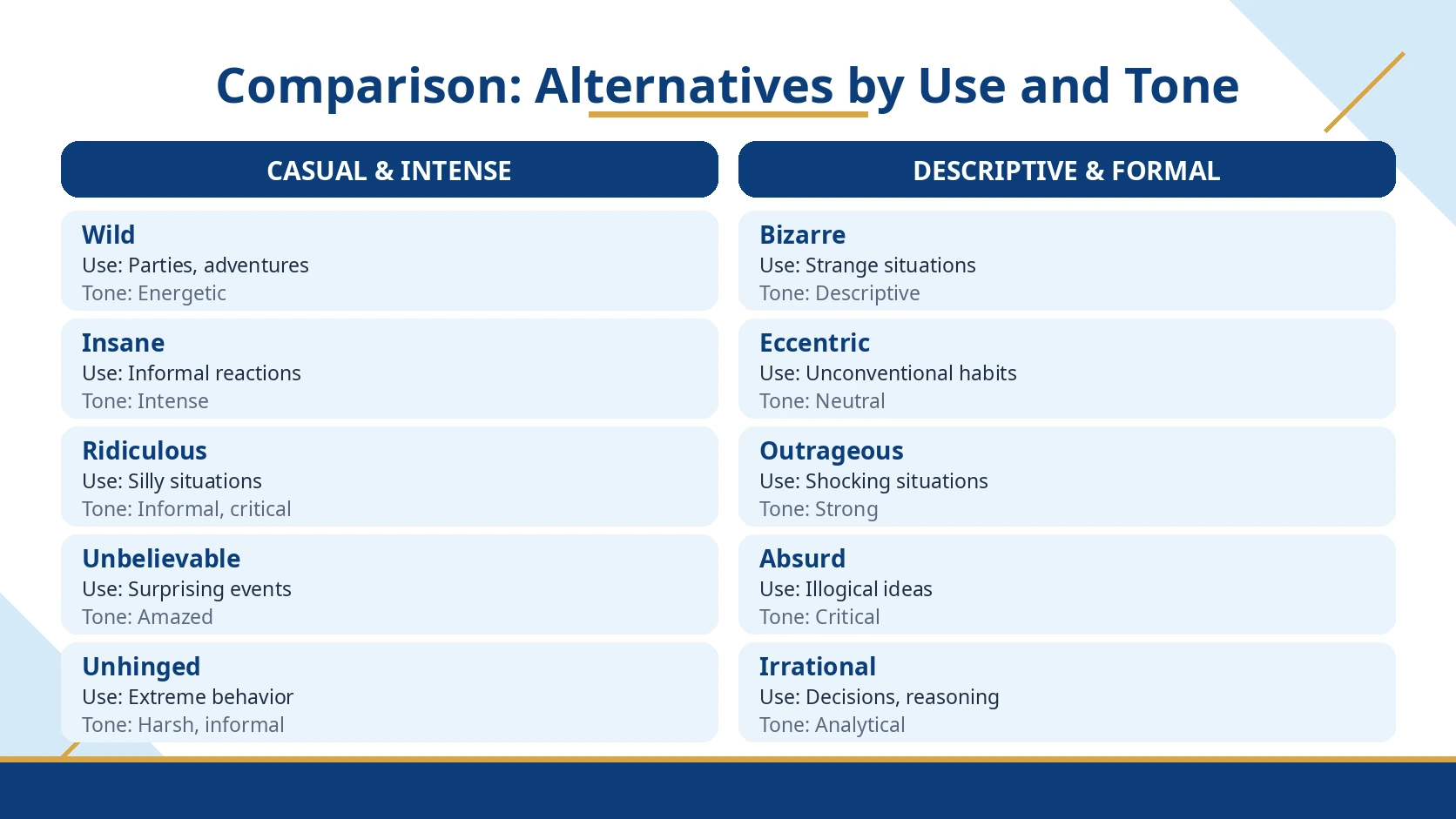
| Alternative | Best Used In | Tone |
|---|---|---|
| Wild | Parties, adventures, exciting events | Energetic |
| Bizarre | Strange or unexpected situations | Descriptive |
| Insane | Informal reactions to extreme events | Intense |
| Unbelievable | Surprising achievements or events | Amazed |
| Eccentric | Unconventional habits or styles | Neutral |
| Outrageous | Excessive or shocking situations | Strong |
| Absurd | Illogical ideas or expectations | Critical |
| Ridiculous | Silly or unreasonable situations | Informal, critical |
| Irrational | Decisions and reasoning | Analytical |
| Unhinged | Extreme or uncontrolled behavior | Harsh, informal |
Common Mistakes When Using Synonyms for Crazy
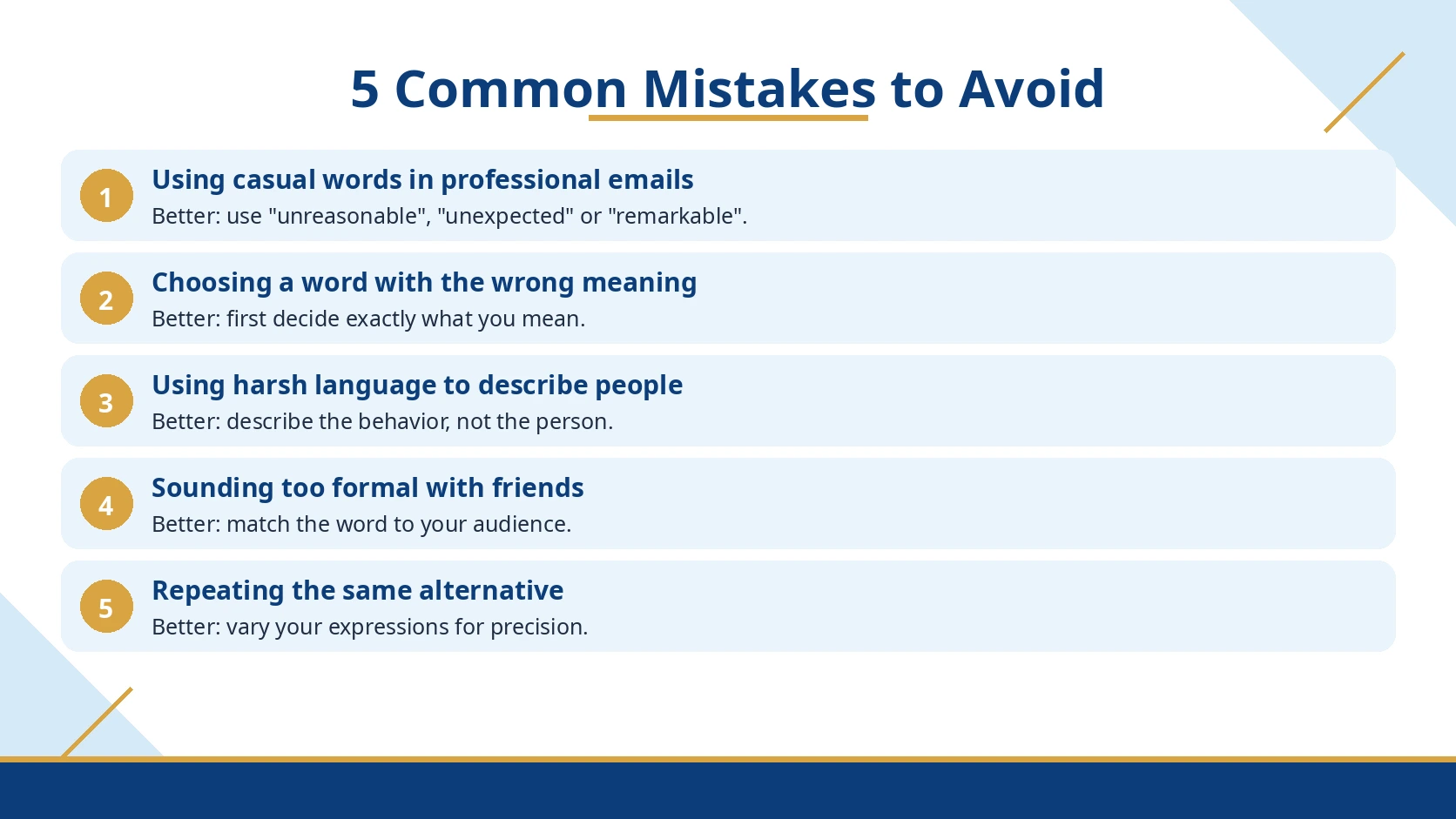
1. Using Casual Words in Professional Emails
Expressions such as “insane” and “unhinged” can sound inappropriate in workplace communication.
Better approach: Use “unreasonable,” “remarkable,” or “unexpected,” depending on the situation.
2. Choosing a Word With the Wrong Meaning
“Wild” often suggests excitement, while “irrational” refers to a lack of sound reasoning. These words are not interchangeable in every sentence.
Better approach: Identify what you mean before selecting a synonym.
3. Using Harsh Language to Describe People
Calling someone “insane” or “unhinged” may sound insulting, especially when you are discussing a disagreement or emotional reaction.
Better approach: Describe observable behavior, such as “He reacted angrily” or “Her response seemed disproportionate.”
4. Making Your Writing Sound Too Formal
Words such as “irrational” and “eccentric” may feel unnatural in a relaxed conversation with friends.
Better approach: Match the word to your audience. “Wild” or “unbelievable” may sound more natural in casual conversation.
5. Repeating the Same Alternative
Replacing every instance of “crazy” with “wild” does not necessarily improve your writing. Different situations call for different words.
Better approach: Use a variety of precise expressions, such as “bizarre,” “absurd,” “exciting,” or “unreasonable,” according to the intended meaning.
Frequently Asked Questions
1. What is another word for crazy?
Common alternatives include wild, bizarre, insane, unbelievable, eccentric, outrageous, absurd, ridiculous, irrational, and unhinged. Each word has a different meaning and tone. For example, “wild” often describes excitement, while “irrational” describes poor reasoning. Choose the word that best expresses your intended meaning.
2. What is a nicer way to say crazy?
A nicer alternative depends on the context. Try “unusual,” “unconventional,” “unexpected,” or “remarkable” when you want to avoid sounding judgmental. For example, instead of saying, “That’s a crazy idea,” you could say, “That’s an unusual idea.” This keeps your message clear without unnecessarily offending someone.
3. What is a professional way to say crazy?
Professional alternatives include “unreasonable,” “unusual,” “unexpected,” “unconventional,” and “illogical.” Use “unreasonable” for excessive demands, “unexpected” for surprising developments, and “illogical” for arguments that lack sound reasoning. The most appropriate choice depends on the subject and whether you intend to describe a situation, decision, or behavior.
4. What is another way to say crazy in slang?
Common informal alternatives include “wild,” “insane,” and “nuts.” People use these expressions to describe surprising events, exciting experiences, or unusual situations. However, some slang terms can sound insulting in certain contexts. Consider your audience and use more neutral language when you are unsure how your words might be received.
5. What is another way to say crazy in a positive way?
Use “amazing,” “incredible,” “unbelievable,” “fantastic,” or “wild” when you want to express positive excitement. For example, “That performance was crazy” could become “That performance was incredible.” These alternatives communicate admiration more clearly and avoid the negative meanings that “crazy” can sometimes carry.
6. What is a synonym for crazy when describing an idea?
“Absurd,” “unreasonable,” “unrealistic,” “unconventional,” and “outlandish” can describe different types of unusual ideas. Use “unrealistic” when an idea is difficult to achieve, “absurd” when it lacks logic, and “unconventional” when it differs from traditional thinking. Select the term that accurately reflects your concern.
7. Is “crazy” a formal or informal word?
“Crazy” is widely used in informal American English, including conversations, entertainment, and social media. It may also appear in casual professional discussions, but it can sound vague or inappropriate in formal writing. In reports, business emails, and academic work, more precise words such as “unusual,” “unreasonable,” or “remarkable” are often better choices.
8. Is it offensive to call someone crazy?
It can be, depending on the context, relationship, and intended meaning. Some people use “crazy” playfully, but others may find it dismissive or stigmatizing, particularly when it relates to mental health. When discussing a person’s behavior, describe what happened rather than making a broad judgment about the person.
Conclusion
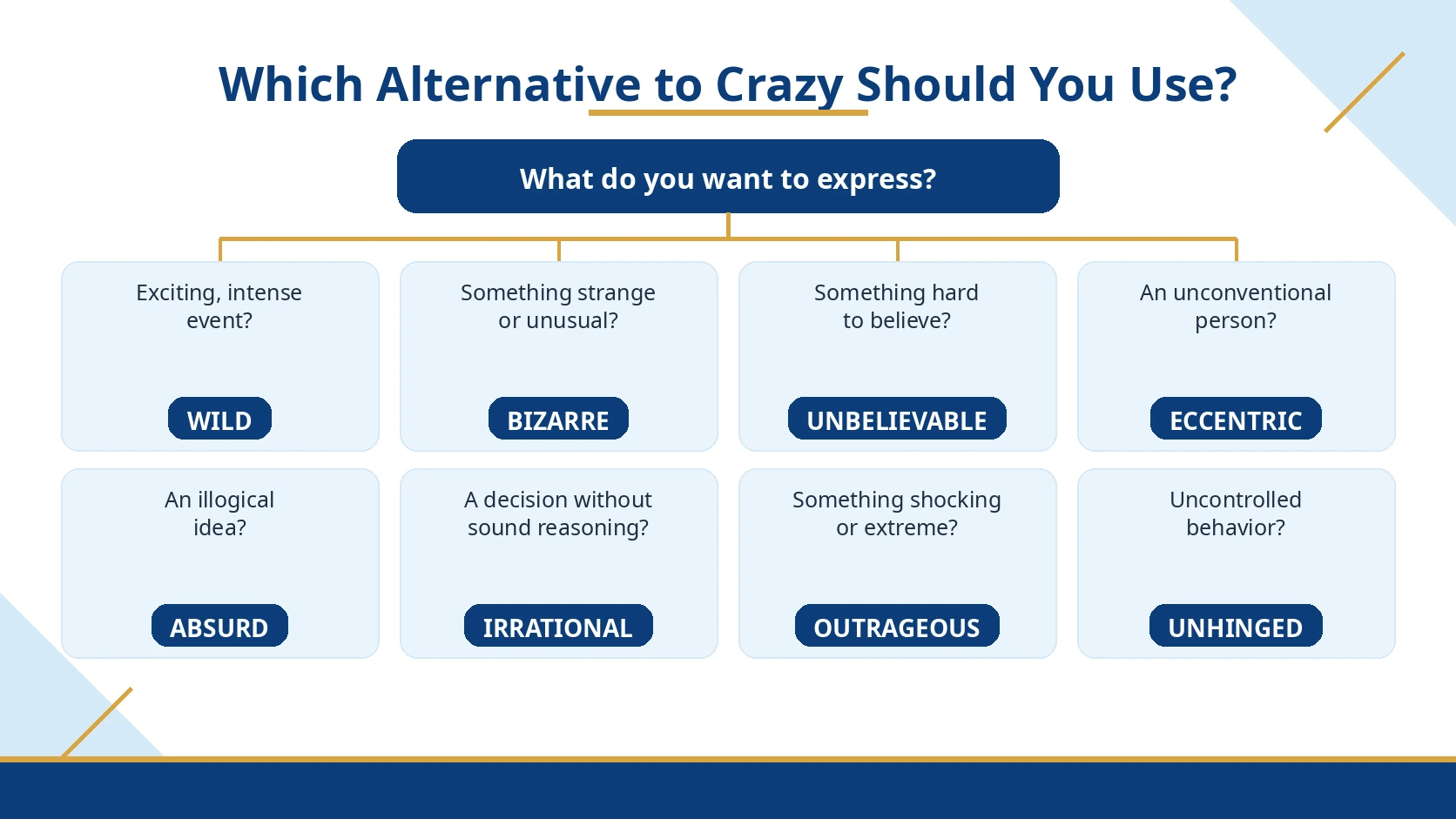
Finding another way to say crazy can make your English clearer, more natural, and better suited to different situations. The best alternative depends on what you want to express. Choose “wild” for exciting experiences, “bizarre” for strange events, and “unbelievable” for something astonishing. Use “eccentric” to describe unconventional habits, “absurd” for illogical ideas, and “irrational” when a decision lacks sound reasoning.
For professional communication, words such as “unreasonable,” “unexpected,” and “remarkable” may express your meaning more precisely. In casual conversations, “wild” and “unbelievable” often sound natural and friendly.
Remember that synonyms do not always carry the same meaning or emotional weight. Before choosing a replacement, consider the context, your audience, and the tone you want to create. The best word is not simply another word for “crazy”; it is the word that communicates exactly what you mean.
Looking for more ways to refresh everyday phrases? Explore our guides to fresher ways to say said and done, or find a better way to say he says.

Editorial Desk
The Titan Standards Editorial Team develops, reviews, and maintains practical English-language resources. The team checks articles for clarity, accuracy, context, readability, and consistency with Titan Standards’ editorial guidelines.