Another way to say figure out is determine, work out, understand, solve, or find out. These alternatives help you express the idea of discovering an answer, understanding something difficult, or finding a solution.
The best choice depends on your sentence, audience, and situation.
Key Takeaways
- Use determine when you need to establish a fact or reach a conclusion.
- Choose work out when solving a problem or understanding how something works.
- Use understand when explaining that something has become clear.
- Choose find out when discovering new information.
- Use get to the bottom of when investigating something thoroughly.
The phrase “figure out” is a common part of everyday American English. People use it when they need to understand something, solve a problem, or discover information that was not immediately clear.
However, repeating this expression can make your writing sound less varied. Choosing a suitable alternative can help you communicate more clearly, especially in professional emails, academic assignments, and everyday conversations.
Below are 10 useful alternatives to “figure out,” along with their meanings, examples, and practical usage tips.
What Does “Figure Out” Mean?
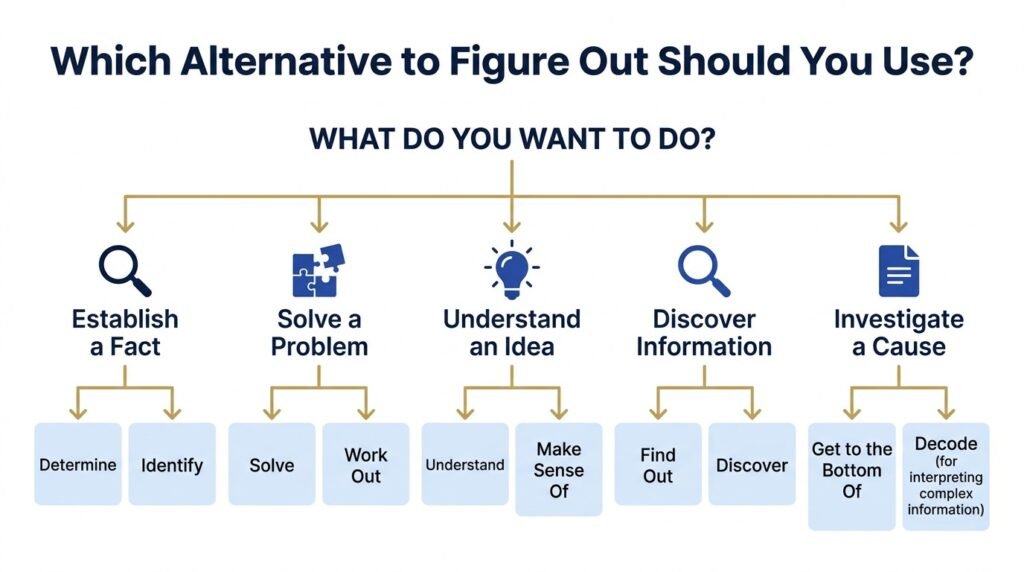
“Figure out” means to understand something, discover an answer, or find a way to solve a problem. It often describes the process of thinking carefully until something becomes clear.
People commonly use this phrase in casual conversations, workplace discussions, school assignments, and problem-solving situations.
For example:
- I need to figure out how this machine works.
- She figured out the answer to the question.
- We need to figure out a better way to manage our time.
The expression is flexible, but its exact meaning depends on the context. Sometimes it refers to understanding an idea, while other times it means finding a solution or discovering a fact.
Why Use Other Ways to Say “Figure Out”?
Using different expressions makes your communication clearer and more natural. It also helps you choose language that matches your audience and situation.
Here are some reasons to use alternatives:
- Avoid repetition: Make your writing more interesting by using varied vocabulary.
- Sound professional: Choose more precise expressions in business communication.
- Improve clarity: Explain whether you are understanding, discovering, or solving something.
- Match the situation: Use casual expressions with friends and formal language in professional settings.
- Strengthen your writing: Make emails, essays, and reports sound more polished.
10 Best Other Ways to Say “Figure Out”
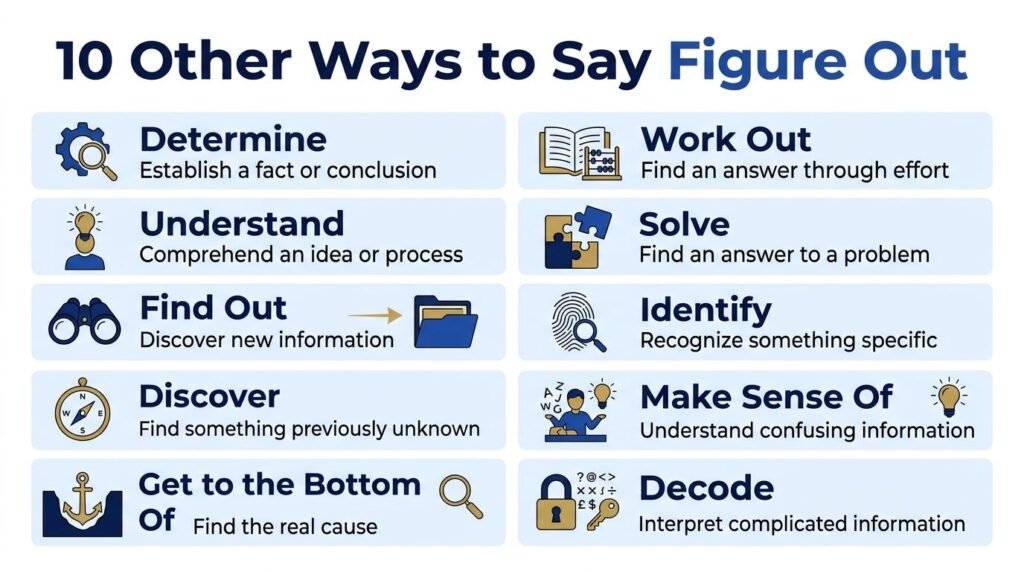
1. Determine
Meaning
“Determine” means to establish something through investigation, research, or careful consideration. It is a more formal alternative when you want to discover a fact or reach a clear conclusion.
Best For: Professional, Formal
Example 1: We need to determine the main reason for the delay.
Example 2: The research team will determine whether the new method is effective.
Quick Tip: Use “determine” in reports, business discussions, and academic writing when referring to a specific finding or decision.
2. Work Out
Meaning
“Work out” means to find an answer or solution through thought, effort, or calculation. It is especially useful when dealing with a difficult situation or understanding how something functions.
Best For: Casual, Friendly, Professional
Example 1: I finally worked out how to fix the printer.
Example 2: We can work out a schedule that suits everyone.
Quick Tip: Use “work out” in everyday conversations when describing the process of solving something. It is more conversational than “determine.”
3. Understand
Meaning
“Understand” means to recognize the meaning of something or become aware of how it works. It is a straightforward alternative when the main idea is gaining knowledge rather than finding a specific solution.
Best For: Casual, Professional, Friendly
Example 1: It took me a while to understand the new instructions.
Example 2: Once you understand the process, the task becomes much easier.
Quick Tip: Choose “understand” when you want to emphasize knowledge or comprehension instead of investigation.
4. Solve
Meaning
“Solve” means to find an answer to a problem, question, or difficult situation. It is a strong choice when “figure out” refers specifically to overcoming a challenge.
Best For: Professional, Formal, Casual
Example 1: Our team worked together to solve the technical issue.
Example 2: She solved the puzzle without asking for help.
Quick Tip: Use “solve” when there is a clear problem that needs an answer or solution.
5. Find Out
Meaning
“Find out” means to discover information or learn something that you did not previously know. It is particularly useful when you are asking questions, checking facts, or searching for information.
Best For: Casual, Friendly, Professional
Example 1: I’ll find out when the next meeting is scheduled.
Example 2: We need to find out why the delivery hasn’t arrived.
Quick Tip: Use “find out” when discovering information. It is not always interchangeable with “solve” because learning a fact and fixing a problem are different actions.
6. Identify
Meaning
“Identify” means to recognize, name, or establish exactly what something is. It works well when you need to locate a particular issue, cause, person, or detail.
Best For: Professional, Formal
Example 1: The manager identified the biggest challenge facing the department.
Example 2: Doctors are trying to identify the cause of the problem.
Quick Tip: Choose “identify” when your goal is to recognize or pinpoint something specific.
7. Discover
Meaning
“Discover” means to find something new or learn information that was previously unknown. It often suggests that you have uncovered an answer through observation, research, or experience.
Best For: Formal, Professional, Friendly
Example 1: We discovered a more efficient way to organize the files.
Example 2: He discovered why the application kept crashing.
Quick Tip: Use “discover” when you want to emphasize finding something previously unknown rather than simply understanding an existing idea.
8. Make Sense Of
Meaning
“Make sense of” means to understand something that seems confusing, complicated, or difficult to explain. It is a natural expression for situations involving unclear information or unfamiliar ideas.
Best For: Casual, Friendly, Professional
Example 1: I’m trying to make sense of these financial reports.
Example 2: She needed more time to make sense of the complicated instructions.
Quick Tip: Use this expression when something initially seems confusing but you are trying to understand it.
9. Get to the Bottom Of
Meaning
“Get to the bottom of” means to investigate something carefully until you discover its real cause or explanation. It suggests a deeper search rather than a quick answer.
Best For: Professional, Casual, Formal
Example 1: The company is working to get to the bottom of the customer complaints.
Example 2: We need to get to the bottom of what caused the unexpected error.
Quick Tip: Use this phrase when investigating a problem, misunderstanding, or situation that requires more detailed attention.
10. Decode
Meaning
“Decode” means to interpret or understand something that is difficult to read, explain, or recognize. It is particularly useful for complicated messages, unfamiliar information, and hidden meanings.
Best For: Casual, Professional, Friendly
Example 1: I finally decoded the instructions for setting up the device.
Example 2: The analyst helped us decode the unusual pattern in the data.
Quick Tip: Use “decode” when information feels like a puzzle or requires careful interpretation. It is not a general replacement for every use of “figure out.”
Comparison Table
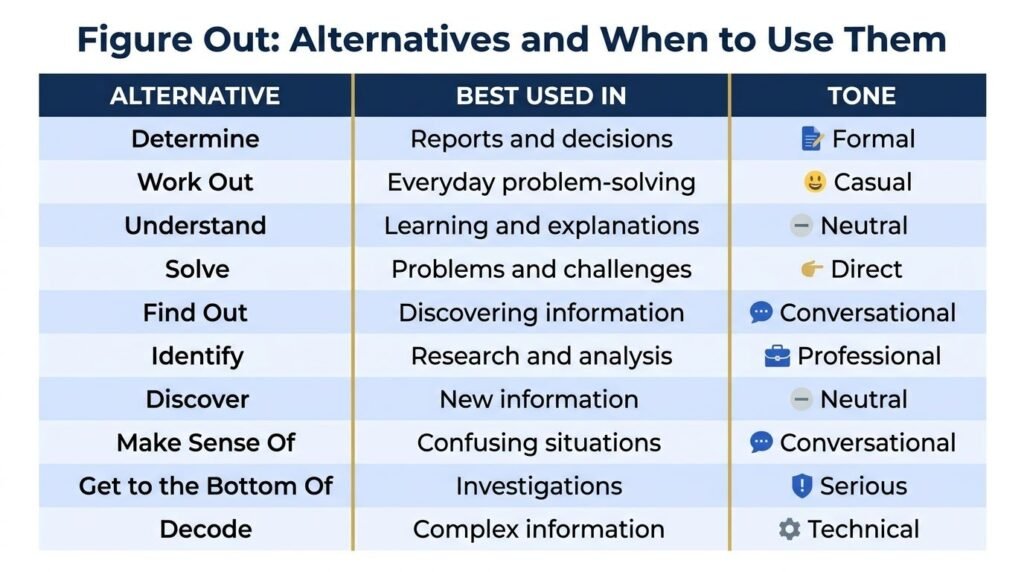
| Alternative | Best Used In | Tone |
|---|---|---|
| Determine | Reports and decisions | Formal |
| Work out | Everyday problem-solving | Casual |
| Understand | Learning and explanations | Neutral |
| Solve | Problems and challenges | Direct |
| Find out | Discovering information | Conversational |
| Identify | Research and analysis | Professional |
| Discover | New information | Neutral |
| Make sense of | Confusing situations | Conversational |
| Get to the bottom of | Investigations | Serious |
| Decode | Complex information | Informal / Technical |
Common Mistakes When Using Alternatives to “Figure Out”
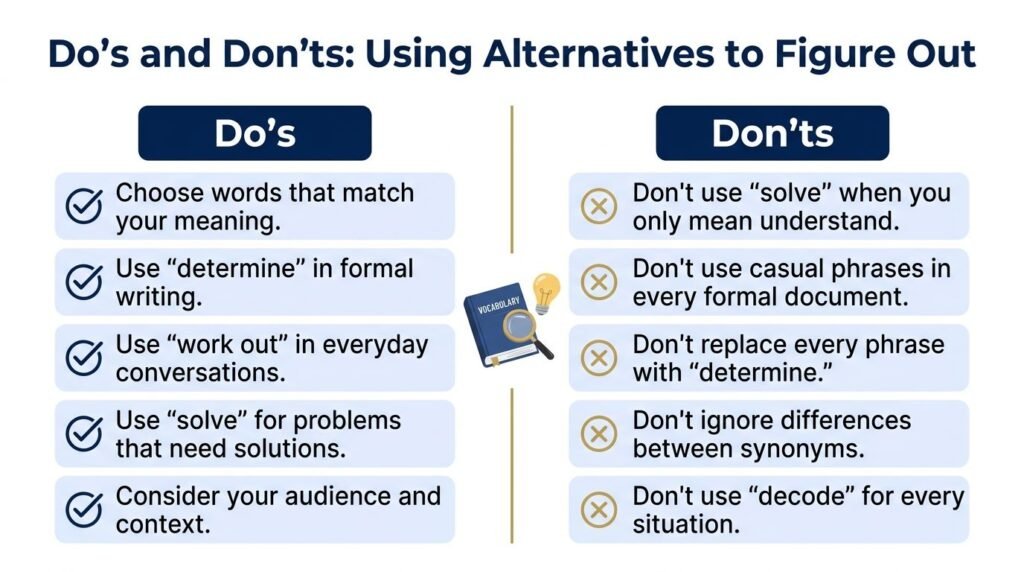
Choosing a synonym without considering its meaning can make your sentence confusing. Avoid these five common mistakes.
1. Using “Solve” for Every Situation
“Figure out” can mean understanding an idea, but “solve” specifically refers to finding an answer to a problem. For example, you can understand a concept, but you do not always solve it.
2. Using Casual Phrases in Formal Writing
Expressions like “work out” and “get to the bottom of” may sound too conversational in certain academic or formal documents. Consider using “determine” or “identify” when appropriate.
3. Confusing “Find Out” With “Understand”
“Find out” focuses on discovering information, while “understand” focuses on comprehending it. Use the expression that communicates your actual intention.
4. Choosing Words Without Considering Context
Not every alternative fits every sentence. For example, “decode” works well for interpreting complicated information but may sound unusual when discussing a simple everyday decision.
5. Repeating the Same Alternative Too Often
Replacing “figure out” with “determine” in every sentence does not improve your vocabulary. Mix suitable expressions naturally while keeping your meaning clear.
Frequently Asked Questions
1. What is another word for figure out?
Some useful alternatives include determine, understand, solve, discover, identify, and find out. Each expression has a slightly different meaning. For example, use “solve” for a problem, “understand” for an idea, and “determine” when establishing a fact or reaching a conclusion.
2. What is a more professional way to say figure out?
“Determine,” “identify,” and “establish” are professional alternatives to “figure out.” These expressions work well in business emails, workplace reports, and formal discussions. For example, instead of saying, “We need to figure out the cause,” you could write, “We need to determine the cause.”
3. Is figure out formal or informal?
“Figure out” is generally considered an informal or neutral conversational expression. It is perfectly acceptable in everyday American English and many workplace conversations. However, more formal writing may benefit from alternatives such as “determine,” “identify,” or “establish,” depending on the sentence.
4. What is another way to say figure out a problem?
You can say “solve a problem,” “work out a solution,” “identify the issue,” or “find a solution.” The best expression depends on what you want to communicate. Use “solve” when describing a successful result and “identify” when explaining how you recognize the problem.
5. What is another way to say figure out what happened?
Useful alternatives include “find out what happened,” “discover what occurred,” “determine what happened,” and “get to the bottom of it.” The last expression is especially useful when you need to investigate a situation and uncover its actual cause.
6. Can I use understand instead of figure out?
Yes, you can use “understand” when “figure out” means becoming familiar with an idea or learning how something works. For example, “I figured out the instructions” can become “I understood the instructions.” However, “understand” does not always communicate finding a solution or discovering new information.
7. What is a simple synonym for figure out?
“Find out,” “understand,” and “work out” are simple alternatives that fit many everyday situations. They are easy to understand and sound natural in American English. Choose “find out” for information, “understand” for meaning, and “work out” for solving something.
8. What is another way to say figure out in an academic essay?
In academic writing, consider using “determine,” “establish,” “identify,” or “analyze.” These words can make your writing more precise and appropriate for formal contexts. For example, replace “Researchers figured out the cause” with “Researchers identified the cause.”
Writing something similar? Try another way to say “done”, another way to say “support” or another way to say “stop”.
Conclusion
Choosing another way to say figure outcan make your English more natural, clear, and effective. The best alternative depends on what you want to express and who will read or hear your message.
Use “determine” or “identify” in professional and academic writing when discussing facts or findings. Choose “work out” or “find out” for everyday conversations, and use “solve” when talking about problems that need solutions. If something is confusing, “make sense of” is a natural choice, while “get to the bottom of” works well when describing a detailed investigation.
Remember that synonyms are not always interchangeable. Consider the meaning, tone, and context before choosing an alternative. Using the right expression will help you communicate confidently and improve your everyday and professional English.

Editorial Desk
The Titan Standards Editorial Team develops, reviews, and maintains practical English-language resources. The team checks articles for clarity, accuracy, context, readability, and consistency with Titan Standards’ editorial guidelines.