What Is Another Way to Say Affect?
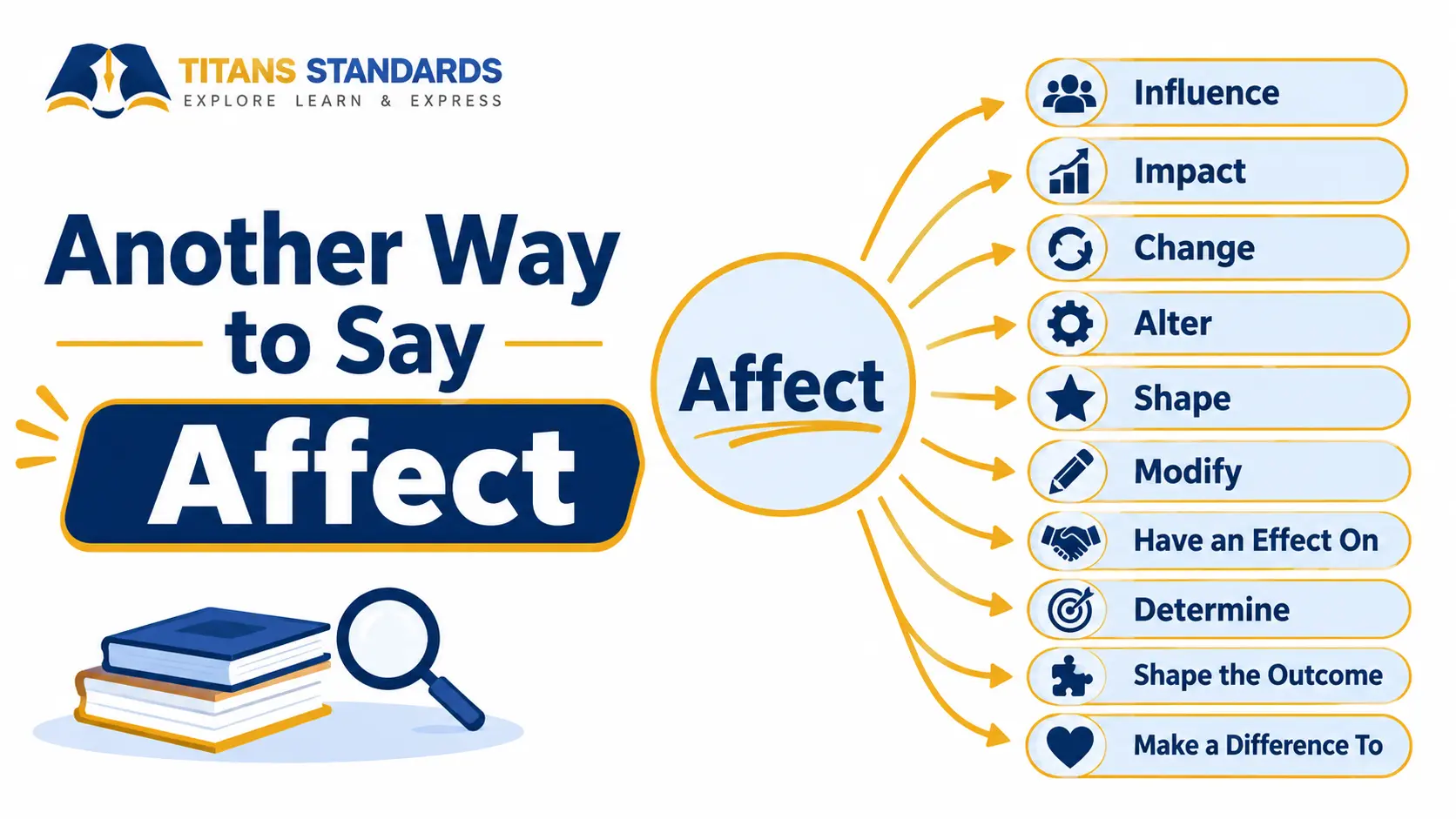
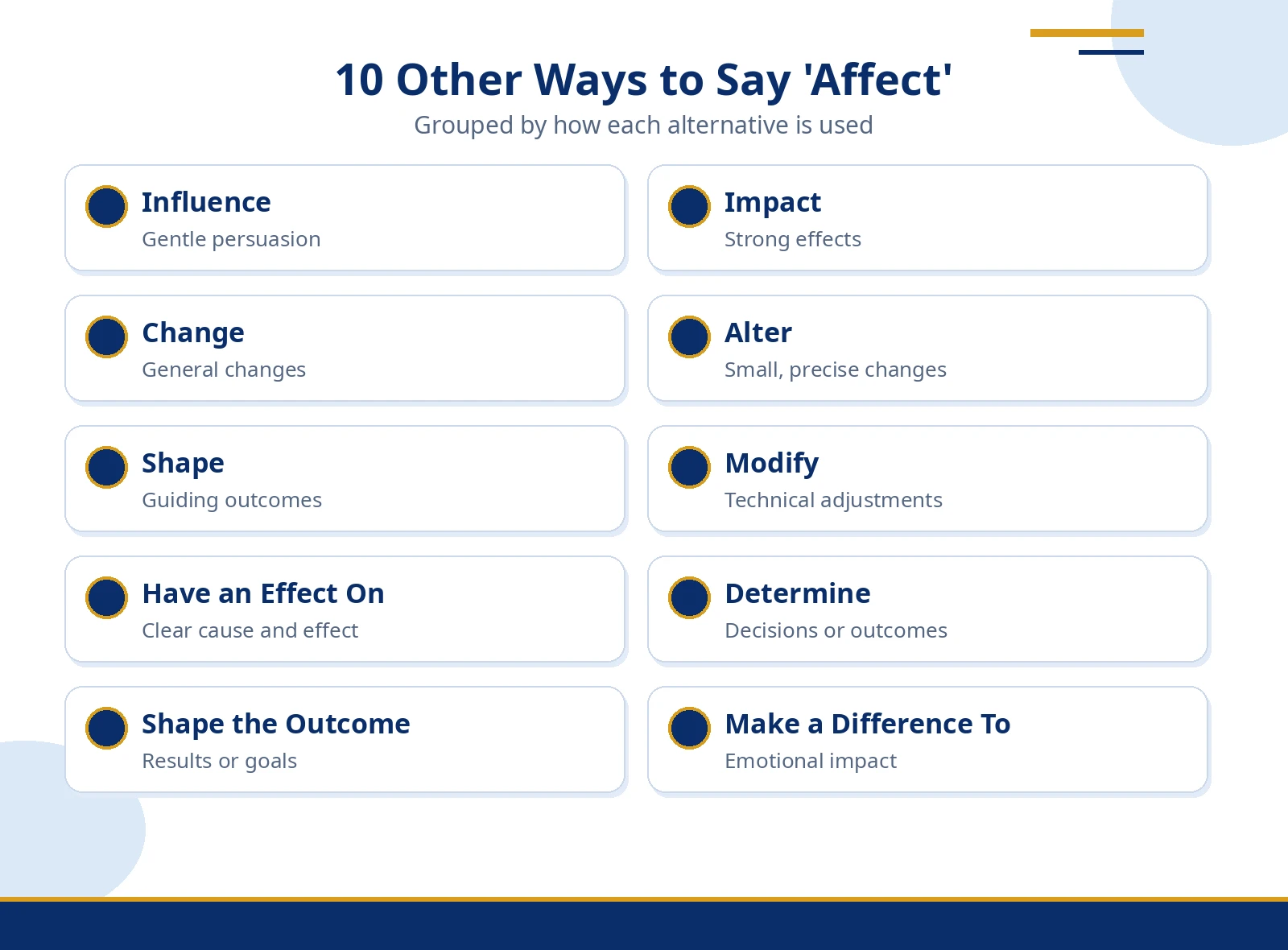
Another way to say affect includes influence, impact, change, alter, shape, modify, and have an effect on. These alternatives help explain how one person, action, or event changes something else.
The best choice depends on the situation, whether you’re writing an academic paper, sending a professional email, or having an everyday conversation.
Key Takeaways
- Influence is a natural alternative when something affects a decision, opinion, or behavior.
- Impact emphasizes a noticeable or significant effect.
- Change works when something makes a difference to a condition or situation.
- Alter and modify are useful in formal and professional writing.
- Choose an alternative based on the strength and type of effect you want to describe.
The word affect appears frequently in everyday conversations, academic assignments, business communication, and professional writing. Although it works in many situations, using the same word repeatedly can make your writing sound less engaging.
Fortunately, several alternatives can help you communicate the same idea with greater accuracy. Some emphasize a strong impact, while others describe a small adjustment or gradual change.
What Does “Another Way to Say Affect” Mean?
The phrase “another way to say affect” refers to alternative words or expressions that communicate the idea of influencing, changing, or making a difference to someone or something.
People commonly use these alternatives to improve sentence variety, make their writing clearer, and choose words that match their intended meaning.
For example, instead of writing, “The weather affects my mood,” you could say, “The weather influences my mood.”
These alternatives are useful in academic essays, workplace communication, business reports, personal conversations, and creative writing.
For a standard definition, see Cambridge Dictionary.
Why Use Other Ways to Say Affect?
Using different expressions instead of repeating affect can make your communication more natural and precise.
Here are some benefits:
- Avoid repetition: Keep your sentences interesting and varied.
- Improve clarity: Choose a word that explains the type of effect more accurately.
- Sound professional: Use appropriate vocabulary in reports, emails, and presentations.
- Strengthen academic writing: Express relationships between ideas more clearly.
- Match your tone: Select language that suits casual, formal, or professional situations.
10 Best Other Ways to Say Affect
1. Influence
Meaning
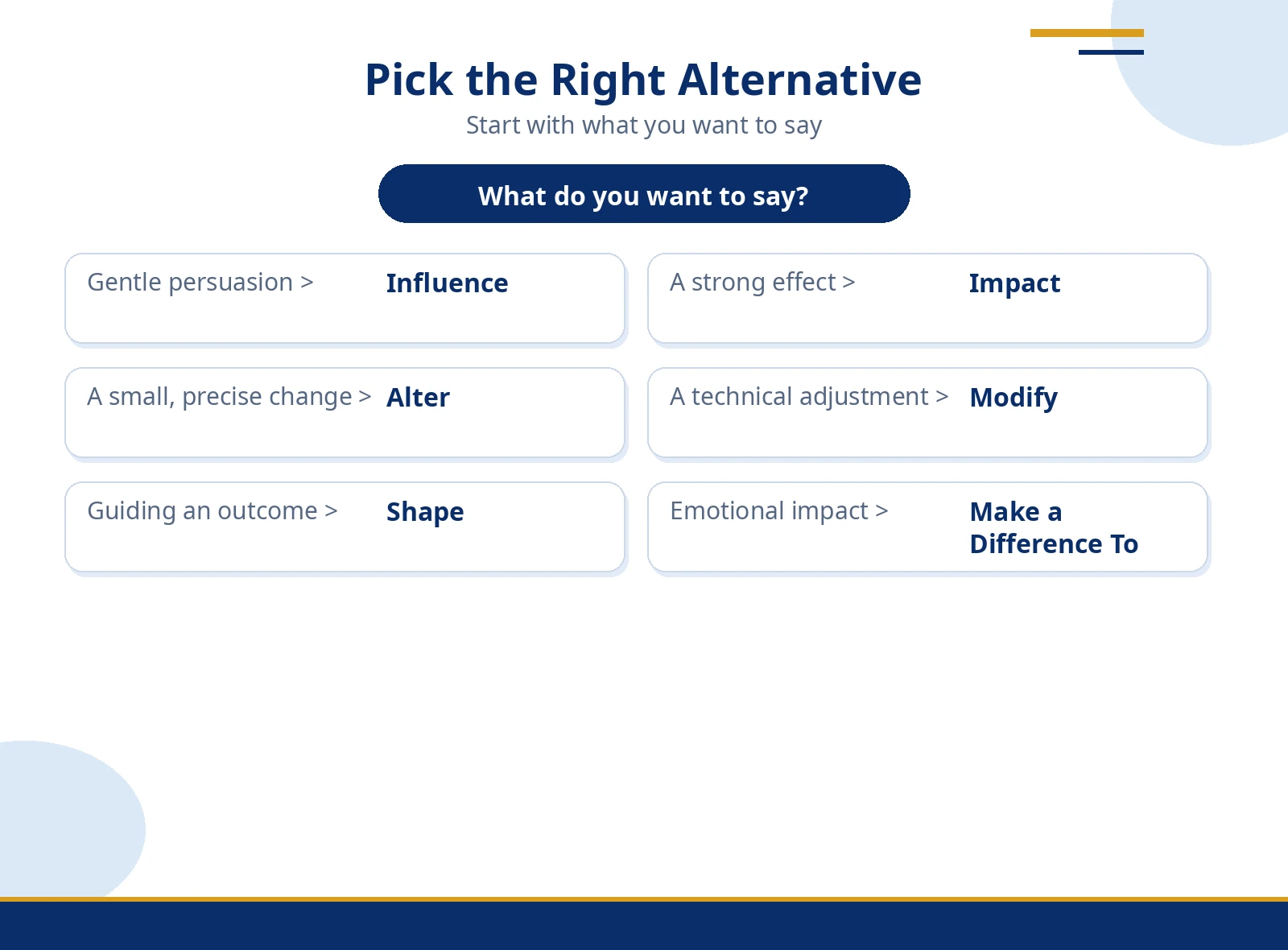
Influence means to have an effect on someone’s decisions, opinions, behavior, or actions. It often describes a gradual or indirect effect rather than an immediate change.
Best For: Professional, Formal, Casual
Example 1: Your childhood experiences can influence the way you see the world.
Example 2: Social media continues to influence consumer buying habits.
Quick Tip: Use influence when discussing how something shapes someone’s thinking, choices, or behavior.
2. Impact
Meaning
Impact describes a noticeable or significant effect on a person, situation, or outcome. It is especially useful when you want to emphasize the importance of a particular change.
Best For: Professional, Formal
Example 1: The new policy could impact thousands of small businesses.
Example 2: Regular exercise has a positive impact on overall well-being.
Quick Tip: Choose impact when you want to highlight the strength or importance of an effect.
3. Change
Meaning
Change means to make something different from its previous condition. It is a simple and versatile alternative that works in everyday conversations and professional writing.
Best For: Casual, Friendly, Professional
Example 1: A few positive habits can change your daily routine.
Example 2: The unexpected announcement changed everyone’s plans.
Quick Tip: Use change when the result involves a noticeable difference in condition, appearance, or behavior.
4. Alter
Meaning
Alter means to make a change to something, often by adjusting its original form, structure, or condition. It sounds slightly more formal than change.
Best For: Formal, Professional
Example 1: The company decided to alter its marketing strategy.
Example 2: Even a small design adjustment can alter the appearance of a room.
Quick Tip: Use alter when describing a specific adjustment rather than a complete transformation.
5. Shape
Meaning
Shape means to influence how something develops, grows, or takes form. It often describes long-term effects on personalities, decisions, experiences, or future outcomes.
Best For: Professional, Formal, Warm
Example 1: Good teachers help shape their students’ confidence.
Example 2: Early experiences can shape a person’s future goals.
Quick Tip: Choose shape when discussing lasting or developing influences.
6. Modify
Meaning
Modify means to make partial changes to something without completely replacing it. It is commonly used in technical, academic, and professional communication.
Best For: Formal, Professional
Example 1: We need to modify the original plan before presenting it to the client.
Example 2: Certain lifestyle adjustments can modify your daily routine.
Quick Tip: Use modify when referring to controlled or specific adjustments.
7. Have an Effect On
Meaning
This expression means to produce a result or influence a person, object, or situation. It is a clear alternative that works in both everyday and academic English.
Best For: Professional, Formal, Casual
Example 1: Lack of sleep can have an effect on your concentration.
Example 2: Rising prices have an effect on household spending.
Quick Tip: Use this expression when you want to explain a cause-and-effect relationship clearly.
8. Determine
Meaning
Determine means to establish, decide, or strongly influence an outcome. It is particularly useful when one factor plays an important role in deciding what happens next.
Best For: Professional, Formal
Example 1: Your final exam score will help determine your overall grade.
Example 2: Several factors determine the success of a business.
Quick Tip: Use determine when something plays a deciding role, not merely when it has a small influence.
9. Shape the Outcome
Meaning
Shape the outcome means to influence how a situation or process eventually develops. It emphasizes the role of a particular action, decision, or circumstance in producing a result.
Best For: Professional, Formal
Example 1: Strong leadership can shape the outcome of a challenging project.
Example 2: Your preparation will help shape the outcome of the interview.
Quick Tip: Use this expression when discussing decisions, planning, teamwork, or important results.
10. Make a Difference To
Meaning
Make a difference to means to produce a noticeable or meaningful change in someone or something. It often has a positive or personal tone, although it can describe negative effects too.
Best For: Friendly, Warm, Professional
Example 1: Your support can make a difference to someone going through a difficult time.
Example 2: Better communication can make a difference to the entire team.
Quick Tip: Choose this expression when you want to emphasize the importance or value of an action.
Comparison Table
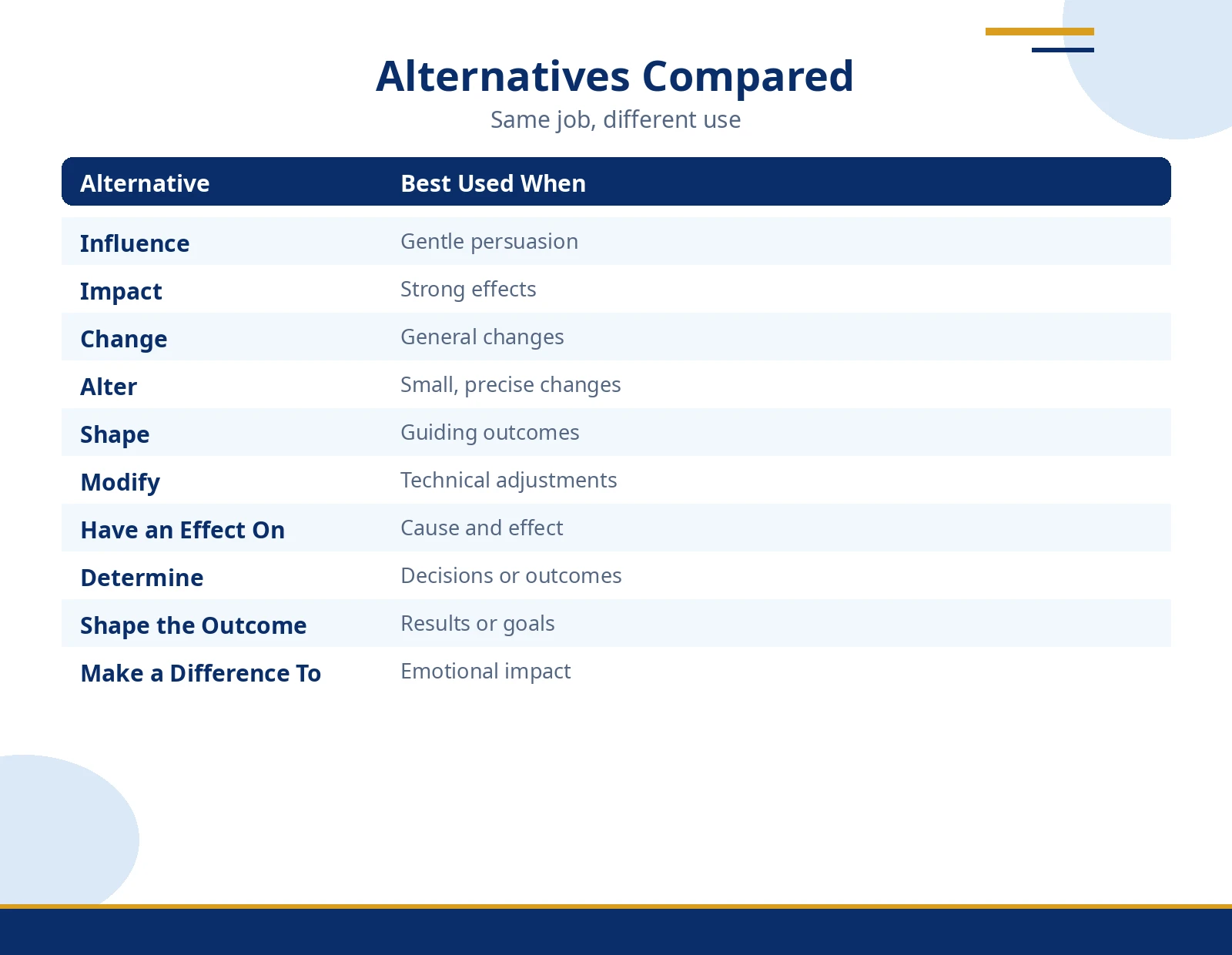
| Alternative | Best Used In | Tone |
|---|---|---|
| Influence | Behavior and decisions | Neutral |
| Impact | Significant effects | Professional |
| Change | Everyday situations | Simple |
| Alter | Specific adjustments | Formal |
| Shape | Long-term development | Thoughtful |
| Modify | Technical adjustments | Professional |
| Have an Effect On | Cause-and-effect explanations | Neutral |
| Determine | Decisions and outcomes | Formal |
| Shape the Outcome | Projects and results | Professional |
| Make a Difference To | Personal and meaningful effects | Warm |
Common Mistakes When Using Alternatives to Affect
Choosing the wrong alternative can change the meaning of your sentence. Watch out for these five common mistakes.
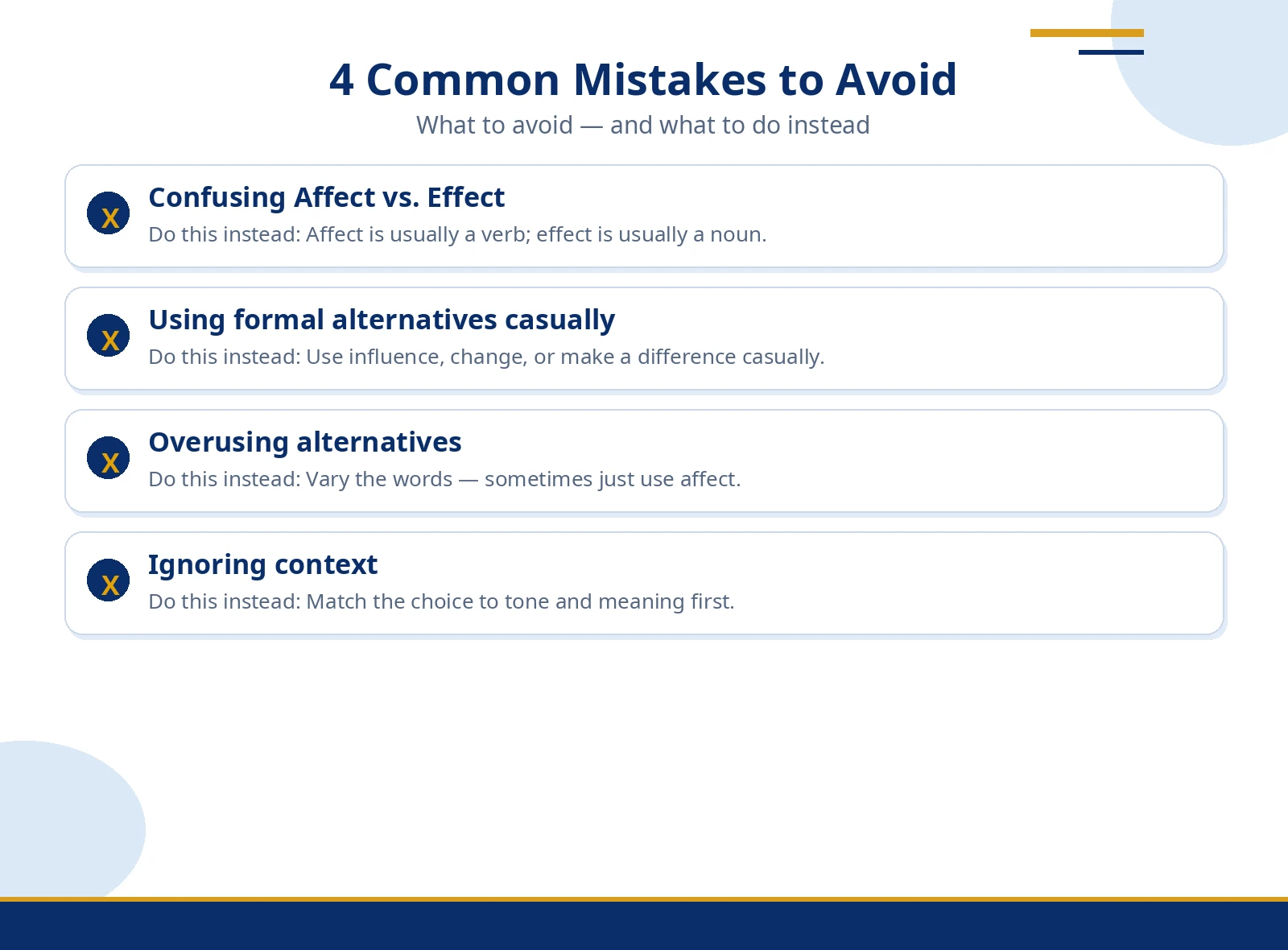
- Using impact for every situation: Impact often suggests a noticeable effect. For smaller or gradual changes, influence may be more accurate.
- Confusing affect with effect: Affect is usually a verb, while effect is usually a noun. For example, “Stress can affect sleep” and “Stress has an effect on sleep.”
- Using overly formal language: Words like modify and determine may sound unnatural in simple conversations. Choose language that matches your audience.
- Ignoring the original meaning: Not every alternative works in every sentence. For example, shape describes development, while alter suggests making an adjustment.
- Repeating the same alternative: Replacing every instance of affect with influence does not solve repetition. Mix suitable alternatives according to context.
Frequently Asked Questions
1. What is the best synonym for affect?
Influence is one of the best general synonyms for affect. It works when describing how something changes someone’s thoughts, decisions, or behavior. However, impact, alter, and change may be more appropriate when discussing stronger effects or specific adjustments.
2. What is a professional way to say affect?
Influence, impact, and have an effect on are useful professional alternatives. For example, instead of saying, “The changes affect productivity,” you could write, “The changes influence productivity.” Choose the expression that best explains the relationship.
3. What is another word for affect in academic writing?
Academic writing often uses influence, impact, alter, modify, and determine. These words help explain relationships between variables, research findings, and outcomes. Always select a term that accurately represents the strength and type of effect being discussed.
4. Is influence the same as affect?
Influence and affect have similar meanings, but they are not always interchangeable. Influence often suggests shaping someone’s behavior, thinking, or decisions, while affect can describe almost any kind of change or effect on a person or thing.
5. What is another way to say negatively affect?
You can use negatively influence, harm, damage, undermine, or have an adverse effect on. For example, “Poor communication can negatively affect teamwork” could become “Poor communication can undermine teamwork.”
6. What is another way to say positively affect?
Useful alternatives include benefit, improve, support, enhance, and have a positive impact on. For example, “Regular exercise positively affects health” can become “Regular exercise improves overall health.”
7. How can I avoid repeating the word affect?
Use different expressions based on your sentence’s meaning. Try influence when discussing behavior, impact when emphasizing significance, and alter when describing adjustments. You can also restructure sentences to make your writing more natural.
8. Is affect formal or informal?
Affect is appropriate in both formal and informal English. You can use it in conversations, school assignments, professional emails, and research papers. The important thing is to choose the right alternative when you need more precise or varied language.
Writing something similar? Try another way to say “impact”, another way to say “appreciate” or another way to say “learn”.
Conclusion
Choosing another way to say affect can make your writing clearer, more natural, and more engaging. Although affect works in many situations, alternatives such as influence, impact, change, alter, and modify help you express different types of effects more accurately.
For professional communication, consider using influence or impact. In academic writing, modify, determine, and have an effect on can explain relationships more precisely. For everyday conversations, change and make a difference to sound simple and natural.
Remember that not every synonym fits every sentence. Think about what kind of effect you want to describe, who will read your writing, and which expression communicates your meaning best. The right word will make your message easier to understand and more effective.
Looking for more ways to refresh everyday phrases? Explore our guides to fresher ways to say said and done, or find a better way to say he says.

Editorial Desk
The Titan Standards Editorial Team develops, reviews, and maintains practical English-language resources. The team checks articles for clarity, accuracy, context, readability, and consistency with Titan Standards’ editorial guidelines.