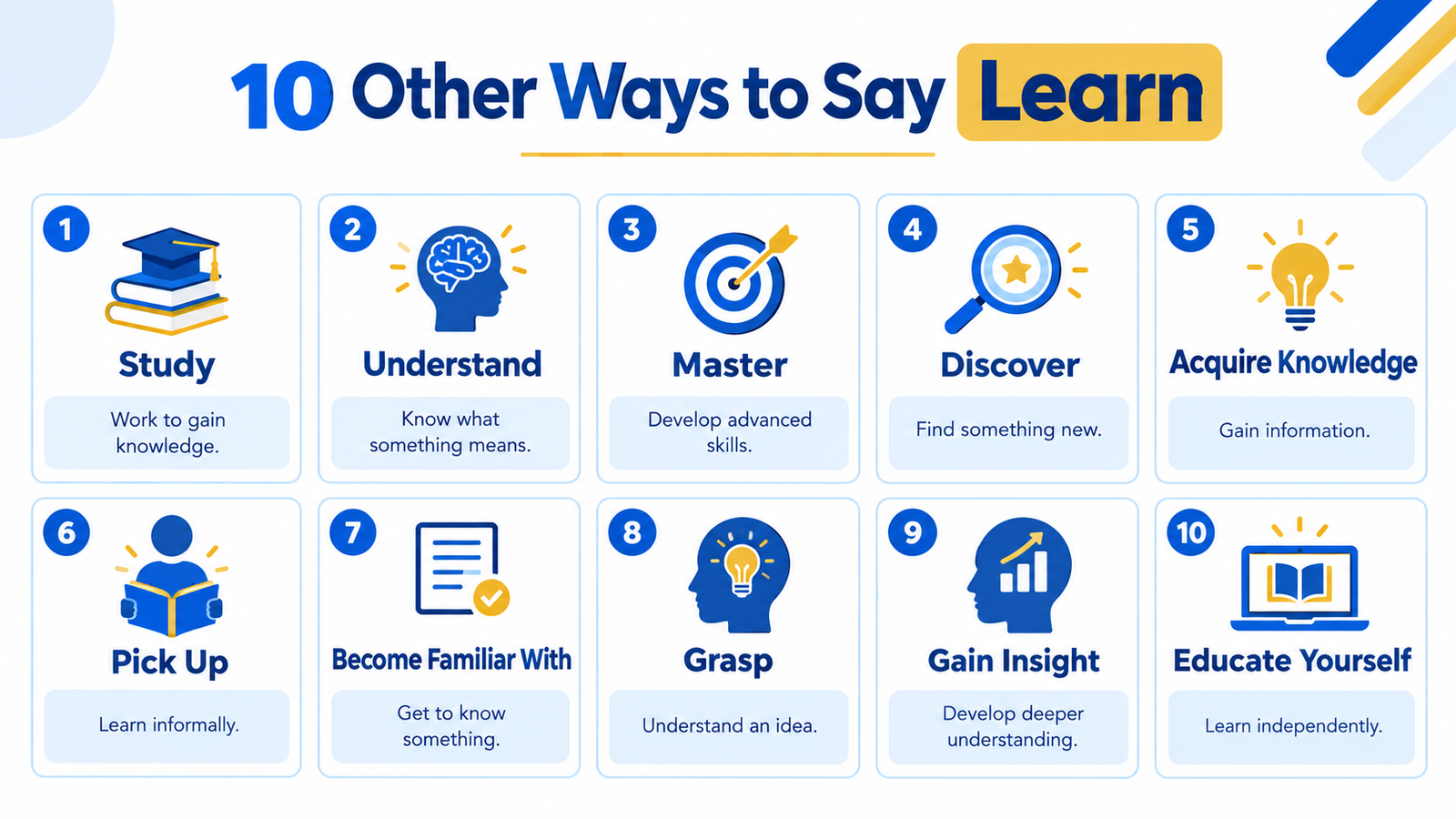
Another way to say learn is study, understand, master, discover, acquire knowledge, pick up, become familiar with, grasp, gain insight, or educate yourself. The best alternative depends on your meaning. Use “study” for focused learning, “master” for advanced skills, and “grasp” when someone understands an idea.
Key Takeaways
- Use study when you focus on a subject or prepare for an exam.
- Choose master when someone develops a high level of skill.
- Use understand or grasp when you mean comprehending an idea.
- Choose pick up for skills or information learned informally.
- Select alternatives based on context, tone, and the type of learning involved.
The word “learn” works in many situations, but repeating it can make your writing sound less varied. Choosing a more precise word helps you explain whether someone is studying a subject, gaining a skill, discovering information, or understanding a difficult concept.
For students, professionals, teachers, and English learners, knowing different ways to say “learn” makes communication clearer. The key is to choose a phrase that fits the situation instead of replacing the original word with a synonym that changes its meaning.

What Does “Another Way to Say Learn” Mean?
The phrase “another way to say learn” refers to alternative words or expressions that communicate the idea of gaining knowledge, understanding information, or developing a skill.
People use these alternatives to improve vocabulary, avoid repetition, and make their writing more precise. For example, a student might “study” biology, “master” a new technique, or “discover” an interesting fact.
These expressions appear in everyday conversations, academic essays, workplace communication, training materials, and personal development writing. However, not every alternative fits every situation.
For the full definition, see Cambridge Dictionary.
Why Use Other Ways to Say Learn?
Using different expressions for “learn” helps you communicate the exact kind of progress or understanding you mean. It also makes your writing sound more natural and engaging.
Here are the main benefits:
- Avoid repetition: Use varied vocabulary when discussing learning several times.
- Improve clarity: Explain whether someone is studying, understanding, or developing a skill.
- Sound professional: Choose appropriate wording for reports, presentations, and workplace discussions.
- Strengthen academic writing: Use precise verbs to describe research, knowledge, and understanding.
- Express different learning styles: Distinguish between formal study and learning through experience.
10 Best Other Ways to Say “Learn”
1. Study
Meaning
“Study” means spending time reading, practicing, or examining information to gain knowledge. It usually involves deliberate effort and is common in educational settings.
Best For: Professional, Formal, Casual
Example 1: I need to study biology before my final exam.
Example 2: She studies American history every weekend.
Quick Tip: Use “study” when someone actively works on a subject. It is not always interchangeable with “learn,” because studying describes the activity, while learning describes gaining knowledge or skill.
2. Understand
Meaning
“Understand” means knowing what something means or how it works. It emphasizes comprehension rather than the process of studying.
Best For: Professional, Formal, Casual, Friendly
Example 1: After the instructor explained the formula, I understood how to solve the problem.
Example 2: We need to understand our customers’ needs before changing the service.
Quick Tip: Choose “understand” when the main point is comprehension. For example, “I understand the instructions” sounds more natural than “I learned the instructions” when you mean you comprehend them now.
3. Master
Meaning
“Master” means developing a high level of knowledge or skill through practice, experience, and effort. It suggests greater proficiency than simply becoming familiar with something.
Best For: Professional, Formal, Casual
Example 1: He hopes to master conversational Spanish before his trip.
Example 2: The new designer mastered the software after months of practice.
Quick Tip: Use “master” when someone has achieved strong proficiency. Avoid it for basic exposure to a topic, because the word suggests a substantial level of ability.
4. Discover
Meaning
“Discover” means finding information, facts, or ideas that were previously unknown to you. It often suggests curiosity, exploration, or an unexpected finding.
Best For: Professional, Casual, Friendly
Example 1: I discovered a useful shortcut while organizing the spreadsheet.
Example 2: The children discovered how plants grow by observing seeds in the classroom.
Quick Tip: Choose “discover” when learning involves finding something new. It works especially well for research, exploration, and personal experiences.
5. Acquire Knowledge
Meaning
“Acquire knowledge” means gradually gaining information or understanding through education, practice, reading, or experience. It sounds more formal than the simple word “learn.”
Best For: Professional, Formal
Example 1: Interns acquire knowledge by working alongside experienced engineers.
Example 2: Reading reliable sources helps students acquire knowledge about environmental issues.
Quick Tip: Use this expression in essays, reports, and professional discussions. In casual conversation, “learn” or “find out” may sound more natural.
6. Pick Up
Meaning
“Pick up” is an informal expression for learning something naturally, often through observation, practice, or everyday interaction. It commonly describes languages, habits, and practical skills.
Best For: Casual, Friendly, Warm
Example 1: I picked up a few useful Italian phrases during my vacation.
Example 2: Maya picked up some helpful computer skills from her coworkers.
Quick Tip: Use “pick up” in relaxed conversations. It is especially useful when learning happens without formal lessons or a structured course.
7. Become Familiar With
Meaning
“Become familiar with” means gaining enough knowledge or experience to recognize, navigate, or use something comfortably. It does not necessarily mean becoming an expert.
Best For: Professional, Formal, Polite
Example 1: Please become familiar with the employee handbook before your first shift.
Example 2: The research team became familiar with the new testing equipment during orientation.
Quick Tip: Choose this expression when someone needs an introduction to a process, system, or topic. Do not use it to suggest complete mastery.
8. Grasp
Meaning
“Grasp” means understanding an idea, concept, or situation, especially when it requires thought. It often emphasizes reaching a clear understanding of something that may be difficult.
Best For: Professional, Formal, Casual
Example 1: It took me a few lessons to grasp the basics of statistics.
Example 2: The manager quickly grasped why the project was falling behind schedule.
Quick Tip: Use “grasp” when you want to emphasize comprehension. It is particularly effective in academic writing and explanations of complex ideas.
9. Gain Insight
Meaning
“Gain insight” means developing a deeper understanding of a topic, problem, or experience. It often involves recognizing patterns, causes, or perspectives that were not obvious before.
Best For: Professional, Formal
Example 1: The interviews helped us gain insight into why customers preferred the older design.
Example 2: Reading personal accounts can help students gain insight into historical events.
Quick Tip: Use “gain insight” when learning leads to a deeper perspective rather than simply memorizing facts. It works well in research, analysis, and business writing.
10. Educate Yourself
Meaning
“Educate yourself” means actively seeking knowledge through reading, research, courses, or other learning opportunities. It emphasizes taking personal responsibility for gaining information.
Best For: Professional, Formal, Casual
Example 1: I decided to educate myself about retirement planning before meeting with an adviser.
Example 2: New homeowners can educate themselves about basic maintenance by reading trusted guides.
Quick Tip: This phrase is useful when discussing independent learning. Depending on the context, it can sound encouraging or critical, so use a respectful tone when addressing someone else.
Comparison Table
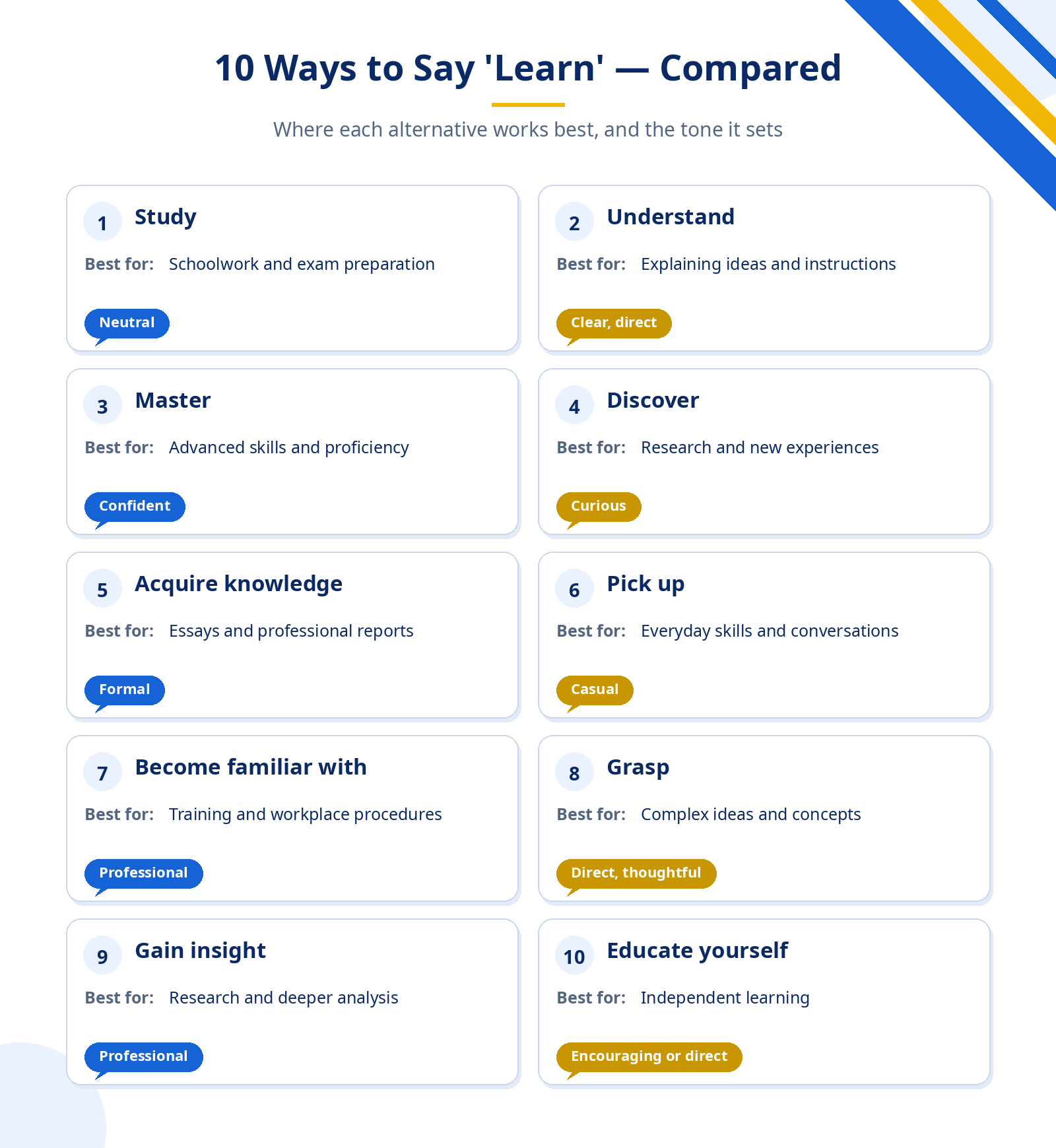
| Alternative | Best Used In | Tone |
|---|---|---|
| Study | Schoolwork and exam preparation | Neutral |
| Understand | Explaining ideas and instructions | Clear, direct |
| Master | Advanced skills and proficiency | Confident |
| Discover | Research and new experiences | Curious |
| Acquire knowledge | Essays and professional reports | Formal |
| Pick up | Everyday skills and conversations | Casual |
| Become familiar with | Training and workplace procedures | Professional |
| Grasp | Complex ideas and concepts | Direct, thoughtful |
| Gain insight | Research and deeper analysis | Professional |
| Educate yourself | Independent learning | Encouraging or direct |
Common Mistakes When Using Alternatives to “Learn”
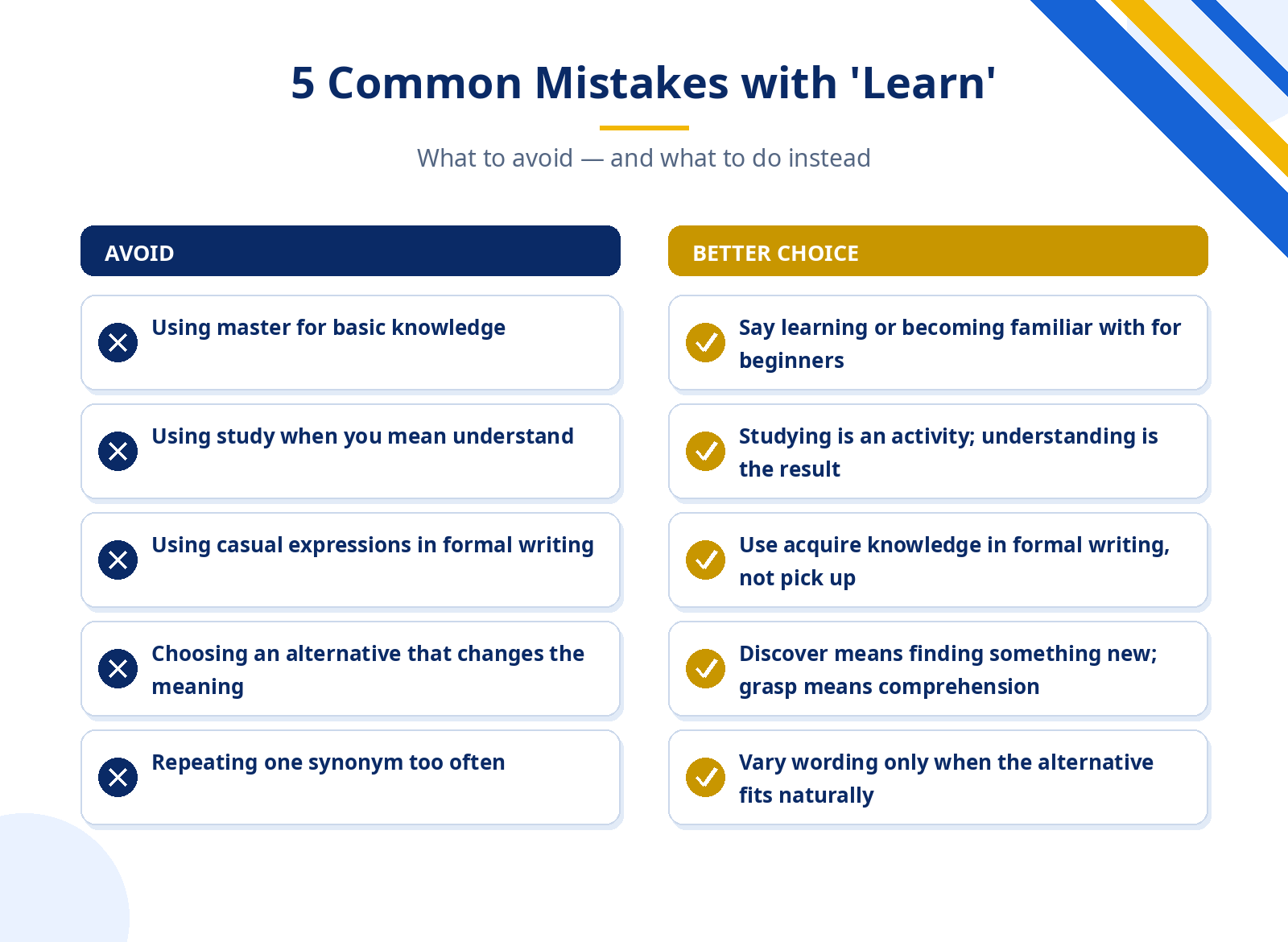
1. Using “master” for basic knowledge
“Master” suggests a high level of proficiency. If someone has only started a course, say they are learning or becoming familiar with the subject.
2. Using “study” when you mean “understand”
Studying is an activity, while understanding is a result. Someone can study a chapter without fully understanding it.
3. Using casual expressions in formal writing
“Pick up” works well in everyday conversation, but “acquire knowledge” or “develop proficiency” may suit a formal report better.
4. Choosing an alternative that changes the meaning
“Discover” suggests finding something new, while “grasp” emphasizes comprehension. Consider the intended meaning before replacing “learn.”
5. Repeating one synonym too often
Replacing every instance of “learn” with “understand” can create another repetitive pattern. Vary your wording only when the alternative fits naturally.
Frequently Asked Questions
1. What is the best synonym for learn?
There is no single best synonym for every situation. “Study” suits focused learning, “understand” emphasizes comprehension, and “master” suggests advanced ability. For everyday conversations, “pick up” often sounds natural. Choose the word that describes the specific learning process or result you want to express.
2. What is a more professional word for learn?
“Acquire knowledge,” “develop proficiency,” and “become familiar with” can sound more professional than “learn” in workplace communication. For example, you could write, “Employees develop proficiency in the new system through training.” The best choice depends on whether you mean gaining information, learning a process, or improving a skill.
3. What is another way to say learn in an essay?
In an essay, you can use “study,” “understand,” “discover,” “gain insight,” or “acquire knowledge.” Use “study” when discussing an academic activity and “gain insight” when describing a deeper understanding. Make sure the alternative fits your sentence and does not change the intended meaning.
4. What is a formal way to say learn new skills?
“Develop proficiency,” “acquire new skills,” and “build expertise” are useful formal expressions. For example, “The training program helps employees develop proficiency in data analysis.” Use “build expertise” when the process involves continued practice and experience rather than a short introductory lesson.
5. What is another way to say learn quickly?
You can say “pick up quickly,” “grasp quickly,” or “master quickly,” depending on the context. “She picked up the software quickly” sounds natural in conversation. “He quickly grasped the concept” emphasizes understanding, while “master quickly” suggests developing a strong level of skill in a short time.
6. Is “understand” the same as “learn”?
No. “Learn” generally describes gaining knowledge or a skill, while “understand” means comprehending information or how something works. For example, you might learn a new formula and then understand how to apply it. The words are related, but they are not interchangeable in every sentence.
7. How can I say “I want to learn” more professionally?
You could say, “I want to develop my skills,” “I hope to expand my knowledge,” or “I would like to gain experience.” In a job interview, “I want to expand my knowledge of project management” sounds specific and professional. Choose a phrase that identifies the area in which you want to grow.
8. What is an informal way to say learn?
“Pick up” is one of the most common informal alternatives. For example, “I picked up a few cooking tricks from my grandmother” sounds natural and conversational. You can also use “figure out” when you mean learning how something works through investigation or practice, rather than through formal instruction.
Conclusion
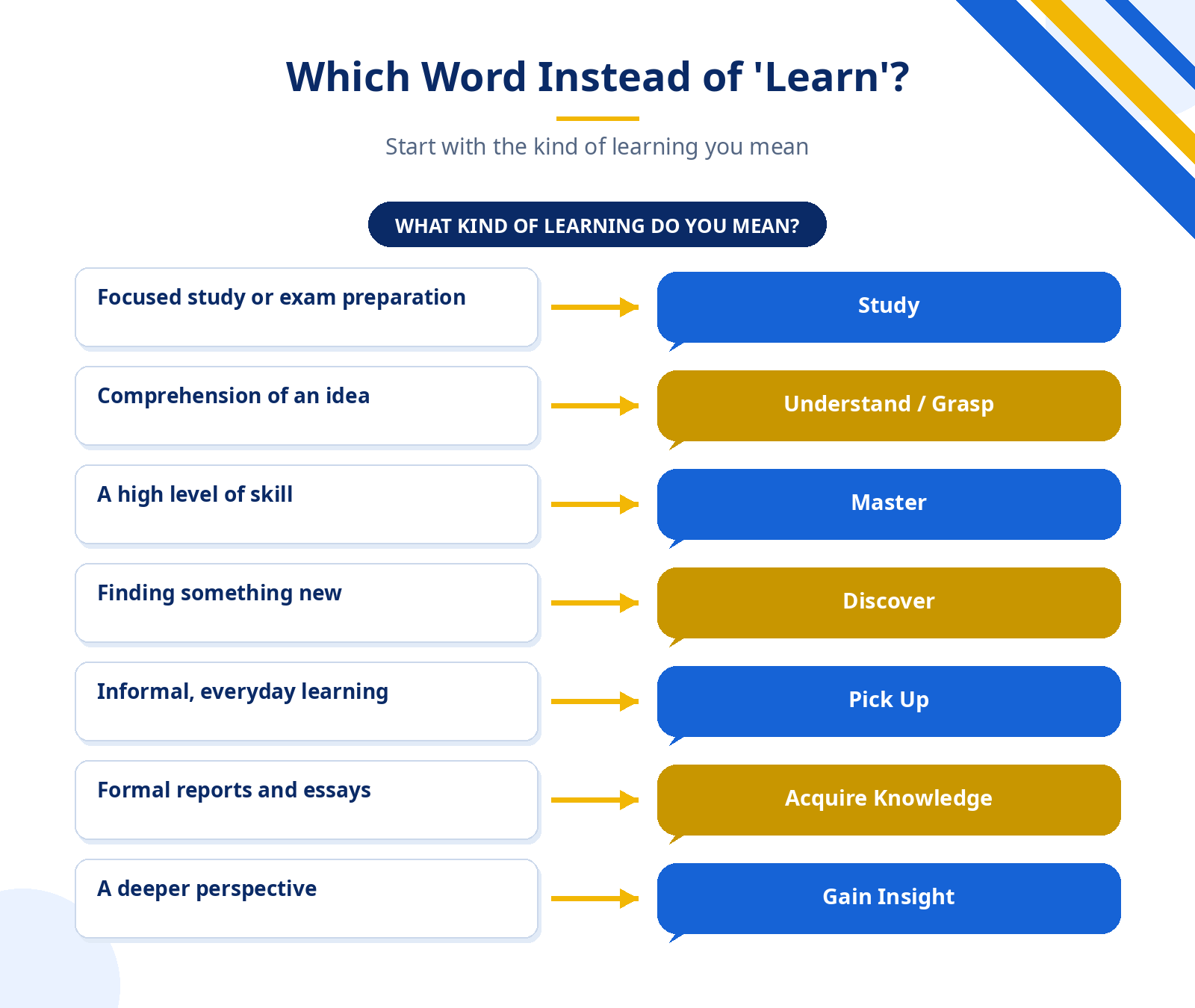
Choosing another way to say “learn” can make your writing clearer, more natural, and more precise. The right expression depends on what you want to communicate. Use “study” for focused academic work, “understand” or “grasp” for comprehension, and “master” when someone develops a high level of skill. For informal learning, “pick up” is often a good choice, while “acquire knowledge” and “gain insight” suit more formal contexts.
Before replacing “learn,” consider the audience, tone, and purpose of your sentence. A synonym should improve the meaning, not simply make the vocabulary sound more advanced. If you are unsure, read the sentence aloud and choose the expression that sounds natural.
Looking for more ways to refresh everyday phrases? Explore our guides to fresher ways to say said and done, or find a better way to say he says.

Editorial Desk
The Titan Standards Editorial Team develops, reviews, and maintains practical English-language resources. The team checks articles for clarity, accuracy, context, readability, and consistency with Titan Standards’ editorial guidelines.