Another way to say but is “however,” “yet,” “although,” “though,” or “nevertheless.” These alternatives help connect contrasting ideas while adding variety to your writing. The best choice depends on the sentence, tone, and meaning you want to express in everyday conversations, essays, emails, or professional documents.
Key Takeaways
- Use however to introduce a contrast in formal and professional writing.
- Choose yet to show an unexpected difference or result.
- Use although and though to introduce a contrasting idea.
- Choose nevertheless or nonetheless to emphasize that something remains true despite a difficulty.
- Match each alternative to your sentence structure and intended meaning.

What Does “Another Way to Say But” Mean?
The phrase “another way to say but” refers to alternative words and expressions that communicate contrast, disagreement, or an unexpected difference between ideas. The word but is a conjunction that connects two contrasting thoughts.
For example, you might write, “The restaurant was expensive, but the food was excellent.” You could replace but with yet to express a similar contrast: “The restaurant was expensive, yet the food was excellent.”
People look for alternatives to but to avoid repetition, improve sentence flow, and adjust their tone. These alternatives appear in everyday conversations, school essays, business emails, creative writing, and formal reports.
However, not every alternative works in every sentence. Some words introduce a complete contrasting statement, while others connect clauses in different grammatical structures.
You can also check the Cambridge Dictionary for the standard meaning and usage of ‘but’.
Why Use Other Ways to Say But?
Using different words for contrast can make your writing clearer and more natural. The right alternative also helps readers understand how two ideas relate to each other.
Consider these benefits:
- Avoid repetition: Use different expressions instead of repeating but throughout an essay.
- Improve professional writing: Choose words such as however or nevertheless when they fit the tone.
- Show different types of contrast: Use whereas to compare two situations or even so to show that a fact does not change the outcome.
- Improve sentence flow: Select an expression that connects your ideas smoothly.
- Express your meaning precisely: Some alternatives suggest a stronger or more surprising contrast than others.
The goal is not to replace every instance of but. Instead, choose the word that communicates your intended relationship between ideas.
10 Best Other Ways to Say But
1. However
Meaning
However introduces a statement that contrasts with something mentioned earlier. It is especially useful in formal writing, reports, academic assignments, and professional emails.
Unlike but, however often begins a new sentence or appears after a semicolon. Punctuation matters when you use it to connect complete sentences.
Best For
Professional, Formal, Polite
Example 1
The team completed the first phase on schedule. However, the final review needs another week.
Example 2
The proposal looks promising; however, we need to confirm the budget.
Quick Tip
When however connects two independent clauses, use a semicolon before it and a comma after it. You can also start a new sentence with it.
2. Yet
Meaning
Yet shows contrast, often when the second idea is surprising or unexpected. It can suggest that something remains true despite a situation that might normally lead to a different result.
It works well in everyday speech, essays, and concise professional writing.
Best For
Casual, Professional, Friendly
Example 1
Maya had little experience, yet she handled the presentation confidently.
Example 2
The apartment is small, yet it feels bright and comfortable.
Quick Tip
Use yet when you want to emphasize an unexpected contrast without making the sentence sound overly formal.
3. Although
Meaning
Although introduces a fact that contrasts with the main idea. It often appears at the beginning of a sentence or before the main clause.
It is useful when you want to acknowledge one point while explaining why another point remains important.
Best For
Formal, Professional, Polite
Example 1
Although the deadline was tight, the designers delivered excellent work.
Example 2
Although Jordan disagreed with the decision, he supported the team.
Quick Tip
Do not use although and but together to express the same contrast in one standard sentence. Write “Although it was raining, we went outside,” not “Although it was raining, but we went outside.”
4. Though
Meaning
Though has a meaning similar to although, but it often sounds more conversational. You can use it to acknowledge a contrasting fact in everyday communication and informal writing.
It can also appear at the end of a sentence, where it often means “however” or “nevertheless.”
Best For
Casual, Friendly, Warm
Example 1
The movie was longer than expected, though I enjoyed the ending.
Example 2
I usually prefer tea. Coffee is good, though.
Quick Tip
Use though for a relaxed tone. In more formal documents, although may be a better fit when introducing a dependent clause.
5. Nevertheless
Meaning
Nevertheless means that something remains true despite a difficulty, objection, or contrasting fact. It emphasizes that the second point still stands even when the first point might suggest otherwise.
This word is common in formal reports, academic writing, and careful professional communication.
Best For
Formal, Professional
Example 1
The first test revealed several weaknesses. Nevertheless, the researchers continued the study.
Example 2
The company faced a difficult quarter; nevertheless, it maintained its customer service standards.
Quick Tip
Choose nevertheless when you want to emphasize persistence or an outcome that holds despite an obstacle. It can sound too formal in casual conversation.
6. Nonetheless
Meaning
Nonetheless is very similar to nevertheless. It introduces a contrasting point while emphasizing that the previous information does not prevent the next statement from being true.
It works well in professional reports, academic essays, and formal explanations.
Best For
Formal, Professional
Example 1
The instructions were complicated. Nonetheless, every participant completed the task.
Example 2
The initial results were limited; nonetheless, they offered useful information for future research.
Quick Tip
Use nonetheless when you want a polished tone. You can often substitute it for nevertheless, but check that the sentence still expresses the intended relationship.
7. Still
Meaning
Still can express contrast by showing that a situation remains true despite another fact. It often sounds more natural and direct than nevertheless.
Depending on the sentence, still can also refer to something continuing over time, so the surrounding context should make your meaning clear.
Best For
Casual, Friendly, Professional
Example 1
The route was longer than we planned. Still, we arrived before sunset.
Example 2
The instructions seemed confusing at first, but the process was still manageable.
Quick Tip
Use still to keep the tone simple and conversational. Remember that in the second example, still describes the continuing condition; it does not replace but.
8. Whereas
Meaning
Whereas introduces a direct comparison between two different facts, people, choices, or situations. It is especially helpful when the contrast itself is the main point.
You will often see it in analytical writing, business reports, academic work, and explanations that compare two sides.
Best For
Formal, Professional
Example 1
The downtown office serves walk-in customers, whereas the regional office handles online orders.
Example 2
Nina prefers detailed instructions, whereas her colleague likes to work independently.
Quick Tip
Choose whereas when comparing two distinct situations. Do not use it automatically wherever you would use but, because it emphasizes comparison rather than every type of contrast.
9. Even So
Meaning
Even so means that something remains true despite the circumstances or information just mentioned. It often introduces a result or decision that might seem unexpected.
This expression is clear and natural in conversations, emails, and general writing.
Best For
Casual, Friendly, Professional
Example 1
The weather forecast looked uncertain. Even so, we decided to hold the outdoor event.
Example 2
The course requires extra study time. Even so, many students find it worthwhile.
Quick Tip
Use even so when the second statement goes ahead despite the first. It usually works well at the beginning of a new sentence, followed by a comma.
10. On the Other Hand
Meaning
On the other hand introduces a different perspective, consideration, or side of an issue. It is particularly useful when weighing pros and cons or presenting two competing viewpoints.
Unlike a simple replacement for but, this expression often signals a broader comparison between alternatives.
Best For
Professional, Formal, Polite
Example 1
Buying a home requires a large upfront payment. On the other hand, renting offers more flexibility.
Example 2
The first candidate has extensive experience. On the other hand, the second candidate brings stronger technical skills.
Quick Tip
Use this expression when presenting another side of a discussion. If you introduce one side with “on the one hand,” use “on the other hand” to make the comparison clearer.
Comparison Table
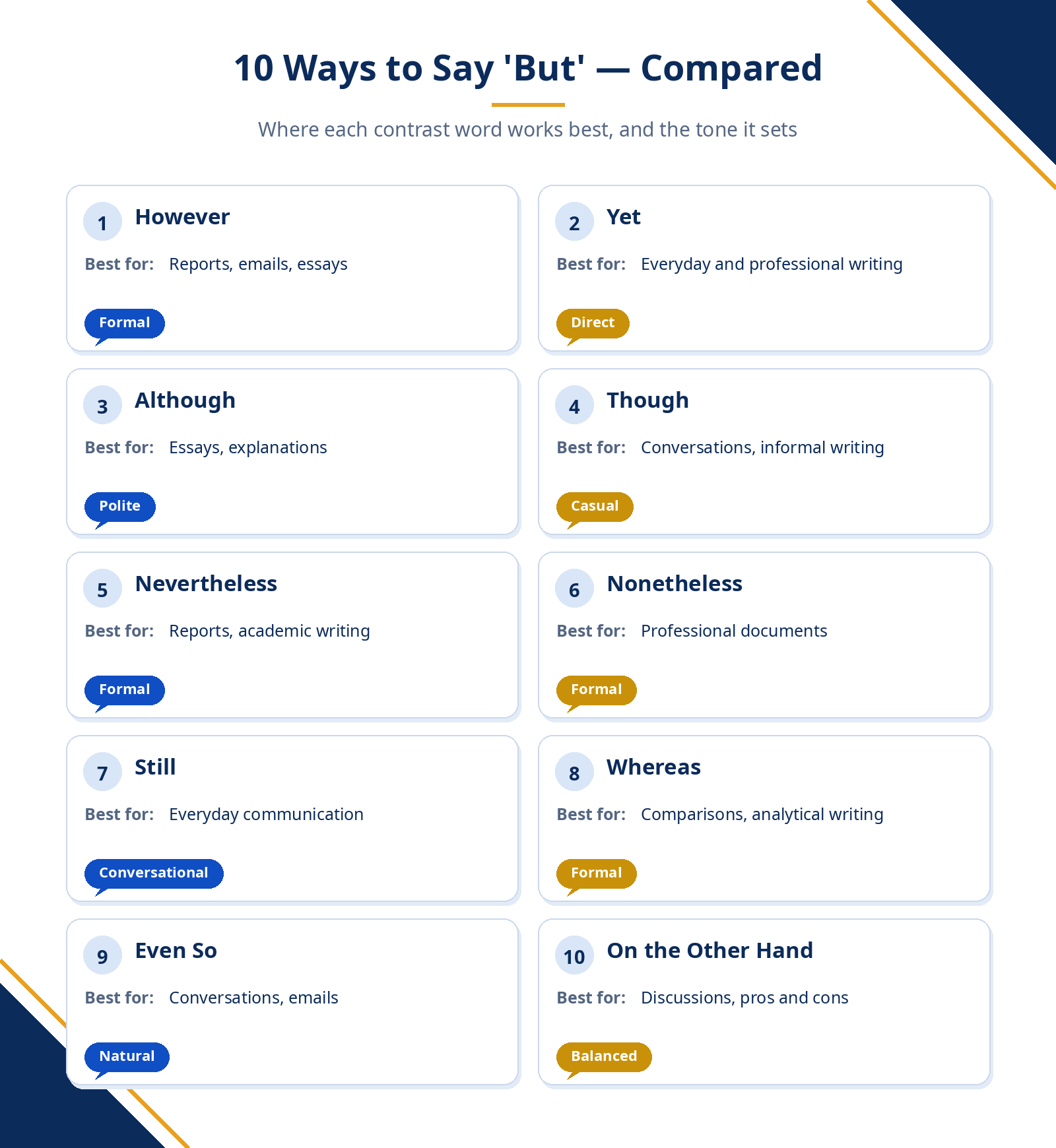
| Alternative | Best Used In | Tone |
| However | Reports, emails, essays | Formal |
| Yet | Everyday and professional writing | Direct |
| Although | Essays, explanations | Polite |
| Though | Conversations, informal writing | Casual |
| Nevertheless | Reports, academic writing | Formal |
| Nonetheless | Professional documents | Formal |
| Still | Everyday communication | Conversational |
| Whereas | Comparisons, analytical writing | Formal |
| Even so | Conversations, emails | Natural |
| On the Other Hand | Discussions, pros and cons | Balanced |
Common Mistakes When Using Alternatives to But
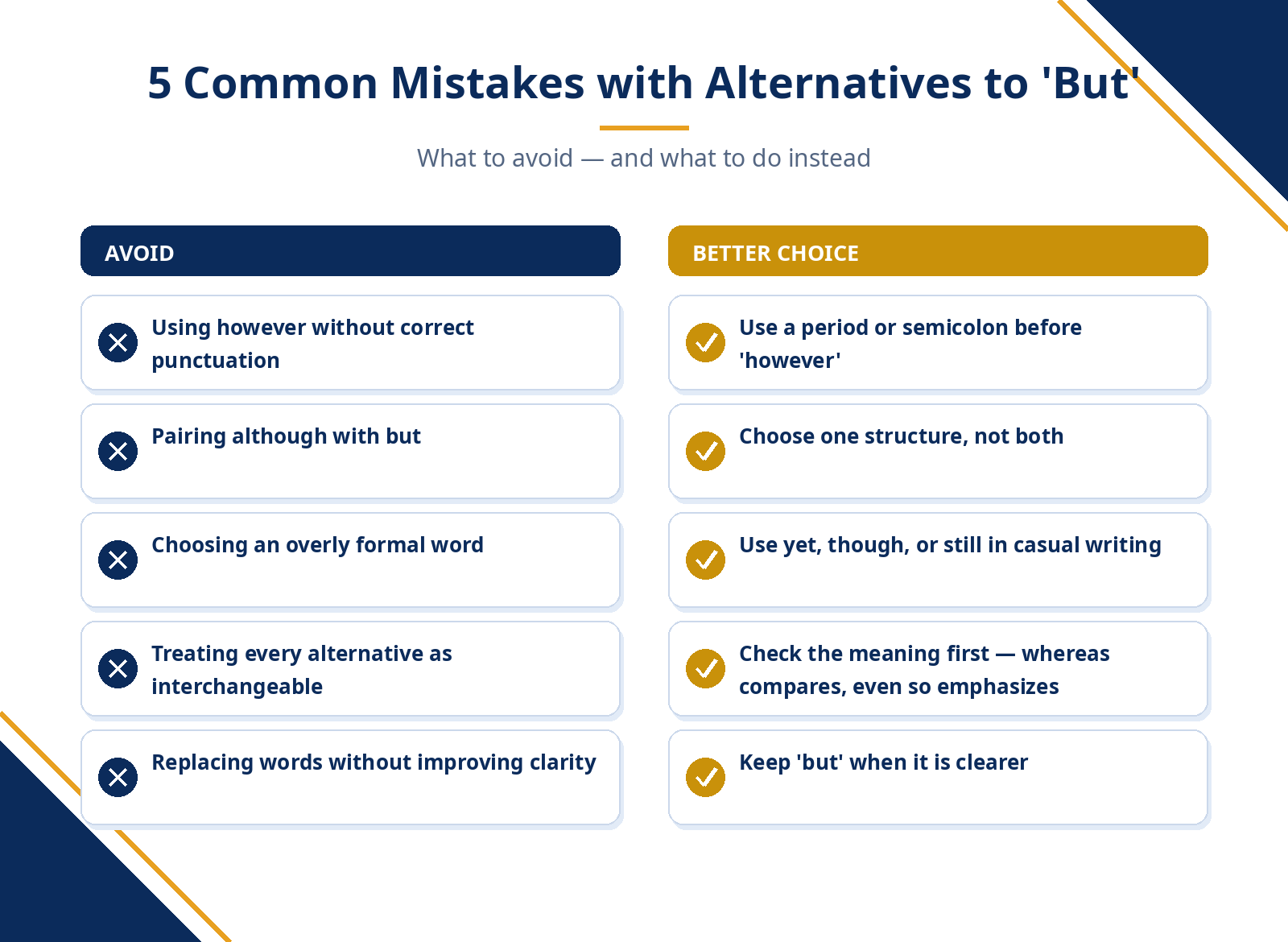
1. Using However Without Correct Punctuation
However cannot usually join two independent sentences with only a comma. Use a period or a semicolon before it when appropriate.
2. Pairing Although With But
Using both words for the same contrast creates a common grammatical error. Choose one structure instead of writing “Although she was tired, but she continued.”
3. Choosing an Overly Formal Word
Words such as nevertheless and nonetheless may sound stiff in a casual text. Use yet, though, or still when they better match the conversation.
4. Treating Every Alternative as Interchangeable
Whereas compares two situations, while even so emphasizes that something remains true despite a circumstance. Check the meaning before replacing but.
5. Replacing Words Without Improving Clarity
Changing but simply to sound sophisticated can make a sentence harder to read. Keep but when it communicates your point more clearly than the alternatives.
Frequently Asked Questions
1. What is the most common alternative to but?
However is one of the most common alternatives, especially in formal and professional writing. Yet, though, and although are also widely used. The best option depends on the sentence structure and the type of contrast you want to express.
2. What is a formal way to say but?
However, nevertheless, and nonetheless are useful formal alternatives. For example, “The proposal is promising; however, it needs revision.” Choose the word that fits your sentence and avoids making your writing sound unnecessarily complicated.
3. What is an informal word for but?
Though, yet, and still can sound natural in informal communication. For example, “I was tired, yet I stayed for the movie.” You can also end a casual sentence with though, as in “It was expensive. I liked it, though.”
4. Can I use however instead of but?
Yes, but you may need to change the punctuation or sentence structure. But commonly connects two contrasting clauses in one sentence, while however often introduces a separate sentence or follows a semicolon. For example: “I wanted to go, but I was busy” can become “I wanted to go. However, I was busy.”
5. What can I use instead of but in an essay?
For an essay, consider however, although, whereas, nevertheless, and nonetheless. Use whereas to compare two things and although to introduce a contrasting fact. Avoid choosing a formal word merely to sound academic; clarity should come first.
6. How can I avoid repeating but in a paragraph?
Identify the relationship between the ideas before choosing a replacement. Use however for a contrasting statement, although to introduce a concession, or whereas for a comparison. You can also restructure a sentence instead of replacing every occurrence with a synonym.
7. Is yet the same as but?
Yet and but can both connect contrasting ideas, but yet often emphasizes an unexpected result. For example, “The task was difficult, yet she succeeded” highlights the contrast between the difficulty and the outcome. In many other contexts, but remains the simpler choice.
8. What is the best way to say but in a professional email?
However is often a good choice in professional emails because it sounds clear and measured. For example, “We appreciate your proposal. However, we need additional time to review the costs.” Use although when introducing a concession and nevertheless when emphasizing that a point still stands.

Conclusion
Choosing another way to say but can make your writing more precise, varied, and natural. The best alternative depends on what you want to communicate and who will read your message.
Use however for a clear, professional contrast, yet for an unexpected result, and although or though to acknowledge a contrasting fact. Choose nevertheless or nonetheless when a point remains true despite a challenge, and use whereas when comparing two situations. For balanced discussions, on the other hand can help introduce another perspective.
Remember that these expressions are not interchangeable in every sentence. Check their meanings, grammar, and punctuation before using them.
The most helpful rule is simple: choose the word that makes your contrast easiest to understand. Sometimes, the original word but is still the clearest and most natural choice.
Looking for more ways to refresh everyday phrases? Explore our guides to fresher ways to say said and done, or find a better way to say he says.

Editorial Desk
The Titan Standards Editorial Team develops, reviews, and maintains practical English-language resources. The team checks articles for clarity, accuracy, context, readability, and consistency with Titan Standards’ editorial guidelines.