Another way to say next in an essay includes furthermore, subsequently, afterward, then, following this, in addition, moreover, moving on to, the next step, and finally. Choose the phrase that matches your meaning. Use formal transitions to support arguments and sequence words to explain steps or events in academic writing.
Key Takeaways
- Use transition words to connect ideas and improve essay flow.
- Choose formal alternatives when writing academic papers.
- Use sequence words to explain steps, events, or processes.
- Avoid repeating “next” throughout your essay.
- Select transitions based on the relationship between your ideas.

What Does “Another Way to Say Next in an Essay” Mean?
The phrase “another way to say next in an essay” refers to alternative words and expressions that help writers introduce a new point, explain a sequence, or move from one idea to another.
Writers often use “next” to organize information. However, repeating it too often can make an essay sound basic or repetitive. Choosing suitable transition words helps connect sentences and guide readers through an argument.
These alternatives are useful in school assignments, college essays, research papers, explanatory writing, and professional documents.
You can also check the Cambridge Dictionary for the standard meaning and usage of ‘next’.
Why Use Other Ways to Say Next in an Essay?
Using different transitions makes your writing clearer and more natural. The best alternative depends on whether you are adding information, describing a sequence, or introducing the following step.
Here are the main benefits:
- Avoid repetition: Keep your writing interesting and varied.
- Improve flow: Connect paragraphs and sentences smoothly.
- Sound more academic: Use transitions that fit formal assignments.
- Clarify meaning: Show readers how ideas relate to each other.
- Organize information: Present arguments, instructions, and events logically.
10 Best Other Ways to Say Next in an Essay
1. Furthermore
Meaning: “Furthermore” introduces additional information that supports or expands on a previous point. It works especially well when building an argument or adding evidence in academic writing.
Best For: Professional, Formal, Polite
Example 1: Furthermore, regular exercise can improve concentration and reduce stress.
Example 2: Furthermore, the study highlights the importance of affordable public transportation.
Quick Tip: Use “furthermore” to add a supporting idea, not simply to describe the next event in a sequence.
2. Subsequently
Meaning: “Subsequently” means something happens after an earlier event or action. It is useful when explaining a process, reporting research findings, or describing events in chronological order.
Best For: Professional, Formal
Example 1: The researchers collected the data and subsequently analyzed the results.
Example 2: The city approved the proposal and subsequently began construction.
Quick Tip: Choose “subsequently” when timing matters. It may sound too formal for simple, everyday explanations.
3. Then
Meaning: “Then” is a simple, direct word that shows what happens after something else. It works well when explaining steps, describing events, or presenting ideas in a clear order.
Best For: Casual, Friendly, Polite
Example 1: First, identify the main problem. Then, compare the available solutions.
Example 2: The author introduces the conflict and then explains its consequences.
Quick Tip: “Then” is easy to understand, but vary your sentence structure if you use it repeatedly.
4. In Addition
Meaning: “In addition” introduces another point, fact, or reason. It is especially helpful when adding information that strengthens your explanation without suggesting a strict time sequence.
Best For: Professional, Formal, Polite
Example 1: In addition, school libraries provide students with reliable research materials.
Example 2: In addition, flexible schedules can help employees manage their responsibilities.
Quick Tip: Use this phrase when adding a related point. It is not always interchangeable with “next” when describing events.
5. Afterward
Meaning: “Afterward” refers to something that happens after a particular event. It is a natural choice for essays that discuss historical events, personal experiences, or the stages of a process.
Best For: Professional, Casual, Friendly
Example 1: The committee reviewed the applications. Afterward, it interviewed the strongest candidates.
Example 2: The experiment lasted three weeks, and afterward, the students discussed their observations.
Quick Tip: Use “afterward” when the order of events matters. In American English, “afterward” is standard, while “afterwards” is also accepted.
6. Following This
Meaning: “Following this” signals that the writer will discuss the next event, action, or stage after the one just mentioned. It can create a smooth connection between related steps.
Best For: Professional, Formal
Example 1: Following this, the team evaluated the effectiveness of the new policy.
Example 2: Following this discussion, the essay examines the long-term effects of climate change.
Quick Tip: Make sure “this” clearly refers to an action, event, or discussion in the preceding sentence.
7. Moreover
Meaning: “Moreover” introduces an additional point that strengthens the previous statement. It is common in formal essays, persuasive writing, and academic discussions where each point builds on the argument.
Best For: Professional, Formal
Example 1: Moreover, early childhood education supports long-term academic development.
Example 2: Moreover, the proposed changes could reduce operating costs for small businesses.
Quick Tip: Use “moreover” when adding a meaningful supporting point. Do not use it merely because another sentence follows.
8. The Next Step
Meaning: “The next step” identifies the action or stage that should follow the current one. This expression is useful in process essays, instructions, problem-solving discussions, and explanations of research methods.
Best For: Professional, Formal, Polite
Example 1: The next step is to examine the evidence before reaching a conclusion.
Example 2: Once the budget is approved, the next step involves hiring qualified staff.
Quick Tip: Use this phrase when explaining a specific action or stage rather than introducing unrelated information.
9. Moving On to
Meaning: “Moving on to” signals a shift toward another topic, point, or part of an argument. It helps readers understand that the discussion is progressing to a different subject.
Best For: Professional, Casual, Friendly
Example 1: Moving on to the economic effects, the report considers changes in household spending.
Example 2: Moving on to the final section, the essay explores possible solutions to the problem.
Quick Tip: This expression can work in explanatory writing, but a more direct transition may suit highly formal academic prose.
10. Finally
Meaning: “Finally” introduces the last point, stage, or argument in a sequence. It helps readers recognize that a list or discussion is reaching its conclusion.
Best For: Professional, Formal, Polite
Example 1: Finally, the survey results reveal how customers respond to the revised service.
Example 2: Finally, communities should consider the long-term impact of their environmental policies.
Quick Tip: Reserve “finally” for the last major point or stage. Avoid using it when several important points still follow.
Comparison Table
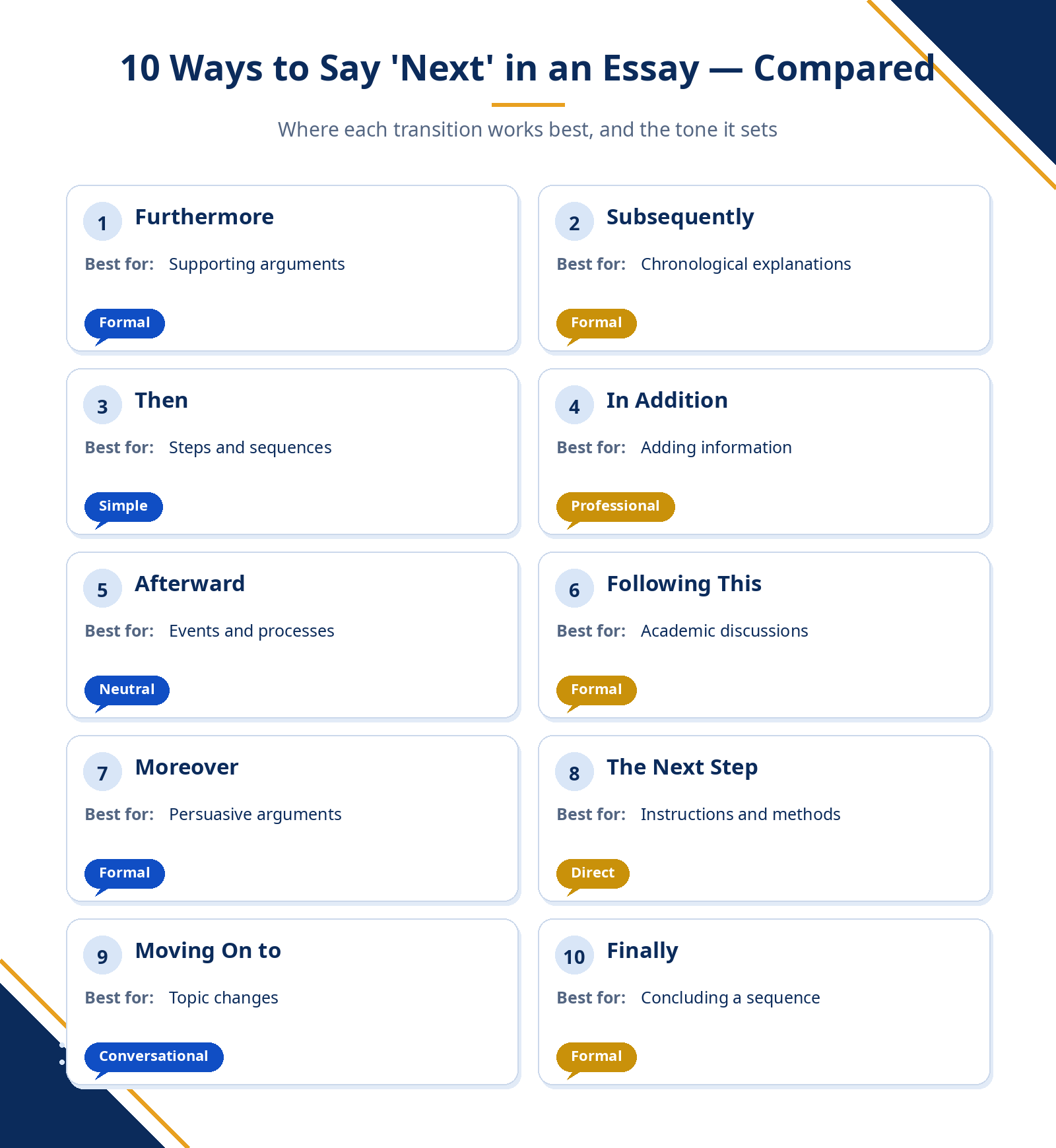
| Alternative | Best Used In | Tone |
| Furthermore | Supporting arguments | Formal |
| Subsequently | Chronological explanations | Formal |
| Then | Steps and sequences | Simple |
| In addition | Adding information | Professional |
| Afterward | Events and processes | Neutral |
| Following this | Academic discussions | Formal |
| Moreover | Persuasive arguments | Formal |
| The next step | Instructions and methods | Direct |
| Moving on to | Topic changes | Conversational |
| Finally | Concluding a sequence | Formal |
Common Mistakes

1. Using casual language in formal essays: Words such as “and then” may be suitable in some contexts, but academic writing often benefits from more precise transitions.
2. Choosing a transition that changes the meaning: “Furthermore” adds information, while “subsequently” shows time or order. Select the expression that matches your intended relationship.
3. Repeating the same transition: Starting every paragraph with “next” or “moreover” makes writing predictable. Vary your transitions naturally.
4. Using overly formal words: A simple word like “then” may communicate an idea more clearly than a complicated expression. Prioritize readability over formality.
5. Adding transitions without a clear purpose: A transition should connect ideas, not decorate a sentence. Remove it if the relationship between sentences is already clear.
Frequently Asked Questions
1. What is another word for “next” in an essay?
Common alternatives include “then,” “subsequently,” “afterward,” “furthermore,” and “in addition.” The right choice depends on your meaning. Use “then” for a sequence, “subsequently” for later events, and “furthermore” when adding a supporting point to an argument.
2. What is a formal way to say “next”?
“Subsequently,” “following this,” and “furthermore” can sound formal in the right context. However, they serve different purposes. Use “subsequently” for events that happen later, “following this” for a subsequent stage, and “furthermore” to introduce additional supporting information.
3. How can I avoid repeating “next” in an essay?
Choose transitions according to the relationship between your ideas. You can use “then” for steps, “afterward” for later events, and “in addition” for extra information. You can also connect sentences through their meaning without adding a transition word to every paragraph.
4. Is “furthermore” better than “next”?
Neither word is always better. “Furthermore” adds information that supports or expands a point, while “next” usually signals the following item or stage. Choose “furthermore” for an argument and “next” when explaining a sequence. The purpose of your sentence should guide your choice.
5. What transition words are best for academic essays?
Useful academic transitions include “furthermore,” “moreover,” “subsequently,” “in addition,” and “finally.” Each serves a different purpose, such as adding evidence, describing events, or presenting a final point. Select the word that accurately expresses the connection between your ideas.
6. Can I use “then” in a formal essay?
Yes. “Then” is grammatically correct and can work well in formal essays, especially when explaining a process or a sequence of events. You do not need to replace every simple word with a more formal expression. Clear, accurate writing is more important than using complicated vocabulary.
7. What can I use instead of “next” when adding another point?
Use “in addition,” “furthermore,” or “moreover” when introducing another relevant point. These expressions are particularly useful in argumentative and explanatory essays. If the new point presents a contrasting view rather than additional support, choose a contrast transition instead.
8. Should every paragraph in an essay begin with a transition word?
No. Every paragraph does not need to start with a transition. A clear topic sentence can connect naturally to the previous paragraph without an extra linking phrase. Use transitions when they help readers understand the relationship between ideas, and avoid inserting them simply to follow a formula.
Conclusion
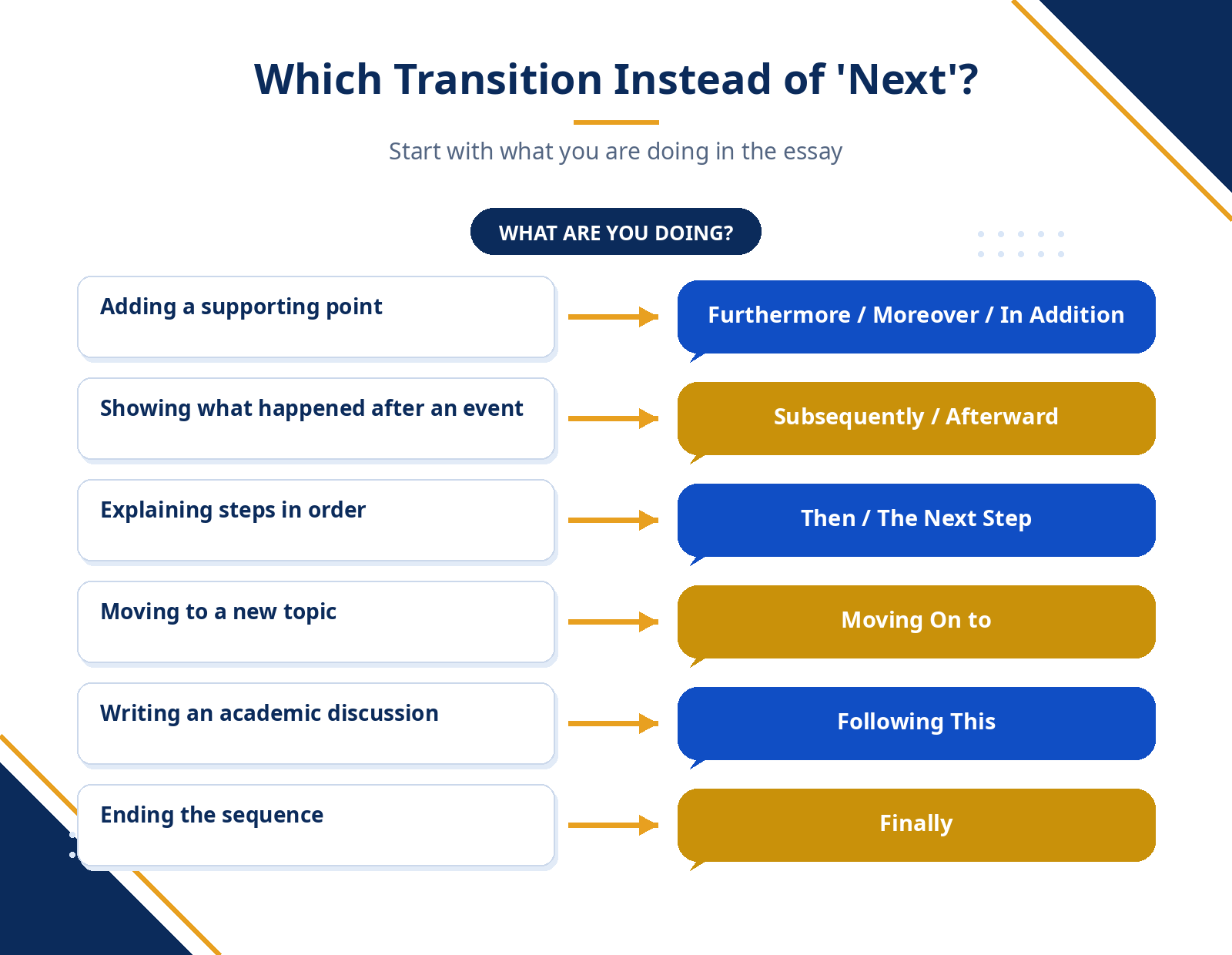
Choosing another way to say next in an essay can make your writing clearer, more varied, and easier to follow. The best alternative depends on the message you want to communicate. Use “then” for simple sequences, “subsequently” for events that happen later, and “furthermore” or “moreover” when adding supporting arguments. Phrases such as “following this” and “the next step” are useful when explaining processes or stages, while “finally” signals the last point in a sequence.
Remember that effective academic writing does not require complicated vocabulary in every sentence. Instead, choose transitions that express the correct relationship between your ideas. Avoid repetition, keep your sentences easy to understand, and use linking words only when they improve the flow of your essay. A well-chosen transition helps readers follow your reasoning from one point to the next.
Looking for more ways to refresh everyday phrases? Explore our guides to fresher ways to say said and done, or find a better way to say he says.

Editorial Desk
The Titan Standards Editorial Team develops, reviews, and maintains practical English-language resources. The team checks articles for clarity, accuracy, context, readability, and consistency with Titan Standards’ editorial guidelines.