
Another way to say many includes numerous, several, plenty of, a lot of, countless, multiple, and a large number of.
The best alternative depends on context, tone, and whether you are describing countable or uncountable things. Using the right phrase helps you avoid repetition and make everyday conversations, essays, and professional writing clearer.
Key Takeaways
- Use numerous or a large number of for formal writing.
- Choose a lot of or plenty of for everyday conversations.
- Use countless when you want to emphasize a very large number.
- Remember that some alternatives work only with countable or uncountable nouns.
- Choose expressions that fit your sentence, tone, and intended meaning.
The word “many” is useful when describing a large number of people, objects, events, or ideas. However, using it repeatedly can make your writing sound predictable.
Learning other ways to say many helps you express quantities more naturally. Whether you are writing an academic essay, preparing a business report, or having a casual conversation, the right alternative can make your message clearer and more engaging.
What Does “Another Way to Say Many” Mean?
The phrase “another way to say many” refers to words and expressions that communicate a large number or quantity without repeating the word “many.”
For example, instead of writing, “Many students attended the meeting,” you could write, “Numerous students attended the meeting.”
These alternatives appear in everyday conversations, academic assignments, business communication, articles, and creative writing. However, not every alternative has exactly the same meaning, so context matters.
Also, remember the difference between countable and uncountable nouns. You can say “many books,” but you would normally say “a lot of information,” rather than “many information.”
Why Use Other Ways to Say Many?
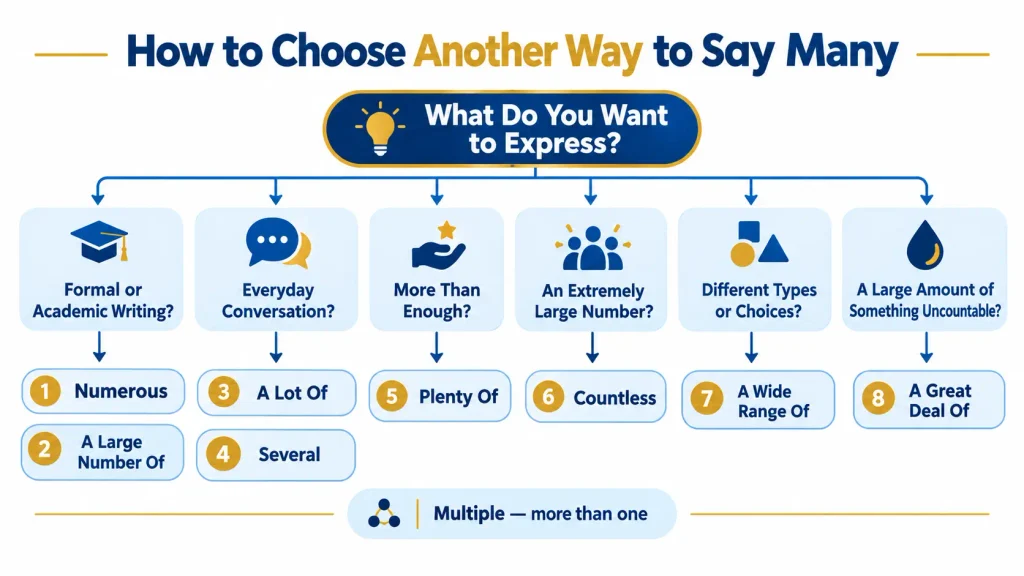
Choosing different expressions helps you communicate more precisely and keeps your writing interesting.
Here are the main benefits:
- Avoid repetition: Use varied vocabulary instead of repeating “many” throughout a paragraph.
- Improve clarity: Select words that describe the quantity more accurately.
- Match your tone: Choose casual language for conversations and formal language for reports.
- Strengthen academic writing: Use appropriate alternatives to make your arguments sound polished.
- Create emphasis: Words such as “countless” can highlight an especially large or seemingly unlimited quantity.
10 Best Other Ways to Say Many
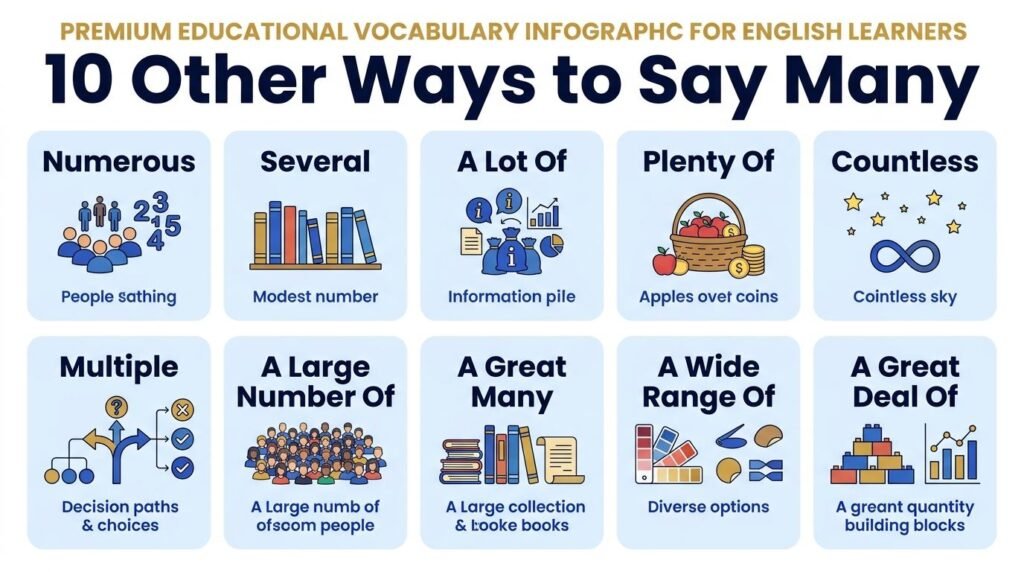
1. Numerous
Meaning
“Numerous” means a large number of people or things. It is more formal than “many” and works particularly well when discussing facts, research, events, or problems.
Use it with plural countable nouns, such as studies, examples, opportunities, and questions.
Best For: Professional, Formal
Example 1: Numerous studies have examined the effects of regular exercise on sleep quality.
Example 2: Our team received numerous applications for the open position.
Quick Tip: Use “numerous” in reports and essays when you want a polished alternative to “many.”
2. Several
Meaning
“Several” refers to more than two people or things, usually an unspecified number that is not necessarily large. It is a useful alternative when you want to be less general than “many.”
Although the words overlap, “several” often suggests a smaller quantity than “many.”
Best For: Professional, Casual, Friendly
Example 1: Several students stayed after class to ask questions.
Example 2: I visited several local stores before finding the right jacket.
Quick Tip: Choose “several” when you mean more than two but do not want to suggest a very large number.
3. A Lot Of
Meaning
“A lot of” is a common, natural expression that means a large number or amount. It works with both countable and uncountable nouns, making it useful in everyday English.
For example, you can say “a lot of friends” and “a lot of time.” It is generally less formal than “numerous.”
Best For: Casual, Friendly, Professional
Example 1: A lot of customers prefer shopping online because it saves time.
Example 2: We have a lot of work to finish before Friday.
Quick Tip: Use “a lot of” in conversations and informal writing. In formal reports, consider a more precise alternative when appropriate.
4. Plenty Of
Meaning
“Plenty of” means more than enough or a generous amount. Unlike “many,” which focuses mainly on quantity, this expression often suggests that there is enough to meet a need.
It works with both countable and uncountable nouns, depending on the sentence.
Best For: Casual, Friendly, Warm
Example 1: We have plenty of chairs for everyone attending the event.
Example 2: You have plenty of time to prepare for your interview.
Quick Tip: Use “plenty of” when you want to emphasize that the available quantity is sufficient or more than sufficient.
5. Countless
Meaning
“Countless” describes an extremely large number of things, often so many that counting them would be difficult or impractical. It adds emphasis and can make a sentence more expressive.
This word is common in storytelling, articles, speeches, and descriptive writing.
Best For: Formal, Warm, Professional
Example 1: Countless volunteers helped the community recover after the storm.
Example 2: She learned countless lessons during her first year as a teacher.
Quick Tip: Use “countless” for emphasis, not when you need to report an exact quantity.
6. Multiple
Meaning
“Multiple” means more than one, often referring to several separate items, choices, stages, or instances. It is common in technical documents, business communication, and professional writing.
However, it does not always mean a large number. Choose it when the fact that there is more than one is important.
Best For: Professional, Formal
Example 1: The software allows users to save multiple versions of the same document.
Example 2: Multiple departments contributed to the company’s annual report.
Quick Tip: Use “multiple” when emphasizing separate items, options, or occurrences rather than an unusually large quantity.
7. A Large Number Of
Meaning
“A large number of” is a clear expression for describing many countable people or things. It works well in academic essays, research summaries, business reports, and formal explanations.
It is especially useful when you want to emphasize quantity without sounding emotional or exaggerated.
Best For: Formal, Professional
Example 1: A large number of residents attended the public meeting.
Example 2: A large number of applicants met the minimum requirements for the position.
Quick Tip: Use this phrase with plural countable nouns, such as employees, visitors, applications, or participants.
8. A Great Many
Meaning
“A great many” means a very large number of people or things. It emphasizes quantity more strongly than “many” and can sound slightly formal or literary.
It is generally used with plural countable nouns and is less common in casual American conversation than “a lot of.”
Best For: Formal, Warm
Example 1: A great many families attended the neighborhood celebration.
Example 2: A great many questions remain unanswered after the investigation.
Quick Tip: Use “a great many” when you want to emphasize quantity in descriptive or formal writing without using an overly technical expression.
9. A Wide Range Of
Meaning
“A wide range of” describes a broad variety of options, types, or possibilities. It is not a direct replacement for “many” in every sentence because it emphasizes diversity rather than quantity alone.
It works particularly well when discussing services, products, subjects, skills, or choices.
Best For: Professional, Formal
Example 1: The training program covers a wide range of communication skills.
Example 2: The library offers a wide range of books for young readers.
Quick Tip: Choose this phrase when variety matters more than the total number of items.
10. A Great Deal Of
Meaning
“A great deal of” means a large amount of something, especially when the noun is uncountable. It is useful for discussing time, effort, attention, information, or research.
Unlike “many,” which normally modifies plural countable nouns, this phrase works naturally with uncountable nouns.
Best For: Formal, Professional, Warm
Example 1: The project required a great deal of patience and careful planning.
Example 2: Researchers collected a great deal of information before reaching a conclusion.
Quick Tip: Use “a great deal of” with uncountable nouns. For countable items, use “a large number of” instead.
Comparison Table
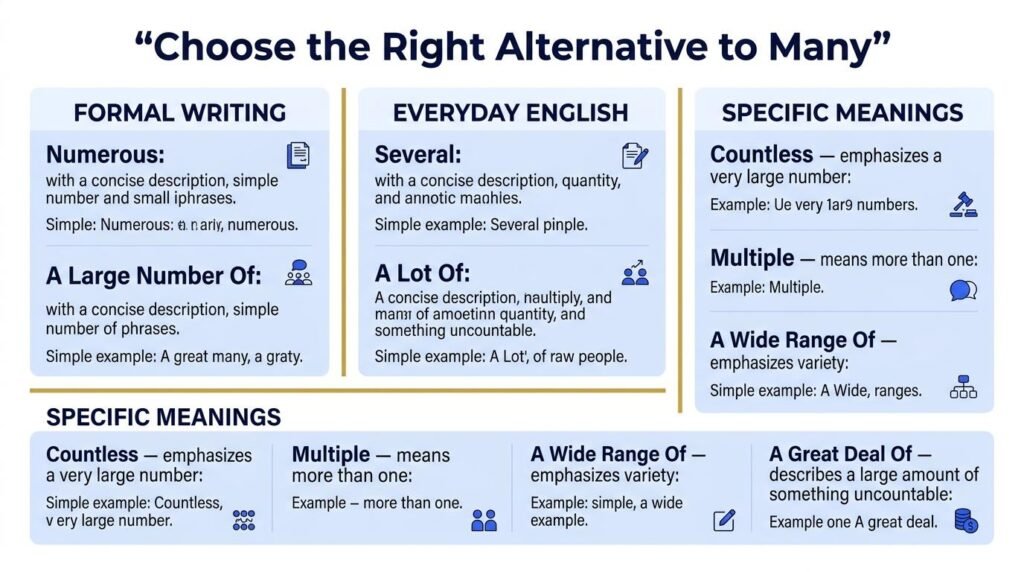
| Alternative | Best Used In | Tone |
| Numerous | Reports and essays | Formal |
| Several | Conversations and general writing | Neutral |
| A lot of | Everyday conversations | Casual |
| Plenty of | Reassuring or informal messages | Friendly |
| Countless | Descriptive writing | Emphatic |
| Multiple | Business and technical documents | Professional |
| A large number of | Research and reports | Formal |
| A great many | Descriptive and formal writing | Emphatic |
| A wide range of | Products, options, and subjects | Professional |
| A great deal of | Time, effort, and information | Formal |
Common Mistakes When Using Alternatives to Many
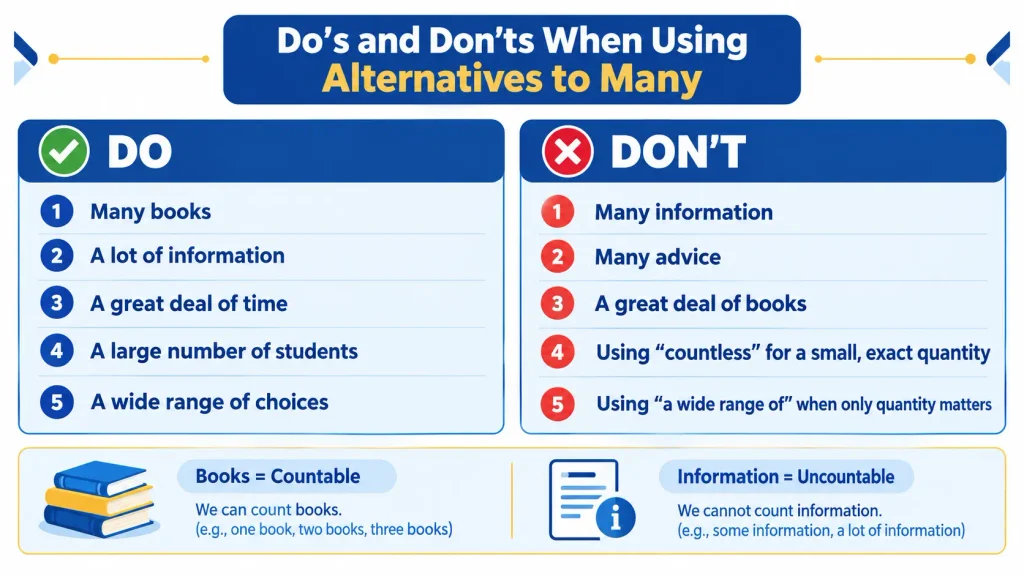
1. Using “Many” With Uncountable Nouns
Avoid phrases such as “many information” or “many advice.” Use “a lot of information” and “a lot of advice” instead.
2. Treating Every Alternative as an Exact Synonym
“Several” often suggests a smaller quantity, while “countless” emphasizes an extremely large number. Choose a phrase that preserves your intended meaning.
3. Using Casual Expressions in Formal Writing
“A lot of” is natural in everyday English, but “numerous” or “a large number of” may suit a research paper or formal report better.
4. Confusing Quantity With Variety
“A wide range of” highlights different types or choices, not simply a large number. Use it when variety is central to your message.
5. Choosing Words That Sound Exaggerated
“Countless” may sound too dramatic when you are describing a small, measurable quantity. If you know the exact number, consider stating it directly.
Frequently Asked Questions
1. What is the best word to use instead of many?
“Numerous” is an excellent alternative in formal writing, while “a lot of” works well in everyday conversation. The best choice depends on the sentence and the intended tone. For example, “numerous studies” sounds appropriate in an academic paper, whereas “a lot of friends” sounds natural in casual conversation.
2. What is a formal way to say many?
Formal alternatives include “numerous,” “multiple,” “a large number of,” and “a great many.” For example, instead of writing, “Many participants completed the survey,” you could write, “Numerous participants completed the survey.” Choose an alternative that fits your meaning rather than replacing every occurrence of “many” automatically.
3. What is another way to say many in an essay?
In an essay, you can use “numerous,” “several,” “a large number of,” or “a great many.” If you are describing different types of something, “a wide range of” may be more accurate. Select the phrase that supports your argument and fits the noun in your sentence.
4. What is a casual way to say many?
“A lot of” is one of the most natural casual alternatives to “many.” You can also use “lots of” in informal conversations and messages. For example, “We met a lot of people at the festival” sounds relaxed and natural. Use more formal expressions when the situation calls for professional language.
5. Can I use “numerous” instead of “many”?
Yes. “Numerous” often replaces “many” when describing plural countable nouns, such as examples, visitors, or opportunities. However, it generally sounds more formal. For example, “Numerous reports support this conclusion” works well in professional writing. It is not normally used with uncountable nouns such as water or information.
6. What is the difference between “many” and “several”?
“Many” generally emphasizes a large number, while “several” usually refers to more than two without necessarily suggesting a large quantity. The exact distinction depends on context. For instance, “many guests attended” suggests a substantial crowd, while “several guests attended” often suggests a smaller group.
7. What can I use instead of many in professional writing?
Professional writing can use “numerous,” “multiple,” “a large number of,” and “a wide range of,” depending on the meaning. Use “numerous” for a large quantity, “multiple” for separate items or instances, and “a wide range of” for variety. Clear, accurate language is more important than choosing the longest phrase.
8. What is the difference between “many” and “a great deal of”?
“Many” usually describes plural countable nouns, such as books, people, or questions. “A great deal of” generally describes uncountable nouns, such as time, effort, or information. For example, say “many books” but “a great deal of time.” This distinction helps you avoid common grammar mistakes.
For related wording choices, see another way to say “a lot”, another way to say “additionally” and another way to say “also”.
Conclusion
Learning another way to say many can make your English more natural, varied, and precise. The best alternative depends on what you are describing and where you plan to use it. Choose “numerous” or “a large number of” for formal writing, “a lot of” for everyday conversations, and “plenty of” when you want to suggest that there is enough. Use “countless” for emphasis and “a wide range of” when variety matters more than quantity.
Remember to check whether your noun is countable or uncountable before choosing a replacement. “Many books” is correct, but “a great deal of information” is more natural than “many information.” Rather than replacing every instance of “many” automatically, focus on clarity, accuracy, and tone. The right expression will help your writing sound confident and easy to understand.

Editorial Desk
The Titan Standards Editorial Team develops, reviews, and maintains practical English-language resources. The team checks articles for clarity, accuracy, context, readability, and consistency with Titan Standards’ editorial guidelines.