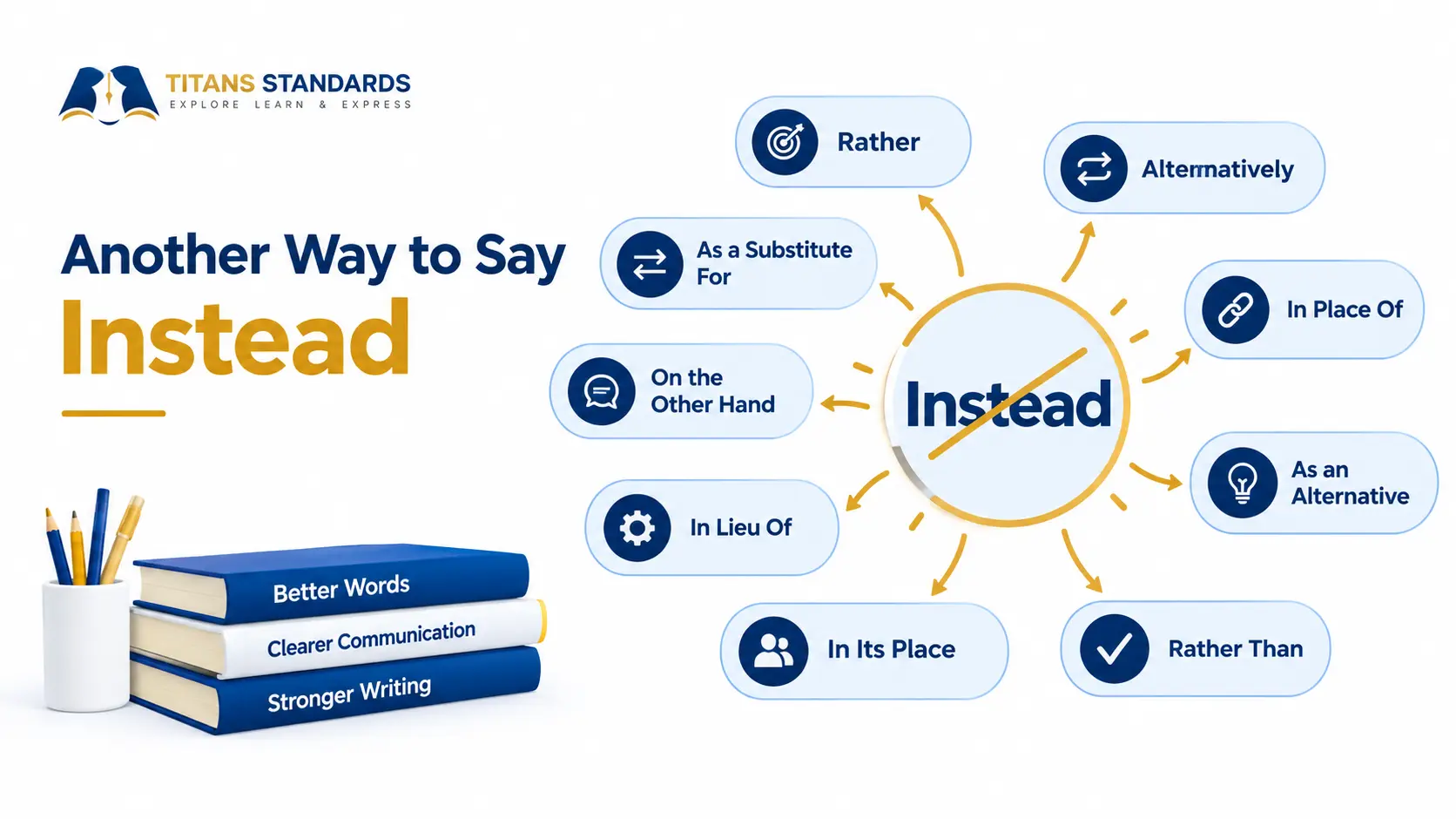
Another way to say instead is rather, alternatively, in its place, or as an alternative. These phrases help you express a different choice, action, or option without repeating the same word.
Use “rather” in everyday conversation, “alternatively” in formal writing, and “in place of” when one thing replaces another.
Key Takeaways
- Use “rather” for corrections, preferences, and everyday choices.
- Choose “alternatively” to introduce another option in formal writing.
- Use “in place of” when one thing replaces another.
- Choose “rather than” to compare two actions or choices.
- Match each alternative to your sentence, audience, and intended meaning.
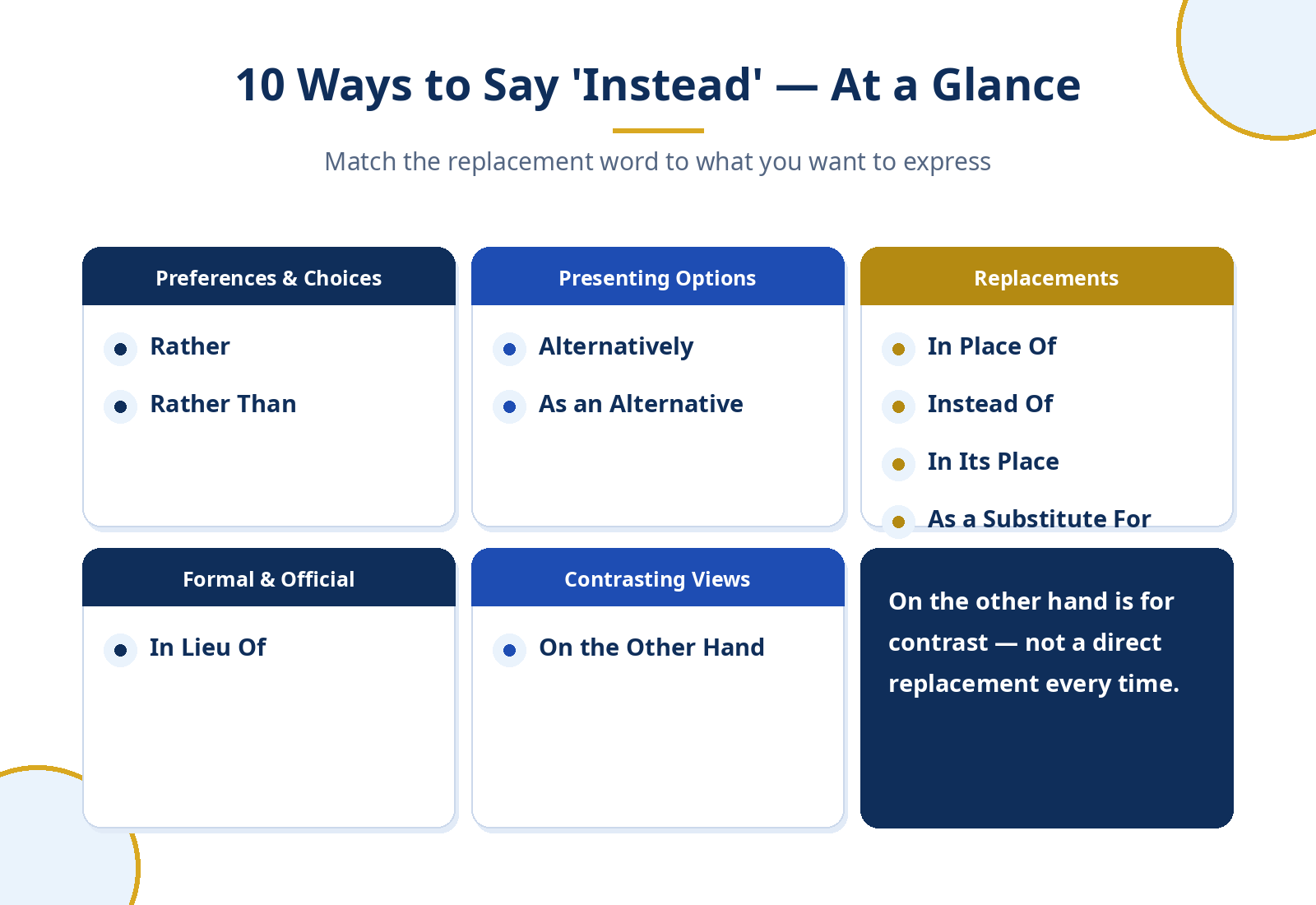
The word “instead” is useful when you want to describe a different choice or action. However, repeating it throughout an email, essay, or conversation can make your writing sound predictable.
Learning alternative expressions helps you communicate more clearly. Whether you’re writing an academic paper, sending a professional email, or having a casual conversation, the right phrase can make your message sound more natural.
What Does “Another Way to Say Instead” Mean?
The phrase “another way to say instead” refers to different words or expressions that communicate a replacement, alternative, or different choice.
For example, instead of writing, “We stayed home instead,” you could write, “We stayed home rather than going out.”
These expressions appear in everyday conversations, business communication, academic writing, and online content. The best choice depends on the sentence because some alternatives introduce a new option, while others compare two actions directly.
For the full definition, see Cambridge Dictionary.
Why Use Other Ways to Say Instead?
Using different expressions makes your writing more precise and engaging. It also helps you adjust your tone for different audiences.
Consider these benefits:
- Avoid repetition: Keep your paragraphs interesting by varying your word choice.
- Improve clarity: Explain exactly what replaces something else.
- Sound professional: Choose expressions that fit business emails and reports.
- Strengthen academic writing: Present alternatives and comparisons more clearly.
- Express preferences: Show why you chose one action over another.
10 Best Other Ways to Say Instead
1. Rather
Meaning
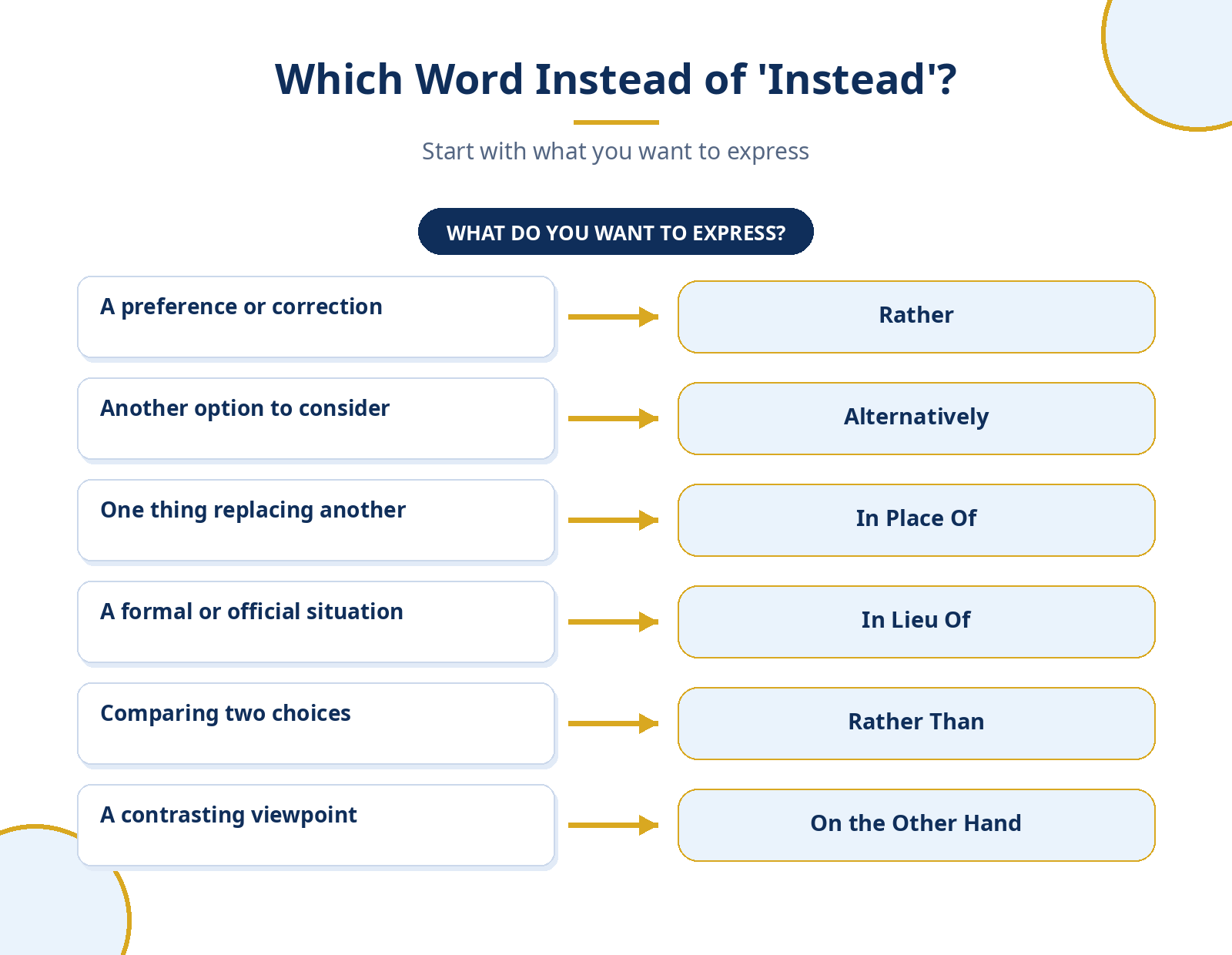
“Rather” introduces a preferred choice or corrects an earlier statement. It often works well when you want to explain what someone prefers or what should happen instead.
Best For: Casual, Professional, Polite
Example 1: I’d rather meet on Friday than postpone the discussion.
Example 2: We should focus on improving the design rather than adding unnecessary features.
Quick Tip: Use “rather than” when comparing two actions. Use “rather” alone when correcting or clarifying a statement.
2. Alternatively
Meaning
“Alternatively” introduces another possible choice or course of action. It works particularly well when presenting solutions, suggestions, or options in formal and professional writing.
Best For: Professional, Formal, Polite
Example 1: We can schedule the meeting for Monday. Alternatively, we could discuss the project over email.
Example 2: You can submit the application online. Alternatively, you may deliver a printed copy to the office.
Quick Tip: Place “alternatively” at the beginning of a sentence when presenting a clear second option.
3. In Place Of
Meaning
“In place of” means using one person or thing as a replacement for another. It is especially useful when explaining substitutions involving materials, items, or people.
Best For: Professional, Formal, Polite
Example 1: The chef used olive oil in place of butter.
Example 2: Maya presented the report in place of her manager.
Quick Tip: Follow “in place of” with a noun or noun phrase, such as “butter,” “the original plan,” or “the team leader.”
4. As an Alternative
Meaning
“As an alternative” introduces another option that someone can consider. It is useful when the original choice is unavailable, unsuitable, or less convenient.
Best For: Professional, Formal, Friendly
Example 1: As an alternative, we could use a free scheduling tool.
Example 2: The hotel is fully booked, so consider a nearby guesthouse as an alternative.
Quick Tip: Use this phrase when offering a practical option rather than simply describing a replacement.
5. Instead Of
Meaning
“Instead of” identifies what someone chooses not to use or do and what takes its place. It is one of the most common expressions for explaining substitutions.
Best For: Casual, Professional, Friendly
Example 1: I took the train instead of driving to work.
Example 2: Instead of buying new furniture, we repaired the old desk.
Quick Tip: Use a noun or an -ing verb after “instead of,” as in “instead of coffee” or “instead of waiting.”
6. Rather Than
Meaning
“Rather than” expresses preference or choice between two possibilities. It helps you emphasize the action or option you prefer.
Best For: Professional, Formal, Casual
Example 1: The team decided to revise the proposal rather than abandon the project.
Example 2: She chose to explain the problem rather than blame her coworker.
Quick Tip: Keep the compared elements grammatically parallel. For example, compare “revising the plan” with “starting over,” not “revising the plan” with “to start over.”
7. In Its Place
Meaning
“In its place” refers to something that replaces a previously mentioned item, idea, or arrangement. The phrase is useful when the reader already knows what is being replaced.
Best For: Professional, Formal, Friendly
Example 1: The company discontinued the old software and introduced a simpler system in its place.
Example 2: We removed the damaged shelf and installed a storage cabinet in its place.
Quick Tip: Make sure the reader can identify what “its” refers to. Otherwise, name the replacement directly.
8. In Lieu Of
Meaning
“In lieu of” means “instead of” or “in place of.” It is more formal and frequently appears in workplace policies, contracts, official notices, and business communication.
Best For: Professional, Formal, Polite
Example 1: Employees may receive additional paid time off in lieu of overtime pay, where permitted by company policy and applicable law.
Example 2: In lieu of flowers, the family requested donations to a local charity.
Quick Tip: Reserve this expression for formal situations. In everyday conversation, “instead of” usually sounds more natural.
9. As a Substitute For
Meaning
“As a substitute for” describes something used in place of another item, material, or option. It is particularly useful when discussing food, products, ingredients, or practical replacements.
Best For: Professional, Formal, Casual
Example 1: You can use Greek yogurt as a substitute for sour cream in this recipe.
Example 2: The teacher provided a recorded lesson as a substitute for the canceled classroom session.
Quick Tip: Follow “for” with the item being replaced so readers understand the substitution clearly.
10. On the Other Hand
Meaning
“On the other hand” introduces a contrasting point or a different perspective. It is not a direct replacement for “instead” in every sentence, but it works when you want to present an alternative viewpoint.
Best For: Professional, Formal, Friendly
Example 1: Renting costs less upfront. On the other hand, buying may offer greater long-term stability.
Example 2: The first design is colorful and bold. On the other hand, the second looks cleaner and more professional.
Quick Tip: Use this expression to contrast ideas, not to describe a simple replacement.
Comparison Table
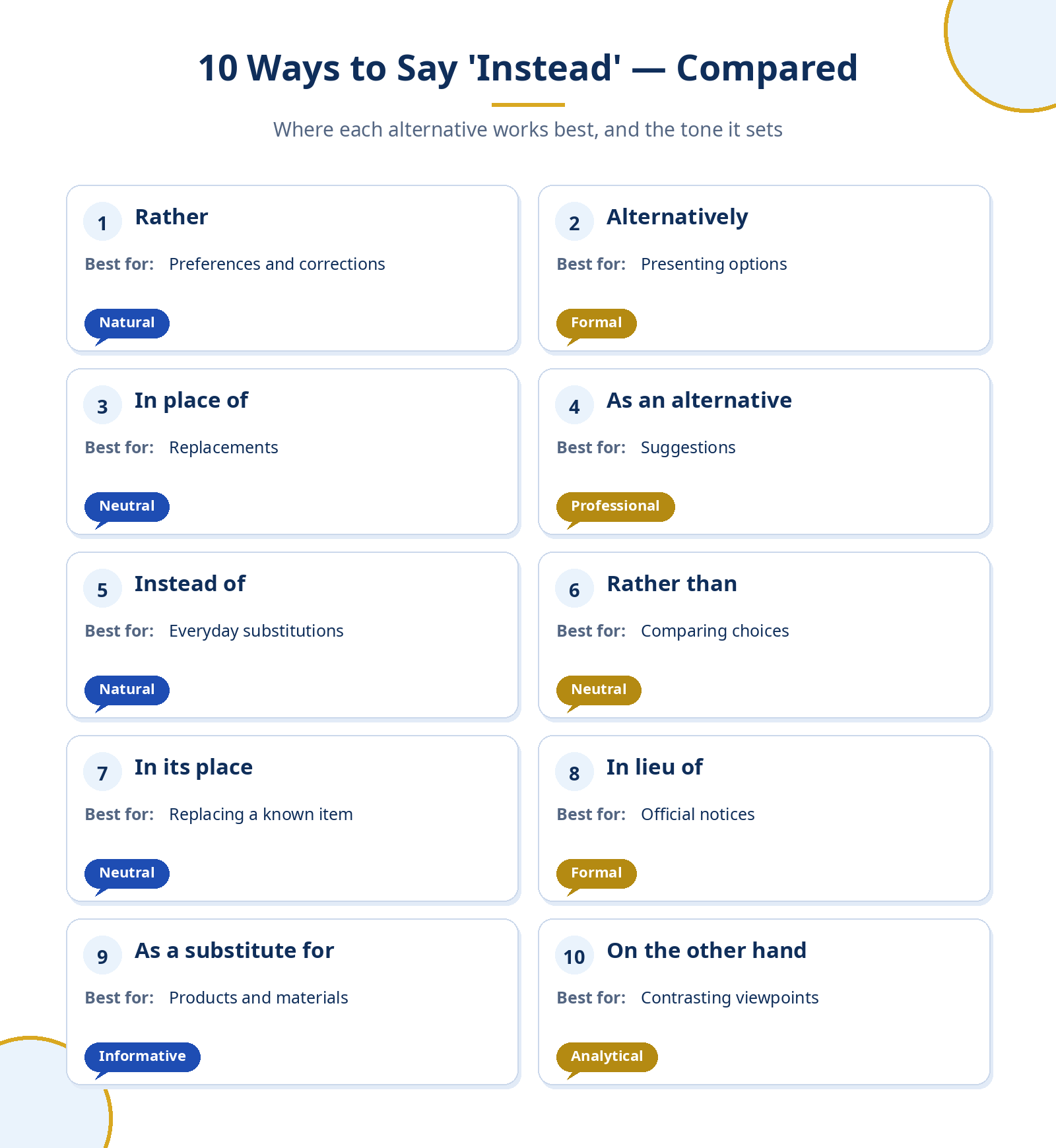
| Alternative | Best Used In | Tone |
| Rather | Preferences and corrections | Natural |
| Alternatively | Presenting options | Formal |
| In place of | Replacements | Neutral |
| As an alternative | Suggestions | Professional |
| Instead of | Everyday substitutions | Natural |
| Rather than | Comparing choices | Neutral |
| In its place | Replacing a known item | Neutral |
| In lieu of | Official notices | Formal |
| As a substitute for | Products and materials | Informative |
| On the other hand | Contrasting viewpoints | Analytical |
Common Mistakes When Using Alternatives to Instead
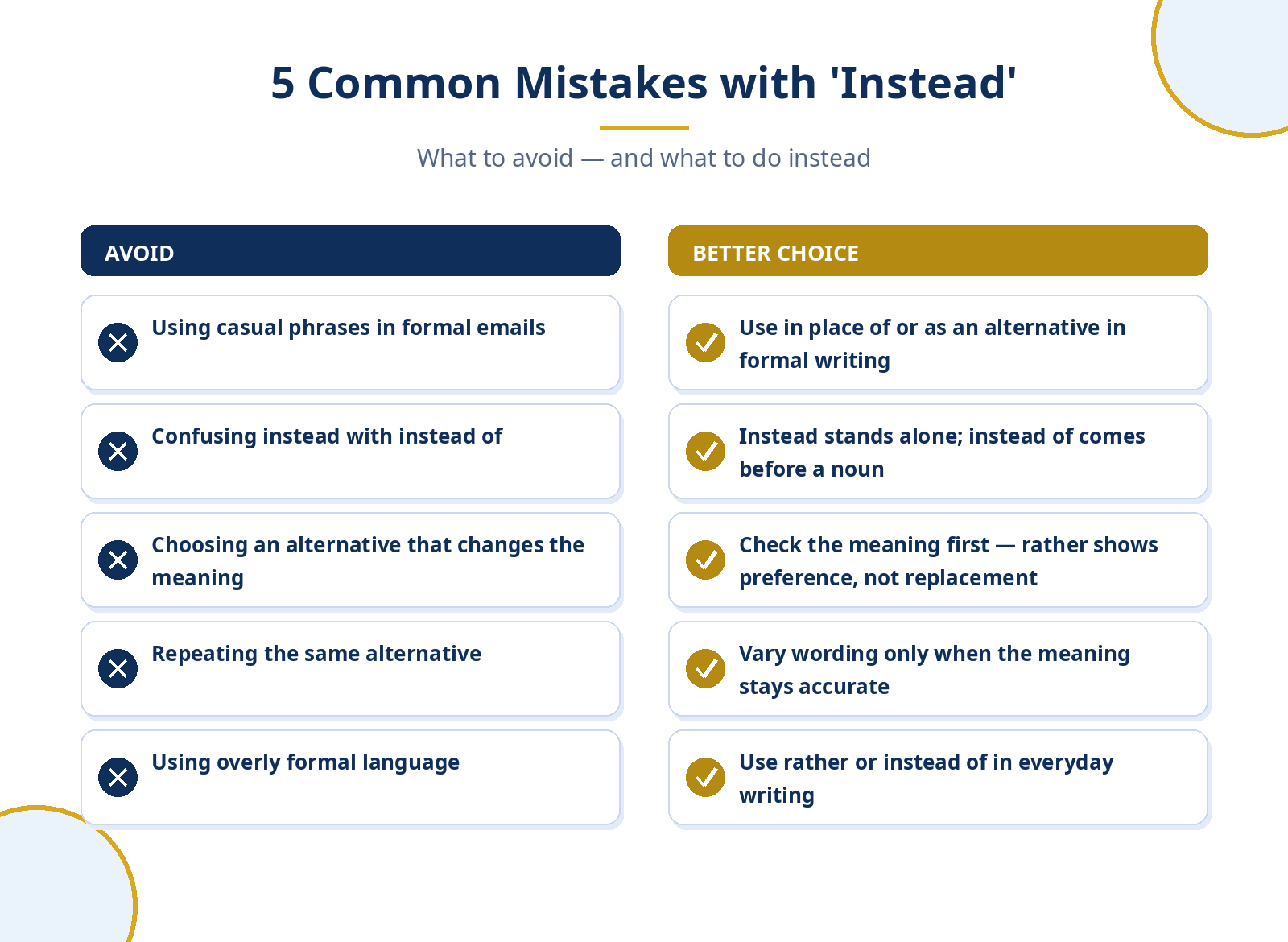
- Using casual phrases in formal emails: Expressions that sound natural in conversation may not fit a business report. Choose “alternatively” or “in lieu of” when the context calls for a formal tone.
- Confusing “instead” with “instead of”: “Instead” can stand alone, while “instead of” introduces the thing or action being replaced. For example, write “We walked instead” or “We walked instead of driving.”
- Choosing an alternative that changes the meaning: “On the other hand” introduces contrast, not necessarily replacement. Use it when comparing perspectives rather than substituting one item for another.
- Repeating the same alternative: Replacing every instance of “instead” with “rather” can make your writing repetitive in a different way. Vary your expressions only when they fit the meaning.
- Using overly formal language: “In lieu of” may sound unnatural in a casual text message. Choose simple expressions when speaking with friends or family.
Frequently Asked Questions
1. What is the most common alternative to instead?
“Rather” and “instead of” are common alternatives, but they serve slightly different purposes. Use “rather than” to compare actions or express preferences, and use “instead of” to identify what replaces another choice. Your sentence structure determines which expression works best.
2. What is a formal way to say instead?
“Alternatively,” “in lieu of,” and “in place of” are useful formal expressions. “Alternatively” introduces another option, while “in lieu of” describes a replacement in official or professional contexts. Choose the phrase that best communicates your intended meaning.
3. What is another word for instead in academic writing?
Academic writers can use “alternatively,” “rather than,” and “in place of,” depending on the sentence. “Alternatively” presents another possible explanation or approach, while “rather than” compares methods or ideas. Avoid choosing a formal synonym simply to sound academic; clarity matters most.
4. Is it the same instead?
Not always. “Rather” can express preference, correction, or comparison, while “instead” usually indicates that one action or choice replaces another. For example, “I’d rather stay home” expresses a preference, while “I stayed home instead” describes the choice that was made.
5. How can I say this instead of in a professional email?
You can use “in place of,” “as an alternative to,” or “rather than,” depending on the sentence. For example, write, “We recommend using the updated template rather than the previous version.” This sounds professional while keeping your message direct and easy to understand.
6. What is a casual way to say instead?
“Instead of,” “rather than,” and simple phrases such as “do this, not that” work well in casual conversations. For example, “Let’s order pizza instead of cooking tonight.” These expressions sound natural without making an everyday message unnecessarily formal.
7. Can I start a sentence with alternatively?
Yes. Starting a sentence with “Alternatively” is grammatically correct when you introduce another option. For example, “We can meet in person. Alternatively, we can arrange a video call.” Use appropriate punctuation and make sure the new sentence offers a clear alternative to the previous one.
8. What is the difference between in lieu of and in place of?
Both expressions mean that one thing replaces another. However, “in lieu of” generally sounds more formal and often appears in official documents, workplace policies, and announcements. “In place of” is more neutral and works comfortably in everyday and professional writing.
Conclusion
Choosing another way to say instead can make your writing clearer, more natural, and better suited to your audience. The key is to select an expression that matches your meaning rather than replacing words without considering context.
Use “rather” for preferences, “alternatively” to introduce another option, and “instead of” when describing a replacement. For professional documents, “in place of” offers a neutral choice, while “in lieu of” works well in more formal situations. When comparing two actions, “rather than” is often the strongest option.
Remember that not every alternative fits every sentence. Read your sentence aloud, check its grammar, and make sure the new expression preserves your original meaning. With practice, you’ll communicate more confidently in emails, essays, reports, and everyday conversations.
Looking for more ways to refresh everyday phrases? Explore our guides to fresher ways to say said and done, or find a better way to say he says.

Editorial Desk
The Titan Standards Editorial Team develops, reviews, and maintains practical English-language resources. The team checks articles for clarity, accuracy, context, readability, and consistency with Titan Standards’ editorial guidelines.