Featured Snippet Answer:
Another way to say “better” depends on the meaning. Use superior for higher quality, improved for something that has become better, preferable for a more desirable choice, and more effective for stronger results. In some contexts, finer, enhanced, upgraded, healthier, or more suitable may be more precise.
Key Takeaways
- Superior works when comparing quality, performance, or status.
- Improved emphasizes positive change from an earlier condition.
- Preferable focuses on which option is more desirable or suitable.
- More effective is useful when something produces stronger results.
- The best replacement for “better” depends on the exact meaning, not just the sentence structure.
What Does “Better” Mean?
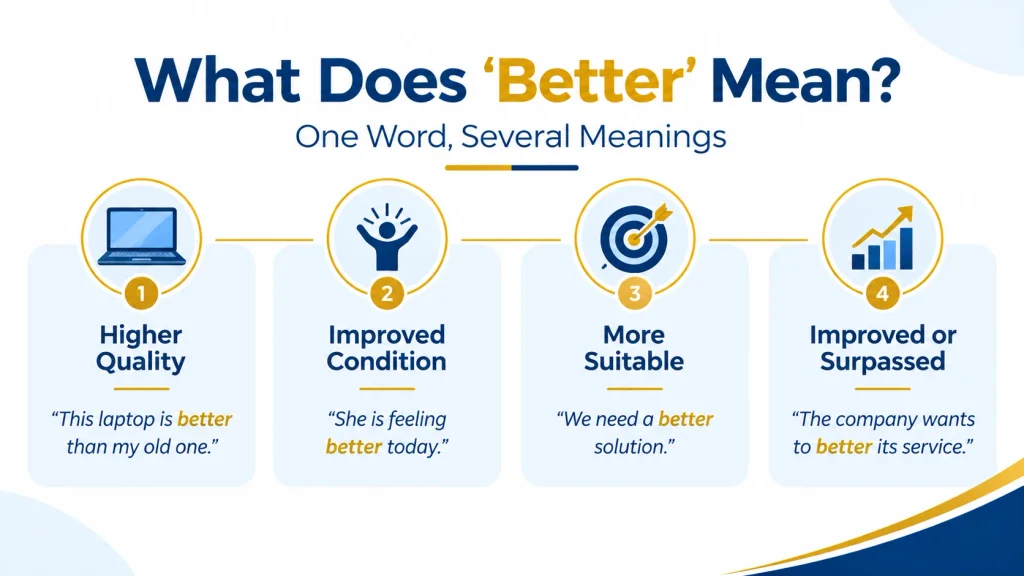
“Better” is the comparative form of good or well, but it has several common uses. It can describe something that has higher quality, produces stronger results, is more suitable, or has improved from an earlier state. It can also refer to improved health, as in “I feel better today.” As a verb, better can mean to improve something or surpass someone or something.
For example:
- “This laptop is better than my old one.” — higher quality or performance
- “She is feeling better today.” — improved health
- “We need a better solution.” — more suitable or effective
- “The company wants to better its service.” — improve its service
That range of meanings is why there is no single replacement that works in every sentence.
Why Use Another Way to Say “Better”?
“Better” is perfectly natural in everyday English, but a more precise word can make your writing clearer.
You might replace it when:
- you want to explain why something is better;
- you need more precise professional or academic wording;
- you want to avoid repeating “better” several times;
- you are comparing two choices based on suitability rather than quality;
- you want to describe improvement, effectiveness, or health more specifically.
For example, “a better process” is broad. “A more efficient process” tells the reader exactly what improved.
12 Best Ways to Say “Better”
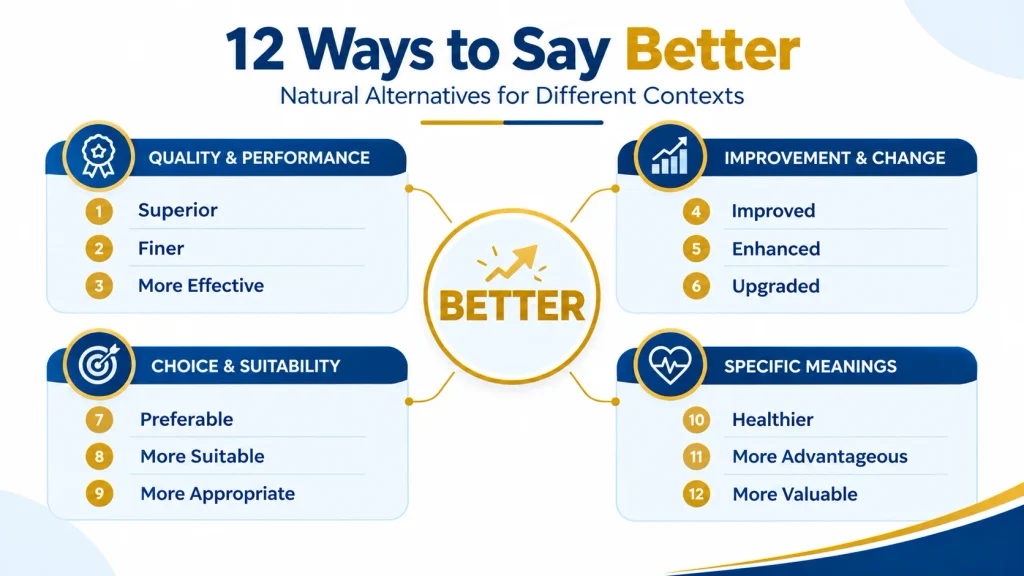
1. Superior
Superior is one of the closest alternatives when “better” means higher in quality, performance, or standard.
The new software offers superior performance.
It is especially useful when making a direct comparison. However, it can sound stronger and more formal than everyday “better,” so it is often more suitable for professional, technical, or evaluative writing.
2. Improved
Use improved when something has changed positively compared with an earlier version or condition.
The updated website provides an improved user experience.
Unlike “superior,” which often compares two things, “improved” emphasizes change over time. This makes it particularly useful for products, systems, skills, processes, and results.
3. Preferable
Preferable means more desirable, suitable, or acceptable than another option.
The second approach is preferable for smaller teams.
Choose this word when the main issue is which option should be chosen, rather than which one has objectively higher quality.
Compare:
- “This model is better.” — broad comparison
- “This model is preferable for small offices.” — emphasizes suitability
4. More Effective
If “better” means that something produces stronger or more useful results, more effective is usually clearer.
The revised training method is more effective for new employees.
This alternative is especially helpful in professional, academic, medical, technical, and business writing because it identifies the specific basis for improvement.
5. Finer
Finer can replace “better” when discussing quality, craftsmanship, taste, or distinction.
The restaurant is known for its finer ingredients.
It has a somewhat polished or literary feel compared with everyday “better.” It works naturally in expressions involving quality, details, materials, or experiences.
6. More Suitable
Use more suitable when “better” means more appropriate for a particular person, purpose, or situation.
This format is more suitable for a formal presentation.
This is often a better choice than “better” when writing professionally because it explains that the advantage comes from fit or appropriateness, not necessarily overall quality.
7. More Appropriate
More appropriate is closely related to “more suitable,” but it often focuses on what fits the circumstances, audience, or expected standard.
A formal greeting would be more appropriate in this email.
It is especially useful when discussing language, behavior, communication, professional decisions, or social situations.
8. Enhanced
Enhanced means improved or strengthened, often by adding features, quality, value, or capability.
The update includes enhanced security features.
This word is common in professional, technical, marketing, and product-related writing. It can sound more formal than “better,” so it should be used when the context supports that tone.
9. Upgraded
Upgraded works when something has been replaced, modified, or improved to a newer or higher-level version.
The company installed an upgraded security system.
It is particularly natural for technology, equipment, software, services, and facilities. It does not always mean that something is universally “better”; it often means that it has been moved to a newer or more advanced version.
10. Healthier
When “better” refers specifically to health or physical condition, healthier is more precise.
She has adopted a healthier diet.
You could also say:
I feel better today.
But if the intended meaning is improved health or a more beneficial lifestyle, “healthier” communicates that meaning more directly.
11. More Advantageous
Use more advantageous when one choice provides greater benefits or practical advantages.
The flexible schedule is more advantageous for remote employees.
This expression is more formal than “better” and works well in business, academic, analytical, and professional writing.
12. More Valuable
More valuable is appropriate when “better” means having greater worth, usefulness, importance, or benefit.
The feedback from experienced users was more valuable than the general survey responses.
It is useful when the comparison involves usefulness or worth rather than general quality.
Which Alternative Should You Choose?
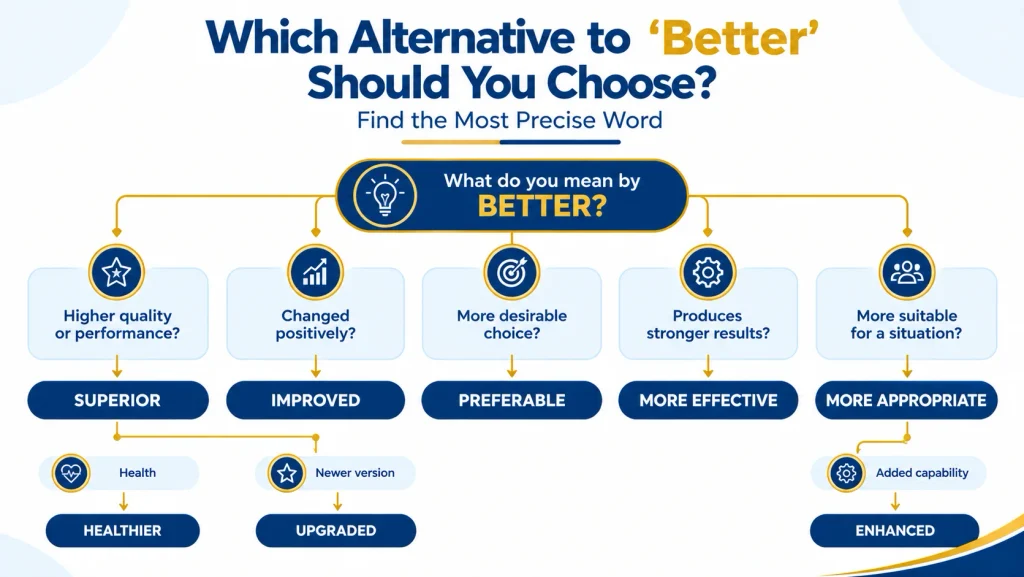
| Alternative | Best Used In | Tone |
| Superior | Higher quality or performance | Formal/Neutral |
| Improved | Positive change | Neutral |
| Preferable | Choosing between options | Formal |
| More effective | Results or performance | Professional |
| Finer | High quality or craftsmanship | Polished |
| More suitable | Fit for a purpose | Neutral/Formal |
| More appropriate | Fit for a situation or audience | Professional |
| Enhanced | Added quality or capability | Professional |
| Upgraded | Newer or improved version | Professional/Technical |
| Healthier | Improved health or well-being | Neutral |
| More advantageous | Greater practical benefit | Formal |
| More valuable | Greater worth or usefulness | Neutral/Formal |
“Better” vs. “Superior” vs. “Preferable”
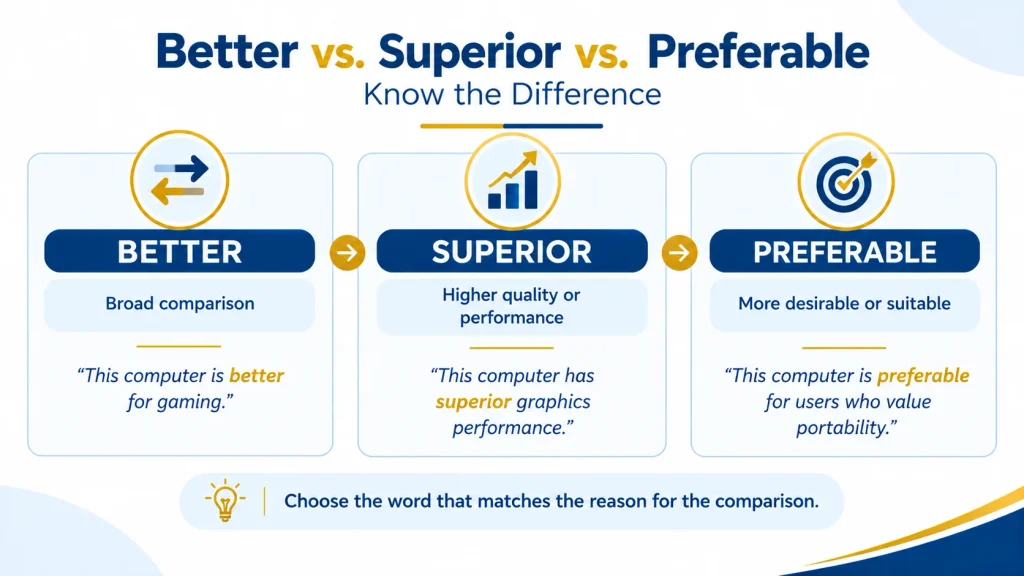
These three words are related but should not always be swapped.
Better is the broadest and most natural choice. It can describe quality, results, suitability, health, or general improvement.
Superior usually suggests that something ranks higher in quality, performance, or standard.
Preferable focuses on choice. Something can be preferable because it fits a particular situation, even if it is not objectively higher in quality.
For example:
This computer is better for gaming.
This computer has superior graphics performance.
This computer is preferable for users who value portability.
The three sentences communicate different reasons for the comparison.
Common Mistakes When Replacing “Better”
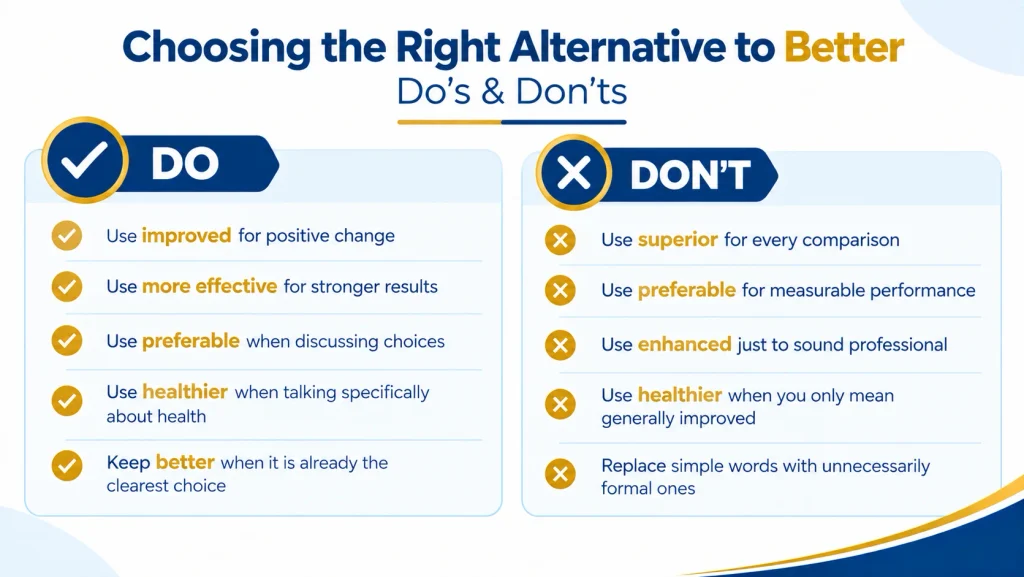
1. Using “superior” for every comparison
“Superior” can sound too strong when you simply mean that something has improved.
Better: “The updated version is improved.”
2. Using “preferable” when discussing measurable performance
If one product works faster, “more effective” or “faster” may be clearer than “preferable.”
3. Using “enhanced” when nothing was actually added or improved
“Enhanced” suggests a positive modification. It should not be used simply to make ordinary writing sound more professional.
4. Confusing “better” with “healthier”
“Better” can describe general recovery, while “healthier” specifically relates to health or a health-promoting condition.
“I feel better today.”
“I am following a healthier diet.”
5. Choosing a formal synonym when simple English is clearer
Words such as more advantageous and superior have their place, but “better” is often the clearest choice in everyday writing. Replacing a simple word does not automatically make a sentence stronger.
FAQs
What is a professional way to say “better”?
Professional alternatives include improved, superior, more effective, more suitable, more appropriate, enhanced, and more advantageous. The best choice depends on what you mean by “better.” For example, “more effective” works well for results, while “more suitable” is better when discussing whether an option fits a particular purpose.
What is another word for “better” in formal writing?
In formal writing, useful alternatives include superior, improved, preferable, enhanced, more effective, and more advantageous. However, formal writing does not require replacing “better” every time it appears. If “better” communicates the intended meaning clearly, keeping it may be the strongest choice.
What is a better word than “better” for improvement?
Improved is often the most precise choice when you mean that something has become better than it was before. For example, “The company introduced an improved process” clearly communicates positive change. If you mean a specific type of improvement, words such as enhanced, upgraded, refined, or more effective may be even more precise.
What is another way to say “better quality”?
Depending on context, you can say higher quality, superior quality, finer quality, improved quality, or higher-grade. “Higher quality” is usually the most natural general alternative, while “superior quality” has a stronger and more formal tone. Choose the phrase that matches the type of comparison you are making.
What is another way to say “better choice”?
Preferable choice, more suitable option, or more appropriate option can replace “better choice.” “Preferable” emphasizes desirability, while “more suitable” focuses on how well an option fits a particular purpose. In many everyday sentences, however, “better choice” remains completely natural.
What is another way to say “feel better”?
The best alternative depends on the meaning. If you mean improved health, you can say feel healthier or feel well again. If you mean improved emotions, you might say feel happier, feel more positive, or feel more at ease. “Feel better” remains the most flexible everyday expression.
Is “better” too informal for professional writing?
No. “Better” is standard English and is acceptable in professional writing. The issue is usually precision, not formality. Instead of automatically replacing it, identify what makes something better. Words such as “more effective,” “more suitable,” or “improved” can communicate that specific meaning more clearly.
Conclusion
The best alternative to “better” depends on what kind of improvement or comparison you mean. Use superior for higher quality, improved for positive change, preferable for a more desirable choice, and more effective when results are the focus. For suitability, choose more suitable or more appropriate; for health, healthier may be more precise. Words such as enhanced and upgraded work well in professional and technical contexts.
You do not need to avoid “better” just because a synonym exists. It is a natural, flexible word. The goal is to replace it only when a more specific alternative makes your meaning clearer.

Editorial Desk
The Titan Standards Editorial Team develops, reviews, and maintains practical English-language resources. The team checks articles for clarity, accuracy, context, readability, and consistency with Titan Standards’ editorial guidelines.