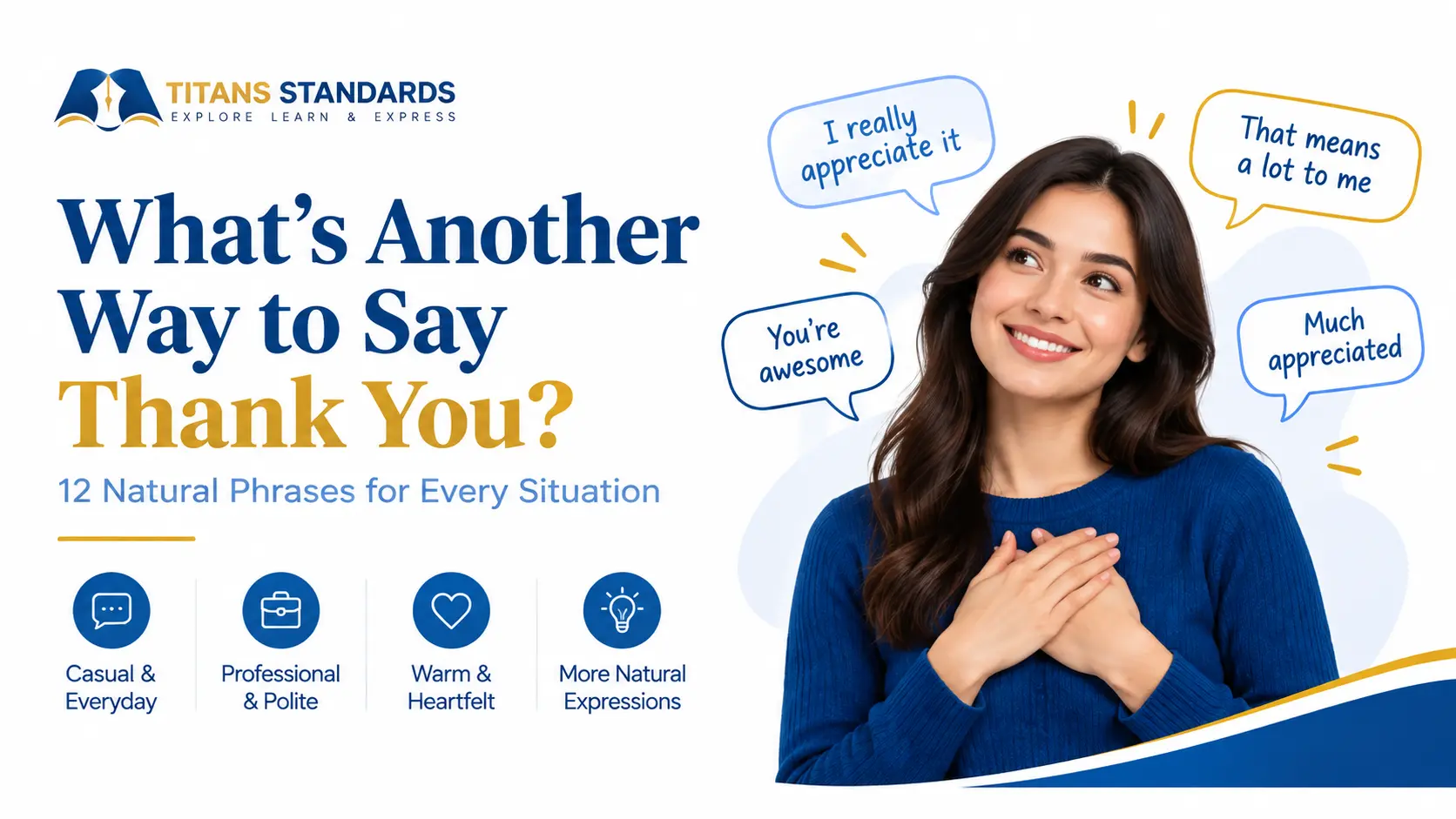
“Thank you” is one of the most useful expressions in English, but you do not have to use the same phrase every time.
The best alternative depends on who you are speaking to, what they did, and how strongly you want to express your appreciation.
For a friend, “Thanks!” may be enough. For a coworker, “I really appreciate your help” sounds specific and professional. If someone gave you meaningful emotional support, “That means a lot to me” may express more than a simple thank-you.
Featured Snippet Answer
Another way to say thank you depends on the situation and how much appreciation you want to express. Natural options include thanks, I really appreciate it, I’m grateful, that means a lot, that’s very kind of you, much appreciated, and I can’t thank you enough. Choose a phrase that matches your relationship, tone, and level of gratitude.
Key Takeaways
- “Thanks” is the easiest casual alternative to “thank you.”
- “I really appreciate it” works naturally in both personal and professional situations.
- “That means a lot” adds warmth when someone has done something meaningful.
- “I owe you one” is friendly and informal, so it is not ideal for formal emails.
- “I can’t thank you enough” expresses strong gratitude when ordinary thanks feels too small.
What Does “Thank You” Mean?
Thank you is a polite expression used to show gratitude or appreciation for something someone has done, given, or said.
It can be used in almost any setting:
- “Thank you for your help.”
- “Thank you for the gift.”
- “Thank you for explaining that.”
- “Thank you for being there for me.”
Because thank you is neutral and widely accepted, it is rarely wrong. The main reason to choose another expression is not that “thank you” is incorrect. It is to make your response more specific, personal, casual, warm, or formal.
Why Use Another Way to Say Thank You?
Different expressions can help you:
- avoid repeating the same phrase
- show stronger or deeper appreciation
- sound more natural in casual conversation
- make a professional message more specific
- match the relationship and situation
The important point is not to replace “thank you” just for variety. Choose another phrase when it communicates your meaning more precisely.
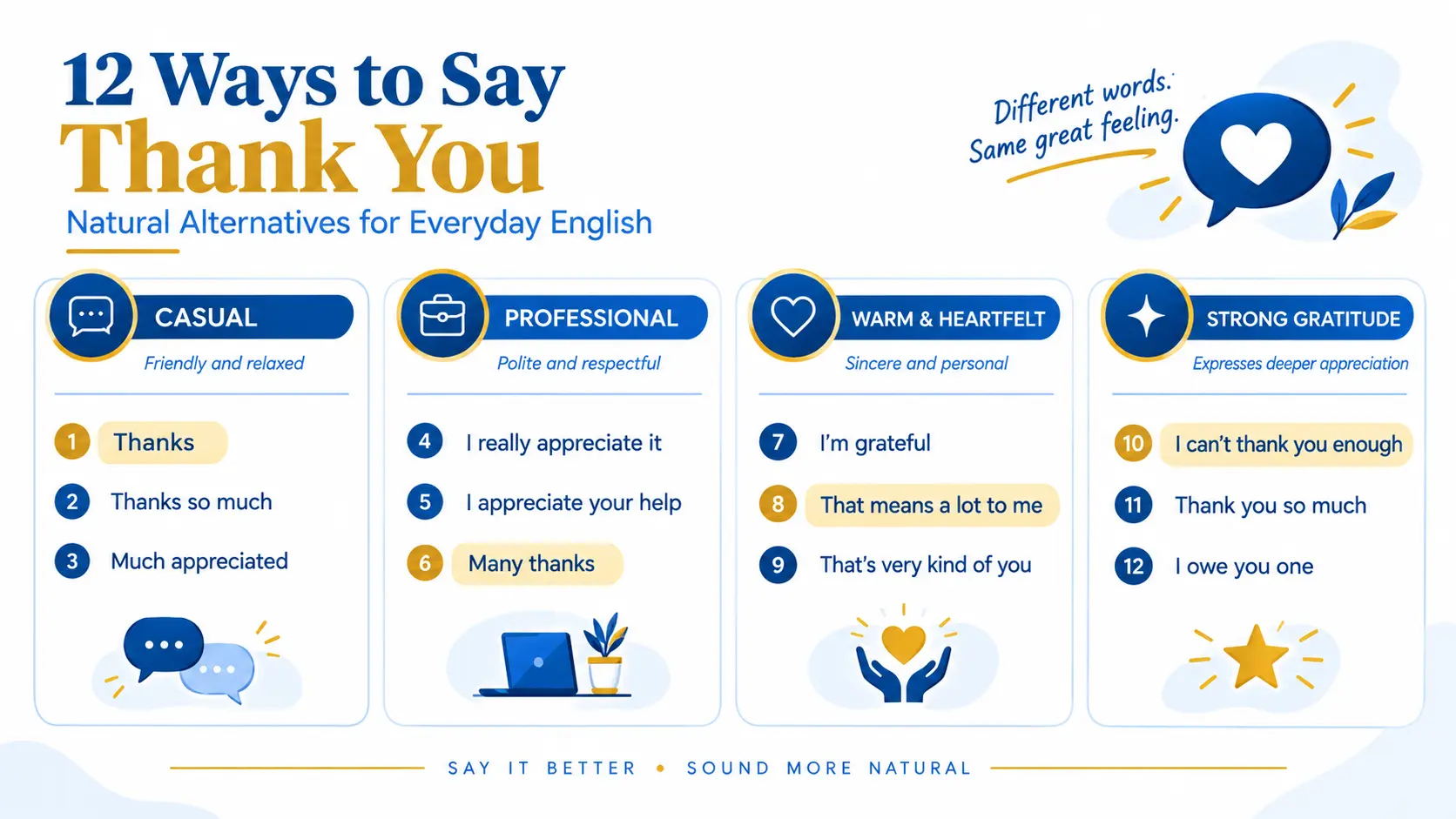
12 Best Ways to Say Thank You
1. Thanks
Thanks is the simplest and most common casual alternative to thank you. It works well with friends, family, coworkers you know well, and in quick everyday exchanges.
“Thanks for picking me up at the airport.”
It is shorter and more relaxed than “thank you,” but it still clearly expresses appreciation.
2. Thanks so much
Use thanks so much when you want to sound warmer or more appreciative than a simple “thanks.”
“Thanks so much for helping me move this weekend.”
It fits texts, conversations, cards, and friendly messages. It can also work in professional communication when the relationship is reasonably friendly.
3. I really appreciate it
I really appreciate it is one of the most flexible alternatives. It works when someone has done something helpful, thoughtful, or generous.
“You stayed late to help me finish the report. I really appreciate it.”
This phrase is especially useful when you want your gratitude to sound sincere without becoming overly formal.
4. I appreciate your help
When you want to identify exactly what you are grateful for, I appreciate your help is a strong choice.
“I appreciate your help with the presentation.”
This is particularly natural in workplace communication because it recognizes the person’s assistance directly. It can also be used with friends or family.
5. I’m grateful
I’m grateful expresses more personal or meaningful appreciation than a quick “thanks.”
“I’m grateful for everything you did to support me.”
It works especially well when someone has offered significant help, support, kindness, or encouragement. For a small everyday favor, however, it may sound more serious than necessary.
6. That means a lot to me
Use that means a lot to me when the person’s action has emotional or personal importance.
“You remembered my birthday. That means a lot to me.”
This is warmer and more personal than a routine “thank you,” making it useful for close friends, family members, partners, or someone who offered meaningful support.
7. That’s very kind of you
That’s very kind of you acknowledges not only what someone did but also the kindness behind the action.
“You brought dinner for everyone? That’s very kind of you.”
It can be used in both personal and polite everyday situations. It is especially natural after a thoughtful gesture.
8. Much appreciated
Much appreciated is a concise way to show appreciation, particularly in informal or professional communication.
“Thanks for sending the updated file. Much appreciated.”
It is efficient and friendly, but it can sound less personal than I really appreciate it. It works well when you want to keep a message brief.
9. I owe you one
I owe you one is an informal expression that suggests you will return the favor later.
“Thanks for covering my shift. I owe you one!”
This is best for friends or familiar coworkers. It is not a direct substitute for every “thank you,” because it adds the idea of future repayment or reciprocity.
10. I can’t thank you enough
Use I can’t thank you enough when someone has helped you so much that a normal expression of thanks feels insufficient.
“I can’t thank you enough for helping my family through this.”
This phrase communicates strong gratitude. It is better suited to meaningful favors or major support than to small everyday actions.
11. Many thanks
Many thanks is a polite, concise expression often used in writing.
“Many thanks for your quick response.”
It can work in emails, notes, and other written communication. It sounds more polished than “thanks,” while remaining less formal than highly ceremonial expressions of gratitude.
12. Thank you so much
Although it still contains the original phrase, thank you so much deserves a place among useful alternatives because it changes the strength and warmth of the expression.
“Thank you so much for making time to meet with me.”
It works across many situations, from personal conversations to professional messages. The added so much makes the appreciation more emphatic without requiring an entirely different expression.
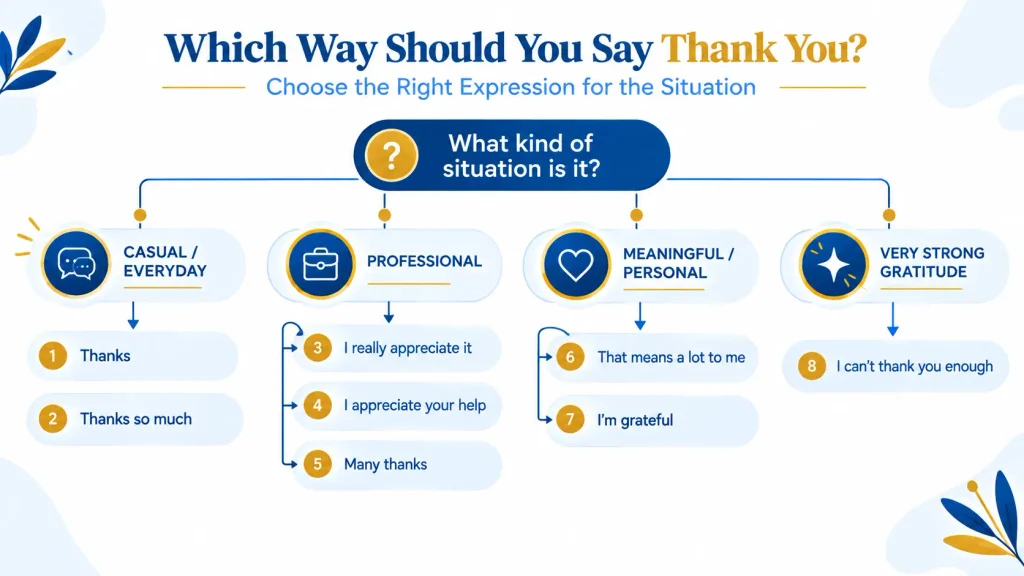
Which Thank-You Phrase Should You Choose?
| Alternative | Best Used In | Tone |
| Thanks | Quick everyday exchanges | Casual |
| Thanks so much | Friendly conversations and messages | Warm, casual |
| I really appreciate it | Help, favors, and support | Warm, neutral |
| I appreciate your help | Workplace or specific assistance | Professional, polite |
| I’m grateful | Meaningful support or kindness | Sincere |
| That means a lot to me | Personal or emotional situations | Warm, heartfelt |
| That’s very kind of you | Thoughtful gestures | Warm, polite |
| Much appreciated | Short messages and workplace communication | Polite, concise |
| I owe you one | Friendly favors | Casual, playful |
| I can’t thank you enough | Significant help or support | Strong, heartfelt |
| Many thanks | Emails, notes, and written thanks | Polite |
| Thank you so much | Most everyday situations | Warm, emphatic |
Casual vs. Professional Ways to Say Thank You
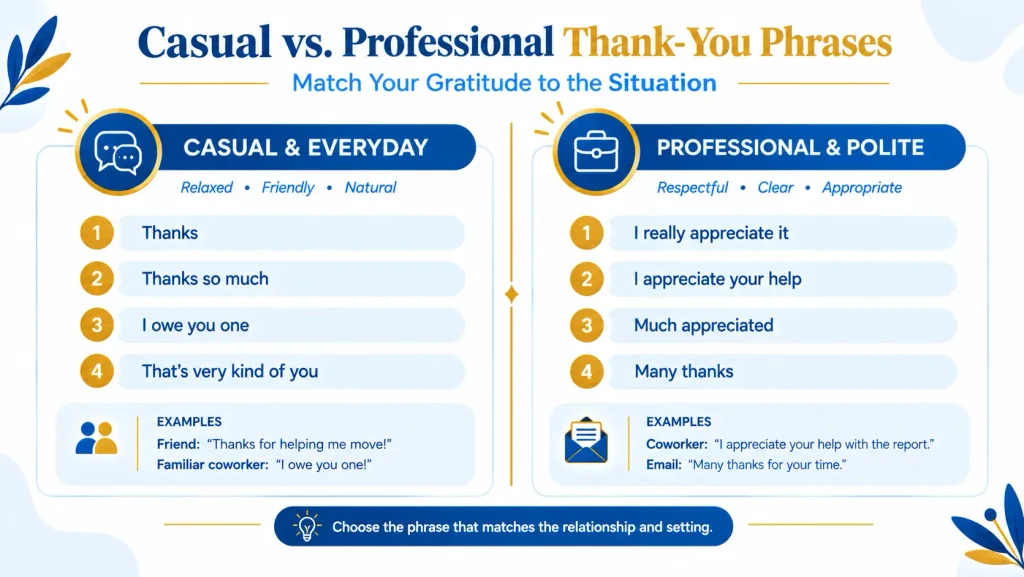
The setting matters as much as the words.
For a friend, you might say:
“Thanks! I really appreciate it.”
For a coworker:
“I really appreciate your help with the report.”
For a more formal email:
“Many thanks for your time and assistance.”
For someone who gave you important personal support:
“I’m so grateful. That means a lot to me.”
The same basic feeling—gratitude—can therefore sound casual, professional, or heartfelt depending on the expression you choose. Current English-learning resources similarly organize thank-you expressions around casual, professional, formal, and emotional contexts.
Common Mistakes When Saying Thank You
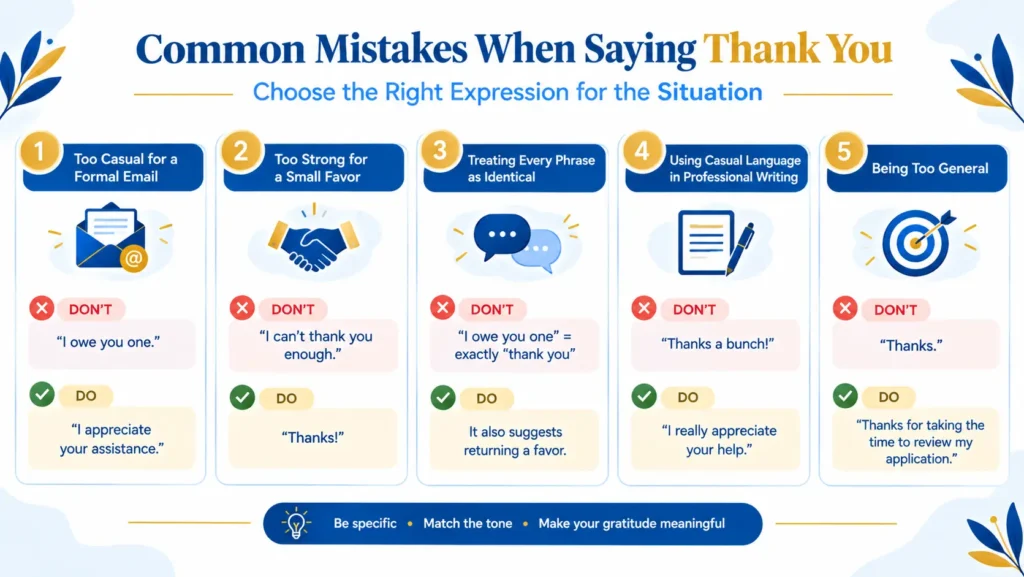
1. Using “I owe you one” in a formal email
“I owe you one” is friendly and informal. It suggests that you will return the favor, so it is better for friends or familiar coworkers than clients or formal correspondence.
Better: “I really appreciate your assistance.”
2. Using a very strong phrase for a tiny favor
“I can’t thank you enough” can sound excessive if someone simply holds a door or hands you a pen.
For small favors, “Thanks” or “I appreciate it” is usually enough.
3. Assuming every alternative means exactly the same thing
Expressions such as “I owe you one” and “That means a lot to me” add meanings that plain “thank you” does not. One suggests returning a favor; the other highlights emotional importance.
4. Making professional thanks too casual
Expressions such as “Thanks a bunch” or “I owe you one” may be fine with a close coworker but can sound too relaxed in a formal business message.
For professional writing, specific phrases such as “I appreciate your help” or “Many thanks for your assistance” are safer choices.
5. Forgetting to say what you appreciate
A specific thank-you often sounds more sincere than a generic one.
Compare:
“Thanks.”
with:
“Thanks for taking the time to review my application.”
The second version tells the reader exactly what you appreciate.
Related Alternatives Worth Exploring
If you want to express gratitude more precisely, consider the situation first. A casual favor may call for “Thanks!” A professional email may need “I appreciate your assistance.” A meaningful personal gesture may be better answered with “That means a lot to me.”
You can also make your thanks more specific by naming the action, effort, time, advice, support, or kindness you appreciate.
FAQs
What is a casual way to say thank you?
“Thanks” is the most natural casual alternative to “thank you.” You can also say “Thanks so much,” “Much appreciated,” or “I owe you one” when the situation fits. “I owe you one” is more informal because it suggests that you will return the favor.
What is a professional way to say thank you?
For professional communication, try “I really appreciate it,” “I appreciate your help,” “I appreciate your time,” or “Many thanks.” A specific expression usually works better than trying to sound overly formal. Mentioning what you appreciate can make a professional thank-you clearer and more genuine.
What is a heartfelt way to say thank you?
For deeper gratitude, use “I’m so grateful,” “That means a lot to me,” or “I can’t thank you enough.” These expressions work best when someone’s support, kindness, or effort had meaningful personal value. They may sound too strong for a small everyday favor.
Is “much appreciated” a good way to say thank you?
Yes. “Much appreciated” is a concise and natural expression of gratitude, especially in short messages and workplace communication. It is slightly less personal than “I really appreciate it,” but it efficiently acknowledges someone’s help or effort.
Is “I owe you one” the same as “thank you”?
Not exactly. “I owe you one” expresses thanks while also suggesting that you will return the favor. It is informal and works best with friends or familiar coworkers. For a formal situation, use “I appreciate your help” instead.
Can I say “many thanks” in a professional email?
Yes. “Many thanks” is a polite expression that works well in professional emails and other written communication. For example: “Many thanks for sending the information.” It is concise without sounding as casual as “Thanks!”
How do I make a thank-you sound more sincere?
Be specific about what you appreciate. Instead of simply saying “Thank you,” say “I really appreciate you taking the time to explain that.” Naming the person’s action, effort, time, or support makes the gratitude more personal and meaningful.
Conclusion
There is no single replacement for “thank you” that works best in every situation. “Thanks” is ideal for quick, casual moments, while “I really appreciate it” is flexible enough for both personal and professional communication. When the gesture feels meaningful, “That means a lot to me,” “I’m grateful,” or “I can’t thank you enough” can communicate deeper appreciation. For workplace writing, “I appreciate your help” and “Many thanks” keep the tone polite and appropriate.
The simplest rule is to match the expression to the situation: casual for everyday favors, specific for professional help, and more heartfelt for meaningful support.

Communication Editor
Nadia Ellery is a communication editor focused on everyday English, conversational expressions, common phrases, and natural ways to communicate. She helps turn complicated language questions into practical guidance readers can use in everyday situations.