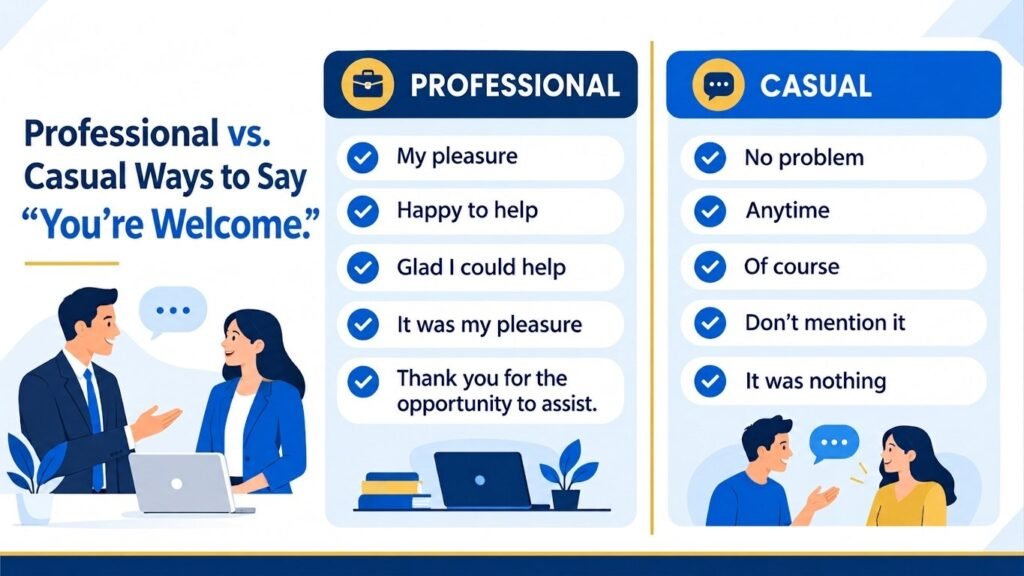
Looking for another way to say you’re welcome? Try “No problem,” “My pleasure,” “Anytime,” “Happy to help,” or “Of course.”
These alternatives help you respond naturally when someone thanks you. Choose a friendly, professional, or formal expression based on the situation, your relationship with the person, and the tone you want to convey.
When someone thanks you, saying “You’re welcome” is polite and appropriate. However, using the same response every time can make conversations feel repetitive. Learning different ways to say you’re welcome helps you sound more natural, friendly, and confident.
Whether you’re replying to a coworker, helping a customer, answering a friend’s message, or writing a professional email, the right expression can make your response more personal. Below are 10 useful alternatives, with meanings, examples, and practical tips to help you choose the best phrase.
Key Takeaways
- “You’re welcome” is a polite response to someone’s thanks.
- “My pleasure” works well in professional and formal situations.
- “No problem” and “Anytime” sound friendly and casual.
- “Happy to help” is ideal for workplace conversations and emails.
- Choose an expression that matches the situation and your relationship with the other person.
What Does “Another Way to Say You’re Welcome” Mean?
The phrase refers to alternative expressions you can use when someone thanks you for your help, kindness, time, or support.
In American English, “You’re welcome” is a common and polite response to “Thank you.” However, expressions such as “My pleasure,” “No problem,” and “Happy to help” can communicate additional warmth, friendliness, or professionalism.
These alternatives are commonly used in everyday conversations, workplace communication, customer service, text messages, and emails.
Grammar tip: “You’re welcome” means “You are welcome.” “Your welcome” is generally incorrect when used as a response to thanks because “your” shows possession.
Why Use Other Ways to Say You’re Welcome?
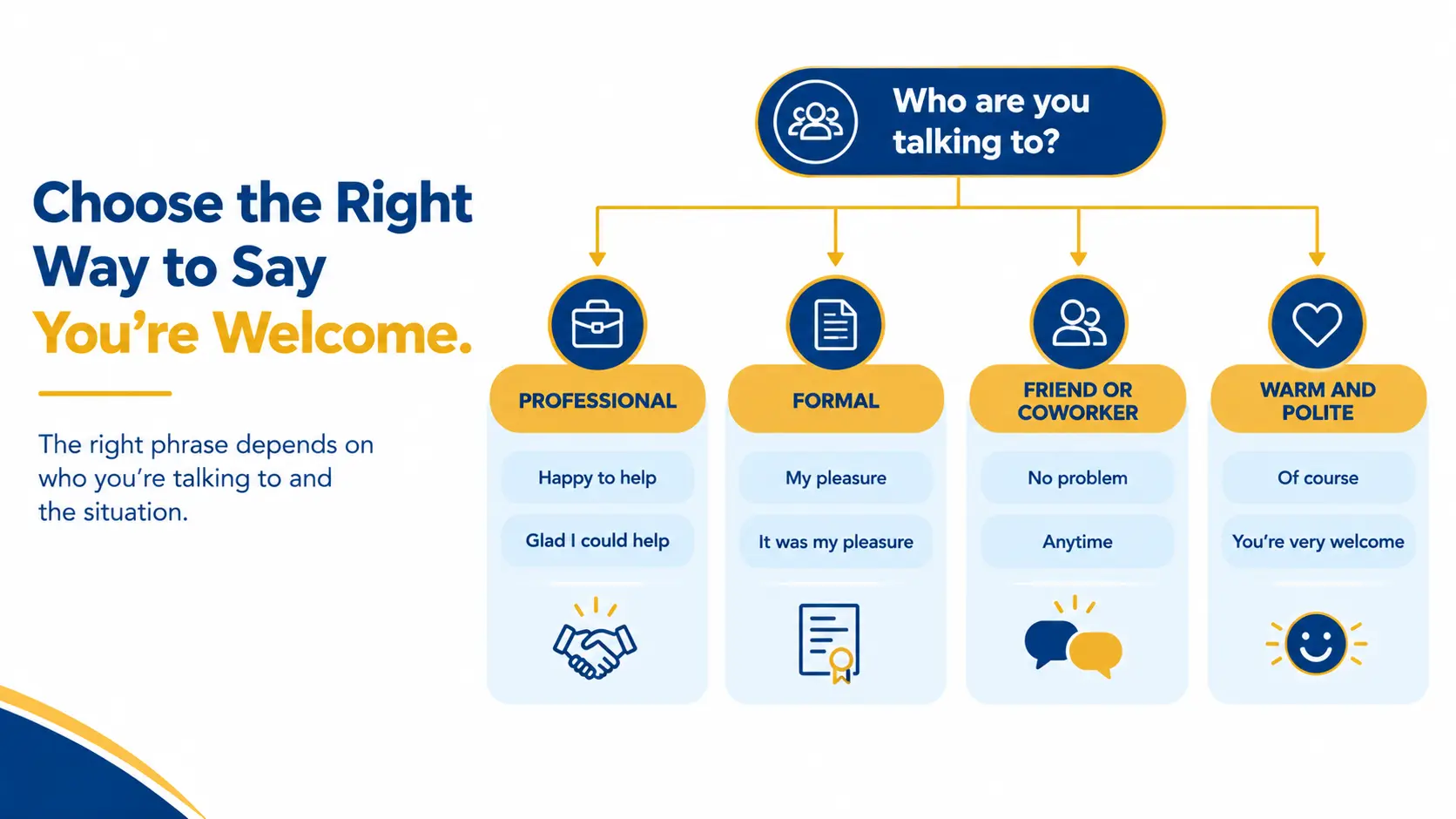
Using different expressions helps you respond naturally without repeating the same words. It also allows you to adjust your tone to fit the situation.
Here are the main benefits:
- Avoid repetition: Keep everyday conversations fresh and natural.
- Sound more professional: Choose appropriate expressions for workplace emails and customer interactions.
- Show warmth: Make friends, family members, and colleagues feel appreciated.
- Improve communication: Match your response to the favor or assistance you provided.
- Build stronger relationships: Communicate kindness, respect, and a willingness to help.
10 Best Other Ways to Say You’re Welcome
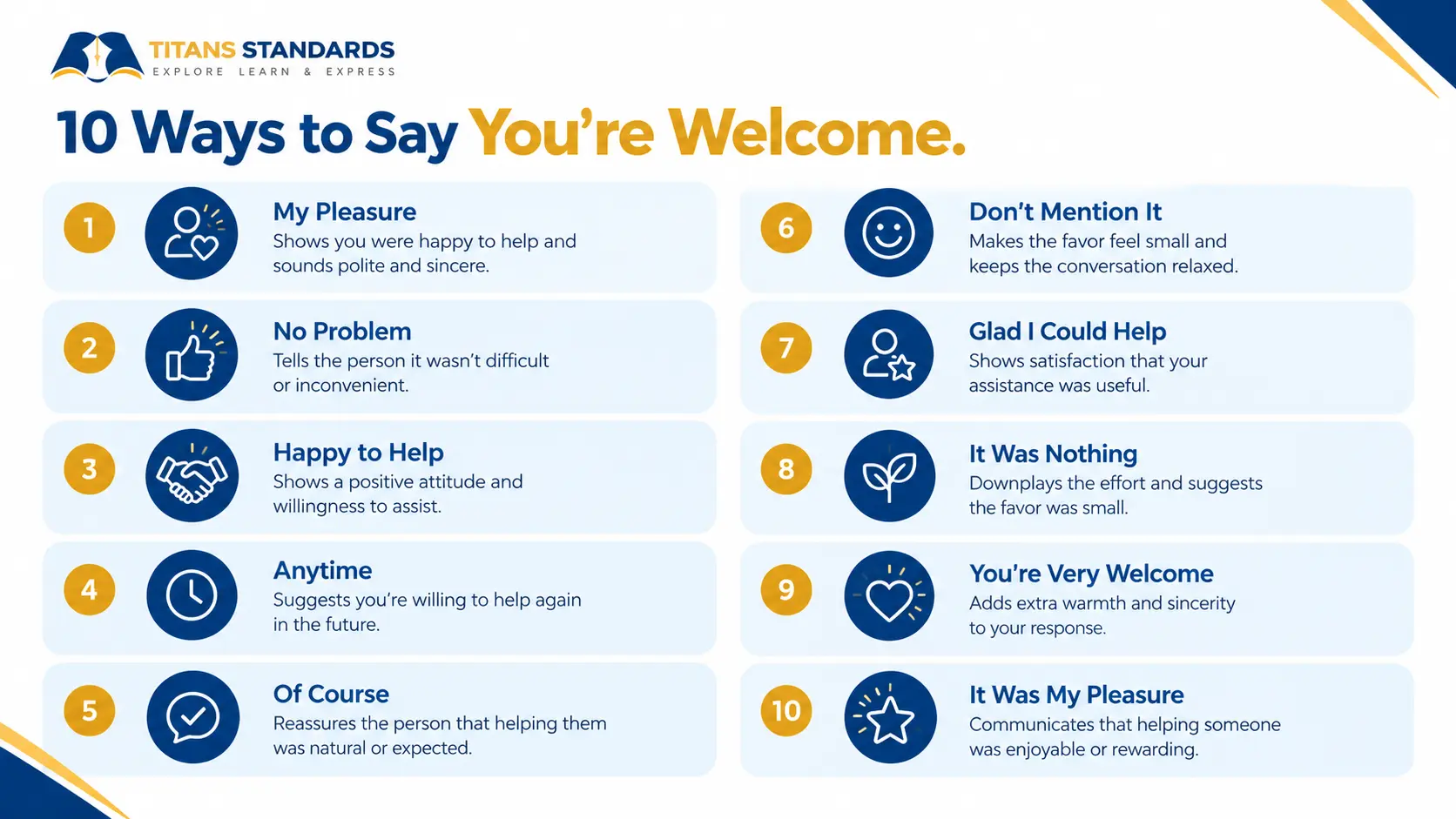
1. My Pleasure
Meaning: “My pleasure” communicates that you were happy to help someone. It sounds courteous, sincere, and slightly more polished than the standard response.
Best For: Professional, Formal, Polite, Warm
Example 1: “Thank you for helping me prepare the presentation.” “My pleasure. I’m glad we got everything ready.”
Example 2: “Thank you for taking the time to explain the process.” “My pleasure. Please let me know if you have more questions.”
Quick Tip: Use this expression in business emails, customer service, and situations where you want to sound genuinely helpful.
2. No Problem
Meaning: “No problem” tells someone that helping them was not difficult or inconvenient. It’s a relaxed, reassuring expression widely used in American English.
Best For: Casual, Friendly, Polite
Example 1: “Thanks for sending me the notes.” “No problem! I hope they help.”
Example 2: “Thank you for saving me a seat.” “No problem. There’s room for you here.”
Quick Tip: This phrase works well with friends and coworkers. For highly formal situations, consider “My pleasure” instead.
3. Happy to Help
Meaning: “Happy to help” shows that you were willing and pleased to provide assistance. It communicates a positive attitude without sounding overly formal.
Best For: Professional, Friendly, Warm, Polite
Example 1: “Thanks for helping me fix the spreadsheet.” “Happy to help! Let me know if anything else comes up.”
Example 2: “I appreciate your guidance with the new project.” “You’re welcome. I’m happy to help whenever you need it.”
Quick Tip: Use this phrase in workplace conversations, professional emails, and customer support messages to show that assistance is welcome.
4. Anytime
Meaning: “Anytime” suggests that you’re willing to help again in the future. It makes your response sound generous, approachable, and supportive.
Best For: Casual, Friendly, Warm
Example 1: “Thanks for giving me a ride to the airport.” “Anytime! Just let me know when you need another ride.”
Example 2: “I really appreciate you reviewing my resume.” “Anytime. I’m glad I could help.”
Quick Tip: Choose this phrase when you genuinely want to offer future assistance. Avoid making promises you cannot keep.
5. Of Course
Meaning: “Of course” reassures the other person that helping them was natural or expected. Depending on your tone, it can sound warm, confident, and considerate.
Best For: Friendly, Professional, Polite
Example 1: “Thank you for explaining the instructions again.” “Of course! I want to make sure everything is clear.”
Example 2: “I appreciate you sharing your notes with me.” “Of course. I hope they make studying easier.”
Quick Tip: Add a short, friendly sentence when needed to ensure your response sounds welcoming rather than dismissive.
6. Don’t Mention It
Meaning: “Don’t mention it” means the favor was not a big deal and doesn’t require further thanks. It can make a conversation feel relaxed and modest.
Best For: Casual, Friendly, Polite
Example 1: “Thanks for bringing my package inside.” “Don’t mention it. I was heading that way anyway.”
Example 2: “I appreciate you helping me clean up after the party.” “Don’t mention it. We make a good team.”
Quick Tip: This phrase works best for small favors among friends, neighbors, and familiar coworkers.
7. Glad I Could Help
Meaning: “Glad I could help” expresses satisfaction that your assistance was useful. It acknowledges the person’s gratitude while emphasizing the positive outcome.
Best For: Professional, Friendly, Warm, Polite
Example 1: “Thank you for helping me understand the report.” “Glad I could help. The figures make more sense now, don’t they?”
Example 2: “Thanks for helping us resolve the scheduling issue.” “Glad I could help. I’m happy we found a solution.”
Quick Tip: Use this expression after solving a problem, answering a question, or helping someone complete a task.
8. It Was Nothing
Meaning: “It was nothing” downplays the effort involved in helping someone. It suggests that the favor was small and that you didn’t mind doing it.
Best For: Casual, Friendly, Polite
Example 1: “Thank you for holding the door for me.” “It was nothing. Have a great afternoon!”
Example 2: “I appreciate you picking up my coffee.” “It was nothing. I was already placing an order.”
Quick Tip: Reserve this phrase for small favors. If you made a significant effort, “My pleasure” may acknowledge the situation more appropriately.
9. You’re Very Welcome
Meaning: “You’re very welcome” adds emphasis to the standard expression. It can communicate extra warmth, sincerity, and reassurance when someone expresses genuine appreciation.
Best For: Formal, Professional, Warm, Polite
Example 1: “Thank you for your patience throughout the application process.” “You’re very welcome. We appreciate your cooperation.”
Example 2: “I can’t thank you enough for your support.” “You’re very welcome. I’m glad I could be there for you.”
Quick Tip: Use this phrase when you want to acknowledge someone’s gratitude warmly without changing to a casual expression.
10. It Was My Pleasure
Meaning: “It was my pleasure” communicates that helping someone was enjoyable or rewarding. It sounds gracious and is particularly suitable for professional interactions and thoughtful acts of service.
Best For: Professional, Formal, Warm, Polite
Example 1: “Thank you for arranging the meeting with our team.” “It was my pleasure. I hope the discussion proves useful.”
Example 2: “We appreciate your assistance with our event.” “It was my pleasure to be part of such a wonderful occasion.”
Quick Tip: Choose this expression for formal emails, business meetings, and customer interactions where a courteous tone matters.
Comparison Table
| Alternative | Best Used In | Tone |
| My pleasure | Business and formal settings | Courteous |
| No problem | Everyday conversations | Casual |
| Happy to help | Work and customer service | Helpful |
| Anytime | Friends and familiar coworkers | Friendly |
| Of course | Personal and workplace conversations | Reassuring |
| Don’t mention it | Small favors | Relaxed |
| Glad I could help | Workplace and personal support | Positive |
| It was nothing | Minor everyday favors | Modest |
| You’re very welcome | Professional and personal situations | Warm |
| It was my pleasure | Formal emails and service interactions | Gracious |
Common Mistakes When Saying You’re Welcome
1. Using Casual Phrases in Formal Emails
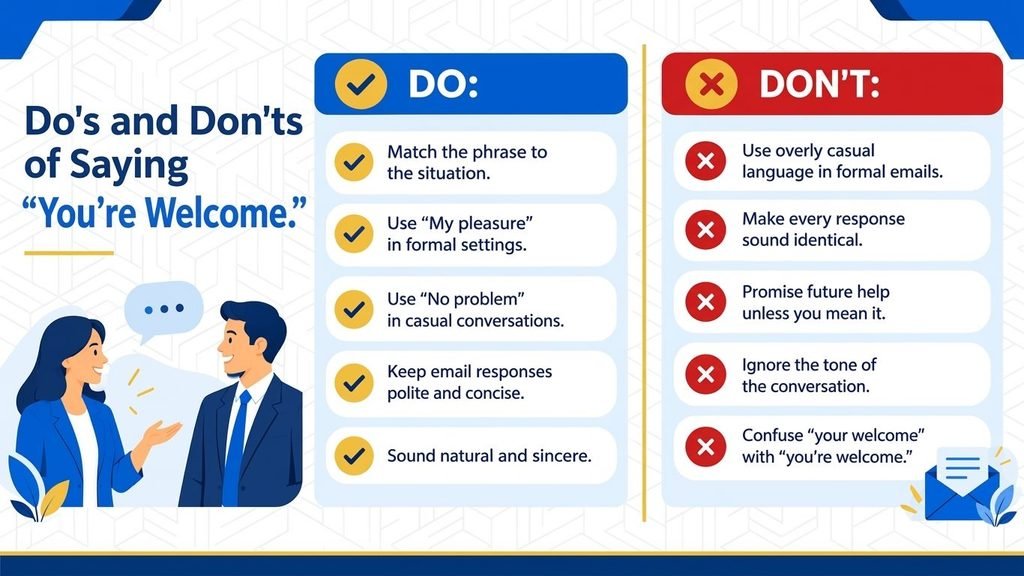
Expressions such as “No problem” may sound too informal in certain business situations. Choose “My pleasure” or “You’re very welcome” when communicating with clients or senior professionals.
2. Choosing Overly Formal Language
Using “It was my pleasure” in every text message can sound unnatural. Match your language to the relationship and the conversation.
3. Repeating the Same Expression
Responding with the same phrase every time may make your communication feel routine. Alternate between suitable expressions to keep your responses natural.
4. Ignoring Context
“Anytime” suggests future willingness to help, while “It was nothing” minimizes the favor. Choose a phrase that accurately reflects what happened.
5. Sounding Insincere
Even a polite phrase can feel cold if your tone doesn’t match your words. Use a natural, friendly tone and add a personal sentence when the situation calls for it.
Frequently Asked Questions
1. What is another way to say you’re welcome?
Common alternatives include “My pleasure,” “No problem,” “Happy to help,” “Anytime,” and “Of course.” The best choice depends on your relationship with the person and the setting. For professional conversations, “My pleasure” works well, while “No problem” is a natural choice for casual interactions.
2. What is the most professional way to say you’re welcome?
“My pleasure” is one of the most professional alternatives to “You’re welcome.” It sounds courteous and shows that you were glad to assist. “Happy to help” is another strong option for workplace emails, team discussions, and customer service conversations where a friendly, helpful tone is appropriate.
3. How do you say you’re welcome in an email?
You can write “My pleasure,” “Happy to help,” or “I’m glad I could assist.” For example, after a colleague thanks you for reviewing a document, you could reply, “You’re very welcome. I’m glad the feedback was helpful.” Keep your response brief, clear, and appropriate for the relationship.
4. What is a casual way to say you’re welcome?
“No problem,” “Anytime,” and “Don’t mention it” are popular casual alternatives. They work well in conversations with friends, family, and familiar coworkers. Choose “Anytime” when you want to suggest you’re willing to help again, and “No problem” when you simply want to acknowledge someone’s thanks.
5. Is “No problem” rude when someone says thank you?
No, “No problem” is generally friendly and acceptable in American English. However, some people prefer more traditional expressions in formal situations. If you’re speaking with a client, customer, or someone who expects a formal tone, “My pleasure” or “You’re very welcome” may be a safer choice.
6. Is “My pleasure” better than “You’re welcome”?
Neither phrase is always better. “You’re welcome” is a standard, versatile response, while “My pleasure” emphasizes that you were happy to help. The second option can sound especially polished in professional settings, but both expressions are polite and appropriate when used naturally.
7. How do you respond to “Thank you so much”?
You can respond with “You’re very welcome,” “My pleasure,” or “I’m glad I could help.” If a friend thanks you for a small favor, “Anytime!” may sound more natural. Consider the effort involved and the other person’s tone when deciding how warmly to respond.
8. Is it “your welcome” or “you’re welcome”?
The correct expression is “you’re welcome” because “you’re” is short for “you are.” The word “your” indicates possession, as in “your book” or “your email.” Although people sometimes type “your welcome” by mistake, use “you’re welcome” in professional writing, messages, and everyday communication.
Writing something similar? Try another way to say “you’re welcome in Spanish”, another way to say “I love you more” or another way to say “will be missed”.
Conclusion
Knowing another way to say you’re welcome helps you communicate with greater warmth, confidence, and flexibility. Although “You’re welcome” remains a reliable response, alternatives let you adjust your tone to different people and situations.
For professional emails and customer interactions, choose “My pleasure,” “Happy to help,” or “It was my pleasure.” In casual conversations, “No problem,” “Anytime,” and “Don’t mention it” sound relaxed and friendly. When you want to show extra appreciation, “You’re very welcome” is a thoughtful choice.
Remember that the best expression is the one that feels natural and fits the context. You don’t need to replace “You’re welcome” every time someone thanks you. Instead, learn a few alternatives and use them when they communicate your feelings more clearly. A short, sincere response can make everyday conversations and professional relationships more positive.

Editorial Desk
The Titan Standards Editorial Team develops, reviews, and maintains practical English-language resources. The team checks articles for clarity, accuracy, context, readability, and consistency with Titan Standards’ editorial guidelines.