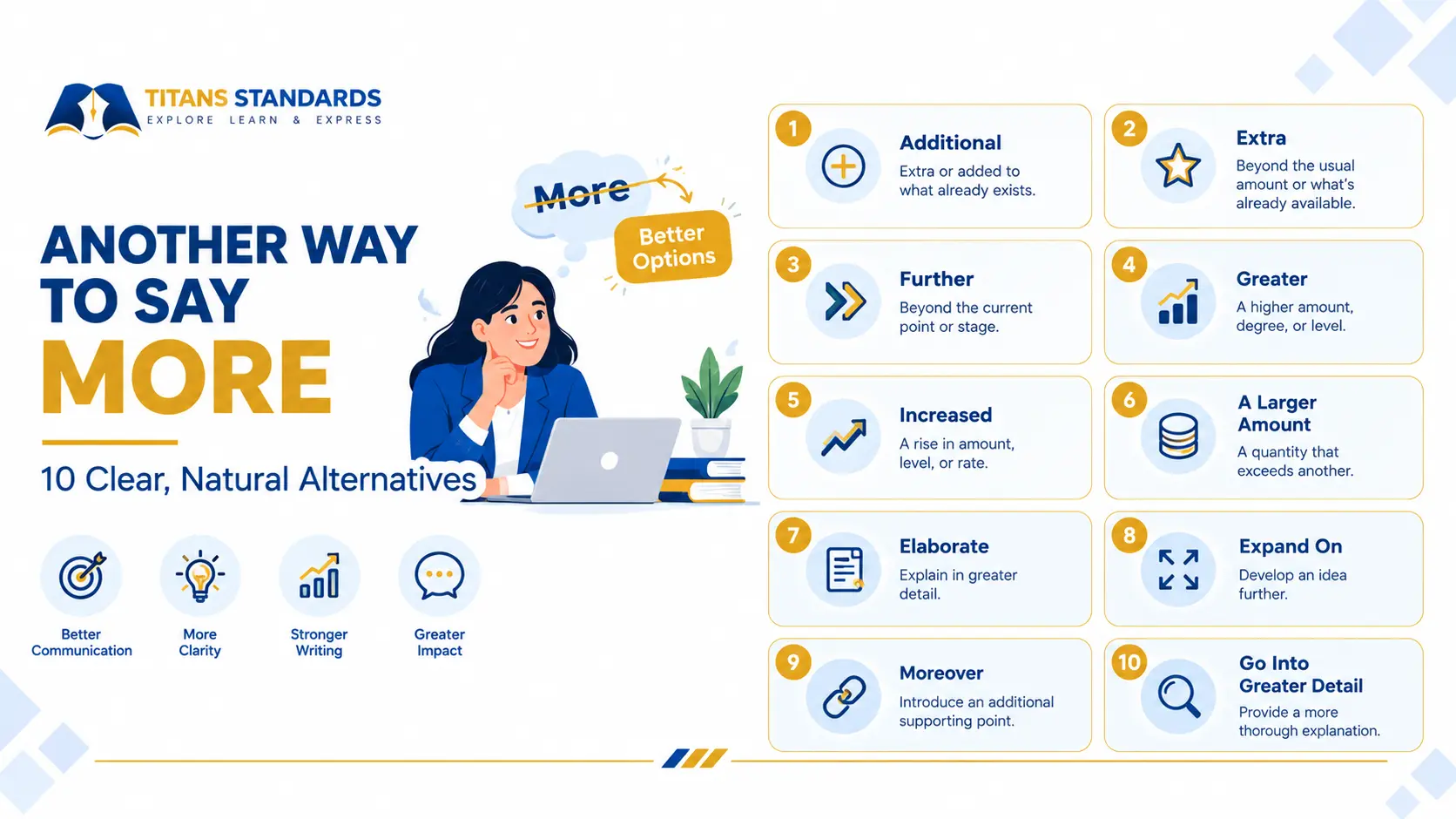
Another way to say more depends on the context. You can use additional, extra, further, greater, increased, or a larger amount when discussing quantity.
For writing and conversations, phrases like elaborate, expand on, provide more details, and go into greater detail help you express your ideas clearly and naturally.
Key Takeaways
- Use additional, extra, or further when referring to something beyond what already exists.
- Choose greater or increased when describing a higher level, amount, or degree.
- Use elaborate or expand on when asking someone to explain an idea in more detail.
- Choose moreover or furthermore to introduce supporting points in formal writing.
- Consider the sentence, audience, and tone before choosing a replacement for “more.”
What Does “Another Way to Say More” Mean?
The phrase “another way to say more” refers to alternative words or expressions that communicate the same or a similar meaning as more. The best replacement depends on whether you are talking about quantity, degree, additional information, or expanding an idea.
For example, you might say “additional information” instead of “more information” in a professional email. In a conversation, “tell me a little more” could become “give me more details” or “elaborate a little.”
People look for alternatives to “more” to avoid repetition, improve sentence flow, and communicate their ideas more precisely. These expressions are useful in emails, essays, business reports, everyday conversations, and academic writing.
Why Use Other Ways to Say “More”?
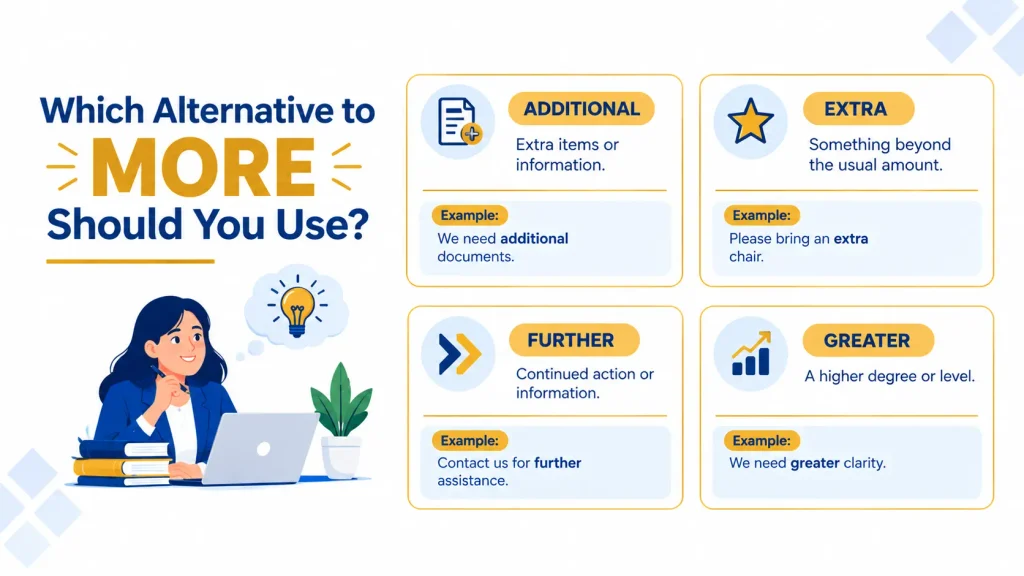
Although “more” is a common and useful word, repeating it too often can make writing sound vague or repetitive. Choosing a more precise expression helps readers understand exactly what you mean.
Here are a few benefits of using alternatives:
- Avoid repetition: Keep your writing varied and engaging.
- Improve clarity: Distinguish between quantity, quality, degree, and detail.
- Sound professional: Use appropriate language in reports, presentations, and business emails.
- Match your tone: Choose expressions that suit formal, casual, or friendly conversations.
- Communicate precisely: Explain whether you need additional items, further information, or a deeper explanation.
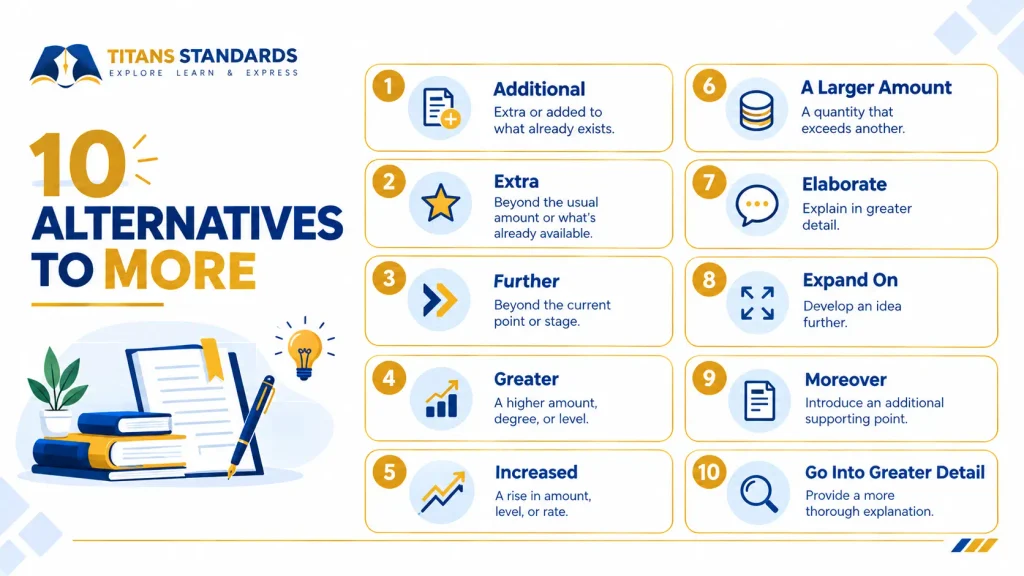
10 Best Other Ways to Say “More”
1. Additional
Meaning
“Additional” means extra or added to something that already exists. It works especially well when discussing information, resources, documents, tasks, or items.
This word is a strong choice for professional communication because it sounds clear and direct without being overly formal.
Best For: Professional, Formal, Polite
Example 1: Please attach any additional documents before submitting your application.
Example 2: Our team may need additional time to complete the final review.
Quick Tip: Use “additional” before a noun, such as “additional support,” “additional details,” or “additional resources.”
2. Extra
Meaning
“Extra” refers to something beyond the usual amount or what is already available. It is a natural alternative to “more” in everyday conversations, customer service, and informal workplace communication.
It often sounds friendlier and more conversational than “additional.”
Best For: Casual, Friendly, Professional
Example 1: Could you bring an extra chair for our guest?
Example 2: The hotel offers extra towels upon request.
Quick Tip: Choose “extra” for everyday situations, but consider “additional” when writing a formal business proposal or official report.
3. Further
Meaning
“Further” refers to something beyond the current point, amount, or stage. It is particularly useful when discussing progress, investigation, explanation, or future action.
In professional writing, it can make requests sound measured and polished.
Best For: Professional, Formal, Polite
Example 1: We will conduct further testing before releasing the software.
Example 2: Please contact our office if you require further assistance.
Quick Tip: Use “further information,” “further discussion,” or “further review” when referring to the next step in a process.
4. Greater
Meaning
“Greater” describes a higher amount, degree, level, or importance. Unlike “additional,” which often refers to something added, “greater” emphasizes the size or extent of something.
It works well in business reports, academic writing, and discussions about performance or impact.
Best For: Professional, Formal
Example 1: The new training program gave employees greater confidence in their abilities.
Example 2: We need greater transparency when reporting project expenses.
Quick Tip: Use “greater” when comparing levels or degrees, such as “greater efficiency,” “greater influence,” or “greater responsibility.”
5. Increased
Meaning
“Increased” describes an amount, level, or rate that has risen. It is especially useful when discussing measurable changes, business performance, demand, costs, or activity.
This alternative is more specific than “more” when the sentence describes growth or an upward change.
Best For: Professional, Formal
Example 1: The company reported increased demand for its online services.
Example 2: Increased practice helped the students improve their reading skills.
Quick Tip: Use “increased” when describing a rise in something, rather than simply referring to extra items that have been added.
6. A Larger Amount
Meaning
“A larger amount” describes a quantity that exceeds another amount. It is useful when comparing money, materials, time, or other quantities that can be measured.
The expression is straightforward and helps make comparisons clearer.
Best For: Professional, Casual, Formal
Example 1: The renovation will require a larger amount of funding than we originally expected.
Example 2: Please set aside a larger amount of time for the final presentation.
Quick Tip: Use “a larger amount” for uncountable quantities, such as money or time. For countable items, “a greater number” may be more accurate.
7. Elaborate
Meaning
“Elaborate” means to explain an idea in greater detail. It is useful when you want someone to clarify a statement, share their reasoning, or provide a fuller explanation.
The word is common in meetings, interviews, academic discussions, and professional emails.
Best For: Professional, Formal, Polite
Example 1: Could you elaborate on the reasons behind your recommendation?
Example 2: During the interview, the candidate elaborated on her experience managing remote teams.
Quick Tip: Use “elaborate on” when referring to a specific subject, idea, or statement. For a simple everyday conversation, “explain a little more” may sound more natural.
8. Expand On
Meaning
“Expand on” means to develop an idea further by adding explanations, examples, or supporting information. It is useful when a topic needs more discussion or when an initial explanation feels incomplete.
The phrase works in both spoken and written English.
Best For: Professional, Friendly, Casual
Example 1: Please expand on your proposal’s expected benefits during tomorrow’s meeting.
Example 2: The teacher asked Mia to expand on her answer with a real-world example.
Quick Tip: Follow “expand on” with the topic you want to develop, such as “expand on your findings” or “expand on this point.”
9. Moreover
Meaning
“Moreover” introduces an additional point that supports or strengthens what you have already said. It is often used in formal writing, persuasive arguments, reports, and essays.
Unlike “additional” or “extra,” it connects ideas rather than describing a larger quantity.
Best For: Formal, Professional
Example 1: The proposal reduces operating costs. Moreover, it improves customer response times.
Example 2: The course covers essential writing skills; moreover, it includes practical exercises.
Quick Tip: Use “moreover” when introducing a related supporting point. Avoid forcing it into casual texts, where “also” or “plus” may sound more natural.
10. Go Into Greater Detail
Meaning
“Go into greater detail” means to explain something more thoroughly by including facts, examples, or background information. It is a natural expression when requesting a fuller explanation or describing a more detailed discussion.
It works well in meetings, presentations, emails, and everyday conversations.
Best For: Professional, Polite, Friendly
Example 1: Could you go into greater detail about the proposed changes to the schedule?
Example 2: The report goes into greater detail about the survey’s findings and limitations.
Quick Tip: Use this expression when you want a deeper explanation, not simply a larger quantity of something.
Comparison Table
| Alternative | Best Used In | Tone |
| Additional | Emails, reports, requests | Professional |
| Extra | Daily conversations, services | Casual, friendly |
| Further | Business communication, processes | Formal, professional |
| Greater | Comparisons, reports, analysis | Professional |
| Increased | Trends, performance, statistics | Formal, analytical |
| A larger amount | Quantities, budgets, planning | Neutral |
| Elaborate | Meetings, interviews, discussions | Professional, polite |
| Expand on | Essays, presentations, conversations | Clear, collaborative |
| Moreover | Essays, arguments, reports | Formal |
| Go into greater detail | Requests, explanations, meetings | Polite, professional |
Common Mistakes When Using Alternatives to “More”
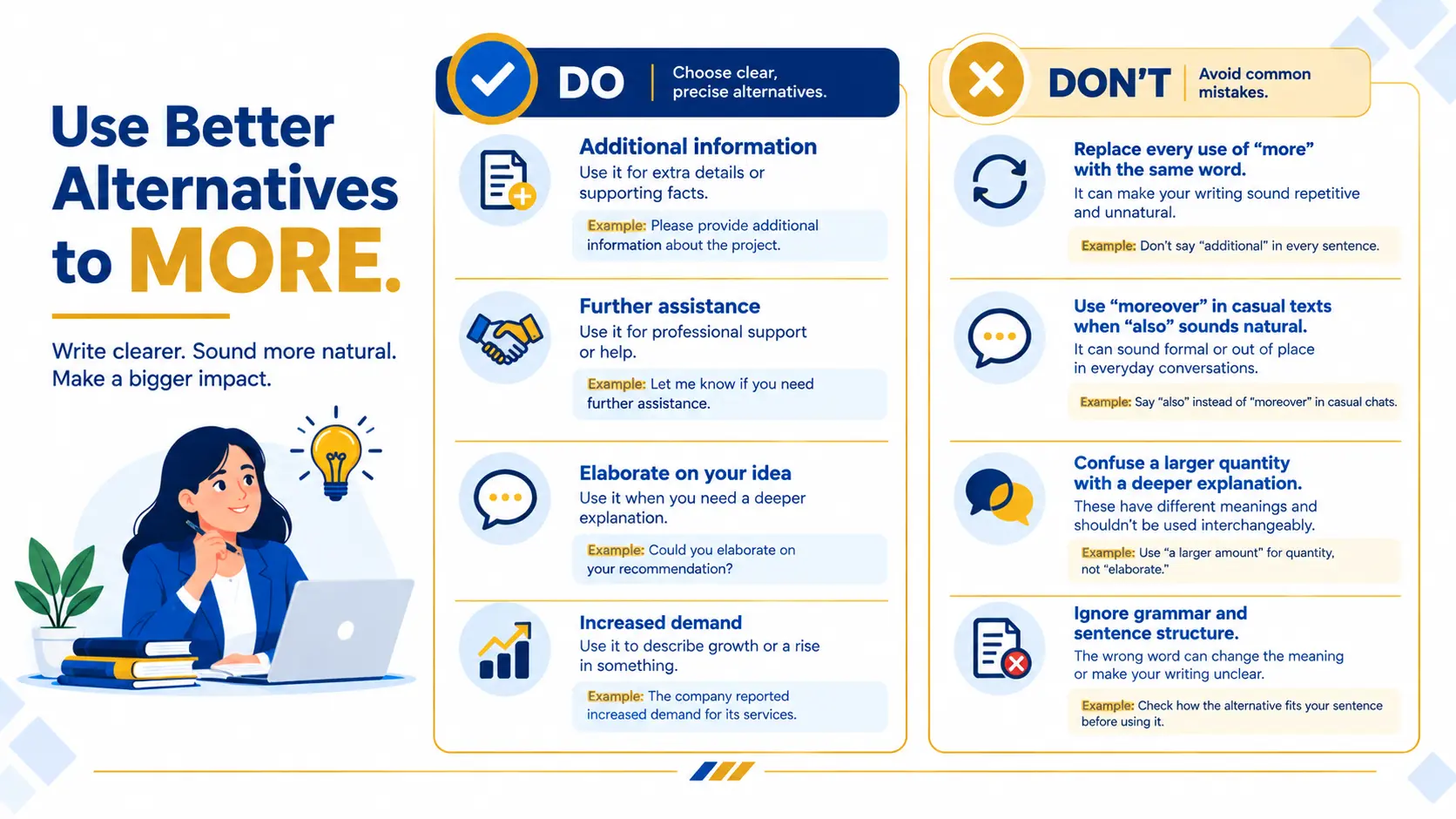
- Using a phrase that changes the meaning. “Additional” means something extra, while “greater” describes a higher degree. Choose the word that matches your intended meaning.
- Using formal language in casual conversations. “Moreover” may sound stiff in a text message. Choose “also,” “plus,” or “another” when the situation calls for a relaxed tone.
- Confusing quantity with explanation. “More information” refers to additional content, while “elaborate” asks someone to explain an existing point in greater detail.
- Repeating the same alternative too often. Replacing every instance of “more” with “additional” can make writing repetitive in a different way. Vary your wording when it improves clarity.
- Ignoring grammar and sentence structure. “Additional” usually describes a noun, while “elaborate” is a verb. Check how the alternative fits into your sentence before using it.
Frequently Asked Questions
1. What is a professional way to say more?
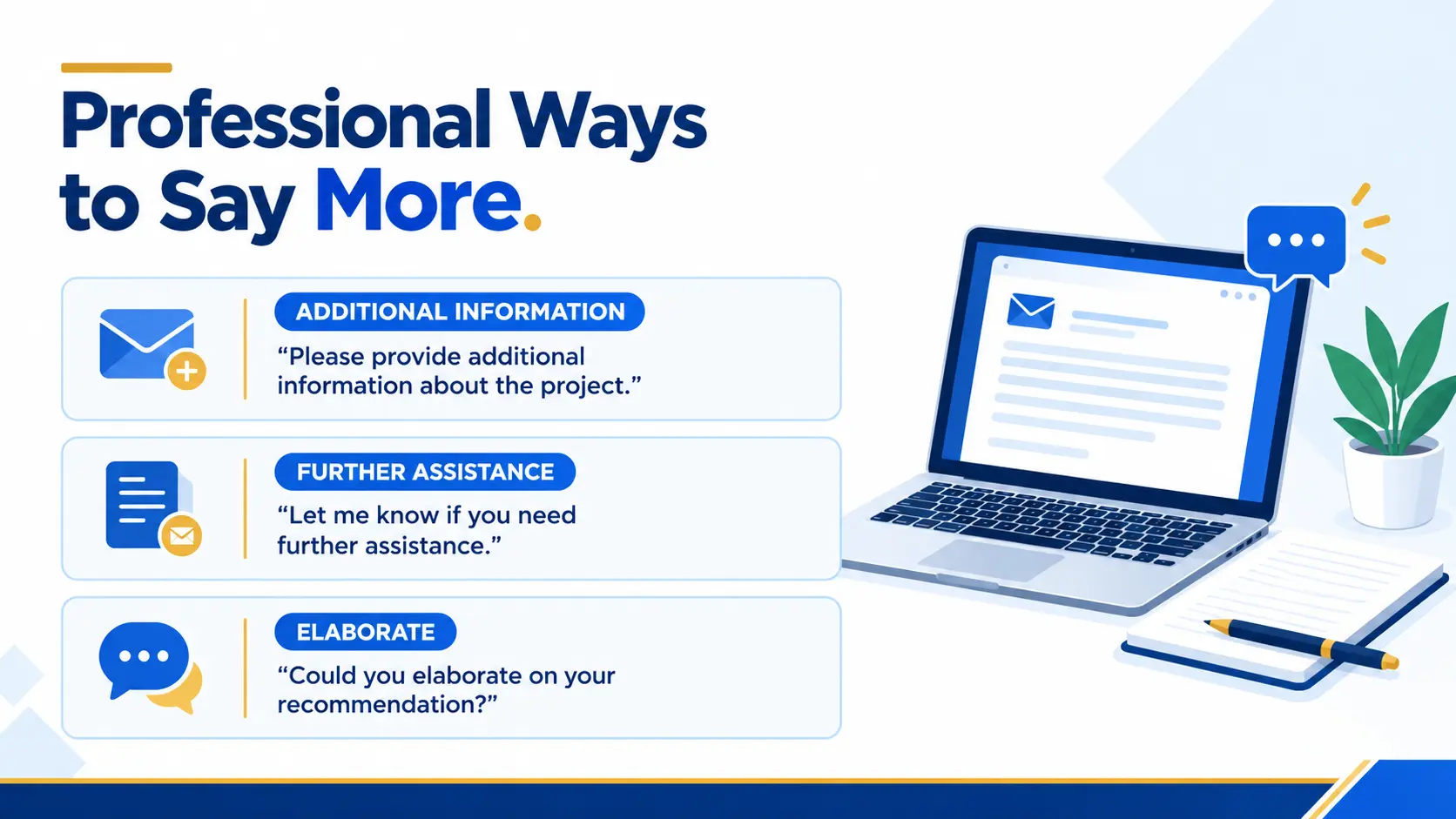
“Additional” and “further” are excellent professional alternatives. For example, you can write “Please provide additional information” or “Let me know if you need further assistance.” Use “greater” when discussing a higher degree and “increased” when describing a rise in a measurable amount or level.
2. What is another word for more in formal writing?
Formal writing often uses “additional,” “further,” “greater,” and “increased.” “Moreover” and “furthermore” work when introducing another supporting point. The right choice depends on your sentence: use “additional” for extra items or information, and use “moreover” to connect related ideas in an argument.
3. How can I say more in an email?
In an email, try phrases such as “additional details,” “further information,” or “please elaborate.” For example, “Please share any additional details before Friday” sounds professional and direct. If you want a fuller explanation, ask the recipient to “go into greater detail” about the specific topic.
4. What is a casual way to say more?
“Extra,” “a little more,” “some more,” and “another” are common casual alternatives. You might say, “Could I get some more water?” or “Let’s spend a little more time on this.” These expressions sound natural in everyday conversations with friends, family, and coworkers.
5. What can I say instead of more information?
You can say “additional information,” “further details,” “more context,” or “a fuller explanation.” Use “additional information” in formal requests and “more context” when you need background that helps explain a situation. If you want someone to clarify an existing point, ask them to elaborate.
6. Is “further” the same as “more”?
“Further” and “more” overlap, but they are not always interchangeable. “More” commonly describes a larger quantity, while “further” often refers to progress, continuation, or something beyond the current point. For example, “more chairs” refers to quantity, while “further discussion” refers to additional conversation.
7. What is another way to say more details?
Useful alternatives include “additional details,” “further information,” “a fuller explanation,” and “greater detail.” For a professional email, “Could you provide additional details about the proposal?” is clear and polite. In a meeting, “Could you elaborate on that point?” is another natural option.
8. How do I avoid repeating the word “more”?
First, identify what “more” means in each sentence. If it refers to quantity, consider “additional” or “extra.” If it refers to growth, use “increased.” If it introduces another argument, try “moreover.” For explanations, use “elaborate” or “expand on.” Prioritize clear meaning over variety.
Readers who checked this guide also looked at another way to say “some”, another way to say “many” and another way to say “a lot”.
Conclusion
Choosing another way to say more can make your writing clearer, more natural, and better suited to your audience. The key is to understand what you want to communicate before selecting a replacement.
For professional emails and reports, “additional” and “further” are reliable choices. Use “extra” in casual conversations, “greater” when comparing levels, and “increased” when describing growth. When you need someone to explain an idea more thoroughly, “elaborate,” “expand on,” and “go into greater detail” are useful alternatives. In formal essays, “moreover” can introduce another supporting point.
Remember that these expressions are not interchangeable in every sentence. A word that works well in a business report may sound unnatural in a text message. Choose the alternative that communicates your meaning accurately, fits your sentence, and sounds natural to your reader.

Editorial Desk
The Titan Standards Editorial Team develops, reviews, and maintains practical English-language resources. The team checks articles for clarity, accuracy, context, readability, and consistency with Titan Standards’ editorial guidelines.