
Another way to say “he said” includes “he replied,” “he explained,” “he remarked,” “he stated,” and “he noted.”
These alternatives help writers create natural dialogue, avoid repetition, and show how a character communicates. Choose the right expression based on the speaker’s meaning, tone, and the context of the conversation.
Key Takeaways
- Use “he replied” when a character responds to someone.
- Choose “he explained” to clarify information or an idea.
- Use “he stated” for direct, formal, or factual statements.
- Try “he remarked” or “he noted” to add variety to dialogue.
- Match every alternative to the speaker’s actual meaning instead of replacing “he said” automatically.
What Does “He Said” Mean?
“He said” is a common expression used to report the words spoken by a male person. Writers use it in stories, conversations, essays, news reports, and everyday communication to show who is speaking.
For example, “He said he would arrive early” tells readers what the person communicated without adding extra emotion or interpretation.
The expression is neutral, clear, and easy to understand. However, using it repeatedly in a story or paragraph can make the writing feel monotonous. Choosing an appropriate alternative can make dialogue more engaging while preserving the speaker’s intended meaning.
Why Use Other Ways to Say “He Said”?
Although “he said” works in most situations, other expressions can provide useful context and improve the flow of your writing.
Consider these benefits:
- Avoid repetition: Vary dialogue tags when several characters speak.
- Clarify meaning: Show whether someone answered, explained, or admitted something.
- Improve storytelling: Help readers understand the purpose of a character’s words.
- Match the tone: Choose language suitable for casual conversations, formal reports, or creative writing.
- Create smoother prose: Make dialogue easier to follow without adding unnecessary descriptions.
Remember that “said” is not a weak word. It is often the best choice when the dialogue itself already communicates the speaker’s feelings.
10 Best Other Ways to Say “He Said”

1. He Replied
Meaning
“He replied” indicates that someone responded to a question, comment, or statement. It works well in conversations because it clearly connects one person’s words to another person’s contribution.
Best For: Casual, Friendly, Professional, Polite
Example 1: “I’ll send you the updated schedule tonight,” he replied.
Example 2: “No, I haven’t spoken to Daniel yet,” he replied.
Quick Tip: Use “he replied” when the sentence directly answers something another person said.
2. He Answered
Meaning
“He answered” emphasizes that a person provided a response, particularly to a question. It is a straightforward alternative that works in fiction, school assignments, interviews, and everyday writing.
Best For: Casual, Professional, Formal
Example 1: “The meeting starts at nine,” he answered.
Example 2: “I chose the blue folder because it was easier to find,” he answered.
Quick Tip: Choose “he answered” when someone responds to a direct question or provides requested information.
3. He Explained
Meaning
“He explained” suggests that the speaker clarified an idea, described a process, or provided reasons for something. This phrase helps readers understand that the character is offering more information rather than simply making a statement.
Best For: Professional, Formal, Friendly
Example 1: “The delay happened because the supplier shipped the wrong parts,” he explained.
Example 2: “You need to save the document before closing the program,” he explained.
Quick Tip: Use “he explained” when the dialogue makes a situation, reason, or instruction clearer.
4. He Stated
Meaning
“He stated” presents information directly and clearly. It often sounds more formal than “he said,” making it suitable for reports, official communications, academic writing, and situations where precise wording matters.
Best For: Professional, Formal
Example 1: “Our department will publish the final results on Friday,” he stated.
Example 2: “The agreement remains valid until December 31,” he stated.
Quick Tip: Reserve “he stated” for contexts where a formal or factual tone is appropriate.
5. He Remarked
Meaning
“He remarked” describes a comment or observation made during a conversation. It can make dialogue feel more varied and natural, particularly when a character shares an opinion or notices something interesting.
Best For: Casual, Friendly, Formal
Example 1: “The new library looks much brighter after the renovation,” he remarked.
Example 2: “Everyone seems unusually quiet this morning,” he remarked.
Quick Tip: Use “he remarked” for comments and observations rather than detailed explanations or direct answers.
6. He Noted
Meaning
“He noted” indicates that someone pointed out a fact, detail, or observation worth considering. It is especially useful when a character highlights information that supports a discussion or adds an important detail.
Best For: Professional, Formal
Example 1: “The latest report shows a steady increase in customer satisfaction,” he noted.
Example 2: “We still have two outstanding items on the checklist,” he noted.
Quick Tip: Choose “he noted” when the speaker draws attention to a specific fact or detail.
7. He Added
Meaning
“He added” introduces another point or piece of information after a previous statement. It helps writers show that a character is continuing an explanation or contributing something extra to the conversation.
Best For: Casual, Friendly, Professional
Example 1: “We should leave before sunset,” he added.
Example 2: “The restaurant also offers a separate menu for children,” he added.
Quick Tip: Use “he added” when the character contributes further information rather than starting an unrelated topic.
8. He Admitted
Meaning
“He admitted” suggests that someone acknowledged a fact, mistake, or truth that might be uncomfortable or difficult to accept. Unlike the neutral “he said,” this expression implies that the information involves some degree of acknowledgment or reluctance.
Best For: Casual, Friendly, Formal
Example 1: “I forgot to attach the file to the email,” he admitted.
Example 2: “I was nervous about speaking in front of the entire class,” he admitted.
Quick Tip: Use “he admitted” only when the speaker acknowledges something significant, such as a mistake or personal concern.
9. He Declared
Meaning
“He declared” presents a statement with emphasis, confidence, or a sense of determination. It can suit dramatic fiction, public announcements, and situations where a character makes a strong claim or expresses a firm intention.
Best For: Formal, Professional, Dramatic
Example 1: “I will finish this project before the deadline,” he declared.
Example 2: “Our team is ready to compete for the championship,” he declared.
Quick Tip: Use “he declared” when the statement feels emphatic. Avoid it for ordinary, low-key conversations.
10. He Observed
Meaning
“He observed” introduces a comment based on something the speaker notices or considers. It works well in descriptive storytelling and thoughtful discussions, especially when a character points out a detail that others may have overlooked.
Best For: Formal, Professional
Example 1: “The two proposals share several important features,” he observed.
Example 2: “Traffic becomes much lighter after the school day ends,” he observed.
Quick Tip: Choose “he observed” for thoughtful comments based on evidence, details, or careful attention.
Comparison Table

| Alternative | Best Used In | Tone |
| He replied | Conversations and dialogue | Neutral |
| He answered | Questions and interviews | Direct |
| He explained | Instructions and clarification | Informative |
| He stated | Reports and official statements | Formal |
| He remarked | Comments and observations | Conversational |
| He noted | Reports and discussions | Professional |
| He added | Continuing dialogue | Neutral |
| He admitted | Confessions and acknowledgments | Personal |
| He declared | Strong statements and dramatic scenes | Emphatic |
| He observed | Thoughtful comments and analysis | Reflective |
Common Mistakes When Choosing Alternatives to “He Said”
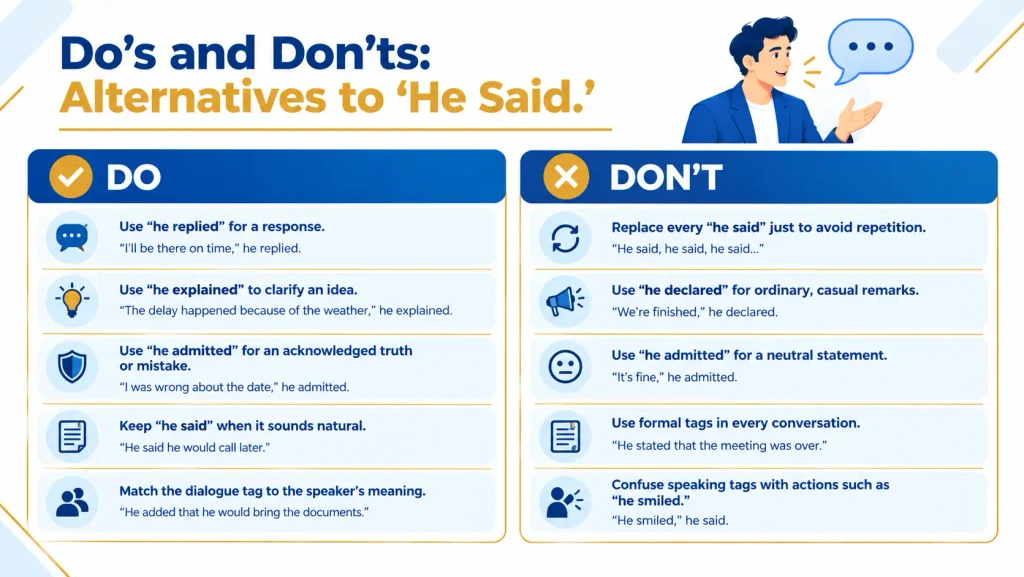
1. Using a Phrase That Changes the Meaning
Not every alternative communicates the same thing. “He admitted” suggests acknowledgment, while “he declared” conveys emphasis. Replacing “he said” without considering the meaning can misrepresent the speaker.
2. Making Every Dialogue Tag Formal
Words such as “he stated” and “he observed” may sound unnatural in a casual conversation. Use them when the context supports their tone, and keep ordinary dialogue simple.
3. Replacing Every Instance of “He Said”
Writers sometimes try too hard to avoid repetition. However, repeating “he said” is perfectly acceptable when it keeps a conversation clear. Vary the wording only when another expression adds useful meaning.
4. Using “He Replied” Without a Response
“He replied” generally indicates a response to something already communicated. If a character introduces a new subject, “he said” or “he remarked” may be more appropriate.
5. Confusing Dialogue Tags With Actions
A phrase such as “he smiled” describes an action, not the act of speaking. In standard dialogue punctuation, write “I understand,” he said, rather than treating a smile as a direct synonym for “said.”
Frequently Asked Questions
1. What is the best alternative to “he said”?
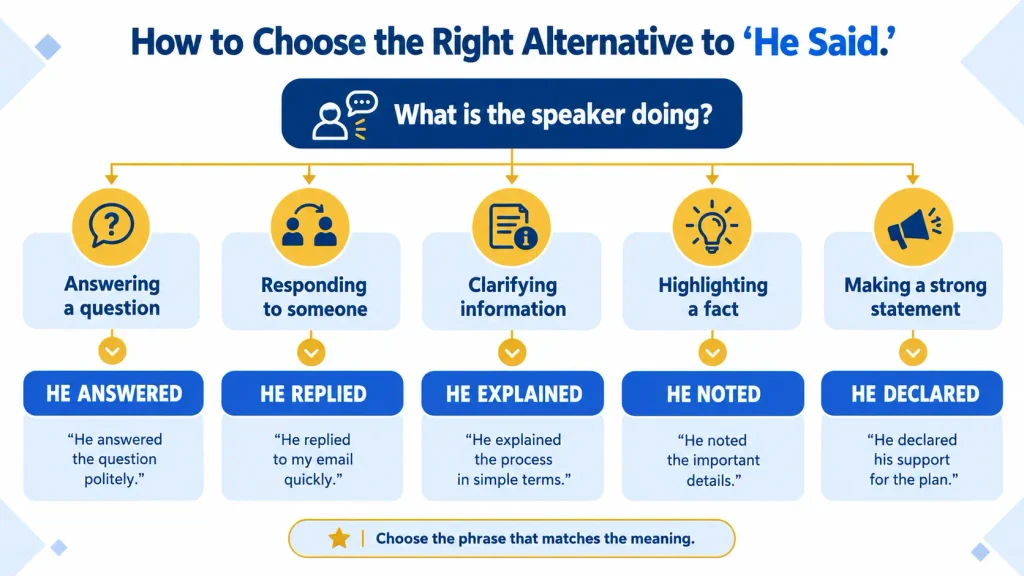
“He replied” is a strong choice when a character responds to someone. However, there is no single best alternative for every situation. Use “he explained” for clarification, “he noted” for an observation, and “he stated” for formal communication. The best phrase depends on the meaning and tone of the sentence.
2. How can I avoid repeating “he said” in a story?
Use a mix of simple dialogue tags, character actions, and natural conversation. For example, alternate “he said” with “he replied” or “he added” when appropriate. You can also let the dialogue establish the speaker when the context is clear. Avoid replacing every occurrence with an unusual word just for variety.
3. What is a formal way to say “he said”?
“He stated” is a useful formal alternative, especially in reports, presentations, and official communication. “He noted” also works when the speaker highlights a particular fact. Choose the phrase that accurately reflects the statement instead of using formal language simply to make the writing sound more sophisticated.
4. What is another way to say “he said” in dialogue?
“He replied,” “he remarked,” and “he added” are useful dialogue alternatives. Use “he replied” for a response, “he remarked” for a comment, and “he added” for additional information. In creative writing, simple tags are often more effective than complicated expressions because they allow readers to focus on the conversation.
5. Is “he responded” the same as “he said”?
They are similar, but they are not always interchangeable. “He responded” emphasizes a reaction to something another person said or did, while “he said” simply reports speech. “He responded” is a useful additional option when the context clearly involves a reaction or answer.
6. Can I use “he explained” instead of “he said”?
Yes, when the character clarifies information, describes a process, or gives a reason. However, “he explained” implies more than ordinary speech. If the character simply makes a short statement without offering clarification, “he said” may be more accurate and natural.
7. What are some alternatives to “he said” for academic writing?
For academic writing, consider “he stated,” “he noted,” and “he observed,” depending on the context. When discussing a researcher’s published work, use precise attribution and follow the required citation style. Do not choose a reporting verb that implies certainty, agreement, or acknowledgment unless the source supports that meaning.
8. Should I stop using “he said” completely?
No. “He said” remains one of the clearest and most natural ways to identify a speaker. It is common in published fiction and everyday writing because it rarely distracts readers. Use alternatives when they add meaning, clarify a response, or improve the flow of a passage.
You may also find these guides useful: another way to say “he says”, another way to say “said” and another way to say “affect”.
Conclusion
Choosing another way to say “he said” can make your writing clearer, more expressive, and easier to follow. The key is to match the alternative to the situation. Use “he replied” or “he answered” for responses, “he explained” for clarification, and “he stated” for formal communication. For comments and observations, “he remarked,” “he noted,” and “he observed” offer useful variety.
When writing stories, you can also use “he added” to introduce another point, “he admitted” to acknowledge a truth, or “he declared” to emphasize a strong statement. Each phrase serves a different purpose, so choose carefully.
Most importantly, do not feel pressured to replace every instance of “he said.” Simple language often works best. Use alternatives when they contribute meaning, preserve the speaker’s intent, and help readers understand the conversation naturally.

Editorial Desk
The Titan Standards Editorial Team develops, reviews, and maintains practical English-language resources. The team checks articles for clarity, accuracy, context, readability, and consistency with Titan Standards’ editorial guidelines.