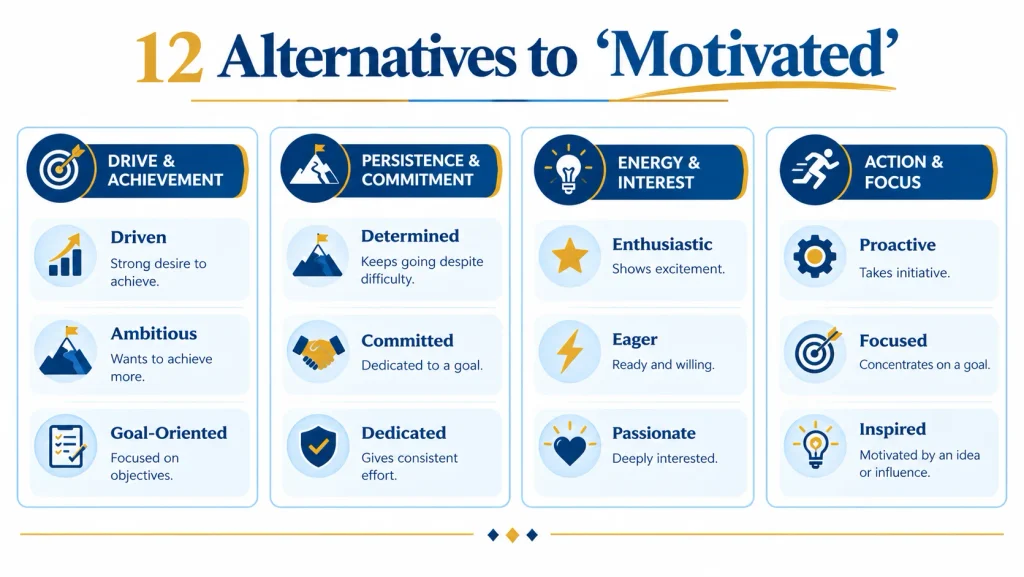
Another way to say motivated includes driven, determined, committed, dedicated, ambitious, focused, enthusiastic, eager, proactive, inspired, goal-oriented, and passionate.
The best choice depends on what you mean.
Use driven for strong goal focus, enthusiastic for excitement, committed for dedication, and proactive when someone takes initiative.
Key Takeaways
- Driven emphasizes strong determination to achieve a goal.
- Committed and dedicated focus on sustained effort and responsibility.
- Enthusiastic and passionate highlight excitement or strong interest.
- Proactive describes someone who takes action without waiting to be told.
- On a resume, specific action verbs can often communicate motivation more clearly than simply calling yourself “motivated.”
What Does “Motivated” Mean?
“Motivated” describes someone who has a strong reason, desire, or willingness to do something. It can refer to a person’s attitude, effort, ambition, or emotional drive.
For example:
She is motivated to improve her writing skills.
Here, motivated means she has the desire and determination to improve.
The word can also describe someone at work:
He is a motivated employee who consistently works toward his goals.
Depending on the situation, however, “motivated” can be too broad. It does not tell the reader exactly why someone is motivated or how that motivation appears.
That is why words such as driven, determined, committed, or proactive can sometimes communicate the idea more precisely.
Why Use Another Way to Say Motivated?
Replacing “motivated” is useful when you want to make your writing more specific.
For example, compare:
She is motivated at work.
with:
She is committed to improving the customer experience.
The second sentence gives the reader more information.
You may want another word for “motivated” to:
- avoid repeating the same adjective
- sound more specific in professional writing
- describe a particular type of motivation
- show enthusiasm rather than determination
- emphasize persistence or commitment
- make a resume statement more concrete
- match the tone of an interview, email, or conversation
The key is not to replace “motivated” automatically. Choose a word that describes the specific quality you want to communicate.
12 Best Ways to Say “Motivated”
1. Driven
Driven is one of the closest alternatives when someone has a strong desire to reach a goal. It works particularly well in professional and career contexts.
She is driven to build a successful career in marketing.
Use driven when the person’s motivation is closely connected to achievement, progress, or results.
2. Determined
Determined emphasizes the decision to keep pursuing something despite difficulty. It is stronger than simply saying someone is interested or willing.
He was determined to finish the project before the deadline.
Choose determined when persistence is the important part of the person’s motivation.
3. Committed
Committed focuses on dedication to a goal, responsibility, person, or cause. It often sounds more measured and professional than driven.
She is committed to providing reliable service to every customer.
This is particularly useful in workplace communication, performance reviews, interviews, and professional profiles.
4. Dedicated
Dedicated describes someone who consistently gives time, effort, or attention to something important.
The team is dedicated to improving the quality of its work.
While motivated can describe a current state of enthusiasm, dedicated often suggests sustained effort and reliability.
5. Ambitious
Ambitious works when motivation is connected to achieving significant goals or advancing professionally.
Marcus is ambitious and hopes to lead a larger team within the next few years.
It is not always interchangeable with motivated. Someone can be highly motivated without wanting a promotion or major achievement, so use ambitious when strong aspirations are part of the meaning.
6. Focused
Focused highlights concentration on a particular objective rather than motivation itself.
She is focused on completing the training program this month.
This word is useful when you want to show that someone’s motivation has turned into clear attention and effort.
7. Enthusiastic
Enthusiastic emphasizes excitement, interest, or positive energy.
He is enthusiastic about joining the new project.
Use it when the emotional side of motivation matters. Someone can be enthusiastic without necessarily being highly determined, so it is not a perfect substitute in every sentence.
8. Eager
Eager means strongly interested or ready to do something. It often sounds more immediate than motivated.
The new employees were eager to learn the company’s procedures.
This is a natural choice when someone is looking forward to an opportunity or is ready to take action.
9. Proactive
Proactive describes someone who takes action without waiting for instructions or problems to appear.
She is proactive about finding ways to improve the team’s workflow.
This is especially useful in professional writing because it describes behavior, not just an internal feeling of motivation.
10. Inspired
Inspired suggests that someone has gained motivation, creativity, or enthusiasm from an idea, person, experience, or goal.
The speaker left the audience inspired to make a change.
Use inspired when you want to identify motivation as something sparked by a particular influence.
11. Goal-Oriented
Goal-oriented describes someone who consistently works toward specific objectives.
He is a goal-oriented professional who plans each project around measurable outcomes.
This phrase is useful in professional settings, although it can sound more formal or resume-like than ordinary conversation.
12. Passionate
Passionate emphasizes strong emotional interest or enthusiasm for a subject, activity, or cause.
She is passionate about creating accessible educational resources.
It works best when motivation comes from genuine interest or strong personal commitment. It is not the best choice when you simply mean someone is disciplined or persistent.
Which Alternative Fits Your Meaning?
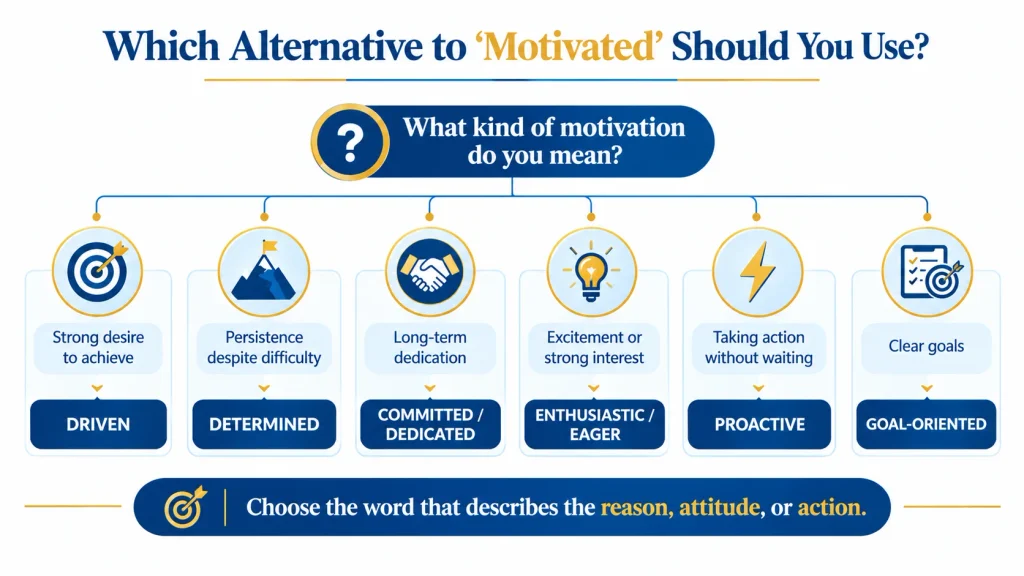
| Alternative | Best Used In | Main Idea |
| Driven | Career, goals, work | Strong desire to achieve |
| Determined | Challenges, goals | Persistence and resolve |
| Committed | Work, responsibilities | Strong dedication |
| Dedicated | Work, projects, causes | Sustained effort |
| Ambitious | Careers, achievement | Strong aspirations |
| Focused | Work, study, goals | Concentration on an objective |
| Enthusiastic | Work, conversation | Excitement and interest |
| Eager | Opportunities, learning | Strong willingness or readiness |
| Proactive | Workplace | Taking initiative |
| Inspired | Creative or personal contexts | Motivation sparked by something |
| Goal-oriented | Resumes, business | Focus on specific objectives |
| Passionate | Interests, causes, careers | Strong emotional interest |
Motivated vs. Driven vs. Determined
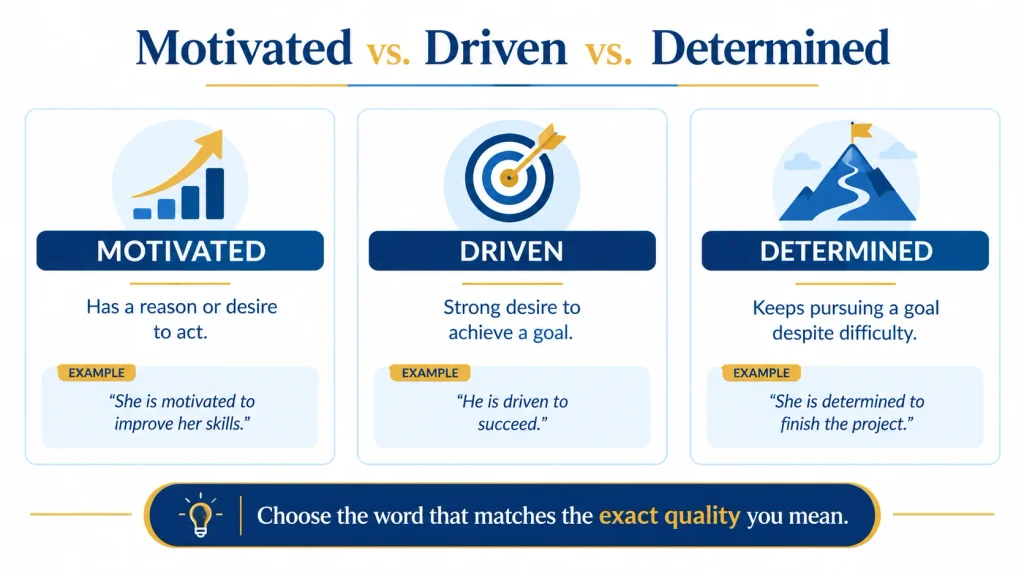
These three words are close, but they are not identical.
Motivated is the broadest. It simply tells you that someone has a reason or desire to act.
Driven suggests stronger internal pressure or ambition toward an objective.
Determined emphasizes persistence, especially when something is difficult.
Compare:
I am motivated to improve my skills.
I am driven to achieve better results.
I am determined to finish the certification.
All three describe motivation, but each emphasizes a different quality.
Common Mistakes When Replacing “Motivated”
1. Treating every synonym as interchangeable
Passionate, proactive, and determined describe different qualities. Choose according to the meaning you actually want.
2. Using “passionate” when you mean disciplined
Someone can be disciplined without feeling passionate. If consistent effort is the point, dedicated or committed may be more accurate.
3. Calling someone “proactive” without evidence
“Proactive” describes action. If someone regularly takes initiative, the word fits. Simply being enthusiastic does not automatically make someone proactive.
4. Overusing “driven” in professional writing
“Driven” is useful, but phrases such as “highly driven professional” can become generic when they are not supported by specific accomplishments or actions.
5. Using “ambitious” when you only mean interested
Ambition usually involves strong goals or aspirations. If someone simply enjoys learning something, enthusiastic, eager, or interested may be more precise.
How to Say “Motivated” on a Resume
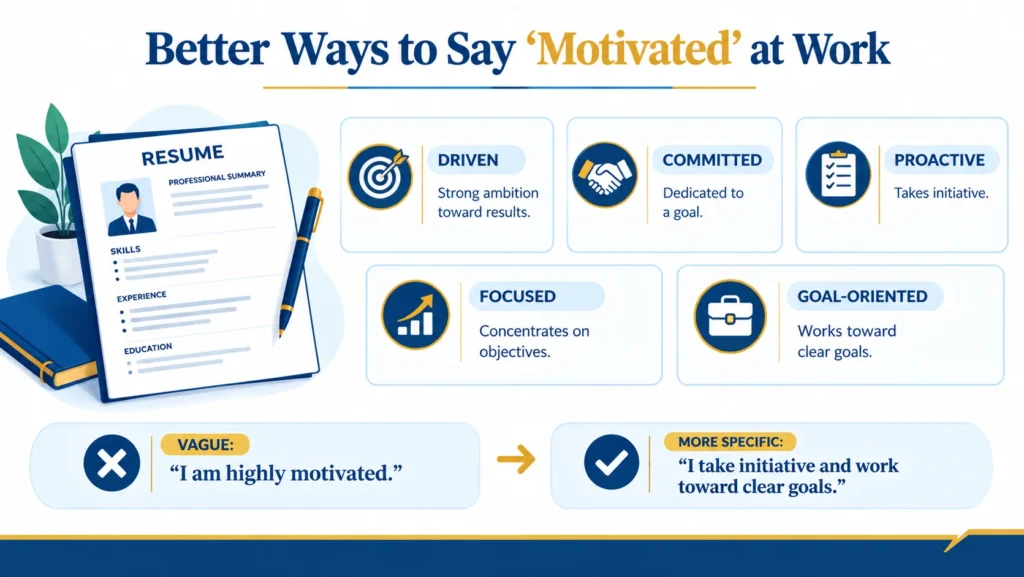
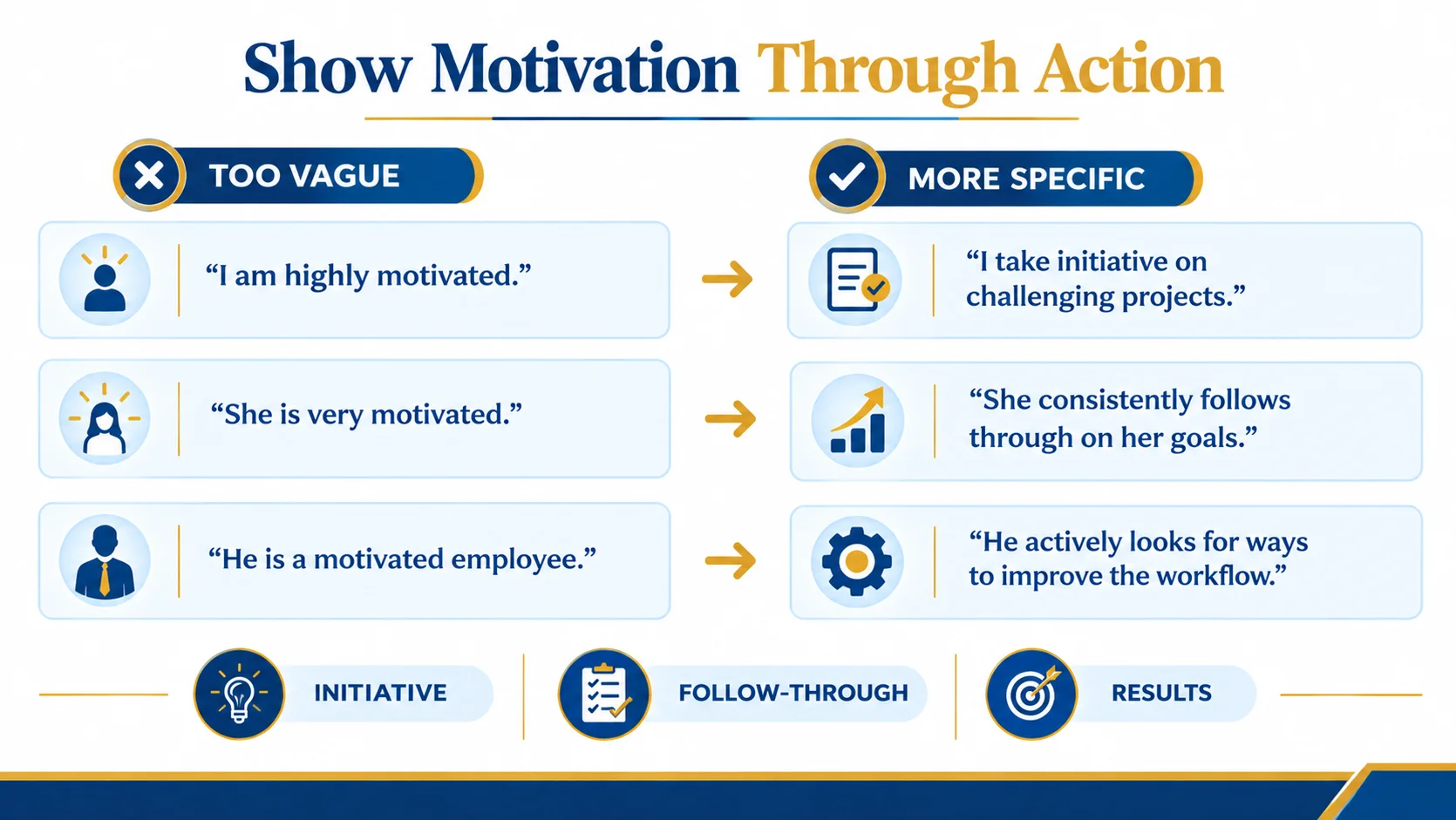
“Motivated” is common on resumes, but it can be vague when it appears without evidence. Career-focused search results similarly emphasize using concrete actions and results rather than relying only on a general claim of motivation.
Instead of:
Motivated marketing professional with strong communication skills.
Try making the behavior more specific:
Proactive marketing professional who developed campaigns to increase customer engagement.
Or:
Results-focused professional who led cross-functional projects and improved workflow efficiency.
The strongest replacement may not be another adjective at all. An action verb such as led, developed, initiated, improved, organized, achieved, or implemented can show motivation through something the person actually did.
Frequently Asked Questions
What is the best professional way to say “motivated”?
Depending on the intended meaning, driven, committed, dedicated, proactive, or goal-oriented can work well. Driven emphasizes achievement, committed emphasizes dedication, and proactive emphasizes initiative. For professional writing, choose the word that describes observable behavior or a specific quality rather than simply sounding stronger.
What is another word for motivated on a resume?
Useful choices include driven, proactive, committed, dedicated, ambitious, and goal-oriented. However, an action verb can sometimes be more effective. Instead of saying you are motivated, describe what you actually did: “led,” “initiated,” “developed,” “improved,” or “achieved.”
Is “driven” the same as “motivated”?
Not exactly. Both describe a desire to act or achieve something, but driven usually suggests stronger determination toward a goal or result. “She is motivated to learn” is broad, while “She is driven to succeed” places more emphasis on ambition and achievement.
What is a casual way to say motivated?
In casual conversation, you can say someone is eager, excited, fired up, or really into it, depending on the situation. These expressions emphasize enthusiasm or readiness rather than the professional qualities associated with words such as committed or goal-oriented.
What is a stronger word than motivated?
There is no single stronger word in every context. Determined can emphasize persistence, driven can emphasize achievement, and passionate can emphasize strong emotional interest. The best choice depends on which aspect of motivation you want to make stronger.
Can “enthusiastic” replace “motivated”?
Sometimes. Enthusiastic means excited or highly interested, while motivated focuses more broadly on having a reason or desire to act. For example, “She is enthusiastic about the project” highlights excitement, whereas “She is motivated to complete the project” highlights her willingness to achieve the goal.
What is the difference between motivated and proactive?
Motivated describes a person’s desire or willingness to act. Proactive describes taking action without waiting for instructions or problems. Someone may be motivated but still wait for direction, while a proactive person takes initiative. In professional writing, use proactive when initiative is the specific quality you want to communicate.
Conclusion
There are many natural ways to say “motivated,” but the best alternative depends on what you want the reader to notice. Choose driven when achievement matters, determined when persistence matters, and committed or dedicated when you want to emphasize steady effort.
Use enthusiastic or eager for excitement and willingness, while proactive is better when someone takes initiative. For resumes and professional profiles, consider replacing a general claim such as “motivated professional” with an action that demonstrates motivation.
The most precise alternative is not necessarily the strongest-sounding word—it is the one that accurately describes why the person acts and how that motivation appears.

Professional English Editor
Caleb Wrenford specializes in professional English, workplace communication, business writing, and formal expressions. His work helps readers communicate with greater clarity and confidence across emails, professional conversations, and written correspondence.