Finding another way to say work together can help you communicate more clearly, avoid repetition, and sound more natural in English.
Whether you’re writing a business email, preparing a team presentation, or talking about a shared project, the right phrase can make your message more effective.
Although “work together” fits many situations, other expressions can highlight teamwork, cooperation, shared responsibility, or a common goal. Here are 10 useful alternatives, along with their meanings, examples, and tips for using them correctly.
What Does “Another Way to Say Work Together” Mean?
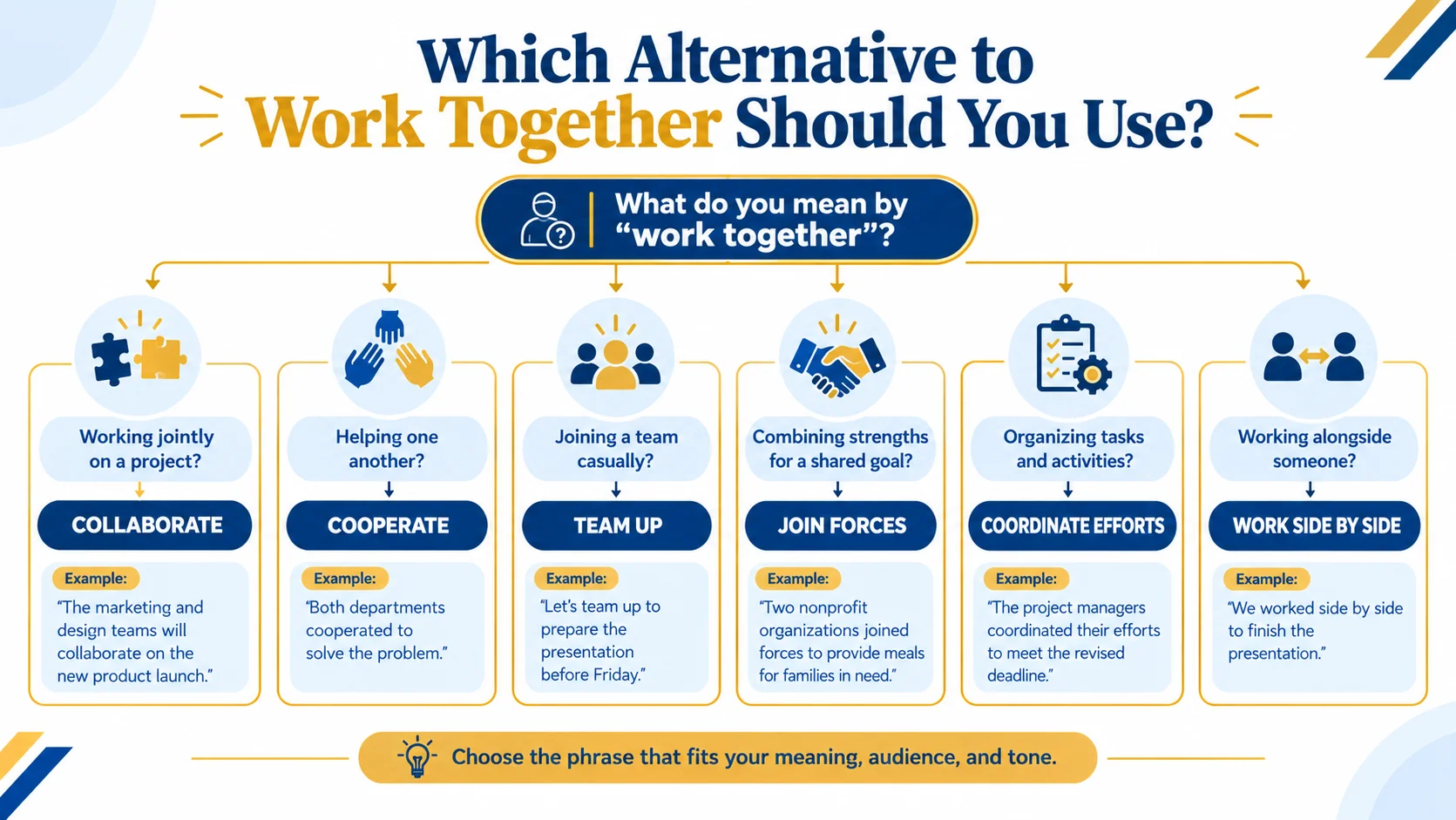
The phrase “another way to say work together” refers to alternative words or expressions that communicate the idea of people combining their efforts to complete a task or reach a shared goal.
People commonly use these expressions in workplaces, schools, community projects, business partnerships, and everyday conversations. For example, you might say that two departments collaborate on a project or that friends team up to organize an event.
Each alternative has a slightly different meaning. Some sound professional, while others feel casual, formal, or especially encouraging.
Why Use Other Ways to Say “Work Together”?
Using different expressions helps you match your language to the situation and explain teamwork more precisely.
Here are some benefits:
- Avoid repetition: Keep emails, essays, and presentations interesting.
- Sound more natural: Choose phrases that fit everyday American English.
- Improve professional communication: Describe partnerships and shared responsibilities clearly.
- Express the right tone: Sound friendly, formal, cooperative, or persuasive.
- Explain teamwork more accurately: Highlight shared goals, combined skills, or mutual support.
10 Best Other Ways to Say “Work Together”
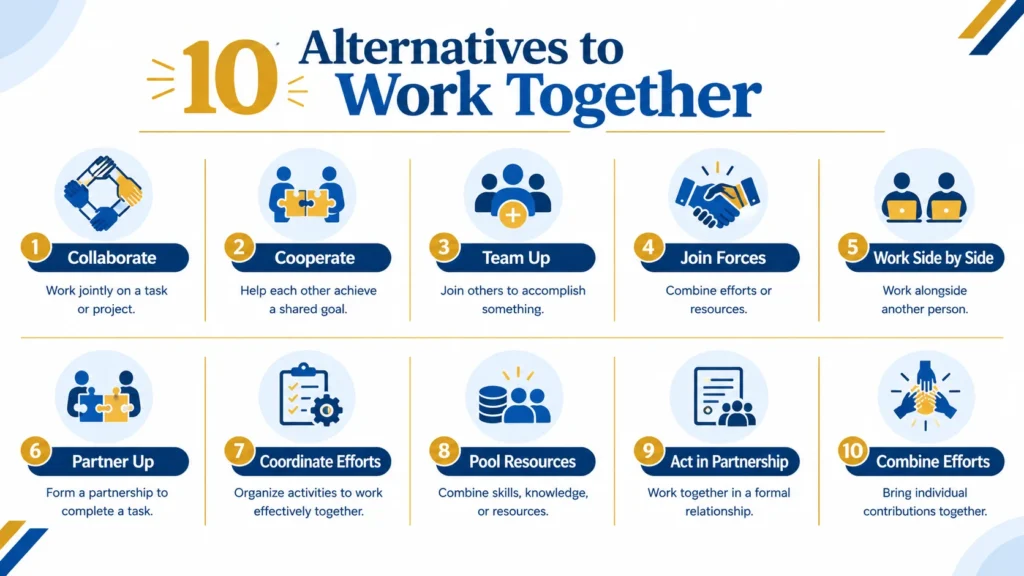
1. Collaborate
Meaning
“Collaborate” means working with one or more people to create something, solve a problem, or achieve a shared objective. It is one of the most useful alternatives to “work together” in professional and academic settings.
Best For: Professional, Formal
Example 1: Our marketing and design teams will collaborate on the new product launch.
Example 2: The researchers collaborated to develop a more effective testing method.
Quick Tip: Use “collaborate on” when naming a project or task, such as collaborating on a report or presentation.
2. Team Up
Meaning
“Team up” means joining another person or group to accomplish something. It sounds friendly and energetic, making it a natural choice for casual conversations, workplace discussions, and shared activities.
Best For: Casual, Friendly, Professional
Example 1: Let’s team up to prepare the conference presentation before Friday.
Example 2: Three local businesses teamed up to organize a neighborhood food drive.
Quick Tip: Use “team up with” to identify your partner, as in “I teamed up with my coworker.”
3. Cooperate
Meaning
“Cooperate” means helping others and making an effort to achieve a common goal. Unlike “collaborate,” which often suggests creating or developing something together, “cooperate” can emphasize willingness, coordination, and following shared plans.
Best For: Professional, Formal, Polite
Example 1: Both departments must cooperate to complete the audit on schedule.
Example 2: The event organizers cooperated with city officials to manage traffic.
Quick Tip: Choose “cooperate” when emphasizing helpful behavior or coordination rather than joint creative work.
4. Join Forces
Meaning
“Join forces” means combining the efforts, skills, or resources of two or more people or groups. It often suggests a purposeful partnership in which everyone contributes toward an important objective.
Best For: Professional, Friendly, Formal
Example 1: Two nonprofit organizations joined forces to provide meals for families in need.
Example 2: Our sales and customer service teams will join forces to improve client support.
Quick Tip: Use this phrase when you want to emphasize the strength that comes from combining resources or expertise.
5. Work in Partnership
Meaning
“Work in partnership” describes a cooperative relationship in which people or organizations contribute toward a shared objective. It sounds more formal than “team up” and can suggest an ongoing relationship with shared responsibilities.
Best For: Professional, Formal, Polite
Example 1: Our company works in partnership with local schools to support career training.
Example 2: The two agencies will work in partnership to expand access to public services.
Quick Tip: Choose this phrase for business proposals, official statements, and discussions about long-term relationships.
6. Coordinate Efforts
Meaning
“Coordinate efforts” means organizing different people’s activities so their work fits together effectively. This expression is especially useful when several teams have separate responsibilities but need to stay aligned.
Best For: Professional, Formal
Example 1: The project managers coordinated their efforts to meet the revised deadline.
Example 2: We need to coordinate our efforts before the new store opens.
Quick Tip: Use this phrase when planning, timing, communication, and organization matter as much as the work itself.
7. Join Hands
Meaning
“Join hands” means coming together to support a cause or achieve something collectively. It often carries a warm, community-focused, or inspirational tone, although it can sound less direct than other expressions in everyday American business writing.
Best For: Friendly, Warm, Formal
Example 1: Neighbors joined hands to rebuild the community garden after the storm.
Example 2: Local volunteers joined hands to collect school supplies for children.
Quick Tip: This expression works best for community initiatives, charitable causes, and messages about shared commitment.
8. Pool Resources
Meaning
“Pool resources” means combining available money, knowledge, equipment, time, or other assets to accomplish a goal. It focuses on what people contribute rather than simply stating that they work together.
Best For: Professional, Formal
Example 1: The two departments pooled their resources to purchase new software.
Example 2: Several small businesses pooled their marketing budgets for a regional campaign.
Quick Tip: Use this phrase when people are sharing practical resources, not just discussing ideas or dividing tasks.
9. Partner Up
Meaning
“Partner up” means joining another person or group to complete a task or participate in an activity. It is a straightforward, approachable expression that works well in classrooms, workplaces, and informal group settings.
Best For: Casual, Friendly, Professional
Example 1: Please partner up with a colleague to review the training materials.
Example 2: The two developers partnered up to build a scheduling app.
Quick Tip: Use “partner up with” when you want to make it clear who will be working alongside whom.
10. Collaborate Closely
Meaning
“Collaborate closely” means working with frequent communication, active involvement, and a strong focus on shared progress. It emphasizes the quality and consistency of the working relationship rather than simply the fact that people are involved in the same project.
Best For: Professional, Formal, Polite
Example 1: Our account managers will collaborate closely with clients during the transition.
Example 2: The engineering team collaborated closely with the safety experts before approving the design.
Quick Tip: Use this phrase when a project requires regular communication, feedback, and careful coordination between participants.
Comparison Table
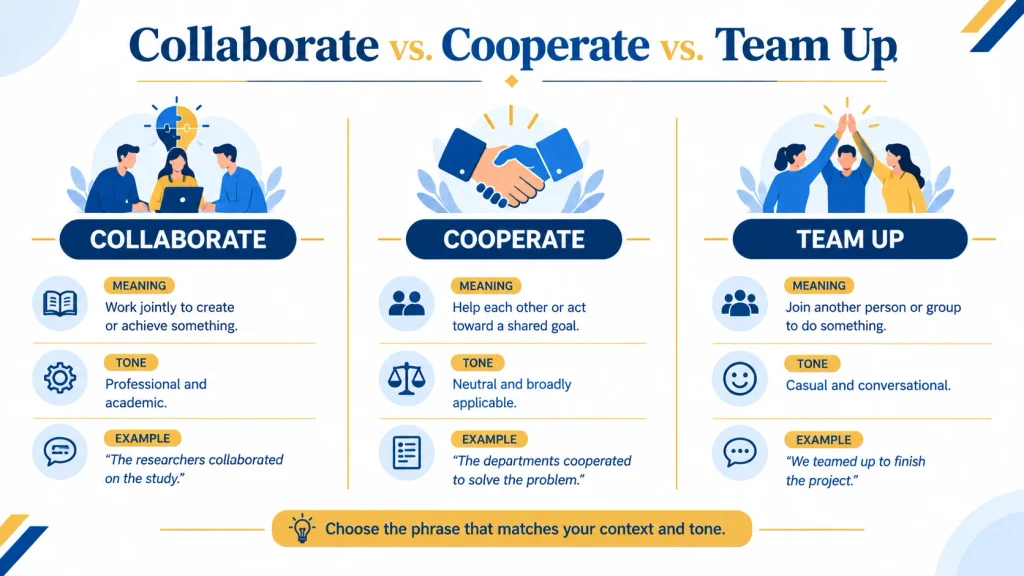
| Alternative | Best Used In | Tone |
| Collaborate | Business projects and research | Professional |
| Team up | Everyday tasks and group activities | Casual |
| Cooperate | Shared responsibilities | Formal |
| Join forces | Joint initiatives and campaigns | Confident |
| Work in partnership | Business relationships | Formal |
| Coordinate efforts | Project planning | Professional |
| Join hands | Community causes | Warm |
| Pool resources | Shared budgets and tools | Practical |
| Partner up | Assignments and projects | Friendly |
| Collaborate closely | Ongoing projects | Professional |
Common Mistakes
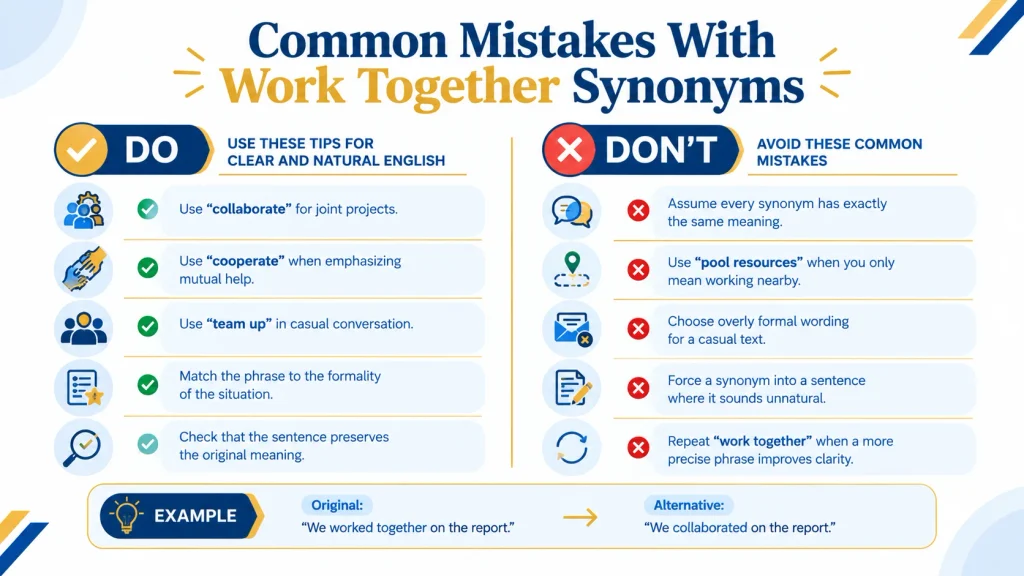
1. Using casual phrases in formal emails. “Team up” may sound too relaxed in some official documents. Choose “collaborate” or “work in partnership” when a more professional tone is appropriate.
2. Choosing overly formal language. Expressions such as “work in partnership” can sound stiff in a friendly conversation. Match your wording to the audience.
3. Repeating the same phrase. Using “work together” in every paragraph can make your writing repetitive. Choose alternatives that fit each sentence naturally.
4. Ignoring the context. “Pool resources” refers to combining assets, while “coordinate efforts” focuses on organizing activities. Select a phrase that communicates the intended meaning.
5. Making teamwork sound insincere. Avoid exaggerated statements about collaboration if people are not genuinely sharing responsibilities. Use clear language that reflects the actual working relationship.
Frequently Asked Questions
1. What is a professional way to say work together?
“Collaborate” is one of the best professional alternatives to “work together.” You can also use “coordinate efforts,” “work in partnership,” or “collaborate closely.” Choose the phrase based on the situation: collaboration often emphasizes joint work, while coordination highlights keeping activities organized and aligned.
2. What is another word for working together?
“Collaboration” is a common noun for the process of working together. Other useful words include cooperation, teamwork, partnership, and coordination. Each has a slightly different meaning, so select one that reflects whether people are sharing ideas, helping one another, managing tasks, or maintaining a business relationship.
3. How do you say work together in a business email?
You can write, “I look forward to collaborating with your team,” or “We appreciate the opportunity to work in partnership with you.” Both options sound professional and positive. For ongoing projects, “We will coordinate our efforts” is useful when you want to emphasize planning and communication.
4. What is a casual way to say work together?
“Team up” and “partner up” are natural casual alternatives. For example, you might say, “Let’s team up to finish the assignment” or “We can partner up for the presentation.” These phrases work well with coworkers, classmates, and friends without sounding overly formal.
5. Is collaboration the same as working together?
The two expressions are closely related, but they are not always interchangeable. “Work together” is a broad phrase for people contributing to a task. “Collaborate” often suggests actively sharing ideas, knowledge, or skills to produce a result. The best choice depends on the kind of teamwork you want to describe.
6. How can I describe two teams working together?
You can say that the teams collaborate, coordinate their efforts, or join forces. Use “collaborate” when they contribute to shared work, “coordinate their efforts” when they align separate tasks, and “join forces” when you want to emphasize their combined strengths toward a common goal.
7. What is another way to say work together toward a common goal?
“Collaborate toward a shared goal” and “join forces to achieve a common objective” are effective alternatives. You could also say “work in partnership to reach our goals.” These expressions fit business writing, project proposals, team presentations, and discussions about shared achievements.
8. How do I avoid repeating work together in an essay?
Use alternatives such as “collaborate,” “cooperate,” “coordinate efforts,” and “form a partnership” where they accurately express your meaning. You can also describe the specific action, such as sharing ideas or combining resources. Prioritize clarity over variety, and avoid replacing a familiar phrase with an unfamiliar one just to sound different.
Conclusion
Choosing another way to say work together can make your writing clearer, more natural, and better suited to your audience. For professional emails, reports, and business projects, “collaborate” is a reliable choice. If you want a relaxed expression for friends or coworkers, “team up” and “partner up” sound approachable. When describing shared responsibilities, “cooperate” and “coordinate efforts” may communicate your meaning more precisely.
For partnerships involving several organizations, “join forces” and “work in partnership” highlight a shared commitment. Meanwhile, “pool resources” is especially useful when people combine money, skills, or equipment.
Before choosing a phrase, consider your audience, purpose, and intended tone. The strongest wording is not necessarily the most formal or sophisticated. It is the expression that conveys your message accurately and helps readers understand how people contribute to a common goal.

Professional English Editor
Caleb Wrenford specializes in professional English, workplace communication, business writing, and formal expressions. His work helps readers communicate with greater clarity and confidence across emails, professional conversations, and written correspondence.