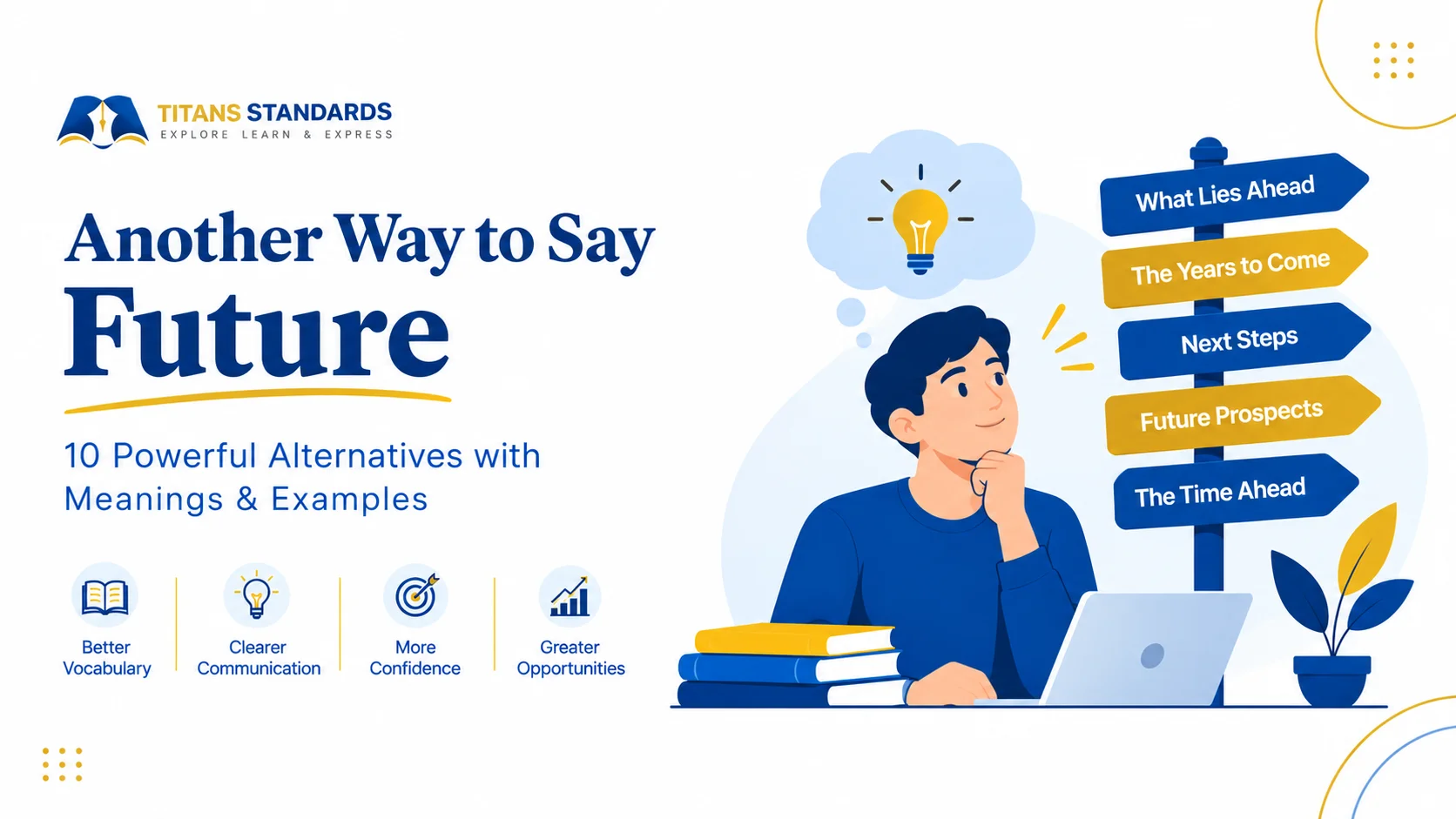
Another way to say future includes “what lies ahead,” “the time ahead,” “the years to come,” “days to come,” and “what’s next.” For professional writing, use “long-term outlook” or “future prospects.” For casual conversations, “what’s next” sounds natural. The best alternative depends on your sentence, audience, and intended meaning.
Key Takeaways
- “What lies ahead” works well when discussing possibilities and upcoming events.
- “The years to come” is ideal for long-term plans and expectations.
- “Future prospects” suits professional, academic, and career-related writing.
- “What’s next” fits casual conversations and questions about upcoming events.
- Choose a synonym based on context rather than replacing “future” automatically.
What Does “Another Way to Say Future” Mean?
The phrase “another way to say future” refers to alternative words or expressions that communicate the time ahead, upcoming events, or possibilities that have not happened yet.
People search for these alternatives to improve their writing, avoid repeating the same word, and express ideas more clearly. Common examples include “what lies ahead,” “the years to come,” and “future prospects.”
You can use these expressions in professional emails, school assignments, business reports, personal conversations, and creative writing. However, each phrase has a slightly different meaning and tone.
Why Use Other Ways to Say “Future”?
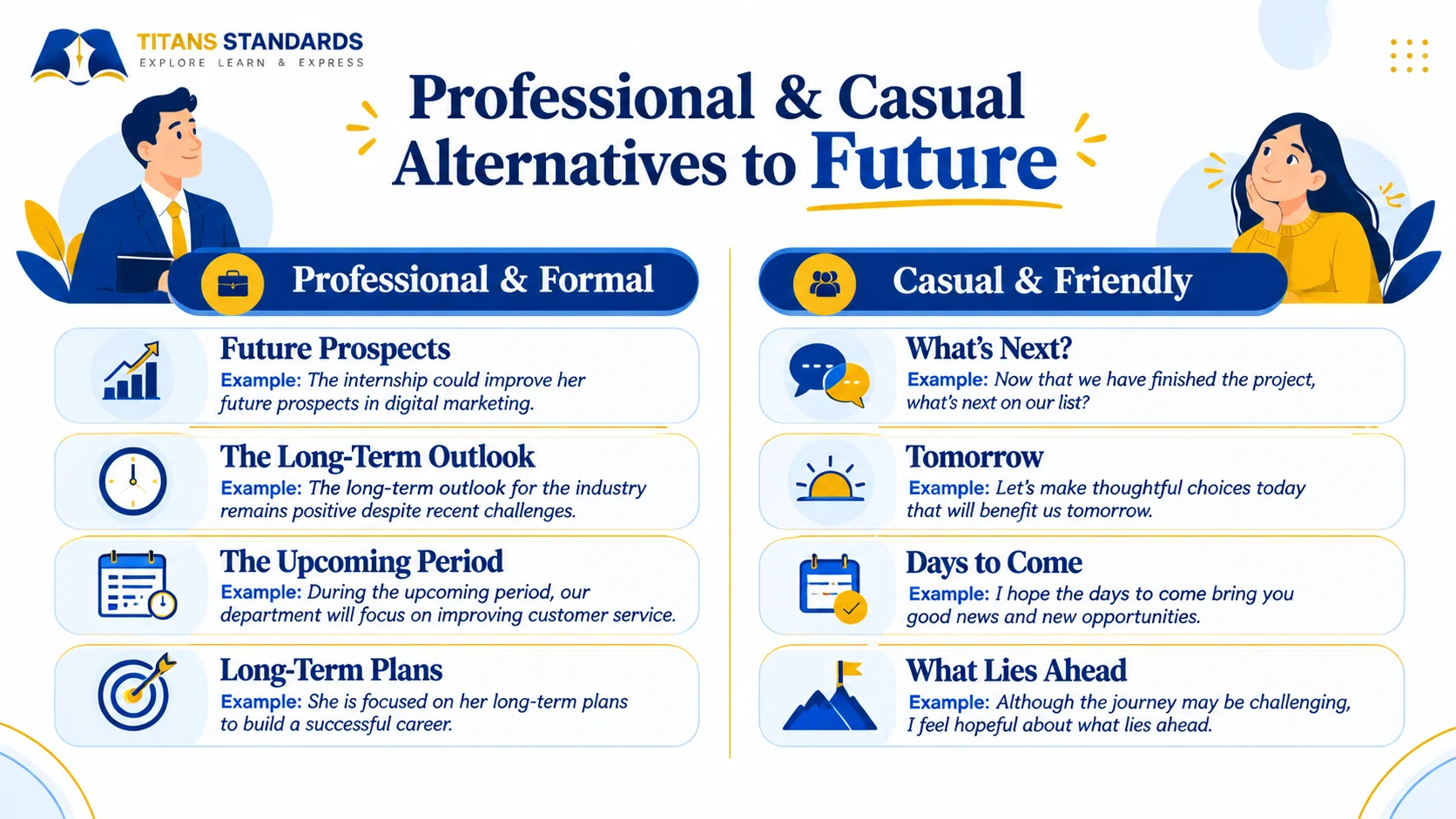
Using alternative expressions can make your writing more precise and engaging. Instead of repeating “future” several times, you can select a phrase that better reflects your intended meaning.
Here are five reasons to explore other ways to say future:
- Avoid repetition: Keep articles, essays, and reports interesting.
- Sound more natural: Choose expressions that fit everyday American English.
- Match different situations: Use casual wording with friends and formal language at work.
- Improve professional communication: Describe business forecasts, career goals, and upcoming projects clearly.
- Express ideas more accurately: Distinguish between immediate plans, long-term expectations, and possible opportunities.
10 Best Other Ways to Say “Future”
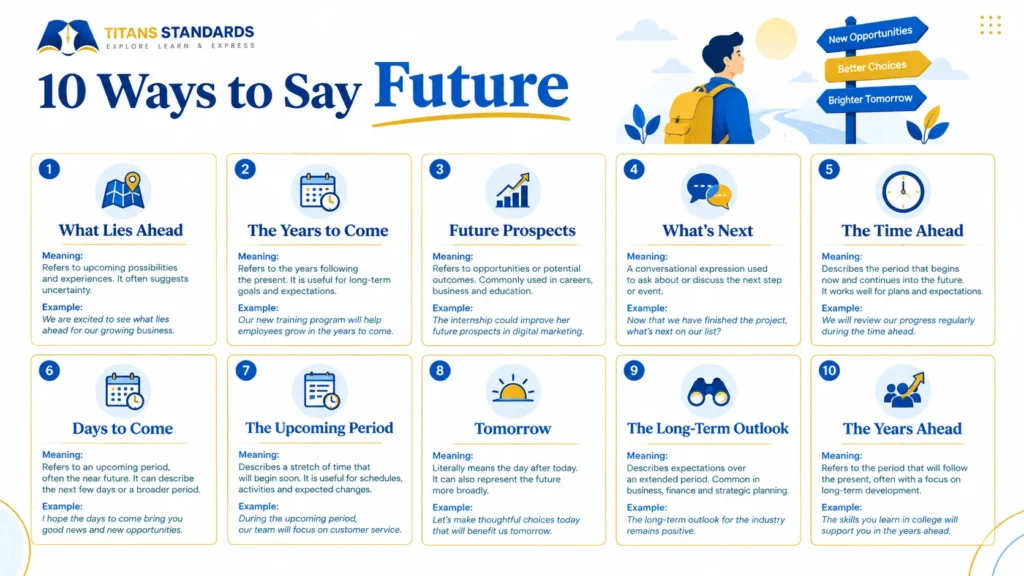
1. What Lies Ahead
Meaning
“What lies ahead” describes events, experiences, or possibilities that may happen in the future. It often suggests uncertainty because no one knows exactly how things will develop.
Best For
- Professional
- Formal
- Warm
Example 1
We are excited to see what lies ahead for our growing business.
Example 2
Although the next chapter may bring challenges, I feel hopeful about what lies ahead.
Quick Tip
Use this expression when discussing possibilities or upcoming experiences rather than a specific date or deadline.
2. The Years to Come
Meaning
“The years to come” refers to the years that follow the present. It is especially useful when discussing long-term goals, relationships, career plans, or lasting changes.
Best For
- Professional
- Formal
- Warm
Example 1
Our new training program will help employees build valuable skills in the years to come.
Example 2
We hope our partnership continues to grow in the years to come.
Quick Tip
Choose this phrase when discussing long-term expectations, not events that will happen in the next few hours or days.
3. Future Prospects
Meaning
“Future prospects” refers to the opportunities or potential outcomes that someone or something may have. This expression commonly appears in discussions about careers, education, business growth, and professional development.
Best For
- Professional
- Formal
Example 1
The internship could improve her future prospects in digital marketing.
Example 2
The company is investing in new technology to strengthen its future prospects.
Quick Tip
Use “future prospects” when discussing opportunities or potential success. It is not a direct replacement for “future” in every sentence.
4. What’s Next
Meaning
“What’s next” is a conversational expression used to ask about or discuss the next event, step, or development. It focuses on what will happen after the current situation.
Best For
- Casual
- Friendly
- Polite
Example 1
Now that we have finished the first assignment, what’s next on our list?
Example 2
I’m curious to see what’s next for the team after this major announcement.
Quick Tip
Use this phrase in everyday conversations, meetings, and informal updates. In formal reports, “next steps” may be more appropriate.
5. The Time Ahead
Meaning
“The time ahead” describes the period that begins now and continues into the future. It works well when discussing plans, expectations, or changes that may develop over time.
Best For
- Professional
- Formal
- Polite
Example 1
We will review our progress regularly during the time ahead.
Example 2
The time ahead will require patience, careful planning, and teamwork.
Quick Tip
Use this expression when emphasizing a period of time rather than one particular event.
6. Days to Come
Meaning
“Days to come” refers to an upcoming period, often the near future. Depending on the context, it can describe the next few days or a broader period of expected change.
Best For
- Casual
- Friendly
- Warm
Example 1
We expect to receive the final results in the days to come.
Example 2
I hope the days to come bring you good news and new opportunities.
Quick Tip
This phrase often sounds reassuring or conversational. If a deadline matters, include the exact date instead.
7. The Upcoming Period
Meaning
“The upcoming period” describes a stretch of time that will begin soon or is approaching. It is useful in business communication when discussing schedules, planned activities, or expected changes.
Best For
- Professional
- Formal
Example 1
During the upcoming period, our department will focus on improving customer service.
Example 2
We expect demand to increase during the upcoming period.
Quick Tip
This expression works best when readers understand which period you mean. Add dates or a time frame when greater precision is needed.
8. Tomorrow
Meaning
“Tomorrow” literally means the day after today. It can also represent the future more broadly, especially in motivational writing, speeches, and conversations about new opportunities.
Best For
- Casual
- Friendly
- Warm
Example 1
Let’s make thoughtful choices today that will benefit us tomorrow.
Example 2
She believes tomorrow will bring better opportunities for her family.
Quick Tip
Use “tomorrow” literally when referring to the next day. When using it symbolically, make sure the broader meaning is clear.
9. The Long-Term Outlook
Meaning
“The long-term outlook” describes expectations about how a situation may develop over an extended period. It commonly appears in business, finance, career planning, and strategic discussions.
Best For
- Professional
- Formal
Example 1
The long-term outlook for the industry remains positive despite recent challenges.
Example 2
Before expanding overseas, the company evaluated the long-term outlook for its products.
Quick Tip
Choose this phrase when discussing trends, forecasts, or expected outcomes over time. It is more specific than the general word “future.”
10. The Years Ahead
Meaning
“The years ahead” refers to the period that will follow the present, often emphasizing long-term experiences, challenges, or opportunities. Depending on the sentence, it can sound optimistic, reflective, or neutral.
Best For
- Professional
- Formal
- Warm
Example 1
The skills you learn in college will support you throughout the years ahead.
Example 2
The community is preparing for the changes expected in the years ahead.
Quick Tip
Use “the years ahead” when discussing long-term development. Unlike “what’s next,” it suggests a broader period rather than the immediate next step.
Comparison Table
| Alternative | Best Used In | Tone |
| What lies ahead | Personal reflections and planning | Thoughtful |
| The years to come | Long-term goals and relationships | Warm |
| Future prospects | Careers and business opportunities | Formal |
| What’s next | Conversations and immediate plans | Casual |
| The time ahead | General plans and expectations | Professional |
| Days to come | Near-term expectations | Friendly |
| The upcoming period | Business updates and schedules | Professional |
| Tomorrow | Everyday speech and motivational writing | Hopeful |
| The long-term outlook | Forecasts and strategic planning | Analytical |
| The years ahead | Long-term changes and development | Reflective |
Common Mistakes
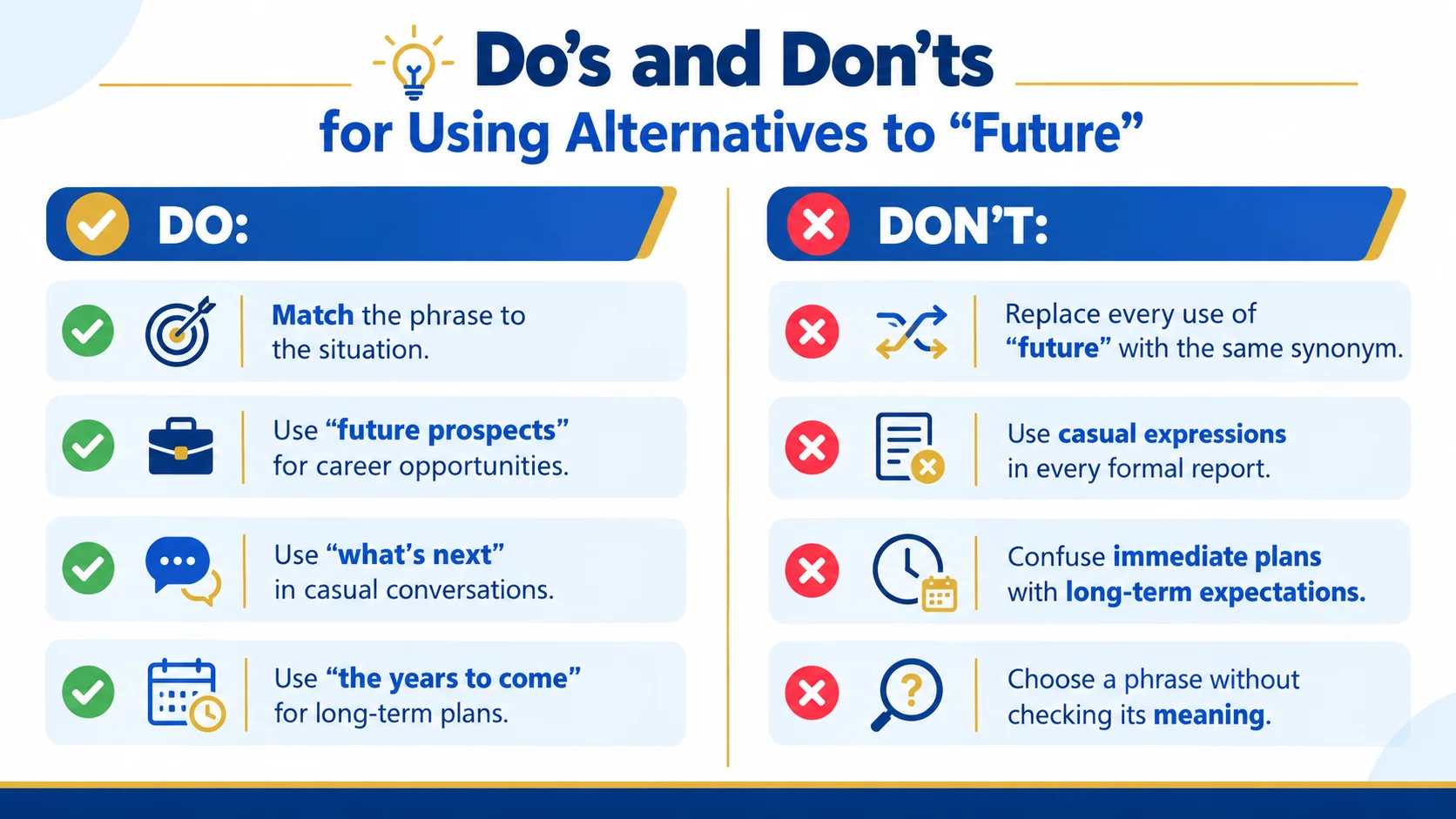
1. Using Casual Phrases in Professional Emails
Expressions such as “what’s next” may sound too informal in a formal report. Consider “next steps,” “future prospects,” or “the long-term outlook,” depending on your message.
2. Choosing Overly Formal Language
Phrases such as “the upcoming period” can sound stiff in everyday conversations. Use simpler expressions, such as “the days ahead,” when speaking with friends or family.
3. Repeating the Same Phrase
Using “the future” in every paragraph can make an article repetitive. Vary your wording when the alternatives accurately communicate your intended meaning.
4. Ignoring Context
“The years to come” suggests a long period, while “tomorrow” usually refers to the next day. These expressions are not interchangeable in every sentence.
5. Making Unrealistic Promises
Saying “the future will definitely be amazing” can sound insincere when outcomes are uncertain. Use balanced language that expresses hope without presenting uncertain events as guaranteed.
Frequently Asked Questions
1. What is another word for future?
Common alternatives include “outlook,” “prospects,” “tomorrow,” and “destiny,” but each has a different meaning. “Outlook” describes expectations, while “prospects” often refers to opportunities. “Destiny” suggests a predetermined course of events. Choose the word that best fits your sentence rather than treating all these terms as exact synonyms.
2. What is a professional way to say future?
Professional alternatives include “long-term outlook,” “future prospects,” “upcoming period,” and “long-term plans.” For example, you could write, “The long-term outlook for the project remains positive.” These phrases are useful in business reports, presentations, workplace emails, and strategic planning because they communicate a more specific idea.
3. What is another way to say the future looks bright?
You can say “the outlook is promising,” “positive prospects lie ahead,” or “there are encouraging opportunities ahead.” These expressions communicate optimism without repeating the same phrase. For a professional report, “the outlook is promising” works well. In a personal message, “good things are ahead” sounds warmer and more conversational.
4. How can I say future in a formal essay?
In a formal essay, consider expressions such as “the years ahead,” “long-term outlook,” “future implications,” or “prospective developments.” The best choice depends on your topic. Use “future implications” when discussing possible consequences and “long-term outlook” when evaluating how a situation may develop over time.
5. What is a casual way to say future?
Casual alternatives include “what’s next,” “tomorrow,” “the days ahead,” and “what’s coming.” For example, you might ask, “What’s next for us?” when talking about plans with a friend. These phrases sound natural in everyday conversation, but some refer to the next event rather than the entire future.
6. What is another way to say future plans?
You can use “upcoming plans,” “long-term goals,” “next steps,” or “plans for the years ahead.” Each expression serves a slightly different purpose. “Next steps” refers to immediate actions, while “long-term goals” describes objectives you hope to achieve over an extended period.
7. Is “what lies ahead” the same as “the future”?
They are similar, but they are not always interchangeable. “The future” is a broad term for the time after the present. “What lies ahead” often emphasizes upcoming experiences, possibilities, or uncertainties. For example, “We cannot predict what lies ahead” highlights uncertainty more naturally than some alternatives.
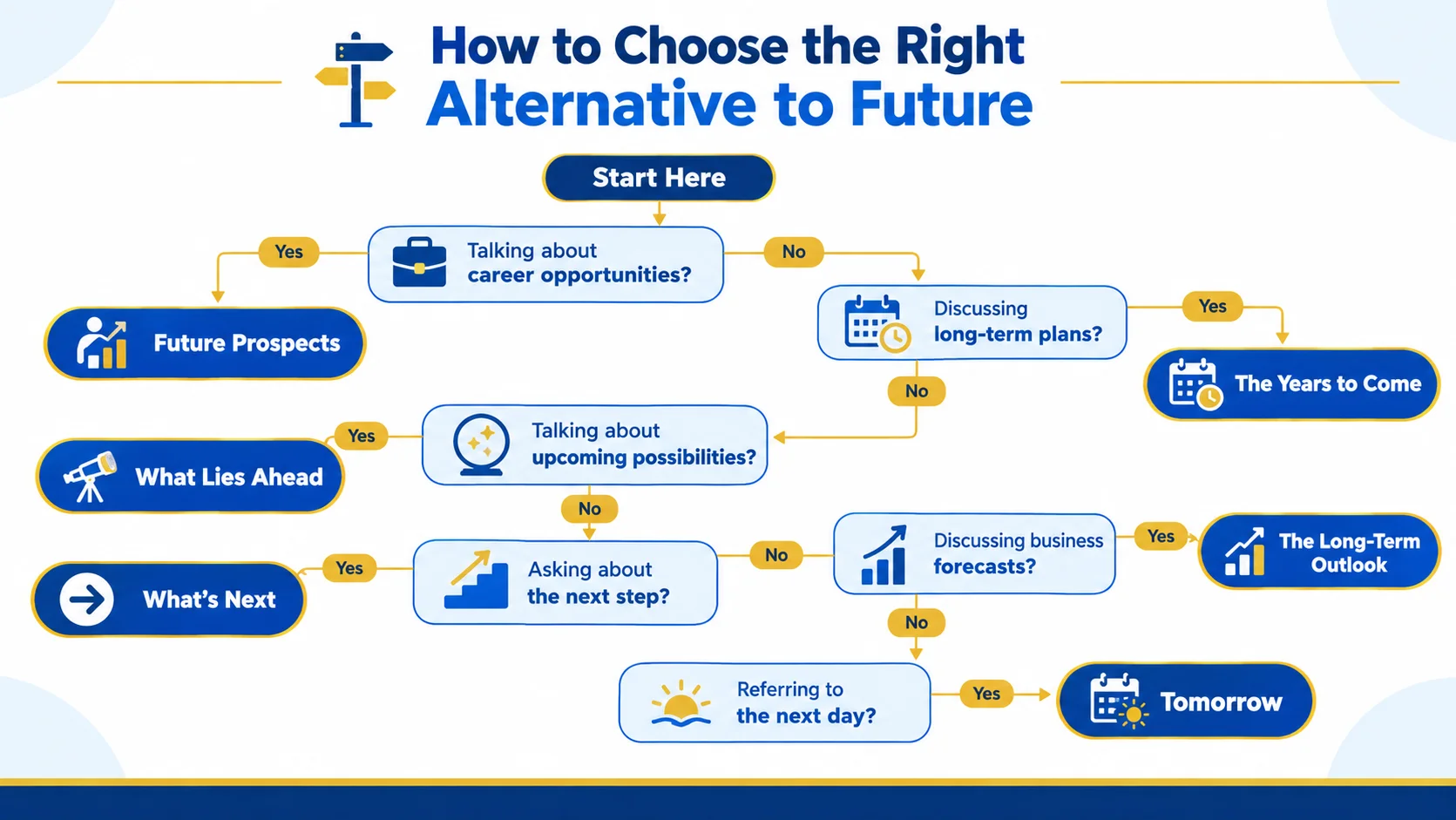
8. How do I choose the best synonym for future?
Start by identifying what you mean: upcoming events, long-term goals, possible opportunities, or expected outcomes. Then consider your audience and tone. Use “what’s next” in casual conversation, “future prospects” for professional opportunities, and “the years to come” for long-term plans. Read the full sentence aloud to check that the phrase sounds natural.
Conclusion
Choosing another way to say future can make your writing clearer, more engaging, and more precise. The best alternative depends on what you want to communicate and who will read your words.
For professional writing, “future prospects” and “the long-term outlook” work well when discussing opportunities, business plans, and expected outcomes. For everyday conversations, “what’s next” and “days to come” sound more natural. Meanwhile, “what lies ahead” and “the years to come” are useful for expressing hope, uncertainty, or long-term expectations.
Remember that synonyms do not always carry exactly the same meaning. Consider the context, the time frame, and the tone before choosing a replacement.
Helpful takeaway: If you want a versatile expression that works in many situations, try “what lies ahead.” If you need a more specific phrase, choose one that directly reflects your intended meaning