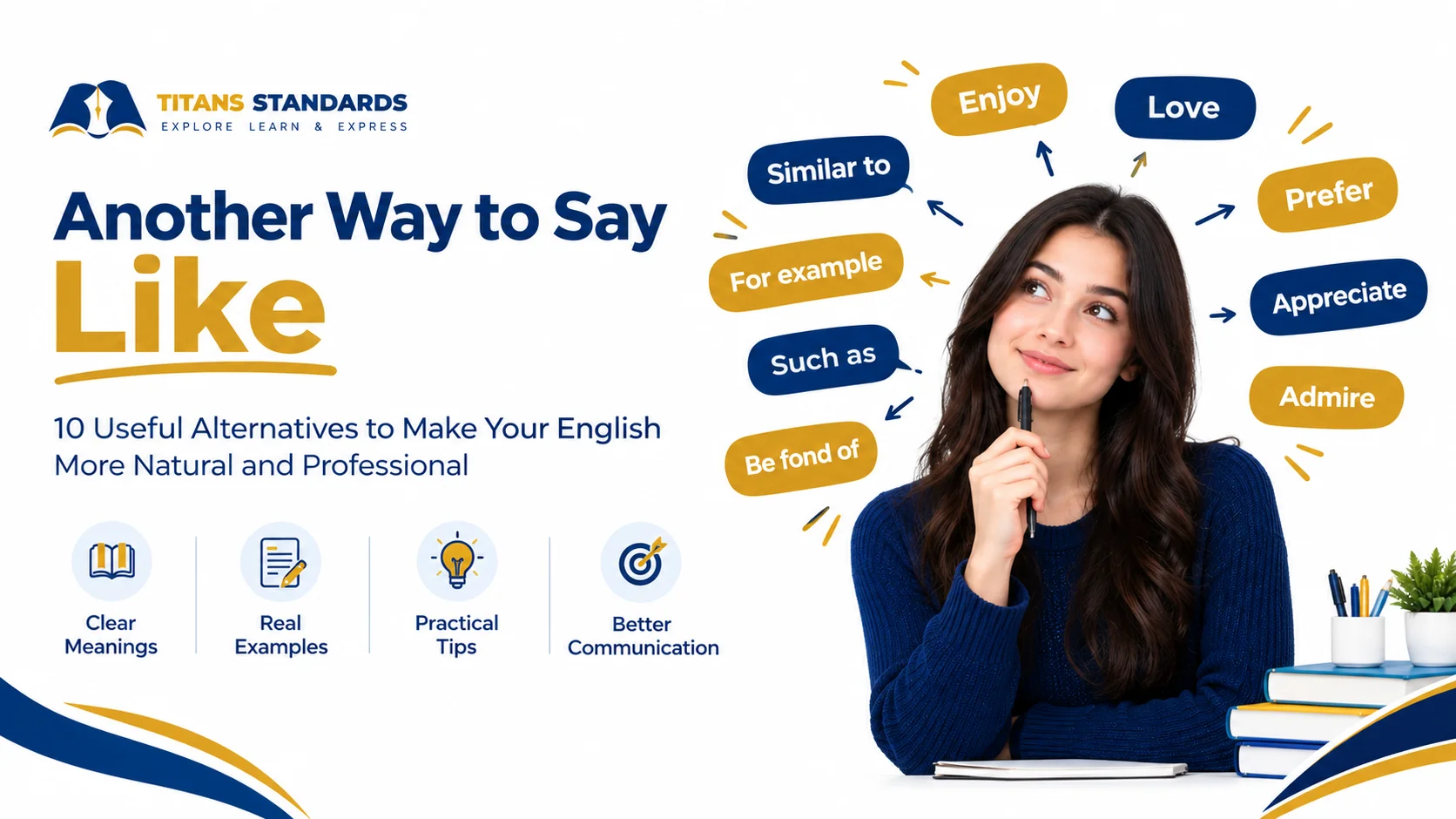
Another way to say “like” depends on the meaning of the sentence. Use enjoy to express pleasure, love for strong feelings, prefer to show a choice, appreciate to recognize value, and admire to express respect. When comparing things, use “similar to.” When giving examples, use “such as” or “for example.”
Key Takeaways
- Use “enjoy” when talking about activities you find pleasurable.
- Choose “love” or “adore” to express stronger positive feelings.
- Use “prefer” when comparing choices or expressing a favorite.
- Replace “like” with “similar to” when describing similarities.
- Use “such as” or “for example” when introducing examples in writing
What Does “Like” Mean?
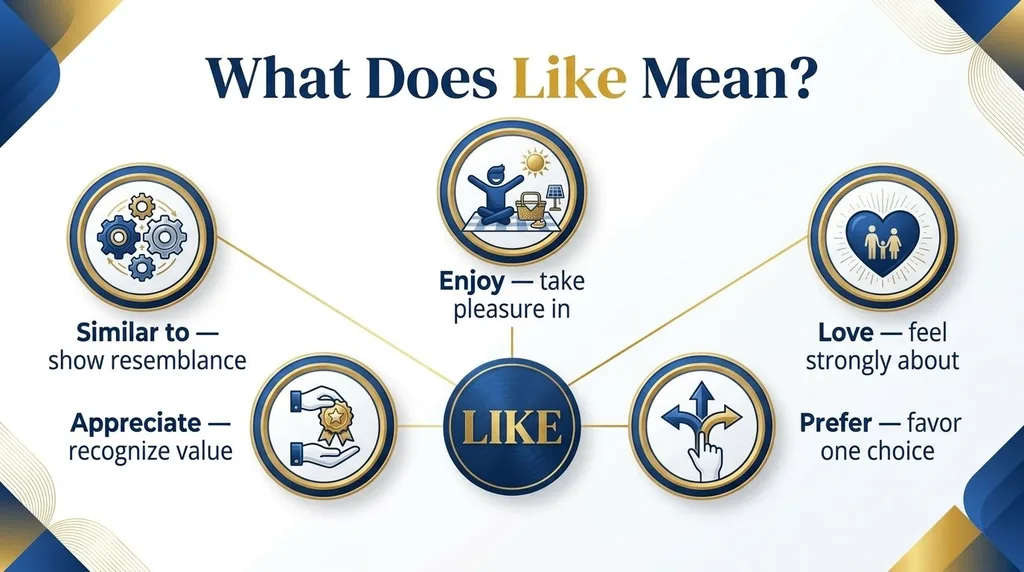
The word “like” has several meanings in American English. It can express enjoyment, show a preference, describe similarities, or introduce examples.
For example, “I like reading” expresses enjoyment, while “She looks like her mother” describes a resemblance. In a sentence such as “Outdoor activities like hiking,” the word introduces examples.
People use “like” because it is simple, familiar, and flexible. However, choosing a more specific word can make your meaning clearer and your writing more effective.
Why Use Other Ways to Say “Like”?
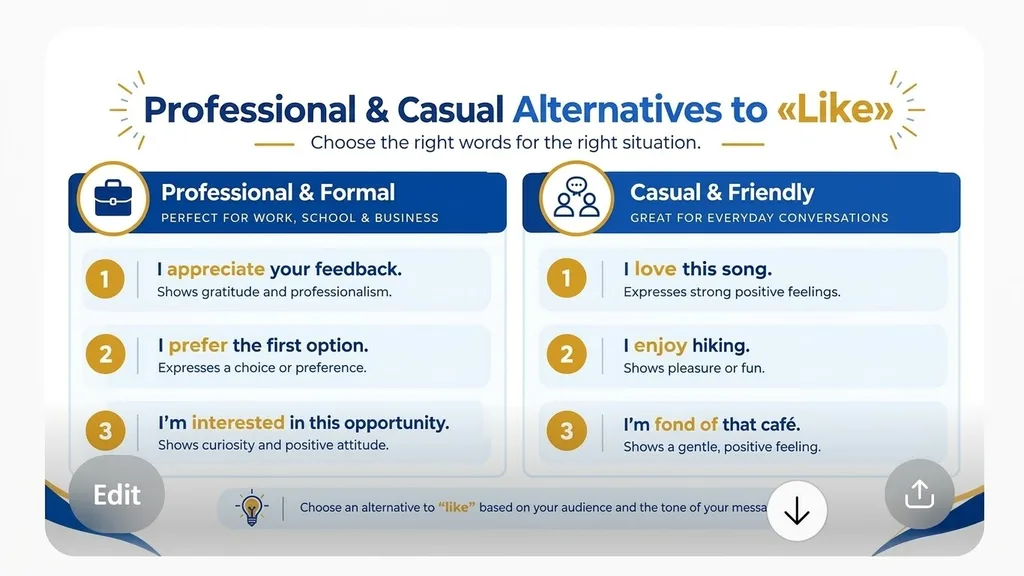
Using alternative phrases helps you communicate with greater variety and accuracy. It also allows you to adjust your language to different situations.
Consider these benefits:
- Avoid repetition: Keep paragraphs and conversations from sounding monotonous.
- Sound more natural: Choose expressions that fit everyday American English.
- Improve professional communication: Make business emails and reports more precise.
- Express stronger feelings: Show whether you enjoy, love, appreciate, or admire something.
- Write more clearly: Separate preferences, comparisons, and examples.
Remember that these alternatives are not always interchangeable. Choose the phrase that matches your intended meaning.
10 Best Other Ways to Say “Like”
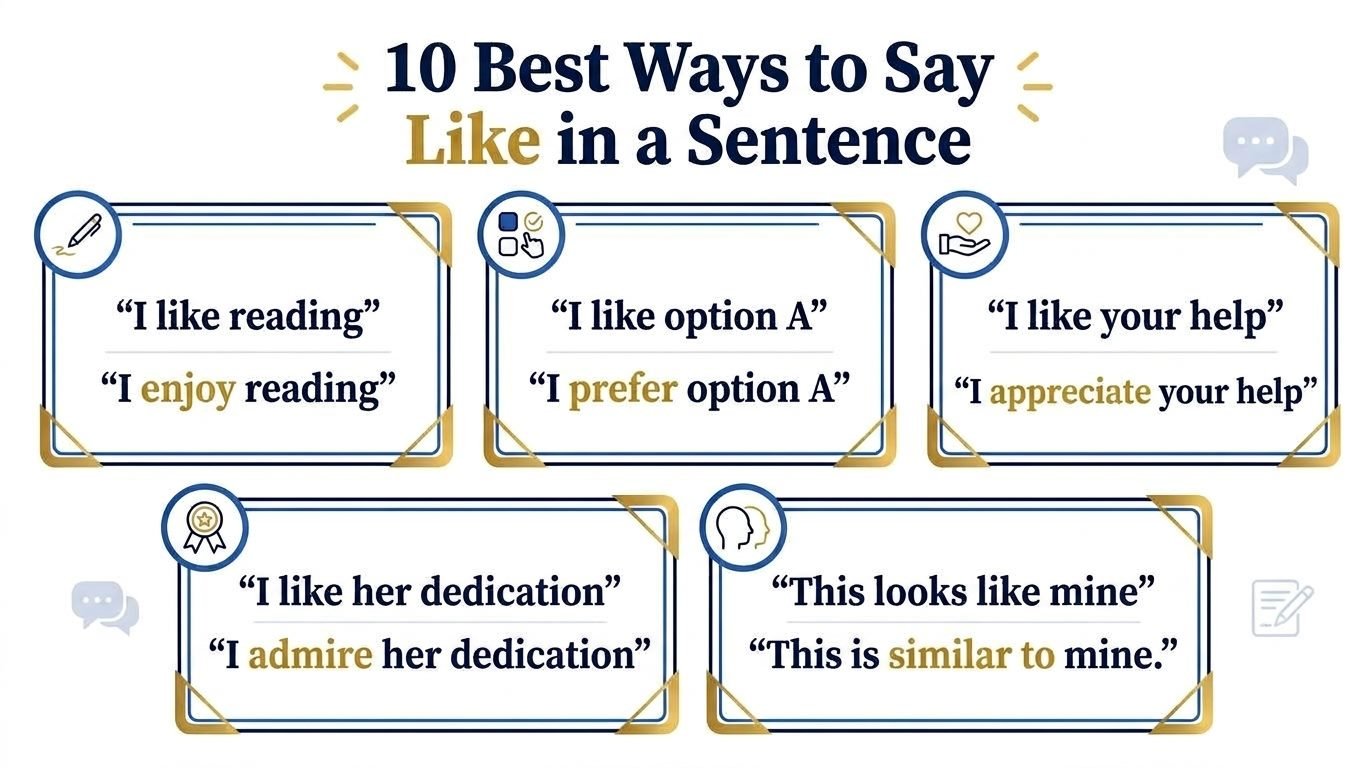
1. Enjoy
Meaning
“Enjoy” means to take pleasure in an activity, experience, or thing. It is one of the most natural alternatives when “like” describes something you find pleasant.
Best For
- Professional
- Casual
- Friendly
Example 1
I enjoy reading mystery novels on the weekends.
Example 2
Our team enjoys working together on creative projects.
Quick Tip
Use “enjoy” when describing activities or experiences, especially in professional bios, personal introductions, and everyday conversations.
2. Love
Meaning
“Love” expresses a stronger positive feeling than “like.” It works well when you feel enthusiastic about a person, activity, place, or experience.
Best For
- Casual
- Friendly
- Warm
Example 1
I love spending summer evenings at the beach.
Example 2
She loves the new coffee shop near her office.
Quick Tip
Use “love” when you genuinely feel strongly about something. In professional writing, consider whether its emotional tone suits the audience.
3. Prefer
Meaning
“Prefer” means to favor one option over another. It is especially useful when discussing choices, habits, or personal preferences.
Best For
- Professional
- Formal
- Polite
Example 1
I prefer morning meetings because I feel more focused.
Example 2
Our customers prefer receiving updates by email.
Quick Tip
When comparing two things, use “prefer A to B” or “prefer doing one thing to doing another.” For example, “I prefer tea to coffee.”
4. Appreciate
Meaning
“Appreciate” communicates that you recognize the value, quality, or benefit of something. It can sound more thoughtful and professional than simply saying you like something.
Best For
- Professional
- Formal
- Polite
- Warm
Example 1
I appreciate the clear instructions you provided.
Example 2
We appreciate your patience during the application process.
Quick Tip
Use “appreciate” to acknowledge help, effort, or a positive quality. It is especially effective in workplace emails and thank-you messages.
5. Admire
Meaning
“Admire” means to respect someone or value a quality they possess. Unlike “enjoy,” it often communicates appreciation for a person’s character, skills, or achievements.
Best For
- Formal
- Professional
- Warm
Example 1
I admire how confidently she handles difficult situations.
Example 2
The students admire their coach’s dedication and patience.
Quick Tip
Choose “admire” when respect is the main feeling. It is more suitable than “like” when discussing someone’s courage, honesty, or professional ability.
6. Be Fond Of
Meaning
“Be fond of” expresses a positive feeling toward a person, activity, or thing. It sounds gentle and personal without expressing the strong emotion associated with “love.”
Best For
- Friendly
- Warm
- Polite
Example 1
My grandfather is fond of old jazz records.
Example 2
I’m particularly fond of the small bookstore on Main Street.
Quick Tip
Use this phrase when you want a warm, conversational alternative. Remember that the verb “be” changes with the subject: “I am fond of” and “she is fond of.”
7. Be Interested In
Meaning
“Be interested in” expresses curiosity, attention, or a desire to learn more about something. It is useful when “like” suggests that a subject or opportunity appeals to you.
Best For
- Professional
- Polite
- Friendly
Example 1
I’m interested in learning more about your marketing program.
Example 2
He is interested in exploring new career opportunities.
Quick Tip
Use “be interested in” when you want to show curiosity without claiming strong enjoyment. Follow “in” with a noun or an -ing verb, such as “interested in photography.”
8. Similar To
Meaning
“Similar to” describes two things that share certain qualities but are not necessarily identical. It replaces “like” when the word means “resembling” rather than “enjoying.”
Best For
- Professional
- Formal
- Polite
Example 1
This laptop is similar to the model I used in college.
Example 2
Her teaching style is similar to her mentor’s approach.
Quick Tip
Use “similar to” in reports, comparisons, and academic writing. Avoid replacing “I like this laptop” with “I am similar to this laptop,” because the meanings are different.
9. Such As
Meaning
“Such as” introduces specific examples of a broader category. It is useful in informative writing when “like” means “for example” rather than expressing a preference.
Best For
- Professional
- Formal
- Polite
Example 1
The workshop covers skills such as public speaking and negotiation.
Example 2
Many U.S. cities offer outdoor activities such as kayaking and cycling.
Quick Tip
Use “such as” to introduce examples within a sentence. It is particularly helpful in articles, reports, educational content, and business documents.
10. For Example
Meaning
“For example” introduces a specific case that helps explain or support a point. Unlike “enjoy” or “prefer,” it does not describe a feeling; it helps readers understand an idea.
Best For
- Professional
- Formal
- Friendly
Example 1
You can improve your writing in several ways. For example, try using shorter sentences.
Example 2
Some free tools can help you organize projects. For example, a digital calendar can track deadlines.
Quick Tip
Use “for example” when you want to make an explanation clearer. It often works well at the beginning of a sentence, followed by a comma.
Comparison Table
| Alternative | Best Used In | Tone |
| Enjoy | Activities and experiences | Natural |
| Love | Strong positive feelings | Warm |
| Prefer | Choices and comparisons | Clear |
| Appreciate | Work emails and gratitude | Professional |
| Admire | Respect and achievements | Respectful |
| Be fond of | Personal interests | Gentle |
| Be interested in | Curiosity and opportunities | Polite |
| Similar to | Comparisons | Neutral |
| Such as | Lists and examples | Formal |
| For example | Explanations | Informative |
Common Mistakes
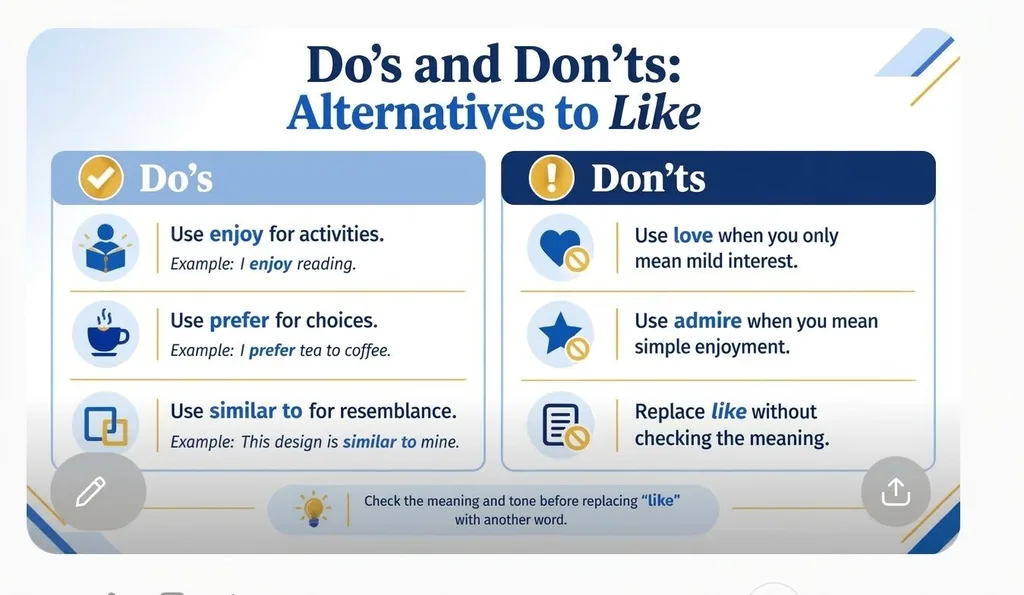
- Using casual phrases in professional emails: Expressions such as “I’m really into this” may sound too informal in some business settings. Choose “I’m interested in” when you want a more professional tone.
- Choosing a word with the wrong meaning: “Enjoy” cannot replace “like” in every sentence. Use “similar to” for resemblance and “such as” when introducing examples.
- Making simple writing too formal: Replacing every instance of “like” with a sophisticated word can make sentences awkward. Everyday language is often the clearest choice.
- Repeating the same alternative: Using “enjoy” in every sentence can create the same problem as repeating “like.” Vary your wording when the meaning allows it.
- Using emotional language carelessly: “Love” expresses stronger feelings than “like,” while “admire” suggests respect. Choose words that honestly reflect what you mean.
Frequently Asked Questions
1. What is another word for “like”?
Common alternatives include “enjoy,” “love,” “prefer,” “appreciate,” and “admire.” Each word communicates a slightly different meaning. Use “enjoy” for activities, “prefer” for choices, and “admire” for respect. The best option depends on the sentence and the feeling you want to express.
2. What is a more professional way to say “like”?
“Appreciate,” “prefer,” and “be interested in” often work well in professional communication. For example, instead of writing “I like your proposal,” you could say “I appreciate your proposal.” Choose the alternative carefully because appreciation, preference, and interest communicate different ideas.
3. What is a stronger word than “like”?
“Love” and “adore” can express stronger positive feelings than “like.” For example, “I love classical music” suggests greater enthusiasm than “I like classical music.” However, stronger language is not always better. Select a word that accurately reflects your feelings and suits the situation.
4. How can I say “I like it” differently?
You can say “I enjoy it,” “I love it,” “I appreciate it,” or “It appeals to me.” Use “I enjoy it” for something pleasant, “I love it” for enthusiasm, and “I appreciate it” when recognizing value. Your choice should reflect why you respond positively.
5. What can I use instead of “like” in academic writing?
In academic writing, “prefer,” “appreciate,” and “similar to” can replace “like” in specific contexts. Use “such as” to introduce examples and “for example” to explain a point. Avoid choosing a replacement simply because it sounds formal; accuracy and clarity matter more than complexity.
6. Is “like” informal English?
No. “Like” is standard English and works in both casual and formal settings, depending on its meaning and use. However, using “like” as a filler word, such as “It was, like, amazing,” can sound informal. In formal writing, remove unnecessary fillers and use precise wording.
7. What is another way to say “like” when giving examples?
Use “such as,” “for example,” or “including,” depending on the sentence. For instance, “I enjoy outdoor activities such as hiking” introduces examples within a sentence. “For example” can introduce a separate illustration. These expressions help make explanations more specific and organized.
8. How do I choose the best synonym for “like”?
First, identify what “like” means in your sentence. If you mean enjoyment, consider “enjoy.” If you mean preference, use “prefer.” If you describe a resemblance, choose “similar to.” When introducing examples, consider “such as.” Reading the revised sentence aloud can help you check whether it sounds natural.
Conclusion
Finding another way to say “like” can make your English more precise, natural, and engaging. The best alternative depends on your meaning, audience, and purpose. Use “enjoy” to describe activities, “love” to express enthusiasm, “prefer” to compare choices, and “appreciate” to recognize value. When discussing people, “admire” can communicate respect, while “be fond of” expresses a gentler feeling.
For professional writing, choose words that communicate your message clearly without sounding overly formal. When describing similarities, use “similar to,” and when introducing examples, choose “such as” or “for example.”
Most importantly, remember that “like” is not a bad word. It is a useful part of everyday English. Instead of replacing it automatically, focus on choosing the word that best expresses your intended meaning. Clear communication always matters more than using complicated vocabulary.

Communication Editor
Nadia Ellery is a communication editor focused on everyday English, conversational expressions, common phrases, and natural ways to communicate. She helps turn complicated language questions into practical guidance readers can use in everyday situations.