Featured Snippet
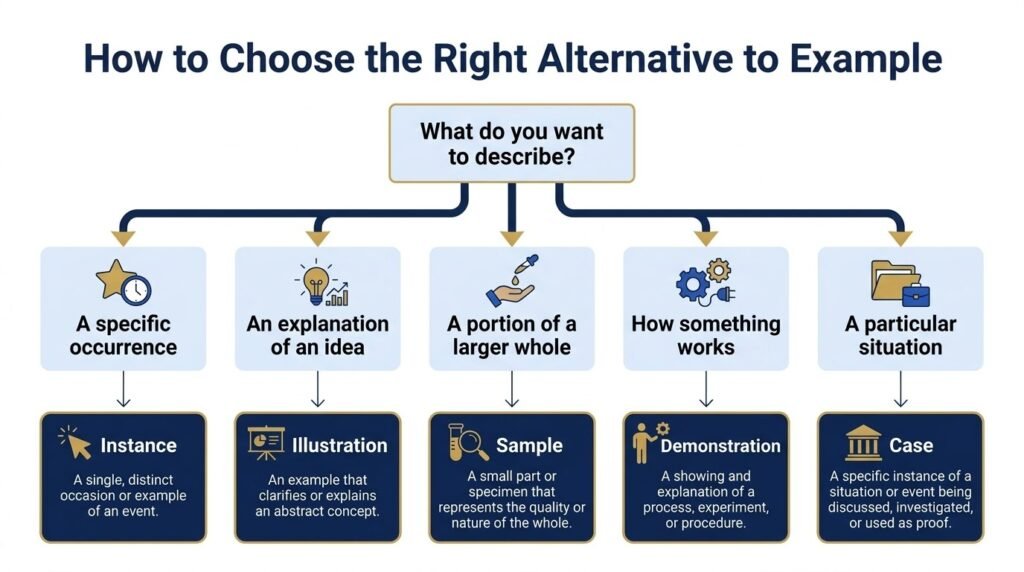
Another way to say example includes instance, illustration, case, sample, demonstration, and model. The best alternative depends on your context. Use “instance” for a specific occurrence, “illustration” to explain an idea, “sample” for a representative piece, and “demonstration” to show how something works. These words help make your writing clearer and less repetitive.
Key Takeaways
- Instance is a natural alternative when referring to a specific occurrence.
- Illustration works well when explaining an idea with details or examples.
- Sample refers to a small or representative part of something larger.
- Demonstration is useful when showing how a process, skill, or method works.
- Choose an alternative based on your meaning, audience, and level of formality.
What Does “Another Way to Say Example” Mean?
The phrase “another way to say example” refers to alternative words or expressions you can use instead of example. People often search for these alternatives when writing essays, preparing presentations, composing emails, or trying to make their English sound more natural.
The word example usually refers to something that helps explain an idea, prove a point, or show how something works. For instance, a teacher might give an example of a grammar rule, while a manager might share an example of successful teamwork.
However, repeating the same word throughout a paragraph can make your writing sound dull. Words such as instance, illustration, and case offer variety, but each has a slightly different meaning. Choosing the right alternative makes your message more precise.
Why Use Other Ways to Say “Example”?
Using different words for example can improve your writing without changing your main message. The key is to choose a replacement that fits the sentence rather than swapping words just to avoid repetition.
Here are the main benefits:
- Avoid repetition: Keep paragraphs and longer articles from sounding repetitive.
- Improve clarity: Choose a word that explains exactly what you mean.
- Match the situation: Use natural language in conversations and more precise wording in formal documents.
- Strengthen explanations: Make ideas easier to understand with illustrations, cases, or demonstrations.
- Sound more professional: Select vocabulary that fits reports, presentations, and business communication.
10 Best Other Ways to Say “Example”
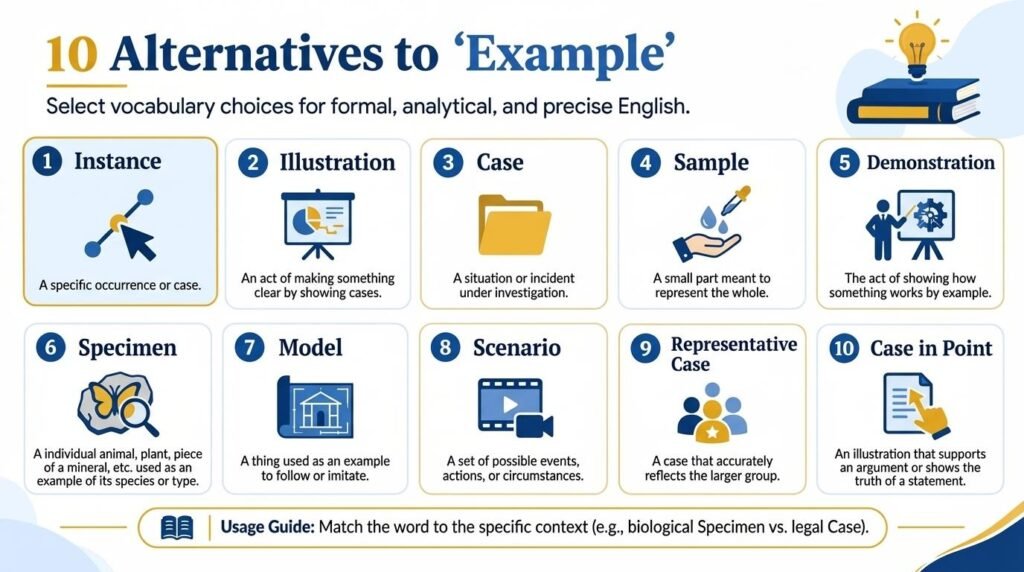
1. Instance
Meaning
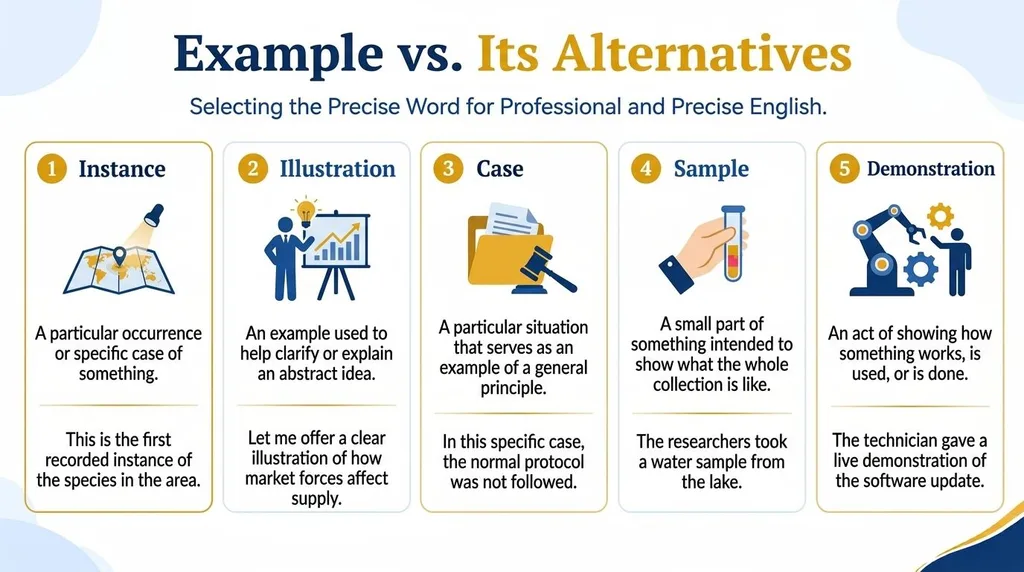
An instance is a particular occurrence of something. It works well when you want to refer to one specific situation or event rather than a general illustration.
Best For: Professional, Formal, Neutral
Example 1: This is one instance in which clear communication prevented a costly mistake.
Example 2: Have you encountered an instance of this problem at work?
Quick Tip: Use instance when discussing a specific occurrence, especially in reports, explanations, or analytical writing.
2. Illustration
Meaning
An illustration is something that helps explain or clarify an idea. It may be a written description, a real-life situation, a picture, or a detailed example.
Best For: Formal, Professional, Friendly
Example 1: The teacher used a simple illustration to explain how fractions work.
Example 2: Her experience provides a useful illustration of the challenges new employees face.
Quick Tip: Choose illustration when your main goal is to make an idea easier to understand.
3. Case
Meaning
A case refers to a particular situation, event, or set of circumstances. It is common in business, law, research, and problem-solving discussions.
Best For: Professional, Formal
Example 1: This case shows why companies need clear data protection policies.
Example 2: In one case, the customer received a refund within an hour.
Quick Tip: Use case when discussing a situation that supports an argument or demonstrates a particular outcome.
4. Sample
Meaning
A sample is a small or representative part of a larger group, collection, or product. It can also refer to a piece of writing or work used to demonstrate quality or style.
Best For: Professional, Casual, Formal
Example 1: Please review this sample before approving the final design.
Example 2: The researcher tested a sample of 200 participants from the larger population.
Quick Tip: Use sample when referring to a portion of something larger, not simply any situation that explains an idea.
5. Demonstration
Meaning
A demonstration shows how something works or how to perform a task. It often involves a practical display, a step-by-step explanation, or a visible action.
Best For: Professional, Formal, Friendly
Example 1: The trainer gave a demonstration of the new scheduling software.
Example 2: Her successful campaign was a demonstration of effective community leadership.
Quick Tip: Choose demonstration when someone shows a process, skill, method, or result in action.
6. Specimen
Meaning
A specimen is an individual item collected or examined as an example of a particular type. The word is especially common in science, medicine, and technical fields.
Best For: Formal, Professional
Example 1: The laboratory examined a specimen under a microscope.
Example 2: The museum displayed a rare specimen of the plant species.
Quick Tip: Use specimen in scientific or technical contexts. It usually sounds too specialized for everyday conversations.
7. Model
Meaning
A model is an example that people can follow, study, or use as a guide. It can refer to a successful approach, a sample of good work, or a representation of how something functions.
Best For: Professional, Formal, Friendly
Example 1: Her leadership style is a model for new team managers.
Example 2: The company introduced a model proposal that other departments can adapt.
Quick Tip: Use model when the example serves as a guide or standard that others can learn from.
8. Scenario
Meaning
A scenario describes a possible or imagined situation. It is particularly useful for explaining what might happen under certain conditions or for practicing how to respond to a challenge.
Best For: Professional, Casual, Formal
Example 1: Consider a scenario in which a customer cancels an order at the last minute.
Example 2: The instructor created a realistic scenario to help students practice emergency procedures.
Quick Tip: Choose scenario for hypothetical situations, planning exercises, and role-playing activities.
9. Representative Case
Meaning
A representative case is a situation that reflects a broader pattern or group. It helps readers understand a general trend through one relevant instance.
Best For: Professional, Formal
Example 1: This project is a representative case of how small teams can improve customer service.
Example 2: The report examines a representative case from a larger group of successful businesses.
Quick Tip: Use representative case when the situation reflects a wider pattern. Avoid calling a case representative unless the evidence supports that description.
10. Case in Point
Meaning
A case in point is a specific situation that clearly supports or demonstrates a statement. It often appears after a general claim to show why that claim makes sense.
Best For: Professional, Formal, Friendly
Example 1: Clear instructions save time; the recent onboarding project is a case in point.
Example 2: Many local businesses succeed through word of mouth, and this neighborhood bakery is a case in point.
Quick Tip: Use case in point to reinforce a statement you have already made. It usually works better in the middle of a sentence than as a direct replacement for the noun example.
Comparison Table: Alternatives to “Example”
| Alternative | Best Used In | Tone |
| Instance | Specific events or occurrences | Neutral |
| Illustration | Explaining ideas and concepts | Clear, explanatory |
| Case | Business, research, and specific situations | Professional |
| Sample | Portions, documents, and representative items | Neutral |
| Demonstration | Showing how something works | Practical, professional |
| Specimen | Science, medicine, and technical writing | Technical, formal |
| Model | Standards, templates, and good practices | Professional |
| Scenario | Hypothetical situations and planning | Neutral, analytical |
| Representative case | Research and broader patterns | Formal, analytical |
| Case in point | Supporting a statement or argument | Conversational, professional |
Common Mistakes When Choosing an Alternative to “Example”
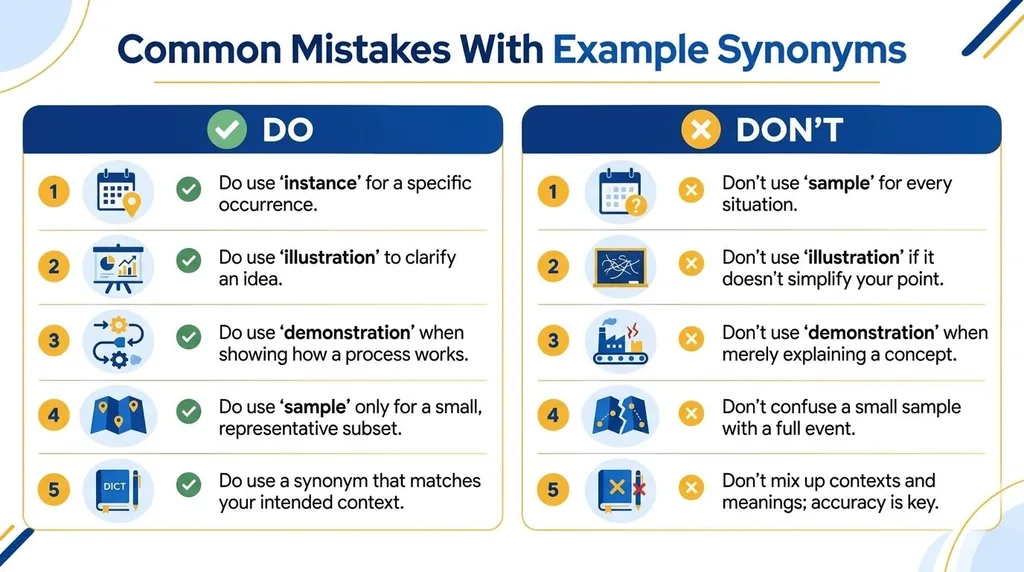
1. Using a word that changes the meaning
Not every alternative is interchangeable with example. A sample is usually part of a larger whole, while a scenario describes a possible situation. Choose the word that expresses your intended meaning.
2. Using overly formal vocabulary in casual conversations
Words such as specimen and representative case can sound unnatural in everyday speech. In a casual conversation, example or instance will often feel more comfortable.
3. Replacing every occurrence of “example”
You do not need to change every use of the word. Repeating example is perfectly acceptable when it keeps your explanation clear. Variety should improve readability, not make the writing harder to follow.
4. Confusing a noun with a linking phrase
Expressions such as for instance and to illustrate can introduce an example, but they do not fit every sentence where the noun example appears.
For example, “Here is an example of my work” can become “Here is a sample of my work.” You would not normally replace it with “Here is a to illustrate of my work.”
5. Choosing a phrase that sounds unnatural in context
A word may be grammatically correct but still feel out of place. Before using an alternative, read the full sentence and consider your audience, purpose, and tone.
Frequently Asked Questions
1. What is another word for example?
Common alternatives include instance, illustration, case, sample, demonstration, and model. Each word serves a slightly different purpose. Use instance for a specific occurrence, sample for a portion of something, and demonstration when showing how something works. The best choice depends on the sentence.
2. What is a more professional way to say example?
In professional writing, you can use instance, case, illustration, or demonstration. For example, “This case highlights the importance of clear communication” sounds appropriate in a business report. Use representative case when a situation reflects a broader pattern and you can support that claim with evidence.
3. What is a formal way to say for example?
Formal alternatives include for instance, to illustrate, and as demonstrated by. You can also use specifically when introducing precise details. For example, “Several factors affected the outcome, specifically the budget and the project timeline.” Choose the expression that matches the structure of your sentence.
4. How can I avoid repeating the word example in an essay?
Use a mix of precise nouns and introductory phrases. Depending on the context, you might choose instance, case, illustration, for instance, or to illustrate. You can also restructure the sentence to present evidence directly. Avoid replacing every occurrence automatically, because clear repetition is sometimes better than awkward wording.
5. Is instance the same as example?
The words overlap, but they are not always identical. An instance usually refers to a specific occurrence of something, while an example can be a case, object, explanation, or model used to clarify an idea. For example, an instance of poor service describes an occurrence; an example of good service illustrates the desired standard.
6. What is another way to say example in an academic paper?
Academic writing commonly uses instance, case, illustration, and example. The right choice depends on the evidence being discussed. Use case for a particular situation or case study, and instance for an occurrence. Do not use technical-sounding words just to appear more academic; precision and clarity matter more.
7. Can I use sample instead of example?
Yes, when you mean a portion or representative item from a larger group. For example, “Please review this sample of the report” is natural. However, sample may not fit when you are describing an event or situation that proves a point. In those cases, instance or case may be more accurate.
8. What phrase can I use instead of for example in a sentence?
You can use for instance, to illustrate, such as, or as an example, depending on the sentence. For instance, “Bring outdoor gear, such as a jacket and sturdy shoes” is natural. “To illustrate” works well when you are about to explain an idea, while “for instance” introduces a specific case.
Conclusion
Choosing another way to say example can make your writing more natural, precise, and engaging. The best alternative depends on what you want to communicate. Use instance for a specific occurrence, illustration to explain an idea, sample for a representative portion, and demonstration to show how something works. For professional reports, case and representative case can help you discuss particular situations, while model is useful when presenting something others can follow. In everyday conversations, simpler words and expressions often sound best.
Remember that you do not need to replace example every time it appears. Clear communication is more important than using a wide range of vocabulary. Before choosing an alternative, consider your audience, the sentence’s meaning, and the tone you want to create. The best word is the one that makes your meaning easier to understand.

Professional English Editor
Caleb Wrenford specializes in professional English, workplace communication, business writing, and formal expressions. His work helps readers communicate with greater clarity and confidence across emails, professional conversations, and written correspondence.