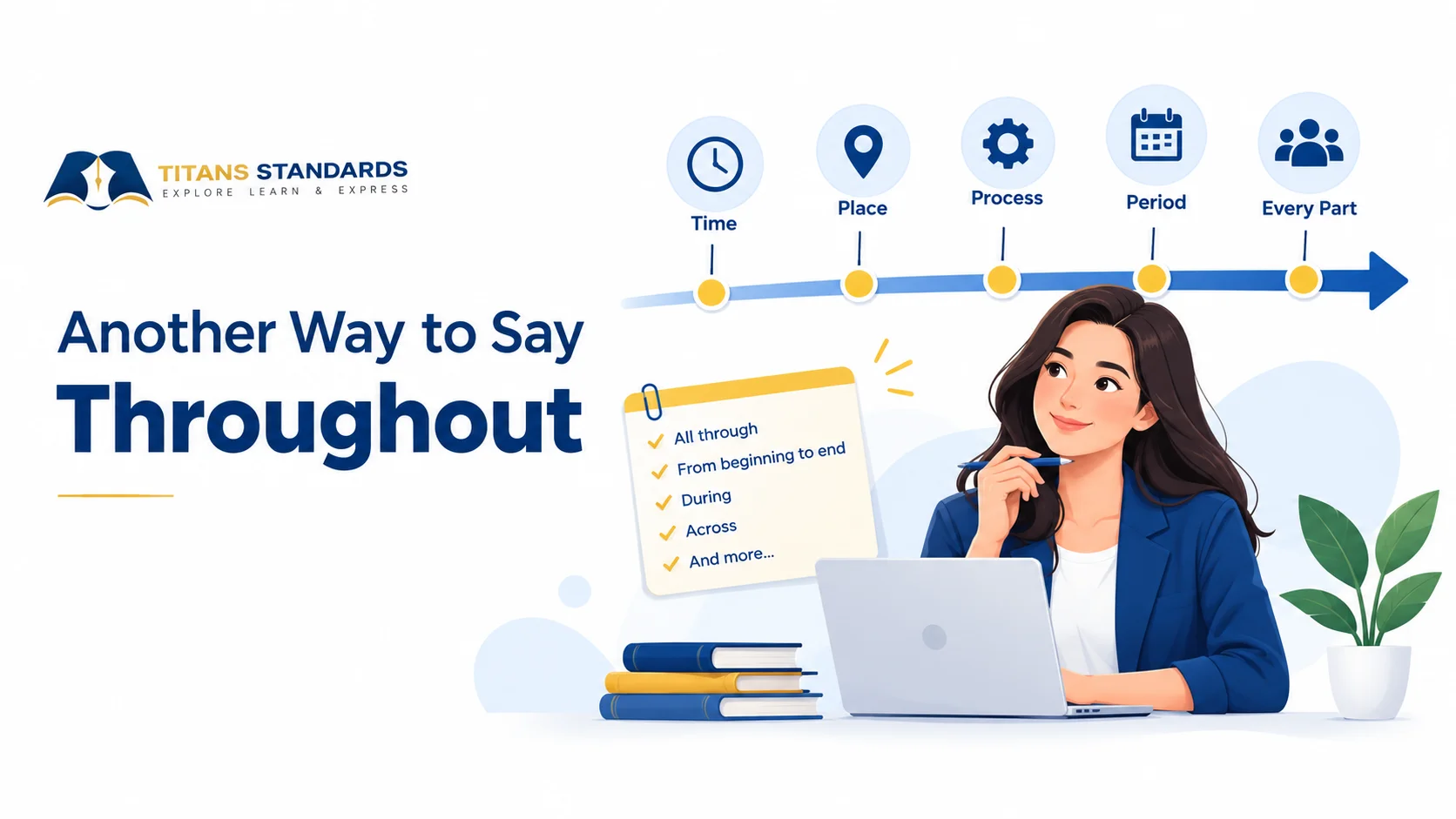
What Does “Another Way to Say Throughout” Mean?
“Another way to say throughout” means looking for a different word or phrase that expresses the same general idea as throughout. The best alternative depends on what you are describing.
“Throughout” commonly means during the whole period of something or in every part of something. For example, “She remained calm throughout the meeting” means she remained calm from the beginning of the meeting to the end.
It can also describe location or distribution: “The same design appears throughout the building” means the design appears in many or all parts of the building.
Because “throughout” has more than one use, replacing it with a synonym requires attention to context.
Why Use Other Ways to Say “Throughout”?
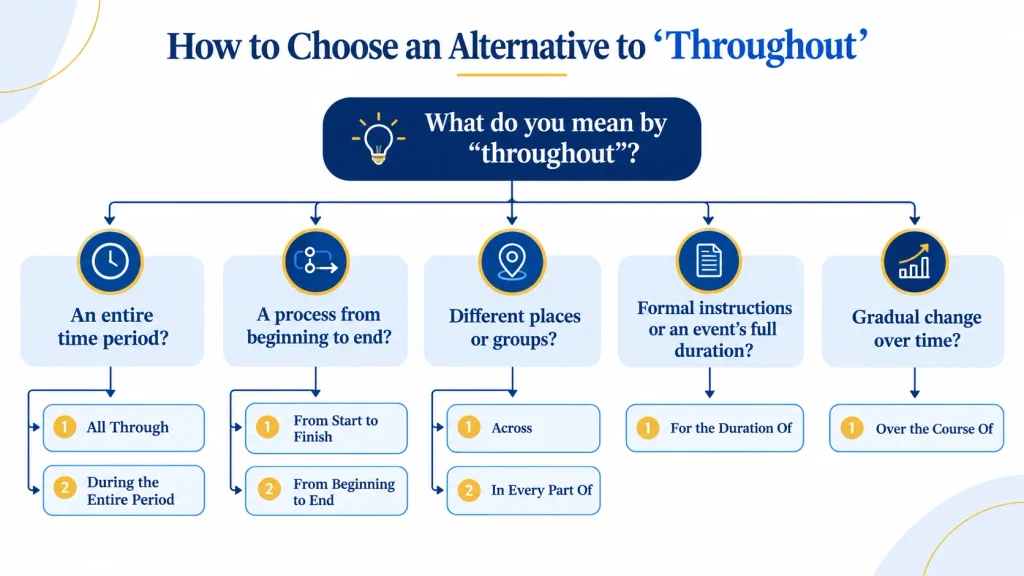
Using an alternative can make your writing more precise and prevent repetitive wording. It can also help you choose a phrase that better matches the tone of a sentence.
You may want another way to say “throughout” to:
- Avoid repeating the same word.
- Make a sentence sound more natural.
- Emphasize the beginning and end of a period.
- Describe different areas or parts more clearly.
- Adapt your writing for casual or professional situations.
- Make a sentence easier for readers to understand.
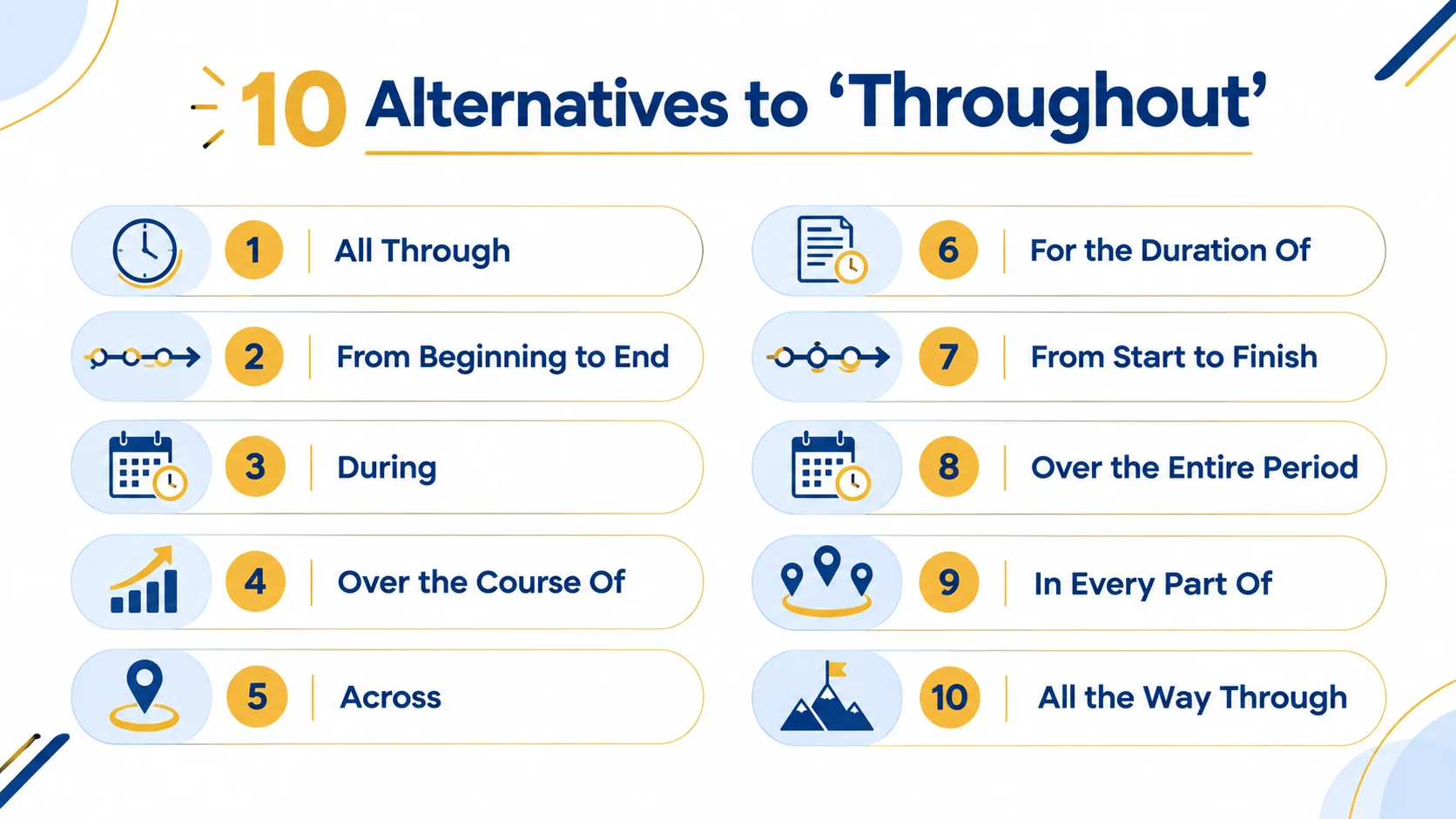
10 Best Other Ways to Say “Throughout”
1. All Through
Meaning
“All through” means during an entire period, from the beginning until the end. It is very close to “throughout,” but it often sounds more conversational and relaxed.
Best For
- Casual
- Friendly
- Everyday
Example 1
She stayed awake all through the night to finish the project.
Example 2
We could hear music all through the evening.
Quick Tip
Use “all through” when you want a natural, conversational alternative to “throughout,” especially in everyday speech.
2. From Beginning to End
Meaning
“From beginning to end” emphasizes that something continues across the complete length of an event, activity, or experience. It is especially useful when you want to stress completeness.
Best For
- Casual
- Friendly
- Professional
- Formal
Example 1
The documentary kept me interested from beginning to end.
Example 2
He supported the team from beginning to end of the campaign.
Quick Tip
Choose this phrase when the complete duration is more important than simply stating when something happened.
3. During
Meaning
“During” refers to something happening within a particular period or event. Unlike “throughout,” it does not necessarily mean that something continued for the entire period.
Best For
- Professional
- Formal
- Casual
- Everyday
Example 1
Please keep your phone silent during the presentation.
Example 2
We received several questions during the training session.
Quick Tip
Use “during” when you mean at some point within a period, rather than necessarily from its beginning to its end.
4. Over the Course of
Meaning
“Over the course of” describes something happening gradually or repeatedly during a particular period. It often works well when discussing changes, developments, or events.
Best For
- Professional
- Formal
- Polite
Example 1
The company gained several new clients over the course of the year.
Example 2
Her confidence improved over the course of the program.
Quick Tip
This phrase is particularly useful for professional writing when describing progress or development over time.
5. Across
Meaning
“Across” can replace “throughout” when you are talking about different places, groups, areas, or sections. It highlights distribution rather than continuous time.
Best For
- Professional
- Formal
- Everyday
Example 1
The policy applies across all departments.
Example 2
The survey was conducted across several major cities.
Quick Tip
Use “across” when the meaning involves multiple locations, groups, or sections rather than an entire period of time.
6. For the Duration of
Meaning
“For the duration of” means for the entire length of a specified period or event. It is more formal than “throughout” and is common in instructions and professional communication.
Best For
- Formal
- Professional
- Polite
Example 1
Employees must wear their identification badges for the duration of the event.
Example 2
The equipment should remain switched off for the duration of the inspection.
Quick Tip
This phrase works best in formal instructions, policies, notices, and workplace communication.
7. From Start to Finish
Meaning
“From start to finish” means during the complete process or experience. It emphasizes that something covers every stage rather than only part of it.
Best For
- Casual
- Friendly
- Professional
Example 1
Our team handled the project from start to finish.
Example 2
The guide explains the application process from start to finish.
Quick Tip
Use this expression when discussing a process, project, task, or experience with clear stages.
8. Over the Entire Period
Meaning
“Over the entire period” clearly indicates that something occurred across a complete, defined span of time. It is a useful option for precise or analytical writing.
Best For
- Formal
- Professional
Example 1
Sales remained stable over the entire period.
Example 2
The researchers monitored the participants over the entire period of the study.
Quick Tip
This alternative is useful in reports, research writing, and business documents where clarity matters more than conversational style.
9. In Every Part of
Meaning
“In every part of” focuses on location or sections rather than time. It means something exists, appears, or occurs in all parts of a particular place, object, or subject.
Best For
- Formal
- Professional
- Everyday
Example 1
Natural light reaches almost every part of the house.
Example 2
The author uses humor in every part of the book.
Quick Tip
Use this phrase when “throughout” means in all areas or sections, not “during an entire period.”
10. All the Way Through
Meaning
“All the way through” emphasizes continuation from one point to another or from the beginning of something to its end. It has a conversational tone and can describe both time and processes.
Best For
- Casual
- Friendly
- Everyday
Example 1
She stayed focused all the way through the final exam.
Example 2
The same theme appears all the way through the novel.
Quick Tip
Use “all the way through” when you want to emphasize continuous presence or progression in a natural, conversational way.
Comparison Table
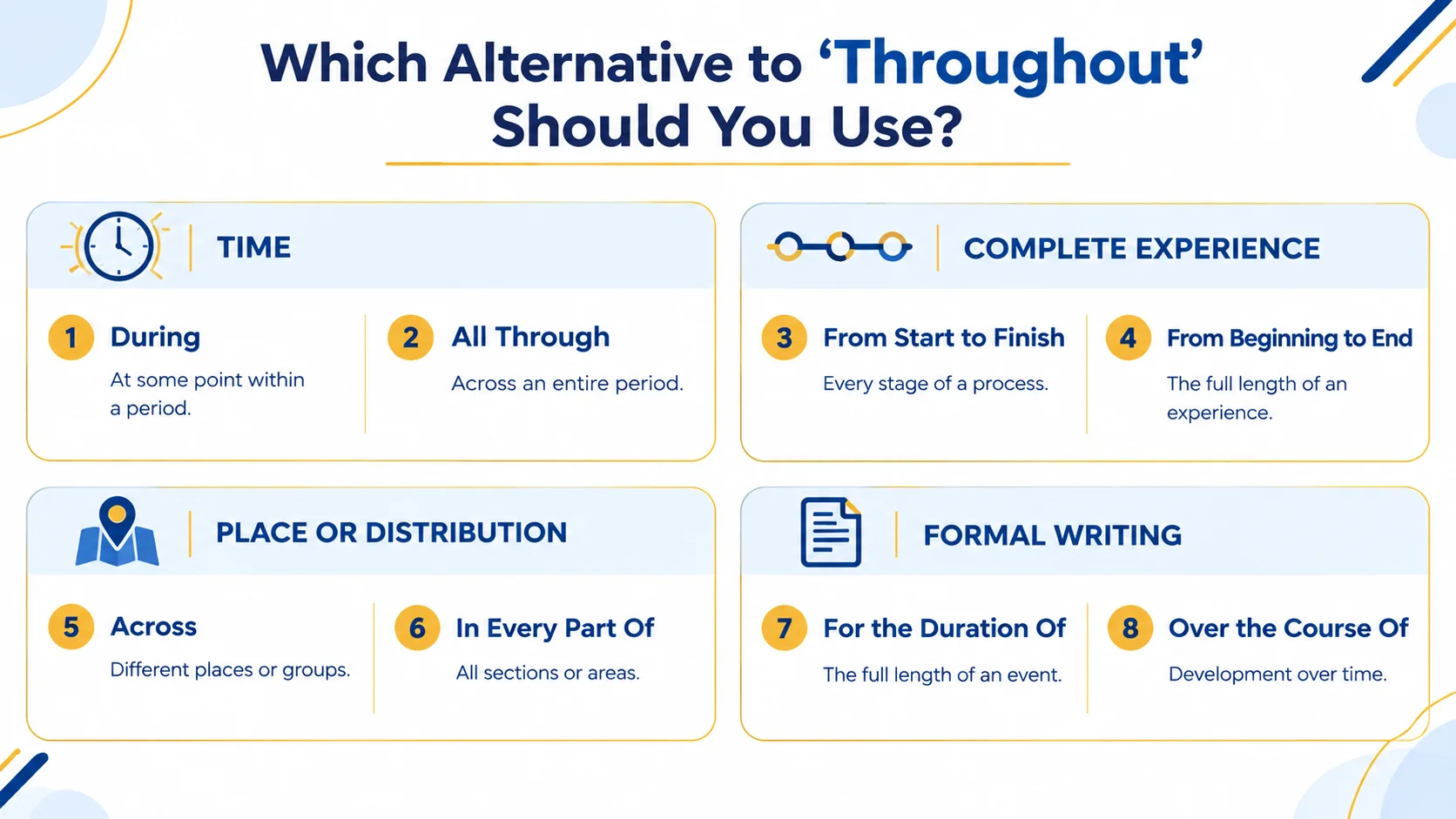
| Alternative | Best Used In | Tone |
| All through | Everyday conversations | Casual |
| From beginning to end | Events and experiences | Neutral |
| During | Specific time periods | Neutral |
| Over the course of | Progress and development | Professional |
| Across | Places, groups, and areas | Neutral |
| For the duration of | Rules and formal instructions | Formal |
| From start to finish | Processes and projects | Neutral |
| Over the entire period | Reports and research | Formal |
| In every part of | Locations and sections | Neutral |
| All the way through | Continuous experiences | Casual |
Common Mistakes
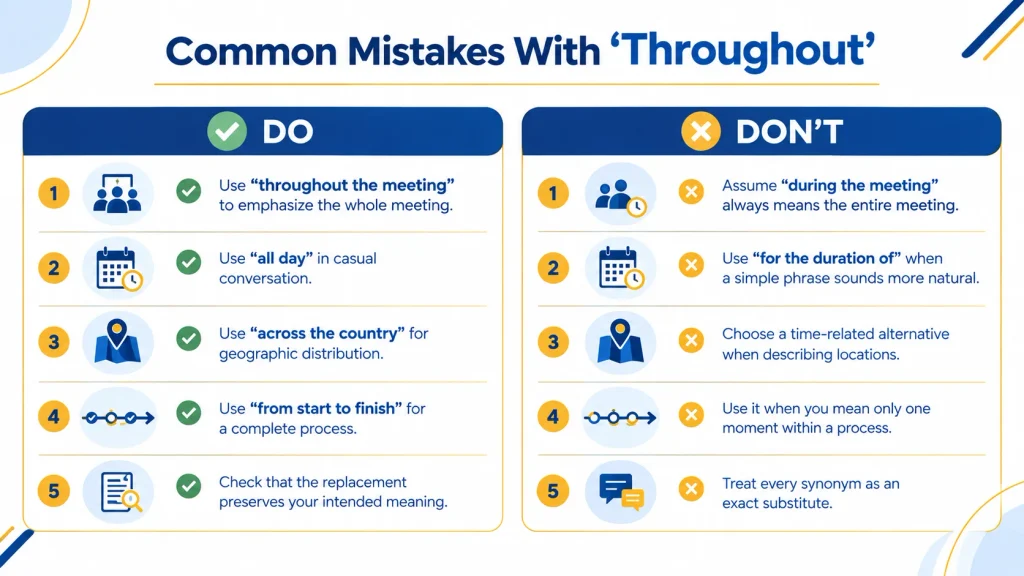
1. Treating Every Alternative as an Exact Synonym
Not every replacement has exactly the same meaning. For example, “during” can describe something that happens at one point within a period, while “throughout” often suggests that it continues across the whole period.
2. Using “During” When You Mean the Entire Period
Consider the difference between “I worked during the weekend” and “I worked throughout the weekend.” The first does not necessarily mean you worked for the entire weekend; the second strongly suggests continuous or repeated activity across it.
3. Using Formal Phrases in Casual Conversation
“For the duration of” is grammatically correct, but it can sound unnecessarily formal in ordinary conversation. In a casual setting, “all through” or “all the way through” may sound more natural.
4. Ignoring Whether You Mean Time or Place
“Throughout” can describe both time and location. If you are talking about different areas, “across” or “in every part of” may communicate the intended meaning more clearly.
5. Choosing a Phrase That Changes the Meaning
“From beginning to end” strongly emphasizes completeness. If something happened only once during an event, replacing “during” with this phrase could make your sentence inaccurate.
Frequently Asked Questions
What is the most common alternative to “throughout”?
“During” is one of the most common alternatives when “throughout” refers to time, but the two words are not always interchangeable. “Throughout” often suggests the whole period, while “during” simply places an event within that period. For example, “throughout the year” suggests the entire year, while “during the year” can refer to any point in it.
What is another way to say “throughout the year”?
Natural alternatives include “all year,” “during the entire year,” “over the course of the year,” and “for the whole year.” The best choice depends on your sentence. “All year” sounds conversational, while “over the course of the year” is often better for professional or analytical writing.
What is another word for “throughout” in formal writing?
In formal writing, options include “during the entire period,” “over the course of,” “for the duration of,” and “across.” However, “throughout” itself is already appropriate for formal writing. The best replacement depends on whether you are discussing time, location, distribution, or a complete process.
Can I use “during” instead of “throughout”?
Sometimes, but the meaning can change. “During” means at some point within a particular period, while “throughout” generally means across the entire period or repeatedly during it. For example, “She spoke during the meeting” does not mean she spoke continuously, but “She remained attentive throughout the meeting” suggests the whole meeting.
What is another way to say “throughout the process”?
You can say “from start to finish,” “from beginning to end,” “over the course of the process,” or “during the entire process.” “From start to finish” is especially natural when you want to emphasize that someone was involved at every stage of the process.
What is another way to say “throughout the day”?
Common alternatives include “all day,” “during the entire day,” “through the day,” and “from morning to night,” depending on the intended meaning. “All day” is the most natural choice in everyday American English, while “during the entire day” sounds more formal and emphasizes the complete period.
Is “across” the same as “throughout”?
Not always. “Across” is particularly useful when describing distribution among different places, groups, or areas, such as “across the country.” “Throughout the country” can have a very similar meaning, but “across” often emphasizes spread from one area or group to another.
Which alternative to “throughout” sounds the most natural?
The most natural choice depends on context. “During” works well for a period of time, “all through” sounds conversational, “from start to finish” fits processes, and “across” works for locations or groups. When no special emphasis is needed, simply using “throughout” may still be the clearest option.
Conclusion
There are several natural ways to say “throughout,” but the right choice depends on what you want to emphasize. Use “during” for a general time reference, “all through” for casual speech, and “from start to finish” when you want to stress an entire process.
For professional or formal writing, “over the course of,” “for the duration of,” and “over the entire period” can provide greater precision. When you are talking about different locations or groups, “across” or “in every part of” may be a better fit.
The key is not simply to replace “throughout” with another phrase. Choose the alternative that preserves your intended meaning, tone, and level of emphasis.

Editorial Desk
The Titan Standards Editorial Team develops, reviews, and maintains practical English-language resources. The team checks articles for clarity, accuracy, context, readability, and consistency with Titan Standards’ editorial guidelines.