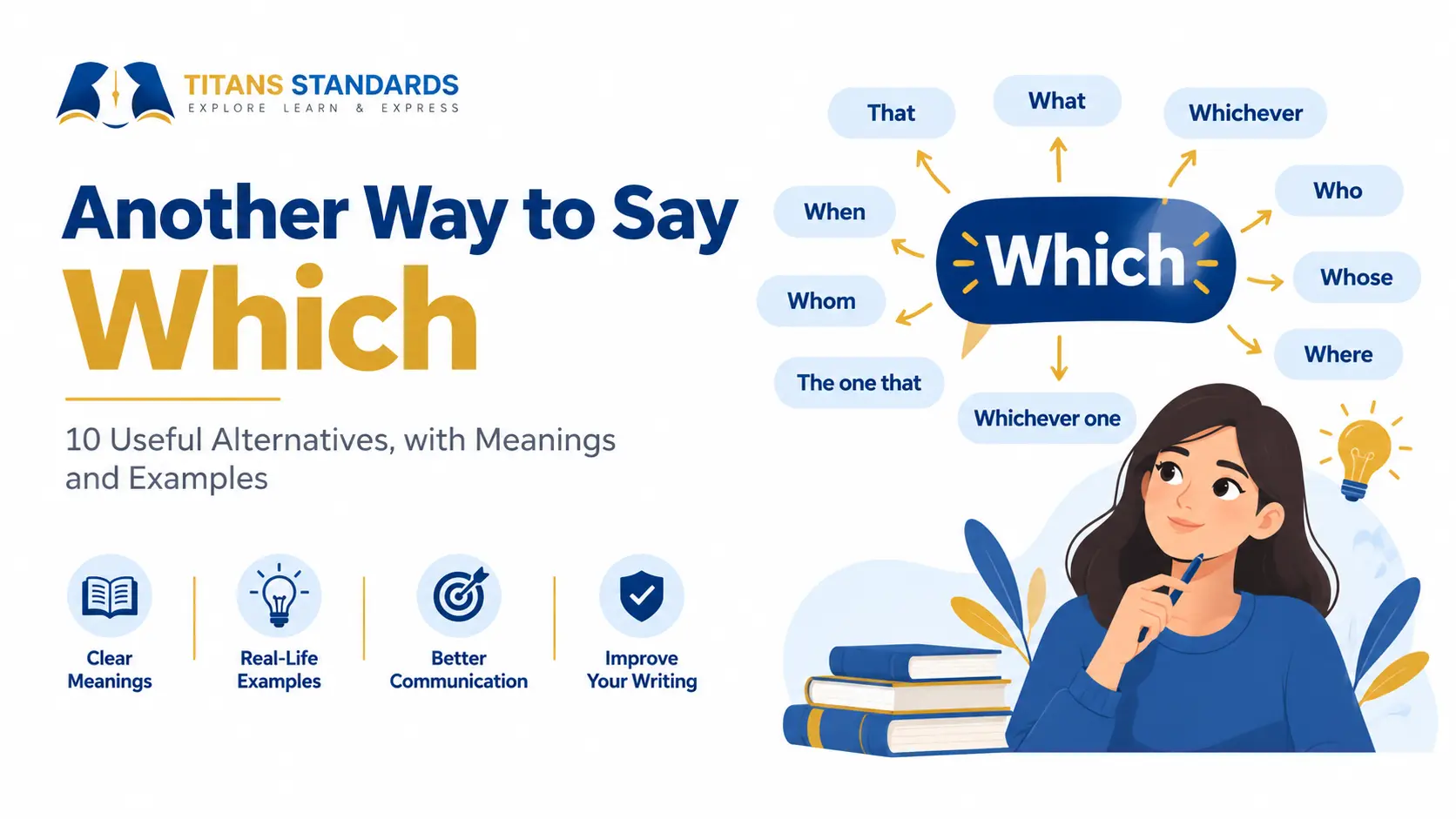
Another way to say “which” depends on how you use it. Common alternatives include “that,” “what,” “whichever,” “who,” “whose,” “where,” and “when.” In some sentences, you can remove “which” or rewrite the sentence for better clarity.
Choose a replacement that preserves the original meaning and follows correct English grammar.
Key Takeaways
- “Which” can introduce questions, identify choices, or add information about a noun.
- “That” often replaces “which” in restrictive relative clauses.
- “What” works when asking about information or identifying something.
- “Whichever” refers to any option that meets a condition.
- Rewriting a sentence can sound more natural than replacing “which” with a synonym.
The word “which” appears in everyday conversations, school assignments, business emails, and professional writing. It helps people ask questions, identify choices, and add details to sentences.
However, using the same word repeatedly can make some writing feel repetitive. Learning suitable alternatives can help you express ideas more clearly and create smoother sentences.
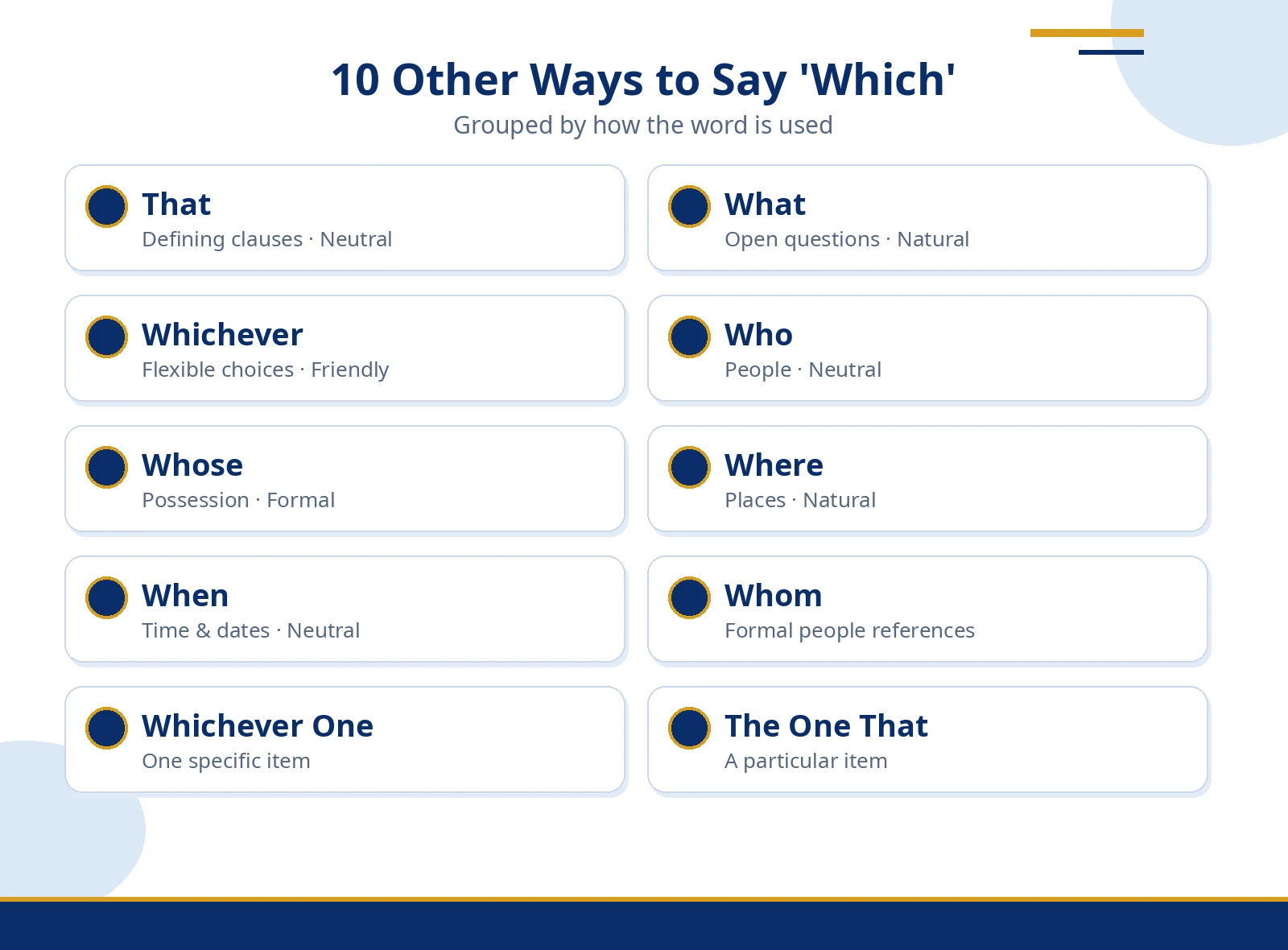
The best replacement depends on your meaning and sentence structure. Below are 10 useful alternatives, with explanations and examples to help you choose the right expression.
What Does “Which” Mean?
“Which” is a question word or relative pronoun that helps identify a person, thing, or choice from a known group. It can also introduce additional information about something already mentioned.
For example, you might ask, “Which book should I read?” Here, “which” asks someone to choose from available books.
It can also connect ideas: “I bought the blue jacket, which was on sale.” In this sentence, “which” introduces extra information about the jacket.
People commonly use “which” in conversations, academic essays, instructions, reports, and emails. Understanding its function is essential before choosing an alternative.
For the full definition, see Cambridge Dictionary.
Why Use Other Ways to Say “Which”?
Finding alternatives can improve clarity and help your writing sound less repetitive. It also allows you to match your language to the situation.
Consider using an alternative when you want to:
- Avoid repetition: Vary sentence structures in essays and articles.
- Improve clarity: Help readers understand exactly what you mean.
- Make choices clearer: Identify a particular option from a group.
- Strengthen professional writing: Use direct, precise language in reports and emails.
- Simplify sentences: Remove unnecessary words when the meaning remains clear.
Remember that “which” does not have one universal synonym. Always consider the meaning and grammar of the complete sentence.
10 Best Other Ways to Say “Which”
1. That
Meaning
“That” can introduce a defining relative clause that identifies a particular person or thing. It often replaces “which” when the information is necessary to understand which item you mean.
Best For
Professional, formal, casual
Example 1
The report that you sent yesterday contains the updated figures.
Example 2
I prefer the laptop that has a longer battery life.
Quick Tip
Use “that” for defining clauses in American English. In many cases, you can also use “which,” but “that” is common when the information identifies the specific item.
2. What
Meaning
“What” works when you ask for information or refer to something that is not specifically named. It is useful when a sentence asks about a choice, detail, or idea.
Best For
Casual, friendly, professional
Example 1
What option would work best for your team?
Example 2
Please tell me what you need before Friday.
Quick Tip
Use “what” when asking an open question or referring to an unspecified thing. Do not automatically substitute it for “which” when the choices are already defined.
3. Whichever
Meaning
“Whichever” refers to any person or thing that meets a condition or is selected from available options. It emphasizes flexibility rather than asking someone to identify one specific choice.
Best For
Casual, friendly, professional, polite
Example 1
Choose whichever seat gives you the best view.
Example 2
You can submit whichever version you think is stronger.
Quick Tip
Use “whichever” when several choices are acceptable and the final selection is up to someone else.
4. Who
Meaning
“Who” refers to people and can replace “which” when a sentence describes or identifies a person. It is often more natural and precise when the subject is a specific individual.
Best For
Casual, formal, professional
Example 1
The teacher who leads the writing workshop is very helpful.
Example 2
I spoke with the manager who approved the request.
Quick Tip
Use “who” for people, not objects. For example, write “the employee who called,” rather than “the employee which called.”
5. Whose
Meaning
“Whose” shows possession or a relationship between a person or thing and something associated with it. It helps explain who owns something or which person or organization has a particular feature.
Best For
Formal, professional, academic
Example 1
We interviewed a designer whose portfolio includes several award-winning websites.
Example 2
The company whose products we reviewed has expanded its services.
Quick Tip
Use “whose” to show possession. It can refer to people and, in appropriate constructions, organizations or other things.
6. Where
Meaning
“Where” refers to a place or location. It can often replace the longer expression “in which” when a sentence describes the place where something happens.
Best For
Casual, friendly, professional
Example 1
This is the office where our design team works.
Example 2
We visited the park where the festival takes place each summer.
Quick Tip
Use “where” for locations. For abstract situations or methods, check whether “in which” or a different phrase better preserves your meaning.
7. When
Meaning
“When” refers to a time, date, or period. It can replace “in which” or “at which” in many sentences that describe when an event happens.
Best For
Casual, professional, formal
Example 1
I remember the year when our family moved to Chicago.
Example 2
Friday is the day when we review our weekly goals.
Quick Tip
Use “when” for time-related information. Depending on the sentence, you may also remove the relative word without changing the meaning.
8. Whom
Meaning
“Whom” refers to a person who receives an action or follows a preposition. It is more formal than “who” and appears most often in academic writing, formal correspondence, and carefully edited sentences.
Best For
Formal, professional, academic
Example 1
The consultant whom we hired helped improve our workflow.
Example 2
To whom should I address the final proposal?
Quick Tip
Use “whom” when the person is the object of a verb or preposition. In everyday American English, people often use “who” in less formal sentences.
9. Whichever One
Meaning
“Whichever one” identifies any single item from a group, depending on preference or circumstances. It is especially useful in conversation when you want to refer to a choice without naming it in advance.
Best For
Casual, friendly, polite
Example 1
Take whichever one fits comfortably.
Example 2
You can order whichever one looks most appealing.
Quick Tip
Use this expression when the available options are clear from context. If the sentence already makes the choice obvious, “whichever” alone may be more concise.
10. The One That
Meaning
“The one that” identifies a particular item by describing a feature or condition. It can make a sentence clearer when “which” feels vague or when you want to emphasize a specific choice.
Best For
Casual, professional, friendly
Example 1
Please select the one that matches your brand colors.
Example 2
I want the one that comes with a two-year warranty.
Quick Tip
Use “the one that” when choosing a specific item from several options. Avoid adding it when a shorter sentence communicates the same idea.
Comparison Table
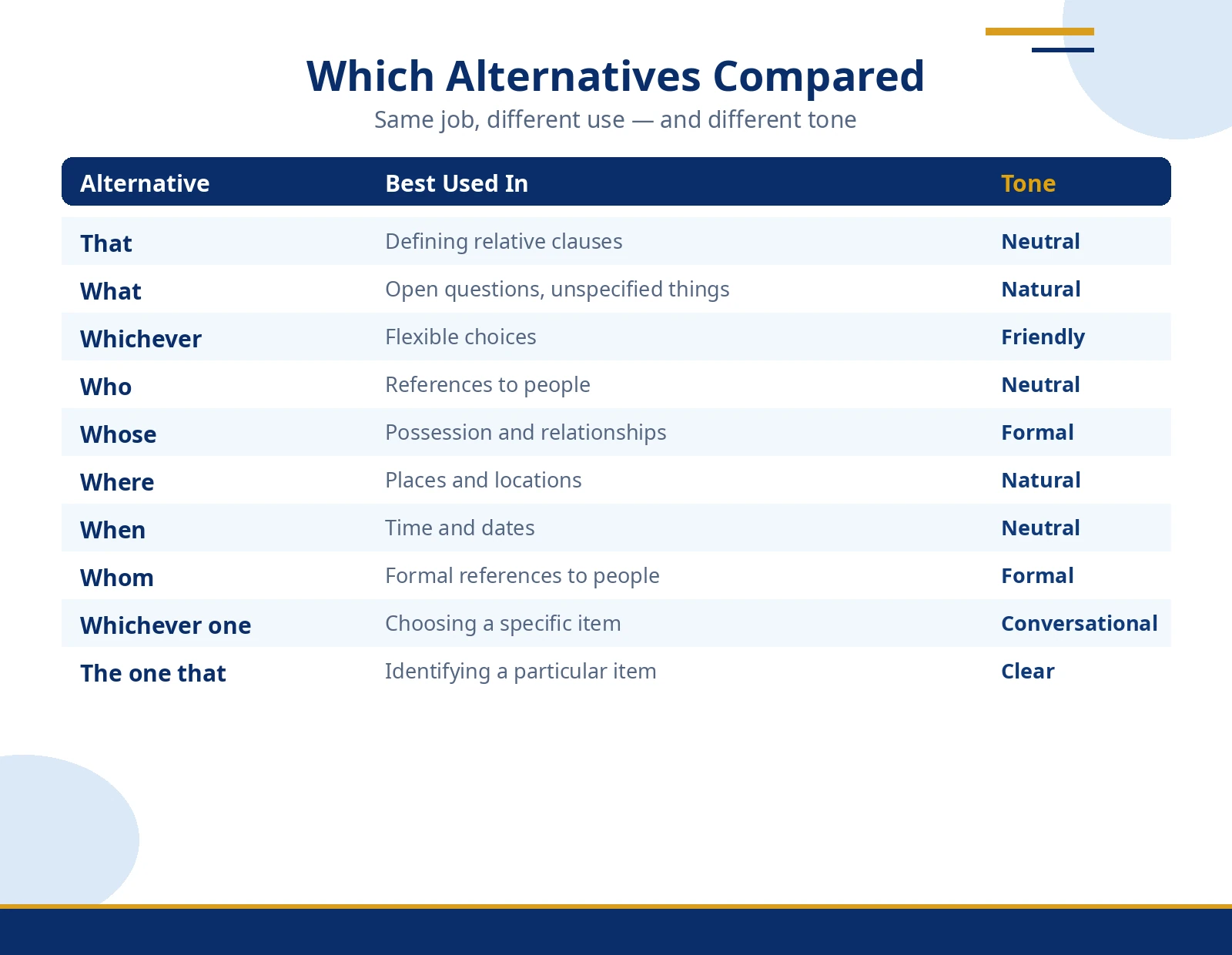
| Alternative | Best Used In | Tone |
|---|---|---|
| That | Defining relative clauses | Neutral |
| What | Open questions and unspecified things | Natural |
| Whichever | Flexible choices | Friendly |
| Who | References to people | Neutral |
| Whose | Possession and relationships | Formal or neutral |
| Where | Places and locations | Natural |
| When | Time and dates | Neutral |
| Whom | Formal references to people | Formal |
| Whichever one | Choosing a specific item from options | Conversational |
| The one that | Identifying a particular item | Clear and direct |
Common Mistakes When Replacing “Which”
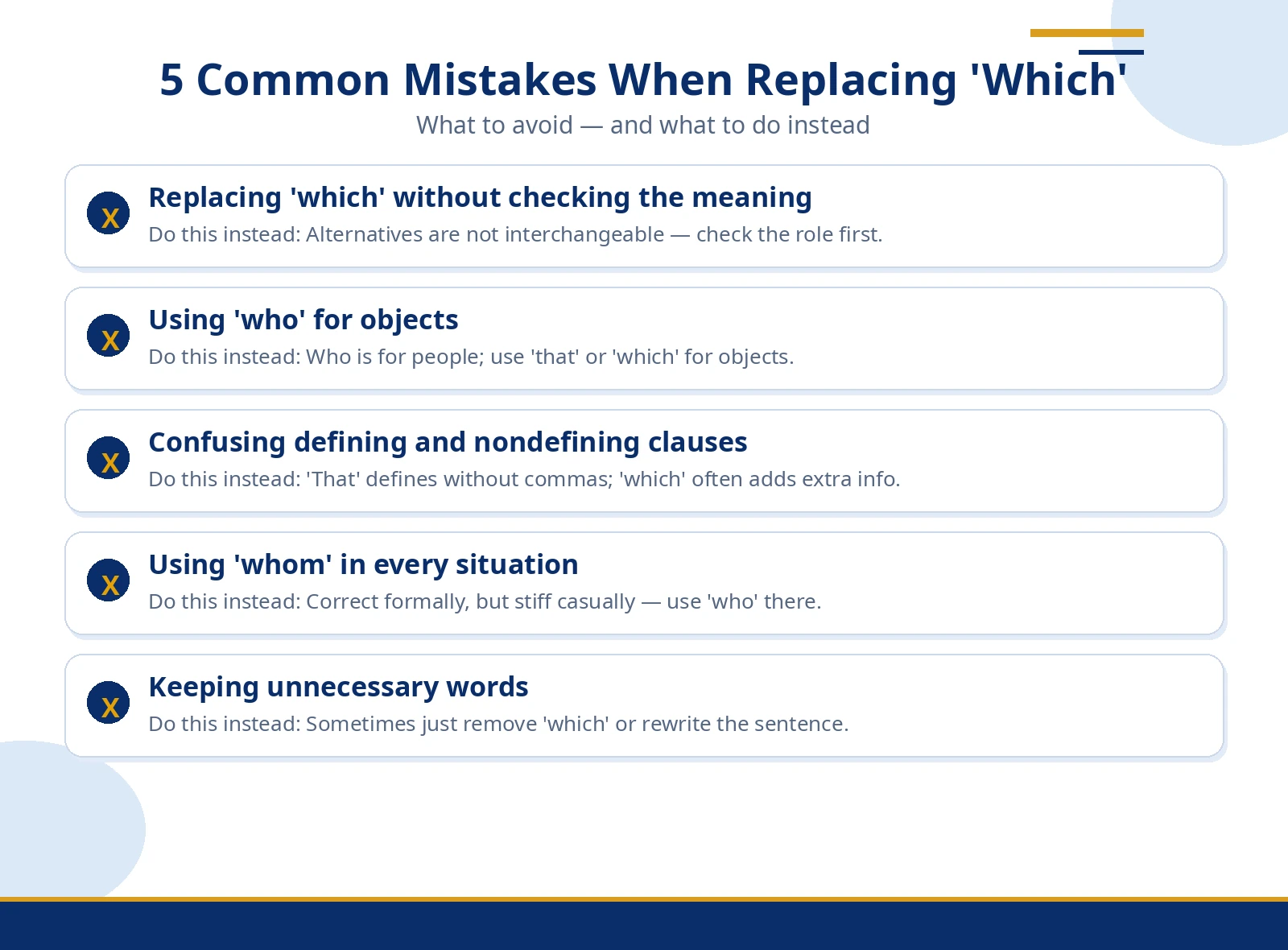
1. Replacing “Which” Without Checking the Meaning
Not every alternative expresses the same idea. “What” asks about information, while “whichever” refers to an available choice.
2. Using “Who” for Objects
Use “who” when referring to people. For objects, “that” or “which” is generally more appropriate in a relative clause.
3. Confusing Defining and Nondefining Clauses
In American English, “that” commonly introduces defining clauses without commas. “Which” often introduces nondefining clauses that add extra information and are separated by commas.
For example: “The car that has a sunroof is mine.” Compare this with “My car, which has a sunroof, is parked outside.”
4. Using “Whom” in Every Situation
“Whom” is grammatically correct in certain formal constructions, but it can sound stiff in casual conversation. Use “who” where appropriate to keep everyday communication natural.
5. Keeping Unnecessary Words
Sometimes the best solution is to remove “which” or rewrite the sentence. For example, “The building in which we work” can become “The building where we work.”
Frequently Asked Questions
1. What is another word for “which”?
Common alternatives include “that,” “what,” “who,” “whose,” “where,” “when,” and “whichever.” The right choice depends on how “which” functions in your sentence. Some alternatives identify people or places, while others introduce questions or choices. Always check grammar before making a replacement.
2. What is a professional way to say “which”?
In professional writing, “that,” “what,” “where,” and “when” may work, depending on the sentence. You can also rewrite a sentence to make the intended choice clearer. For example, “Please confirm which option you prefer” is already professional and usually does not need a replacement.
3. What can I use instead of “which” in an essay?
In an essay, consider “that,” “who,” “whose,” “where,” or “when” when the grammar and meaning support them. You can also restructure a sentence to avoid repetition. Do not replace every instance of “which” simply to use different vocabulary; accuracy and clarity matter more than variation.
4. Is “that” always a synonym for “which”?
No. “That” and “which” overlap in some defining relative clauses, but they are not interchangeable in every sentence. In American English, “that” commonly introduces information needed to identify a noun, while “which” often introduces extra information set off by commas.
5. Can I use “what” instead of “which”?
Sometimes, but the words serve different purposes. “Which” often asks someone to choose from a known set, while “what” commonly asks an open question. For example, “Which dress do you want?” suggests available dresses, whereas “What do you want?” is broader.
6. How do I avoid repeating “which” in writing?
Start by identifying the role of each use. If it refers to a person, “who” may fit; for a location, try “where.” You can also combine ideas, remove unnecessary clauses, or rewrite the sentence. These changes improve readability without forcing an unsuitable synonym into the text.
7. What is another way to say “in which”?
Depending on the context, you can use “where,” “when,” or a simpler sentence structure. For example, “the room in which we met” can become “the room where we met.” For abstract ideas, “in which” may still be the clearest and most accurate option.
8. Is it grammatically correct to start a sentence with “which”?
Yes, a sentence can begin with “which” when the word refers clearly to information in the previous sentence or introduces an appropriate question or clause. For example, “Which option do you prefer?” is correct. When “which” refers back to a previous idea, make sure the connection is clear.
Conclusion
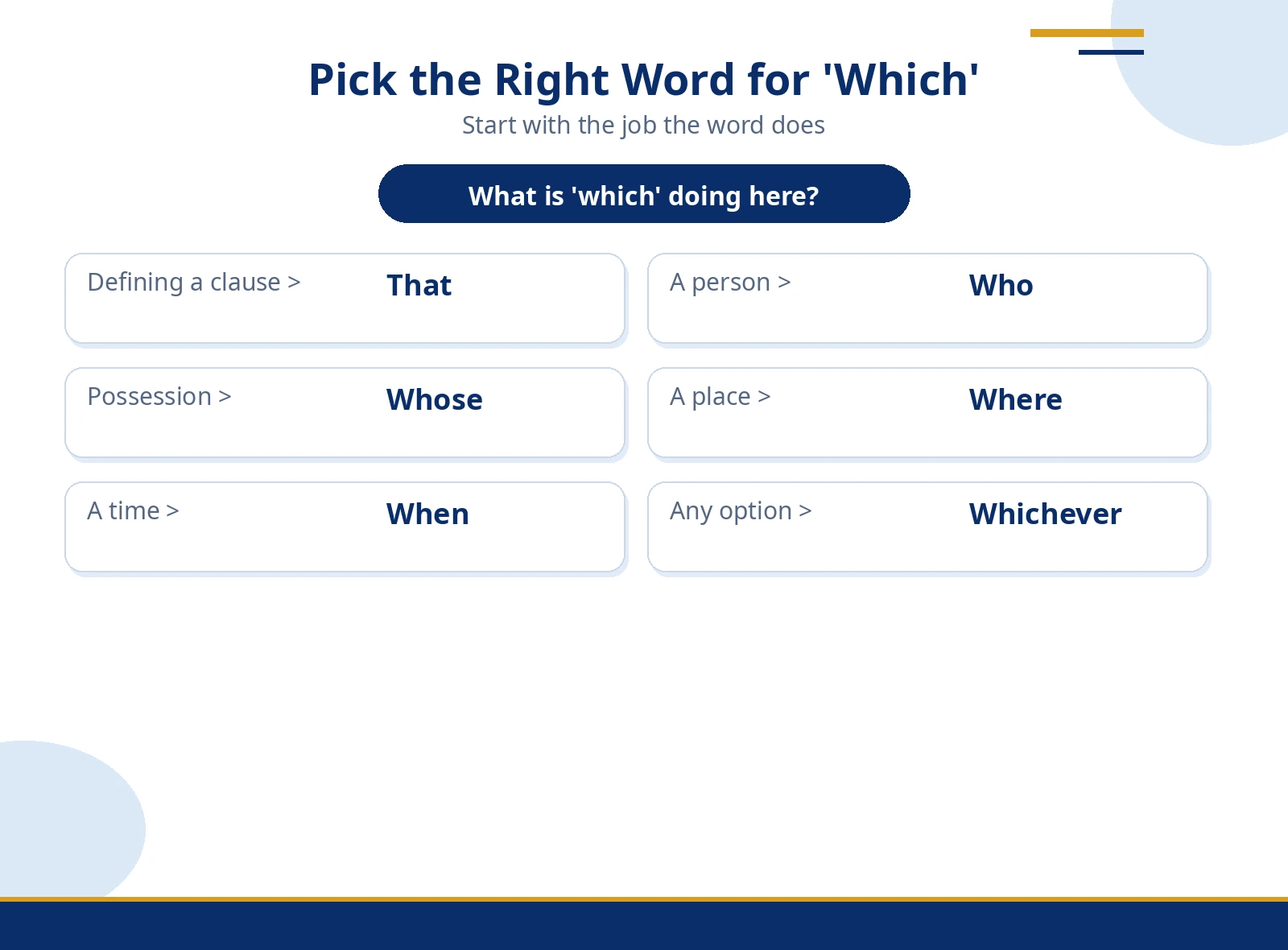
Finding another way to say “which” can make your writing clearer, but the best choice depends on the sentence. Use “that” for many defining relative clauses, “who” for people, “whose” for possession, “where” for places, and “when” for time. Choose “what” for open questions and “whichever” when any suitable option will do.
You do not need to replace every instance of “which.” In many cases, the original word is already the most accurate choice. You can also remove unnecessary wording or restructure a sentence to make your meaning easier to follow.
Before publishing an essay, email, or article, read each sentence aloud and check whether the replacement preserves the original meaning. Clear, natural English is always more effective than using synonyms simply for variety.
Looking for more ways to refresh everyday phrases? Explore our guides to fresher ways to say said and done, or find a better way to say he says.

Editorial Desk
The Titan Standards Editorial Team develops, reviews, and maintains practical English-language resources. The team checks articles for clarity, accuracy, context, readability, and consistency with Titan Standards’ editorial guidelines.