
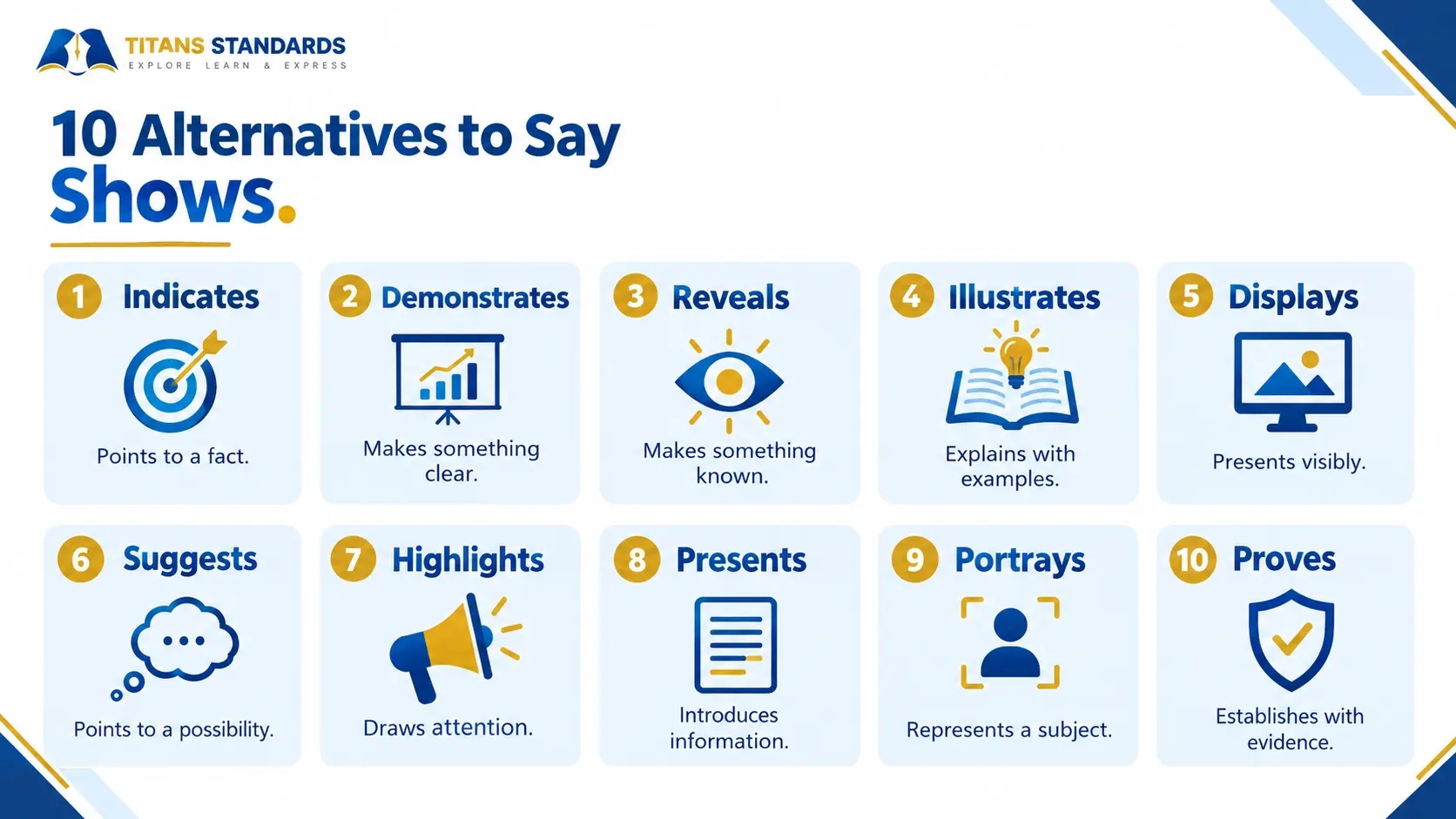
Another way to say “shows” includes indicates, demonstrates, reveals, illustrates, displays, suggests, highlights, presents, portrays, and proves.
The best alternative depends on your context. Use “demonstrates” for clear evidence, “reveals” for new information, and “illustrates” for examples that explain an idea.
Key Takeaways
- Use “indicates” when something points to a fact or conclusion.
- Choose “demonstrates” when evidence clearly explains or supports a point.
- Use “reveals” to introduce something previously unknown.
- Choose “illustrates” when an example helps explain an idea.
- Match your synonym to the meaning, tone, and strength of your evidence.
The word “shows” works in many situations, from school essays to business reports and everyday conversations. However, using it repeatedly can make your writing sound basic or repetitive.
Choosing a more precise verb helps you explain your ideas clearly. Whether you want to describe research findings, explain a chart, or discuss a character in a story, the right alternative can make your sentences more effective.
Below are 10 useful alternatives to “shows,” along with meanings, examples, and tips for choosing the best phrase.
What Does “Another Way to Say Shows” Mean?
The phrase “another way to say shows” refers to different words or expressions that communicate the same or a similar meaning as “shows.” These alternatives can describe evidence, explain information, present visual details, or suggest a conclusion.
People often look for synonyms for “shows” when writing essays, reports, presentations, emails, and articles. Using the right verb helps them avoid repetition and communicate their ideas more accurately.
For example, instead of writing, “The research shows a connection,” you could write, “The research indicates a connection.” The second sentence sounds more precise in many academic contexts.
For the full definition, see Cambridge Dictionary.
Why Use Other Ways to Say “Shows”?
Although “shows” is a useful word, repeating it too often can weaken your writing. Different alternatives help you express the exact relationship between your evidence and your point.
Here are the main benefits:
- Avoid repetition: Keep paragraphs engaging by varying your word choices.
- Improve clarity: Explain whether something proves, suggests, or illustrates a point.
- Strengthen academic writing: Use precise verbs in essays, research papers, and assignments.
- Sound more professional: Choose suitable language for business reports and presentations.
- Match the context: Describe visual information, research findings, and personal observations accurately.
The key is to choose a synonym based on what your sentence actually means, rather than replacing “shows” with a random alternative.
10 Best Other Ways to Say “Shows”
1. Indicates
Meaning
“Indicates” means that something points toward a fact, result, or possible conclusion. It is useful when evidence supports an idea but does not necessarily prove it beyond doubt.
Best For: Professional, Formal
Example 1: The latest survey indicates that customers prefer shorter delivery times.
Example 2: A sudden drop in sales indicates a possible change in buying habits.
Quick Tip: Use “indicates” when discussing data, trends, research, or evidence that points toward a conclusion.
2. Demonstrates
Meaning
“Demonstrates” means to make something clear through evidence, an example, or an action. It often sounds stronger than “indicates” because it suggests that the information clearly supports the point.
Best For: Professional, Formal
Example 1: The experiment demonstrates how temperature affects the reaction rate.
Example 2: Her leadership demonstrates the value of clear communication.
Quick Tip: Choose “demonstrates” when you can clearly explain or support a claim with evidence.
3. Reveals
Meaning
“Reveals” means to make something known that was previously hidden, unclear, or unnoticed. It works well when new information helps readers understand a situation more deeply.
Best For: Formal, Professional, Friendly
Example 1: The investigation reveals several gaps in the company’s safety procedures.
Example 2: His interview reveals why he decided to change careers.
Quick Tip: Use “reveals” when your sentence introduces a discovery, hidden detail, or important new insight.
4. Illustrates
Meaning
“Illustrates” means to explain or clarify an idea through an example, image, comparison, or situation. It is especially useful when you want readers to understand an abstract concept more easily.
Best For: Formal, Professional
Example 1: This case study illustrates the challenges of managing a remote team.
Example 2: The diagram illustrates how water moves through the filtration system.
Quick Tip: Choose “illustrates” when an example, chart, story, or visual makes your point easier to understand.
5. Displays
Meaning
“Displays” means to present something so people can see it. It often describes visible information, emotions, qualities, or items presented on a screen, chart, or physical surface.
Best For: Professional, Casual
Example 1: The dashboard displays each department’s monthly expenses.
Example 2: The athlete displays remarkable patience during difficult matches.
Quick Tip: Use “displays” for visible information or qualities that someone or something presents openly.
6. Suggests
Meaning
“Suggests” means that something points toward a possible explanation or conclusion without establishing it as certain. It is useful when interpreting incomplete evidence or discussing a reasonable possibility.
Best For: Formal, Professional, Polite
Example 1: The early results suggest that the new schedule may improve attendance.
Example 2: Her response suggests that she needs more time to consider the offer.
Quick Tip: Use “suggests” when your evidence supports an interpretation but leaves room for other explanations.
7. Highlights
Meaning
“Highlights” means to draw attention to an important detail, feature, problem, or benefit. It helps readers focus on the part of your message that matters most.
Best For: Professional, Formal, Friendly
Example 1: The annual report highlights the company’s progress in reducing waste.
Example 2: This example highlights the importance of checking your sources.
Quick Tip: Choose “highlights” when you want to emphasize an important point rather than simply present information.
8. Presents
Meaning
“Presents” means to introduce or put information, evidence, an argument, or an idea before an audience. It is useful in academic writing, reports, meetings, and formal discussions.
Best For: Professional, Formal
Example 1: The report presents three possible solutions to the staffing problem.
Example 2: Her presentation presents a clear plan for the next quarter.
Quick Tip: Use “presents” when describing how a report, speaker, or document introduces information.
9. Portrays
Meaning
“Portrays” means to represent or describe a person, event, situation, or character in a particular way. It is especially common in literature, film reviews, journalism, and discussions of public image.
Best For: Formal, Professional
Example 1: The novel portrays a family struggling to adjust to a new community.
Example 2: The documentary portrays the challenges faced by small business owners.
Quick Tip: Choose “portrays” when discussing how a story, film, article, or image represents someone or something.
10. Proves
Meaning
“Proves” means to establish that something is true through sufficient evidence or reasoning. It is stronger than “suggests” and “indicates,” so it should only be used when the evidence justifies that level of certainty.
Best For: Formal, Professional
Example 1: The verified records prove that the payment was completed on time.
Example 2: The mathematical calculation proves that both sides of the equation are equal.
Quick Tip: Use “proves” only when the evidence firmly establishes your claim. For uncertain findings, “suggests” or “indicates” is usually safer.
Comparison Table
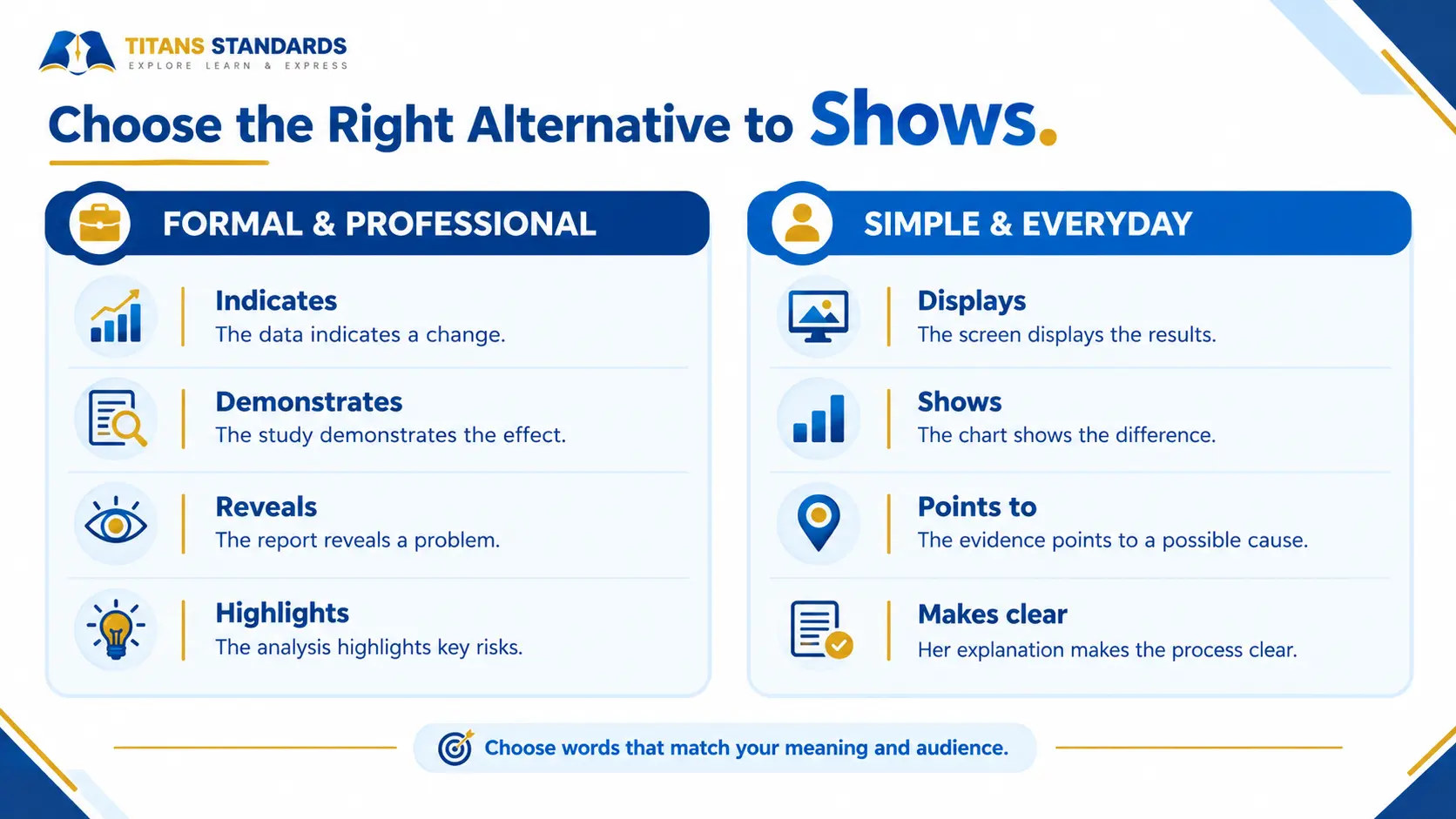
| Alternative | Best Used In | Tone |
|---|---|---|
| Indicates | Data, reports, research | Professional |
| Demonstrates | Essays, evidence, explanations | Formal |
| Reveals | Discoveries, investigations | Informative |
| Illustrates | Examples, diagrams, teaching | Explanatory |
| Displays | Screens, charts, visible qualities | Neutral |
| Suggests | Possibilities, early findings | Cautious |
| Highlights | Important points, benefits | Emphatic |
| Presents | Reports, arguments, meetings | Professional |
| Portrays | Stories, films, descriptions | Descriptive |
| Proves | Verified facts, logical arguments | Strong |
Common Mistakes When Using Alternatives to “Shows”

1. Using a synonym that changes the meaning.
“Suggests” expresses a possibility, while “proves” makes a much stronger claim. Choose a word that matches the evidence.
2. Using overly formal language in casual conversations.
Words such as “demonstrates” may sound unnatural in a simple text message. Use everyday language when the situation calls for it.
3. Repeating the same alternative too often.
Replacing every instance of “shows” with “indicates” does not solve repetition. Vary your vocabulary according to the sentence’s meaning.
4. Ignoring the context.
“Displays” works well for visible information, while “portrays” suits stories and representations. Consider what the subject actually does.
5. Making claims that the evidence cannot support.
Avoid using “proves” when your findings are incomplete or uncertain. Words such as “suggests” and “may indicate” communicate appropriate caution.
Frequently Asked Questions
1. What is the best word to use instead of “shows”?
The best alternative depends on your sentence. “Indicates” works well for data, “demonstrates” suits strong evidence, and “reveals” introduces new information. For essays, “illustrates” can explain an idea through an example. Read the full sentence before choosing a replacement to make sure the meaning stays accurate.
2. What is a formal way to say “shows”?
Formal alternatives include “demonstrates,” “indicates,” “illustrates,” and “reveals.” For example, instead of writing, “The report shows a decline in sales,” you could write, “The report indicates a decline in sales.” Select the verb that best describes whether the report presents a fact, supports a claim, or explains a finding.
3. What is another way to say “shows” in an essay?
In an essay, you can use “demonstrates,” “illustrates,” “indicates,” “suggests,” or “highlights.” Use “demonstrates” when your evidence clearly supports an argument, and choose “illustrates” when an example explains a point. Avoid choosing a synonym only to sound academic; clear and accurate writing is more important.
4. What is another word for “shows” in research?
“Indicates,” “suggests,” and “demonstrates” are useful alternatives in research writing. “Indicates” describes evidence pointing toward a result, while “suggests” signals a possible interpretation. Use “demonstrates” when the evidence clearly supports a conclusion. Your wording should reflect the strength and limitations of the research findings.
5. Can I use “proves” instead of “shows”?
Yes, but only when the evidence establishes the claim with sufficient certainty. “Shows” is more general, while “proves” makes a stronger statement. In scientific or social research, findings often support or suggest a conclusion without proving it absolutely. Consider “indicates” or “demonstrates” when a more cautious or precise description is appropriate.
6. What is another way to say “shows” in a presentation?
“Highlights,” “demonstrates,” “presents,” and “illustrates” can work well in presentations. For example, a chart may “illustrate” a trend, while a speaker may “highlight” an important result. Choose the word based on whether you are introducing information, emphasizing a point, or explaining a concept to your audience.
7. What is a simple synonym for “shows”?
“Displays” is a simple synonym when something is visible, while “indicates” works when something points toward a conclusion. “Reveals” is useful for new information. The easiest replacement is not always the best one, so check whether your sentence describes something visible, an explanation, or evidence supporting an idea.
8. How can I avoid repeating “shows” in my writing?
Start by identifying what each sentence means. Use alternatives such as “indicates,” “reveals,” “illustrates,” or “highlights” where they fit naturally. You can also restructure sentences to improve variety. Do not replace every occurrence automatically; sometimes “shows” remains the clearest and most natural choice.
Conclusion
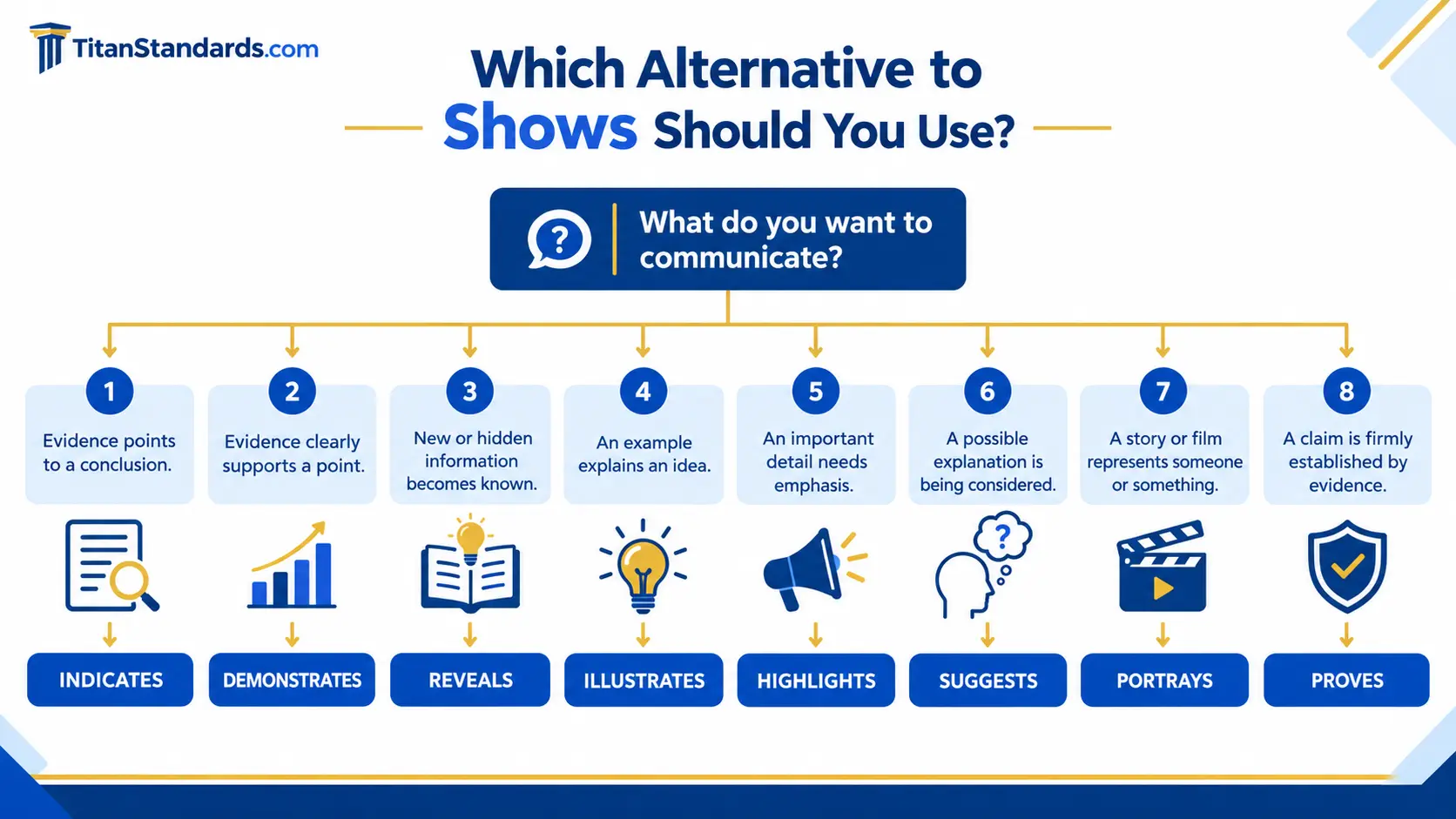
Choosing another way to say “shows” can make your writing clearer, more engaging, and more precise. The best alternative depends on what you want to communicate and how strongly your evidence supports your point.
Use “indicates” for signs or data, “demonstrates” for clear evidence, and “reveals” for new discoveries. Choose “illustrates” to explain an idea with an example, “highlights” to emphasize an important detail, and “portrays” when discussing stories or representations.
Remember that synonyms are not always interchangeable. A word that sounds impressive may change your meaning if it does not fit the context. Before choosing a replacement, consider your audience, tone, and purpose.
The best rule is simple: choose the word that communicates your meaning accurately, not just the word that sounds different. Clear, natural writing will always serve your readers better than unnecessary complexity.
Looking for more ways to refresh everyday phrases? Explore our guides to fresher ways to say said and done, or find a better way to say he says.

Editorial Desk
The Titan Standards Editorial Team develops, reviews, and maintains practical English-language resources. The team checks articles for clarity, accuracy, context, readability, and consistency with Titan Standards’ editorial guidelines.