The word rip is common in American English, but repeating it can make your writing feel less precise.
Choosing a more specific word can tell the reader whether something was gently torn, violently separated, cut with a sharp object, or reduced to pieces.
The best replacement is not always the closest dictionary synonym. It depends on the object, action, and result you want to describe.
What Does “Rip” Mean?
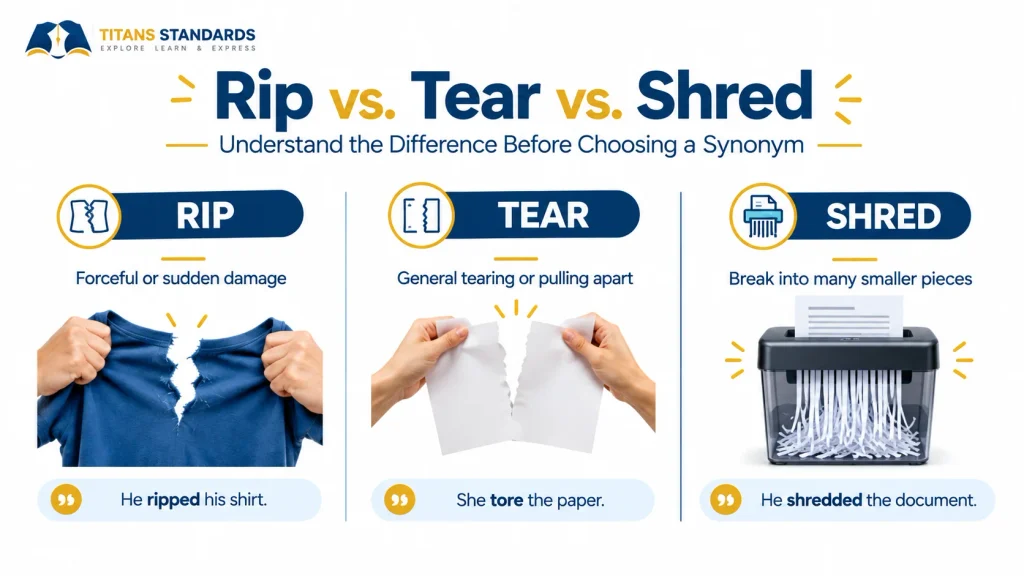
As a verb, rip generally means to tear, pull apart, or cut something with force. It often suggests a quick or rough action that damages the material.
For example:
She accidentally ripped her jacket on the fence.
Here, rip describes the action that damaged the jacket.
As a noun, a rip is a tear or opening in something:
There was a rip in the knee of his jeans.
The word can describe clothing, paper, fabric, packaging, and many other materials.
There is also an important distinction with RIP, usually written in capital letters. In a memorial context, RIP means “rest in peace.” That meaning is unrelated to the physical act of tearing.
Why Use Another Word for “Rip”?
Sometimes rip is exactly the right word. Other times, a more specific alternative makes the sentence clearer.
You might choose another word to:
- avoid repeating rip several times.
- explain exactly how something was damaged.
- distinguish tearing from cutting.
- show that something was divided rather than merely damaged.
- make formal or descriptive writing more precise.
For example, compare these sentences:
He ripped the document.
He shredded the document.
The first sentence tells us that he tore the document, but the second suggests that he reduced it to many smaller pieces. The more specific word gives the reader additional information.
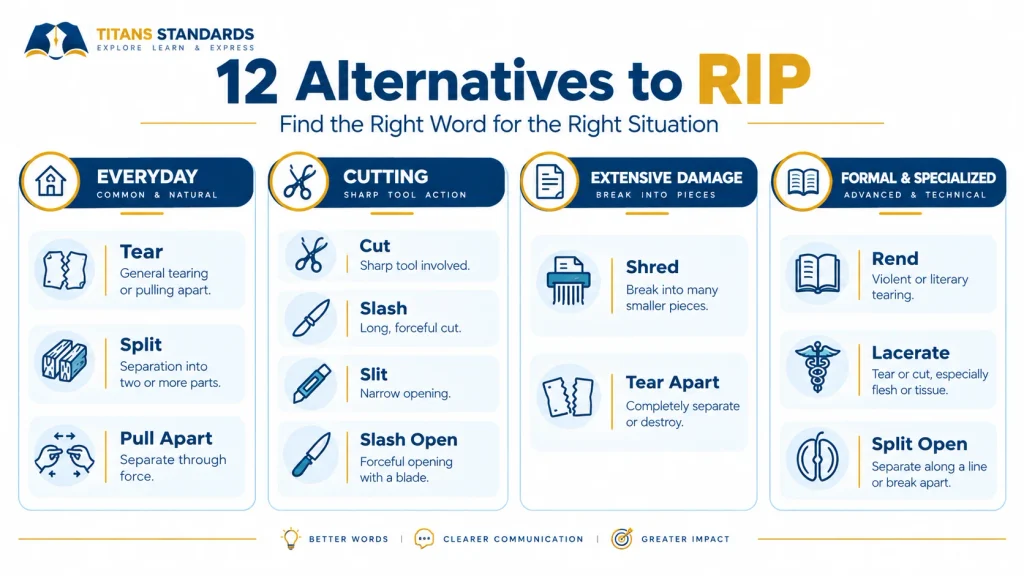
12 Best Alternatives to “Rip”
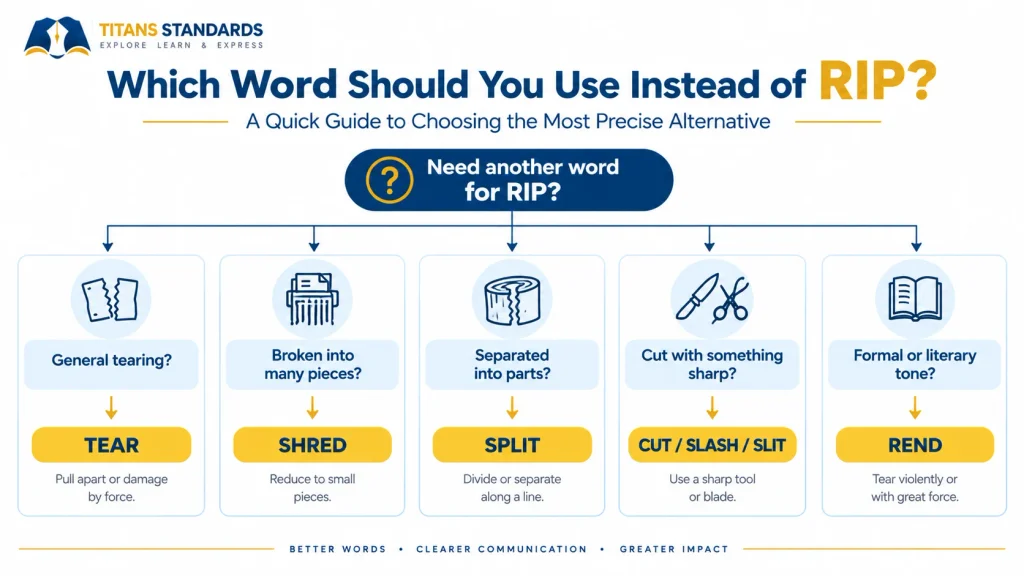
1. Tear
Tear is the closest everyday alternative to rip. It works especially well when something is pulled apart or damaged by force.
Be careful not to tear the wrapping paper.
In many ordinary sentences, tear and rip can be used almost interchangeably. Tear can sound slightly more neutral, while rip often feels more forceful or abrupt.
2. Shred
Use shred when something is torn or cut into small pieces.
She shredded the old receipts before throwing them away.
This is not always a direct replacement for rip. If someone makes one long tear in a shirt, shred would usually be too strong. If the material ends up in numerous pieces, however, shred is much more precise.
3. Split
Split emphasizes the separation of one thing into two or more parts.
The wooden board split down the middle.
It works particularly well with wood, seams, groups, surfaces, and objects that separate along a line.
Instead of saying:
The log ripped apart.
you might say:
The log split apart.
The second version makes the type of separation clearer.
4. Slash
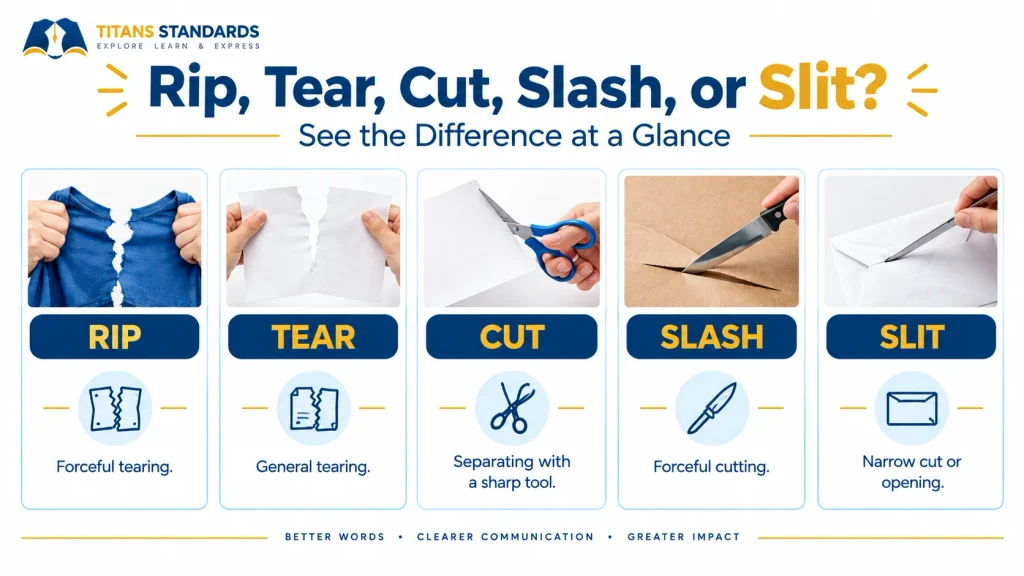
Slash usually suggests making a long cut with a knife or another sharp object.
Someone slashed the canvas with a knife.
Because slash involves a cutting action, it should not replace rip when the damage was caused simply by pulling or tearing.
It is useful when you want the sentence to make the method of damage clear.
5. Slit
Slit means to make a narrow opening with a sharp object.
She slit the envelope open with a letter opener.
A slit is generally narrower and more controlled than a typical rip. That makes it a poor replacement when something has been torn roughly or accidentally.
6. Cut
Cut is a broad, everyday alternative when something is separated or opened with a sharp edge.
He cut the package open with scissors.
The important difference is that cut normally tells the reader that a sharp object was involved. Rip focuses on tearing or forceful separation.
For that reason, “cut the paper” and “rip the paper” can describe different actions even when the final result looks similar.
7. Rend
Rend is a more literary or formal word for tearing something violently or forcefully.
The powerful wind rended the old sail.
It can create a dramatic tone and is much less common in ordinary conversation than rip or tear. Use it when the stronger, more literary effect is intentional.
8. Lacerate
Lacerate means to tear or cut something, especially flesh or tissue, with a rough or sharp action.
The broken glass lacerated his hand.
This is a specialized word and is usually inappropriate as a casual replacement for rip. It is more common in medical, technical, or serious descriptive contexts.
9. Slash Open
Slash open is useful when something is opened by making a forceful cut.
The rescuer slashed open the fabric to reach the trapped passenger.
This phrase is more specific than rip open because it tells the reader that a sharp instrument was used.
10. Tear Apart
Tear apart emphasizes separating something completely or breaking it into distinct pieces.
The children tore apart the cardboard box.
It can also be used figuratively:
The disagreement tore the family apart.
That figurative use makes tear apart more flexible than a simple physical synonym for rip.
11. Pull Apart
Pull apart focuses on the force used to separate something.
The two workers pulled the damaged boards apart.
Unlike rip, this phrase does not necessarily imply that the material itself was torn. It can describe two objects being separated from each other.
12. Split Open
Split open works when something becomes open because it separates along a line or breaks apart.
The ripe fruit split open after falling to the ground.
It can be more descriptive than rip open when the important detail is that the object naturally or forcefully divided.
How to Choose the Right Alternative
| Alternative | Best Used In | Tone |
| Tear | Paper, fabric, clothing, packaging | Neutral |
| Shred | Documents, paper, material reduced to pieces | Direct |
| Split | Wood, seams, objects separating | Neutral |
| Slash | Cutting with a sharp object | Strong |
| Slit | Narrow openings or controlled cuts | Precise |
| Cut | General cutting with a sharp tool | Neutral |
| Rend | Violent or literary tearing | Formal/literary |
| Lacerate | Flesh, tissue, serious cuts or tears | Technical/formal |
| Slash open | Forcefully opening something with a blade | Strong |
| Tear apart | Completely separating something | Direct |
| Pull apart | Separating objects through force | Neutral |
| Split open | Something separating to create an opening | Descriptive |
Common Mistakes When Replacing “Rip”
Using “shred” for every type of tear
Shred suggests multiple pieces or extensive damage. It is not the best choice for a single small tear.
Better: “I tore my sleeve on the door.”
Using “cut” when no sharp object was involved
If someone pulls a shirt until the fabric separates, tear or rip is more accurate than cut.
Using “slit” for a jagged tear
A slit is generally a narrow cut. A jagged opening caused by pulling is better described as a rip or tear.
Using “lacerate” in casual conversation
Although lacerate can technically describe tearing or cutting, it sounds specialized. “I lacerated my shirt” is unnatural in ordinary American English.
Treating every synonym as interchangeable
Words such as rip, tear, split, slash, and shred overlap, but they highlight different actions and results. Choosing the most specific word usually makes the sentence stronger.
FAQs About Another Way to Say “Rip”
What is the closest synonym for “rip”?
Tear is usually the closest everyday synonym for rip. Both can describe pulling something apart or damaging material such as paper, cloth, or packaging. The two words can often replace each other, although rip can suggest a quicker, rougher, or more forceful action in some contexts.
What is a stronger word for “rip”?
Words such as rend can express violent or forceful tearing, while shred emphasizes breaking something into many pieces. Lacerate can describe severe tearing or cutting of flesh or tissue. The best choice depends on whether you want to emphasize force, the resulting pieces, or the type of injury.
Is “tear” the same as “rip”?
They are often interchangeable when describing damaged paper, clothing, or fabric. However, they can carry slightly different emphasis depending on context. Rip often suggests a forceful or sudden action, while tear is a more general term. For precise writing, consider what caused the damage and what the result looks like.
What is another way to say “rip apart”?
Good alternatives include tear apart, pull apart, split apart, separate, and rend. The best option depends on the situation. Pull apart focuses on the action, split apart emphasizes division, and tear apart works naturally for both physical and figurative situations.
What is another word for “rip” when cutting?
If a sharp tool is involved, cut, slash, slit, slice, or lacerate may be appropriate. The exact choice depends on the action. Slit suggests a narrow opening, slash suggests a longer or forceful cut, and slice generally suggests a smooth cutting action.
Is “shred” stronger than “rip”?
Not necessarily in every context, but shred usually describes a more extensive result. If a sheet of paper has one jagged tear, rip or tear is appropriate. If the paper has been reduced to numerous small pieces, shred gives a much clearer description.
What does “RIP” mean when talking about someone who died?
In memorial or condolence messages, RIP usually means “rest in peace.” This is a completely different meaning from the lowercase verb rip, which refers to tearing, splitting, or cutting something. In formal writing, spelling out rest in peace may be clearer than using the abbreviation.
Conclusion
The best alternative to rip depends on the action you want to describe. For everyday tearing, tear is usually the safest choice. Use shred when something is broken into many pieces, split when it separates, and cut, slash, or slit when a sharp tool is involved. More specialized choices such as rend and lacerate work when the context calls for stronger or more formal language.
One useful rule is simple: choose the word that tells the reader how the damage happened, not merely that damage occurred. That small distinction makes your writing more precise and natural.