
Another way to say “inbox” depends on the context. For email, natural alternatives include email folder, mail folder, incoming mail, received messages, and message folder.
In an office, in-tray or in-basket can refer to a physical place for incoming documents. For social media, messages or DMs may be more natural.
Key Takeaways
- Inbox is already the most natural general term for incoming email.
- Email folder and mail folder work when you want to emphasize the folder itself.
- Incoming mail focuses on messages being received rather than the storage location.
- Messages or DMs can work for social platforms, but they are not exact synonyms in every context.
- In-tray and in-basket are mainly useful for physical documents, not modern email.
What Does “Inbox” Mean?
An inbox is a place where incoming messages, emails, or documents are received and held until they are read, processed, or answered. In modern American English, the word most commonly refers to the digital folder where incoming email is stored. Dictionaries also recognize a physical office meaning for a container holding incoming papers.
For example:
I have 42 unread emails in my inbox.
The word can also be used as a verb in informal digital communication:
I’ll inbox you the details later.
That verb use means to send someone a private online message.
Because inbox covers both a location and, more loosely, the collection of incoming messages, there is no single replacement that works perfectly in every sentence.
Why Use Another Way to Say “Inbox”?
Sometimes you need a different expression because the context calls for more precision.
You might want to:
- Avoid repeating inbox several times in the same paragraph.
- Make it clear that you mean email, rather than social-media messages.
- Focus on the messages instead of the folder where they are stored.
- Use language that fits a physical office setting.
- Make a sentence sound more natural in a specific professional or technical context.
The important point is that many supposed “synonyms” for inbox are actually contextual alternatives, not exact replacements.
10 Best Ways to Say “Inbox”

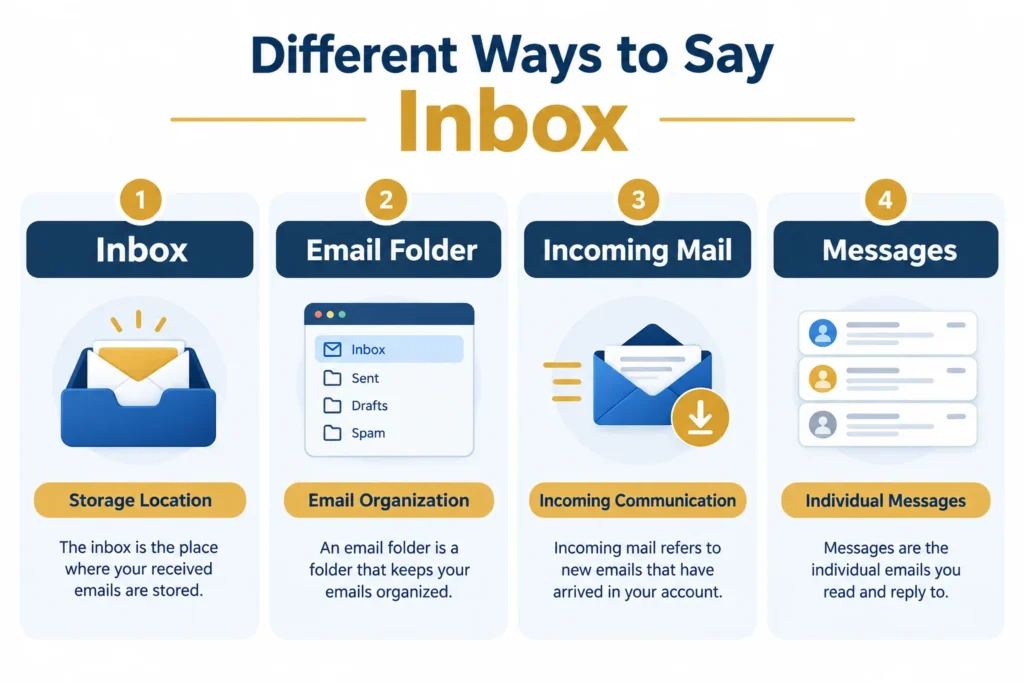
1. Email Folder
Email folder is one of the clearest alternatives when you specifically mean the digital location where emails are stored.
It works particularly well when explaining email organization or software features.
Example:
Move the old messages from your email folder into an archive.
Unlike inbox, this phrase does not necessarily mean incoming mail. It simply describes a folder containing email, so it can be broader than the original word.
2. Mail Folder
Mail folder is a concise alternative when the context already makes it obvious that you are talking about electronic mail.
Example:
Check your mail folder for the confirmation message.
This term is useful in technical or instructional writing, although inbox is generally more natural in everyday conversation. It should not be used when “mail” could mean physical postal mail and the distinction matters.
3. Incoming Mail
Incoming mail shifts the focus from the storage location to the messages being received.
Example:
I review my incoming mail twice a day.
This is especially useful when discussing an ongoing flow of messages rather than a particular folder. It is also more general than inbox, because it can refer to incoming email or physical mail depending on context.
4. Received Messages
When the actual messages matter more than where they are stored, received messages can be a good alternative.
Example:
The app automatically organizes your received messages by sender.
This phrase is especially appropriate in technical explanations or situations involving multiple kinds of digital communication. It is not an exact replacement for inbox, because an inbox is a location or collection, while “received messages” refers to the messages themselves.
5. Message Folder
Message folder is useful when discussing a digital system that stores incoming messages.
Example:
Open the message folder to see the latest customer requests.
It is broader than email folder and may fit messaging platforms, customer-service systems, or other communication software. Still, if you are talking about ordinary email, inbox will usually sound more natural.
6. Mailbox
Mailbox can sometimes work as an alternative, but it requires care.
In digital communication, a mailbox can refer to the broader email account or system that handles a person’s mail. An inbox is specifically the area containing received messages. Collins, for example, describes an email inbox as the part of a mailbox that stores emails that have arrived.
Example:
Your mailbox has reached its storage limit.
Notice the difference: mailbox can refer to the entire email account or mail-storage system, so replacing inbox with it may change the meaning.
7. Incoming Messages
Incoming messages is a natural choice when you want to emphasize what is arriving rather than where it appears.
Example:
Turn on notifications for incoming messages.
This expression works well for email, messaging apps, support platforms, and other digital communication systems. It is therefore more flexible than inbox, but it does not describe the storage location itself.
8. Messages
Sometimes the simplest alternative is simply messages.
Example:
I have several messages to answer before the meeting.
This works when the context already establishes that the messages are in the person’s inbox. It is particularly natural in conversations about texting, social media, or messaging apps.
However, messages is broader than inbox. A message can be sent, received, archived, or deleted, while an inbox specifically refers to the receiving area.
9. Direct Messages (DMs)
For social media and messaging platforms, direct messages or DMs may be more precise than inbox.
Example:
Send me a DM if you have any questions.
This is not a true synonym for an email inbox. Instead, it is a context-specific alternative when the original sentence is referring to private social-media communication.
Use DMs when the platform uses direct messaging. Don’t substitute it for inbox when you’re discussing ordinary email.
10. In-Tray or In-Basket
For physical office documents, in-tray and in-basket are established alternatives to inbox. Wiktionary lists both as synonyms for the physical container meaning of inbox.
Example:
Please put the signed forms in my in-tray.
These expressions are much less suitable for modern email. They belong primarily to office paperwork and physical document handling.
Which Alternative Should You Use?
| Alternative | Best Used In | Tone |
| Email folder | Email organization | Neutral |
| Mail folder | Digital mail systems | Neutral |
| Incoming mail | Received email or postal mail | Neutral |
| Received messages | Digital communication | Neutral |
| Message folder | Messaging or software contexts | Neutral |
| Mailbox | Broader email account/system | Neutral |
| Incoming messages | Digital communication | Neutral |
| Messages | Casual digital communication | Casual/neutral |
| Direct messages (DMs) | Social media | Casual |
| In-tray / in-basket | Physical office documents | Professional/neutral |
The safest choice is usually inbox itself. It is the standard, widely understood term for incoming email. The alternatives become useful when you want to emphasize a different part of the meaning.
Common Mistakes When Replacing “Inbox”
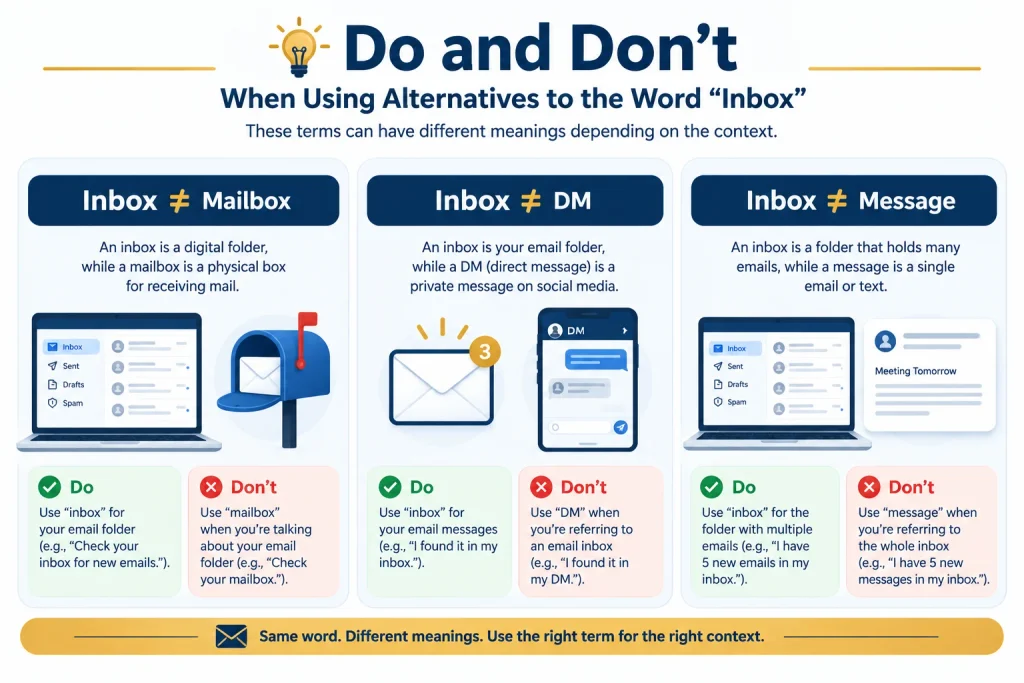
1. Treating “mailbox” as an exact synonym
A mailbox can refer to a broader email account or mail-storage system. If you specifically mean the folder containing received emails, inbox is more precise.
2. Using “DMs” for email
A direct message is generally a private message sent through a social platform or messaging service. It should not automatically replace inbox when discussing email.
3. Calling every message an “incoming message”
An incoming message describes something being received. An inbox describes the place where incoming messages are kept. The two ideas overlap but are not identical.
4. Using “in-tray” for digital email
An in-tray traditionally refers to a physical container for documents or correspondence. It can be understood metaphorically, but inbox is the normal modern term for email.
5. Choosing a more complicated phrase when “inbox” is clearer
Vocabulary variety is not always an improvement. If you are writing a normal email, help article, or workplace message, replacing inbox with an unusual expression may make the sentence less natural.
Related Expressions Worth Knowing
Several expressions are connected to inbox but should not be treated as synonyms.
Inbox zero refers to an approach to email management focused on keeping the inbox empty or fully processed.
Inbox overload describes having more incoming messages than you can comfortably manage.
Inbox management refers to organizing, reviewing, responding to, and processing incoming email.
Flood the inbox is a figurative expression meaning to send someone a large number of messages.
These phrases are useful when writing about email productivity, communication, or workplace organization.
Frequently Asked Questions

What is another word for inbox?
There is no perfect one-word synonym for inbox in every context. Depending on the situation, you can use email folder, mail folder, incoming mail, message folder, or received messages. For a physical office container, in-tray and in-basket are established alternatives.
What is another way to say “check your inbox”?
Natural alternatives include “check your email,” “check your messages,” “look for new emails,” and “check your incoming mail.” For social media, “check your DMs” may be appropriate. The best choice depends on whether you mean email, messaging, or another communication platform.
Is “mailbox” the same as “inbox”?
Not always. An inbox is specifically associated with incoming messages, while mailbox can refer to a broader email account or mail-storage system. For example, an email service may have an inbox, sent folder, drafts, archive, and other folders within the broader mailbox.
Can I use “message” instead of “inbox”?
Sometimes, but the meanings are different. An inbox is a receiving area or collection, while a message is an individual piece of communication. You can say, “I have several messages to answer,” but you cannot always replace “inbox” with “message” without changing the sentence.
What is a professional way to say “inbox”?
In most professional writing, inbox itself is already appropriate and natural. If you need a more descriptive term, email folder, incoming mail, or received messages may work depending on the sentence. Avoid replacing a familiar term simply to make the writing sound more formal.
What is another word for an inbox on social media?
For social media, messages or direct messages (DMs) are often more precise. Some platforms informally call private messages an inbox, but the terminology varies by platform. Use DMs when you specifically mean private messages sent through a social network.
What is the old-fashioned or physical equivalent of an inbox?
For physical office paperwork, in-tray and in-basket are established terms. They describe a container where incoming documents are placed before they are reviewed or processed. They are not normally used as replacements for an email inbox.
Conclusion
The best alternative to “inbox” depends on what you want the reader to understand. If you mean the place where email arrives, inbox is usually still the clearest and most natural choice. Email folder emphasizes organization, incoming mail emphasizes what is being received, and messages focuses on the communication itself. For social media, DMs may be more precise, while in-tray and in-basket fit physical paperwork.
When choosing a substitute, don’t change the word just for variety. Choose the expression that preserves the exact meaning you need in that sentence.

Communication Editor
Nadia Ellery is a communication editor focused on everyday English, conversational expressions, common phrases, and natural ways to communicate. She helps turn complicated language questions into practical guidance readers can use in everyday situations.