
Another Way to Say RIP: 12 Natural Alternatives With Examples

The word rip is common in American English, but repeating it can make your writing feel less precise. Choosing a more specific word can tell the reader whether something was gently torn, violently separated, cut with a sharp object, or reduced to pieces. The best replacement is not always the closest dictionary synonym. It depends on the object, action, and result you want to describe. What Does “Rip” Mean? As a verb, rip generally means to tear, pull apart, or cut something with force. It often suggests a quick or rough action that damages the material. For example: She accidentally ripped her jacket on the fence. Here, rip describes the action that damaged the jacket. As a noun, a rip is a tear or opening in something: There was a rip in the knee of his jeans. The word can describe clothing, paper, fabric, packaging, and many other materials. There is also an important distinction with RIP, usually written in capital letters. In a memorial context, RIP means “rest in peace.” That meaning is unrelated to the physical act of tearing. Why Use Another Word for “Rip”? Sometimes rip is exactly the right word. Other times, a more specific alternative makes the sentence clearer. You might choose another word to: For example, compare these sentences: He ripped the document. He shredded the document. The first sentence tells us that he tore the document, but the second suggests that he reduced it to many smaller pieces. The more specific word gives the reader additional information. 12 Best Alternatives to “Rip” 1. Tear Tear is the closest everyday alternative to rip. It works especially well when something is pulled apart or damaged by force. Be careful not to tear the wrapping paper. In many ordinary sentences, tear and rip can be used almost interchangeably. Tear can sound slightly more neutral, while rip often feels more forceful or abrupt. 2. Shred Use shred when something is torn or cut into small pieces. She shredded the old receipts before throwing them away. This is not always a direct replacement for rip. If someone makes one long tear in a shirt, shred would usually be too strong. If the material ends up in numerous pieces, however, shred is much more precise. 3. Split Split emphasizes the separation of one thing into two or more parts. The wooden board split down the middle. It works particularly well with wood, seams, groups, surfaces, and objects that separate along a line. Instead of saying: The log ripped apart. you might say: The log split apart. The second version makes the type of separation clearer. 4. Slash Slash usually suggests making a long cut with a knife or another sharp object. Someone slashed the canvas with a knife. Because slash involves a cutting action, it should not replace rip when the damage was caused simply by pulling or tearing. It is useful when you want the sentence to make the method of damage clear. 5. Slit Slit means to make a narrow opening with a sharp object. She slit the envelope open with a letter opener. A slit is generally narrower and more controlled than a typical rip. That makes it a poor replacement when something has been torn roughly or accidentally. 6. Cut Cut is a broad, everyday alternative when something is separated or opened with a sharp edge. He cut the package open with scissors. The important difference is that cut normally tells the reader that a sharp object was involved. Rip focuses on tearing or forceful separation. For that reason, “cut the paper” and “rip the paper” can describe different actions even when the final result looks similar. 7. Rend Rend is a more literary or formal word for tearing something violently or forcefully. The powerful wind rended the old sail. It can create a dramatic tone and is much less common in ordinary conversation than rip or tear. Use it when the stronger, more literary effect is intentional. 8. Lacerate Lacerate means to tear or cut something, especially flesh or tissue, with a rough or sharp action. The broken glass lacerated his hand. This is a specialized word and is usually inappropriate as a casual replacement for rip. It is more common in medical, technical, or serious descriptive contexts. 9. Slash Open Slash open is useful when something is opened by making a forceful cut. The rescuer slashed open the fabric to reach the trapped passenger. This phrase is more specific than rip open because it tells the reader that a sharp instrument was used. 10. Tear Apart Tear apart emphasizes separating something completely or breaking it into distinct pieces. The children tore apart the cardboard box. It can also be used figuratively: The disagreement tore the family apart. That figurative use makes tear apart more flexible than a simple physical synonym for rip. 11. Pull Apart Pull apart focuses on the force used to separate something. The two workers pulled the damaged boards apart. Unlike rip, this phrase does not necessarily imply that the material itself was torn. It can describe two objects being separated from each other. 12. Split Open Split open works when something becomes open because it separates along a line or breaks apart. The ripe fruit split open after falling to the ground. It can be more descriptive than rip open when the important detail is that the object naturally or forcefully divided. How to Choose the Right Alternative Alternative Best Used In Tone Tear Paper, fabric, clothing, packaging Neutral Shred Documents, paper, material reduced to pieces Direct Split Wood, seams, objects separating Neutral Slash Cutting with a sharp object Strong Slit Narrow openings or controlled cuts Precise Cut General cutting with a sharp tool Neutral Rend Violent or literary tearing Formal/literary Lacerate Flesh, tissue, serious cuts or tears Technical/formal Slash open Forcefully opening something with a blade Strong Tear apart Completely separating something Direct Pull apart Separating objects through force Neutral Split open Something separating to create an
Another Way to Say Inbox: 12 Natural Alternatives, Synonyms & Examples

Another way to say “inbox” depends on the context. For email, natural alternatives include email folder, mail folder, incoming mail, received messages, and message folder. In an office, in-tray or in-basket can refer to a physical place for incoming documents. For social media, messages or DMs may be more natural. Key Takeaways What Does “Inbox” Mean? An inbox is a place where incoming messages, emails, or documents are received and held until they are read, processed, or answered. In modern American English, the word most commonly refers to the digital folder where incoming email is stored. Dictionaries also recognize a physical office meaning for a container holding incoming papers. For example: I have 42 unread emails in my inbox. The word can also be used as a verb in informal digital communication: I’ll inbox you the details later. That verb use means to send someone a private online message. Because inbox covers both a location and, more loosely, the collection of incoming messages, there is no single replacement that works perfectly in every sentence. Why Use Another Way to Say “Inbox”? Sometimes you need a different expression because the context calls for more precision. You might want to: The important point is that many supposed “synonyms” for inbox are actually contextual alternatives, not exact replacements. 10 Best Ways to Say “Inbox” 1. Email Folder Email folder is one of the clearest alternatives when you specifically mean the digital location where emails are stored. It works particularly well when explaining email organization or software features. Example: Move the old messages from your email folder into an archive. Unlike inbox, this phrase does not necessarily mean incoming mail. It simply describes a folder containing email, so it can be broader than the original word. 2. Mail Folder Mail folder is a concise alternative when the context already makes it obvious that you are talking about electronic mail. Example: Check your mail folder for the confirmation message. This term is useful in technical or instructional writing, although inbox is generally more natural in everyday conversation. It should not be used when “mail” could mean physical postal mail and the distinction matters. 3. Incoming Mail Incoming mail shifts the focus from the storage location to the messages being received. Example: I review my incoming mail twice a day. This is especially useful when discussing an ongoing flow of messages rather than a particular folder. It is also more general than inbox, because it can refer to incoming email or physical mail depending on context. 4. Received Messages When the actual messages matter more than where they are stored, received messages can be a good alternative. Example: The app automatically organizes your received messages by sender. This phrase is especially appropriate in technical explanations or situations involving multiple kinds of digital communication. It is not an exact replacement for inbox, because an inbox is a location or collection, while “received messages” refers to the messages themselves. 5. Message Folder Message folder is useful when discussing a digital system that stores incoming messages. Example: Open the message folder to see the latest customer requests. It is broader than email folder and may fit messaging platforms, customer-service systems, or other communication software. Still, if you are talking about ordinary email, inbox will usually sound more natural. 6. Mailbox Mailbox can sometimes work as an alternative, but it requires care. In digital communication, a mailbox can refer to the broader email account or system that handles a person’s mail. An inbox is specifically the area containing received messages. Collins, for example, describes an email inbox as the part of a mailbox that stores emails that have arrived. Example: Your mailbox has reached its storage limit. Notice the difference: mailbox can refer to the entire email account or mail-storage system, so replacing inbox with it may change the meaning. 7. Incoming Messages Incoming messages is a natural choice when you want to emphasize what is arriving rather than where it appears. Example: Turn on notifications for incoming messages. This expression works well for email, messaging apps, support platforms, and other digital communication systems. It is therefore more flexible than inbox, but it does not describe the storage location itself. 8. Messages Sometimes the simplest alternative is simply messages. Example: I have several messages to answer before the meeting. This works when the context already establishes that the messages are in the person’s inbox. It is particularly natural in conversations about texting, social media, or messaging apps. However, messages is broader than inbox. A message can be sent, received, archived, or deleted, while an inbox specifically refers to the receiving area. 9. Direct Messages (DMs) For social media and messaging platforms, direct messages or DMs may be more precise than inbox. Example: Send me a DM if you have any questions. This is not a true synonym for an email inbox. Instead, it is a context-specific alternative when the original sentence is referring to private social-media communication. Use DMs when the platform uses direct messaging. Don’t substitute it for inbox when you’re discussing ordinary email. 10. In-Tray or In-Basket For physical office documents, in-tray and in-basket are established alternatives to inbox. Wiktionary lists both as synonyms for the physical container meaning of inbox. Example: Please put the signed forms in my in-tray. These expressions are much less suitable for modern email. They belong primarily to office paperwork and physical document handling. Which Alternative Should You Use? Alternative Best Used In Tone Email folder Email organization Neutral Mail folder Digital mail systems Neutral Incoming mail Received email or postal mail Neutral Received messages Digital communication Neutral Message folder Messaging or software contexts Neutral Mailbox Broader email account/system Neutral Incoming messages Digital communication Neutral Messages Casual digital communication Casual/neutral Direct messages (DMs) Social media Casual In-tray / in-basket Physical office documents Professional/neutral The safest choice is usually inbox itself. It is the standard, widely understood term for incoming email. The alternatives become useful when you want to emphasize a different part
12 Heartfelt Ways to Say “I’m Sorry for Your Loss”
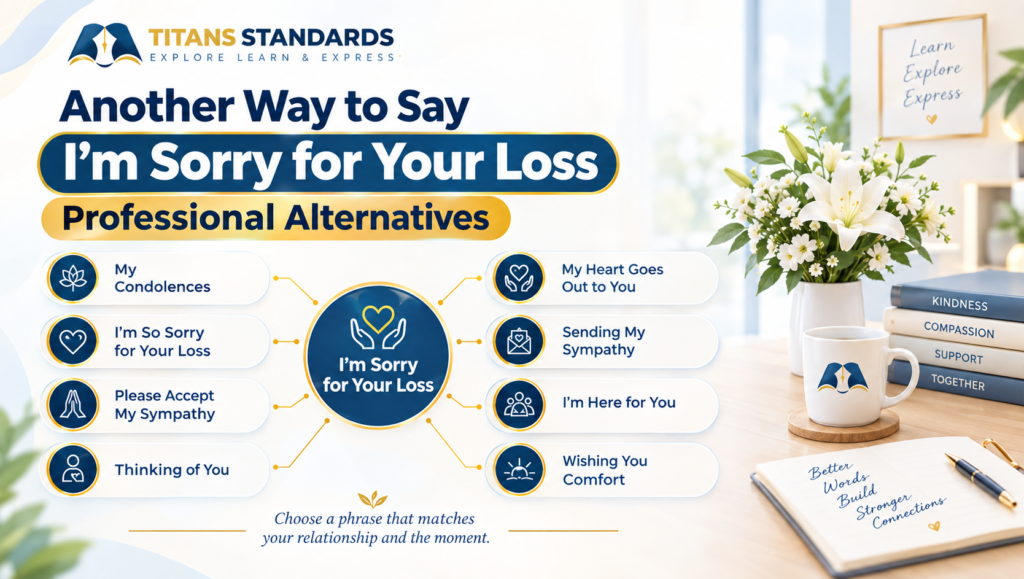
When someone loses a loved one, you may want to say more than “I’m sorry for your loss.” The best alternative depends on your relationship with the person and how personal or formal you want to sound. Options such as “My heart goes out to you,” “I’m thinking of you,” and “Please accept my deepest condolences” can express sympathy while fitting different situations. Key Takeaways – another way to say im sorry for your loss What Does “I’m Sorry for Your Loss” Mean? “I’m sorry for your loss” is a standard expression of sympathy used when someone has lost a loved one. The word “sorry” does not mean that you caused the loss. Instead, it communicates that you recognize the person’s pain and regret that they are going through such a difficult experience. The phrase is neutral enough for many situations. You can use it with a friend, relative, coworker, neighbor, acquaintance, or someone you do not know well. Still, you may want a different expression when you are writing a sympathy card, sending a text, speaking to a close friend, or offering condolences in a professional setting. Why Use Another Way to Say It? There is nothing wrong with “I’m sorry for your loss.” Sometimes, however, another phrase can better match your relationship with the grieving person. You might choose different wording to: The goal is not to find a more impressive phrase. It is to choose words that feel sincere and appropriate. 12 Ways to Say “I’m Sorry for Your Loss” 1. My heart goes out to you. This is a warm and compassionate choice for someone you know personally. It communicates emotional support without trying to explain the person’s grief. Example:“My heart goes out to you and your family during this difficult time.” Best for: Friends, relatives, and personal messages. 2. My deepest condolences. This is more formal than “I’m sorry for your loss.” It works particularly well in sympathy cards, professional messages, or situations where you do not have a close relationship with the person. Example:“Please accept my deepest condolences to you and your family.” Best for: Coworkers, acquaintances, clients, and formal messages. 3. I’m thinking of you and your family. This phrase focuses on your continued care and support rather than simply acknowledging the death. Example:“I’m thinking of you and your family and wishing you comfort during this difficult time.” Best for: Texts, cards, coworkers, friends, and acquaintances. 4. I’m so sorry you’re going through this. This is a natural choice when you want to acknowledge the person’s difficult experience directly. Example:“I’m so sorry you’re going through this. I’m here if you need someone to talk to.” Best for: Friends, family, and supportive personal conversations. 5. You have my heartfelt sympathy. This expression is sincere and somewhat formal. “Heartfelt” adds warmth while keeping the message respectful. Example:“You have my heartfelt sympathy as you grieve the loss of your mother.” Best for: Sympathy cards and semi-formal messages. 6. I’m here for you. This does not directly replace “I’m sorry for your loss,” but it can be a meaningful way to offer support. Example:“I’m so sorry. I’m here for you, whatever you need.” Best for: Close friends and family. 7. Wishing you peace and comfort. This is gentle and appropriate when you want your message to focus on the person’s well-being. Example:“Wishing you peace and comfort in the days ahead.” Best for: Cards, texts, and general sympathy messages. 8. Your loved one will be deeply missed. Use this when you genuinely knew the person who died or when it is appropriate to acknowledge their absence. Example:“Your father was a wonderful person, and he will be deeply missed.” Best for: Friends, family members, colleagues, and people who knew the deceased. 9. I’m keeping you in my thoughts. This is a simple, low-pressure expression of support. It can work when you want to be caring without saying too much. Example:“I’m keeping you and your family in my thoughts during this difficult time.” Best for: Acquaintances, coworkers, friends, and written messages. 10. May their memory be a blessing. This has a spiritual or religious tone and can be especially appropriate when you know the recipient is comfortable with that kind of language. Example:“May his memory be a blessing to everyone who knew him.” Best for: Faith-based or culturally appropriate situations. 11. I’ll always remember [Name]. A specific memory can make a condolence message feel much more personal than a general expression of sympathy. Example:“I’ll always remember how warmly David welcomed everyone. He will be greatly missed.” Best for: Someone whose loved one you personally knew. 12. I’d like to help in any way I can. This moves beyond sympathy and offers practical support. It becomes even more useful when you name something specific you can do. Example:“I’d like to help however I can. I can bring dinner by Thursday if that would make things easier.” Best for: Close friends, relatives, neighbors, and coworkers you know well. How to Choose the Right Expression The best phrase depends largely on relationship, tone, and context. Alternative Best Used In Tone My heart goes out to you Friends and family Warm My deepest condolences Professional or formal situations Formal I’m thinking of you and your family Texts, cards, acquaintances Warm/neutral I’m so sorry you’re going through this Personal conversations Compassionate Heartfelt sympathy Cards and semi-formal messages Warm/formal I’m here for you Close relationships Personal Wishing you peace and comfort Cards and messages Gentle Your loved one will be deeply missed When you knew the deceased Respectful Keeping you in my thoughts General sympathy Neutral/warm May their memory be a blessing Religious or spiritual settings Spiritual I’ll always remember [Name] When you shared memories Personal I’d like to help in any way I can When practical support is appropriate Supportive What Should You Avoid Saying? Good intentions do not always produce helpful words. When someone is grieving, avoid statements that minimize their loss or assume you know exactly how they feel. 1. “Everything happens